
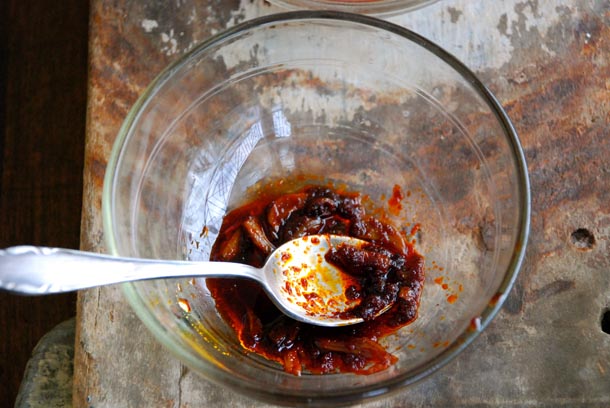

Hunger is the best pickle. ∼ Benjamin Franklin

Mother (-in-law) Of All Pickles!
My last post was called Pickles… Mother (-in-law) Of All Pickles! It was a loving post dedicated to my Mum-in-law who loves collecting recipes. Some would term this as an obsession. This obsession extends mainly to collecting recipes more than actually executing them! She has many hand-written notebooks where she writes down all the recipes that she collects. And one such notebook is her ‘Diary of Pickles’. I call this diary the Mother of all Pickles, or rather Mother (in-law) of all pickles.
Instead of writing these recipes down if she had started typing them in from the very beginning, it could have been easily converted into a culinary blog called ‘The Pickled Diary’!
The next few posts that would follow will be probably be on pickles. Though I’m not a pickle-person, I’m fascinated by the world of pickles – the way they are so painstakingly prepared and meticulously preserved. It’s really worth sharing with the world these small bottles that are lying on the shelf, containing hot and spicy, sour and spicy, sweet and spicy, sweet and sweet(!), spicy and spicy(!) pickles.
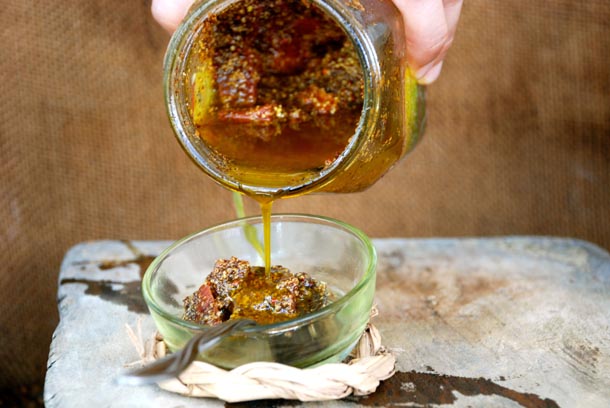
The Pickle of the day is Hot Garlic Pickle, a glimpse into the other two is a just to tickle your senses as you yearn for more. What better way can be there to have Garlic sans the odour…
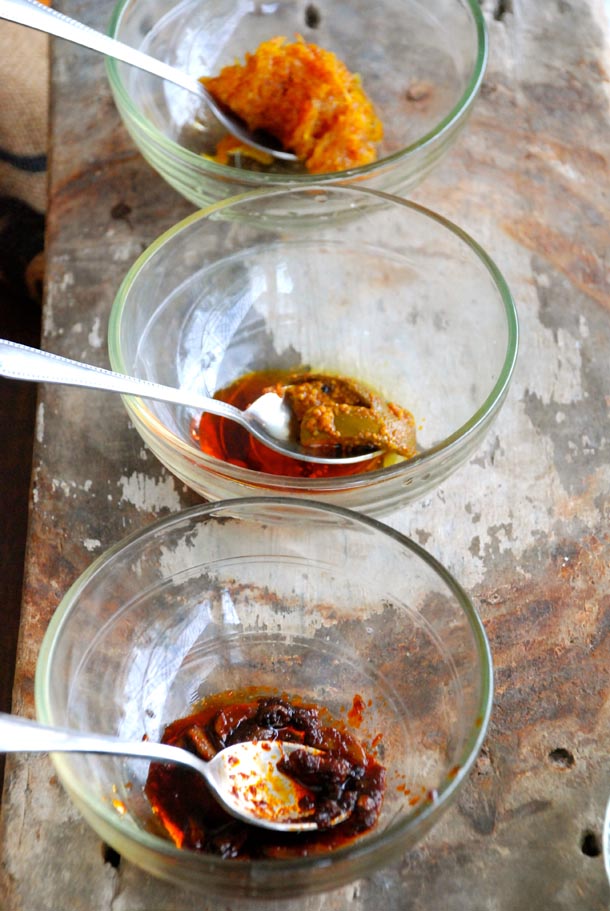
Hot Garlic Pickle
Garlic is said to have originated from Central Asia and is also one of the oldest cultivated plants in the world that has been grown for over 5000 years. Ancient Egyptians seem to have been the first to cultivate this plant that played an important role in their culture. Garlic was introduced into various regions throughout the globe by migrating cultural tribes and explorers. By the 6th century BC, Garlic was known in both China and India, the latter country using it for therapeutic purposes.
Pickled Garlic has entirely different beneficial compounds than dried, cooked Garlic and they work differently in the human body. Eating pickled Garlic does not give an immediate Garlic breath or secondary Garlic odor (sweat, lungs, etc.) hours later whereas cooking fresh or dried Garlic gives both kinds of odor. If the Garlic is soaked in Vinegar or Lemon juice, the acid that is present in them will neutralize the Alliinase and slowly breaks down the rest of the cloves into odorless water soluble compounds that circulate via the bloodstream mostly S-allyl cysteine (SAC). SAC lowers cholesterol, blood pressure and sugar levels and inhibits platelet aggregation as well. The SAC has some anti-tumor properties also. The wonderful thing is that the longer you leave the Garlic in the vinegar or lemon juice, the more SAC is formed. Pickling the Garlic is a great and inexpensive way to enjoy excellent flavor and get a few health benefits too.
Garlic is an excellent source of Manganese. It is also a very good source of vitamin B6 and vitamin C. In addition, Garlic is a good source of Protein and Thiamin (vitamin B1) as well as the minerals – Phosphorus, Selenium, Calcium, Potassium, and Copper. Modern science has shown that Garlic is a powerful natural antibiotic and has a powerful antioxidant effect. Garlic should be seen as part of a healthy lifestyle. (Source: VahRehVah)
Ingredients
Garlic pods – 100 gm, peeled
Red Chilli Powder – 50 gm, dry roasted*
Tamarind – 50 gm
Salt – 1/4 tsp
Sugar – 1 tsp
Mustard Oil – 100gm
* Roast Red Chillies in a heated wok and continuously stir it to prevent the Chillies from burning. When the colour of the Chillies turn deep brown, take them off the fire and grind them into powder in a dry grinder. Note: If you are not used to this, yes, you’ll cough a lot. So Beware!
Method
– Grind the Garlic pods into a paste
– Soak the Tamarind for half an hour and make a paste
– Heat oil in a hot wok
– Add the Garlic and Tamarind paste and fry in the hot oil
– Add the Red Chilli powder
– Add the Salt and Sugar when the garlic is fried
– Stir it continuously in slow flame till the oil separates out
– Cool and put the mixture in an air-tight container
Dos and Don’ts of Pickles
– Stock pickles in an air tight container. Acid corrodes metal and a loose lid can cause the vinegar to evaporate
– Pick vinegar that has at least 5 per cent acetic acid content
– Sea salt enhances the taste of vegetables and meats
– Ensure that ingredients are clean, firm and of best quality to prolong the shelflife of the pickle
– Radish, cauliflower, cucumber, cabbage, mango, lime, fish and ginger pickle best
– Small vegetables and fruits such as cocktail onions and cherries should be used whole; Peel and quarter large vegetables such as tomatoes
– Always use a dry spoon to scoop out pickle from the jar
(Source: Times of India)
Disclaimer: Ma collects recipes from TV, magazines, newspapers etc. Most of the times she doesn’t write down from where they have been collected from. If you happen to own this recipe, do get in touch. I would be too happy to update this post with your link!
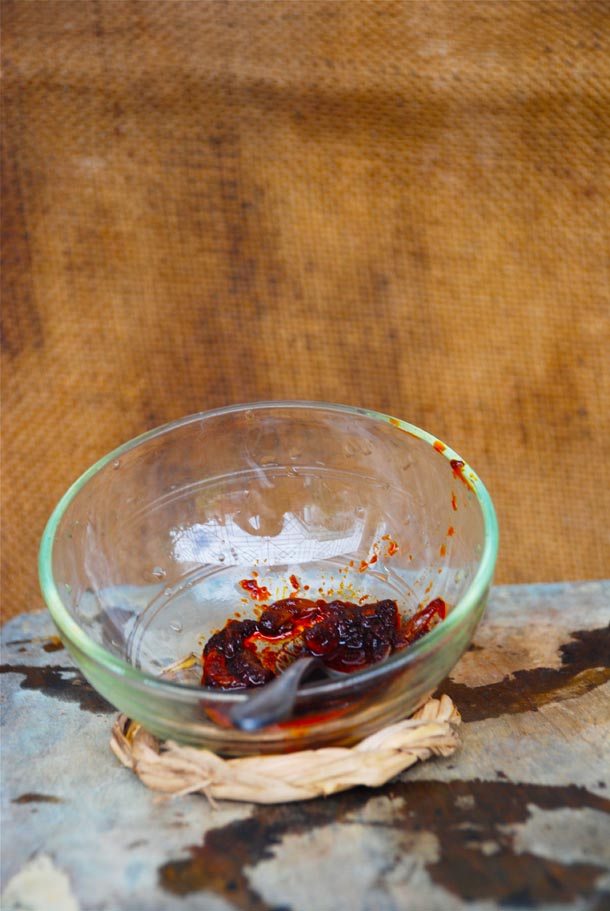
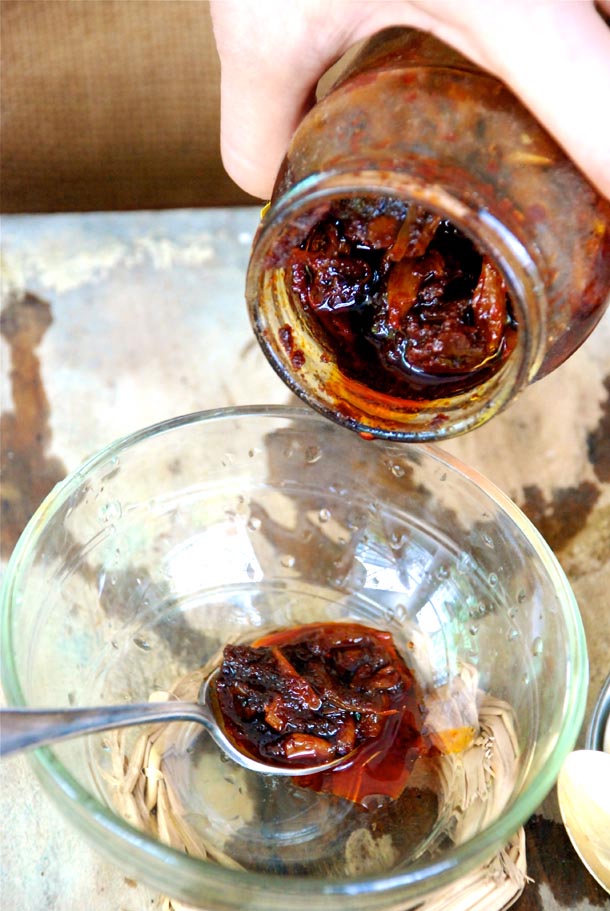
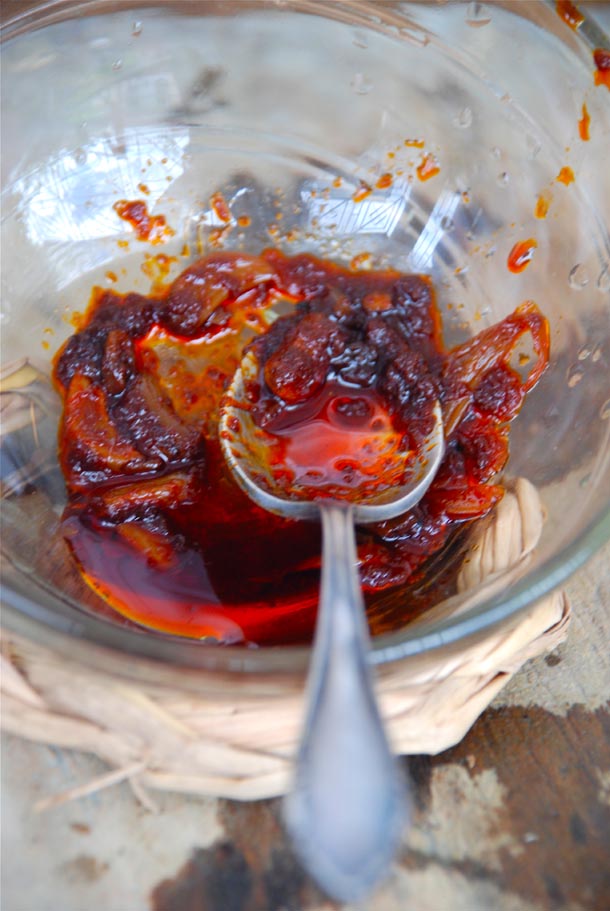
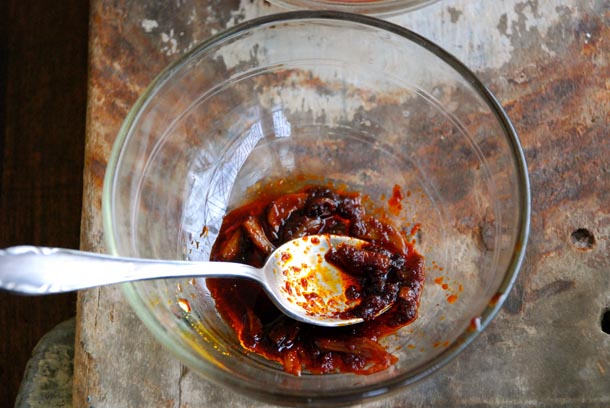
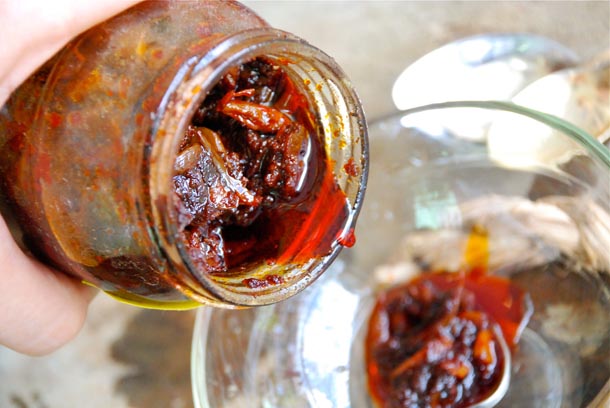
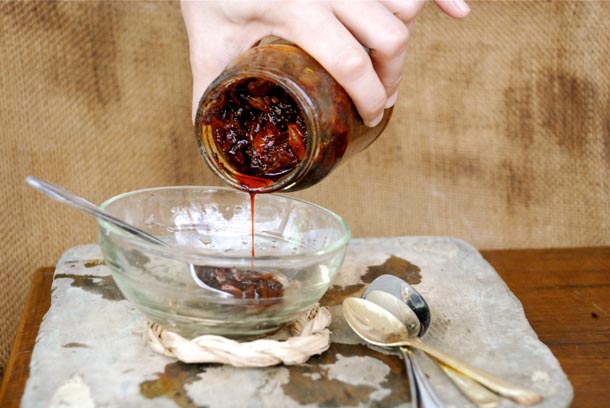

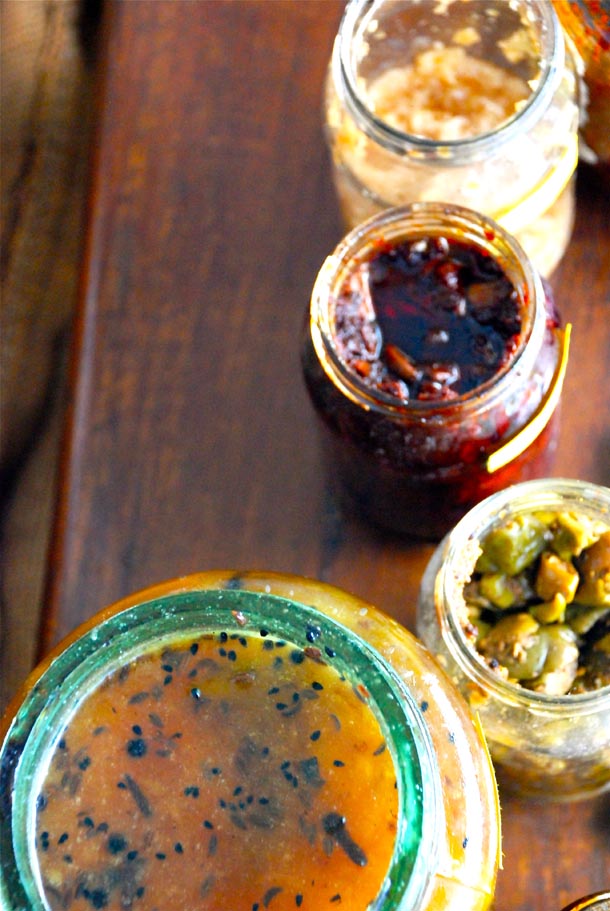
For me Pickles are like Abstract Art – I love them but I don’t understand them. I love them because they tickle my senses with their strong taste and colours and the intensity of the spices going into making them. Pickles are a part of daily diet in many culture and some pickles do have enormous health benefits – they help the body to absorb iron, they are packed with Vitamin C, they are strongly flavoured and various types of fruits and vegetables might go into your tummy through a bottle of pickle (more), they are also high in Sodium and Oil.
But yes, if you can think out of the box for accompaniments that might go with a particular flavour of pickle that you have made, go for it. It’s good to spice up your life once in a while!
Unblogging it all… Ishita
Disclaimer: This is not a sponsored post. The subject, story, opinions and views stated here are my own and are independent. While you enjoy reading the posts with lot of visuals, please do not use any material from these posts. Do join me on my daily food and travel journey on Instagram, Facebook and Twitter.
Related articles
- Pickles… Mother (-in-law) Of All Pickles! (ishitaunblogged.com)
BE SOCIAL. SHARE THIS!

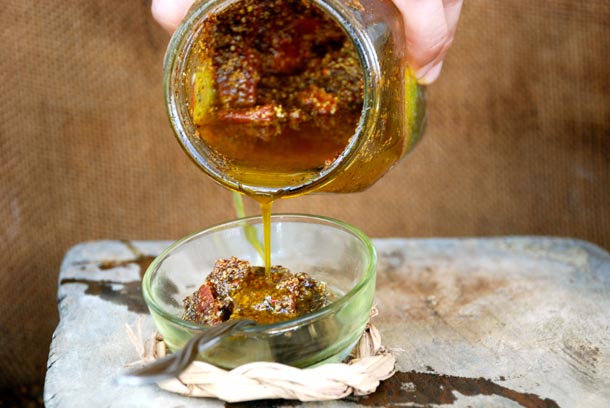
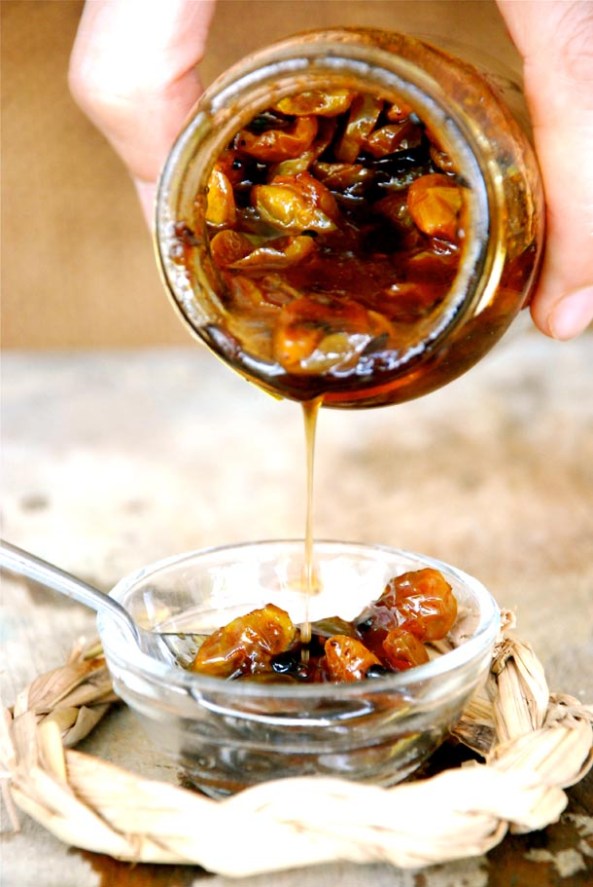
To most Pickles refer to the art of preserving food. And to others it is a tiny pinch of accompaniment with another more important and popular food item. But to me, a Pickle is like Abstract Art. I don’t understand it completely, yet at the same time it tickles my senses with it’s vibrant colours, the strong aroma of the mixtures inside the pickle bottle and finally the strong taste. I am not a pickle person. But I’ll pursue pickles with my camera and research as they always catch my fancy. There is nothing in a pickled bottle that will not catch my fancy – top it up with the hard work and the effort and the mathematical precisions in the proportions that go into pickle-making and Pickles turn gourmet – a delicacy and an art!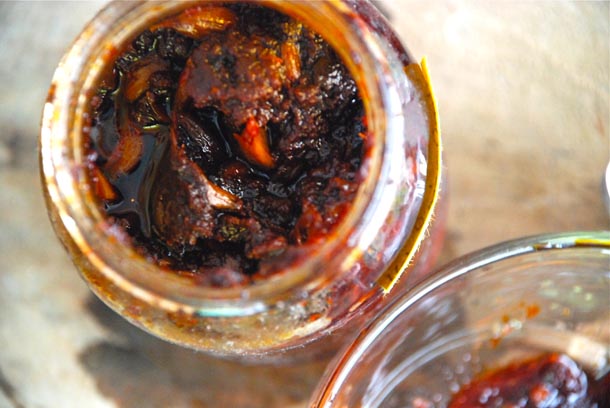
I have never been so mersmerised with Pickles as I have been this time. My annual summer holidays in Kolkata is just the right mini hibernation that I need to get away from my usual life in Dubai. I have been immersing myself in searching for food subjects for my post. And I have been focusing on subjects that I wouldn’t be able to replicate by myself at other times. This time my sole focus has been Kolkata’s street food, specially Chinese food – from street food to fine-dining. The second focus has been my Mum-in-law’s traditional cooking. She has many hand-written notebooks where she writes down all the recipes that she collects. And one such notebook is her ‘Diary of Pickles’. I call this diary the Mother of all Pickles, or rather Mother (in-law) of all pickles!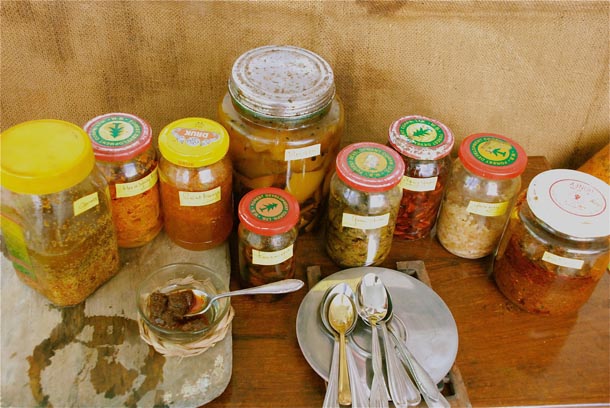
Ma, as I lovingly call her, is fascinated by recipes. She collects recipes – from magazines, newspapers, from television. She doesn’t like cutouts or clippings, she loves organising and segregating them into different notebooks – writing them down as she collects them. At the point of writing this post, Ma‘s shelf had 15 bottles of Pickles – fat bottles, thin bottles, small bottles, large bottles, square bottles, round bottles, plastic containers, glass containers, tin containers – all containing Pickles. Sweet Pickles, sour Pickles, spicy Pickles – pickles of all kinds!
I want my photographs of Ma’s pickles to be the best that I have ever taken in my life (so far!). And share the story of her pickles with all my readers , far and wide. That’s the only way I can do justice to the tremendous effort she has taken to make all these different kind of pickles. For her, its labour of love. ‘Toder jonyo!/All for you guys!’ she always says. Yes Ma, we know that. But do you really think that we can have so many of them in such a short time?
Carrots, Mangoes, Gooseberry, Garlic, Capsicum, Olives, Limes etc – if that sounds like a grocery list, well you are wrong. That’s just a few of the fruits and the vegetables that have been pickled by Ma. Next successive posts will have pickle recipes and if you happen to meet me during these days I’ll most probably be blurting out ‘I have been pickled!’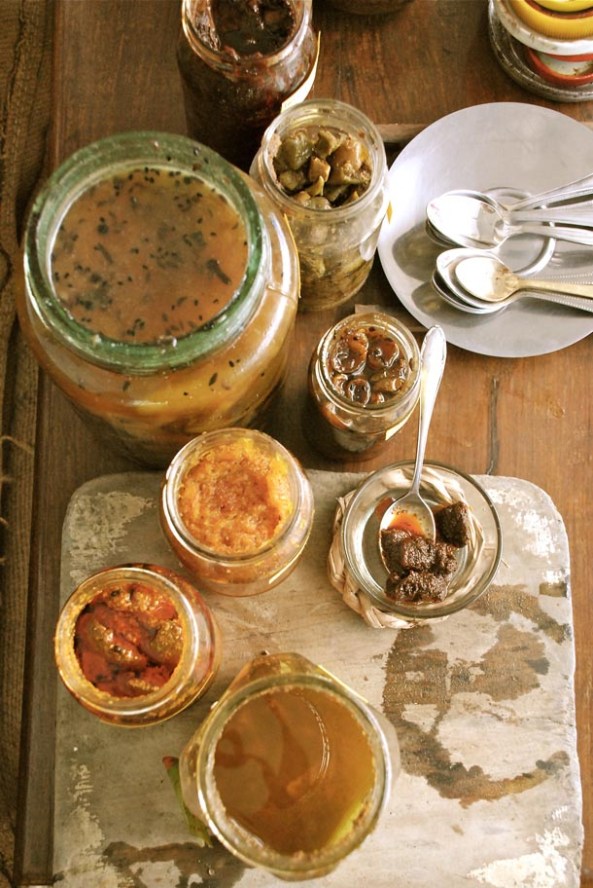
Pickle Nostalgia
Memories of Pickles occupy an important place in my childhood. I don’t have any recollection of my Mum making any pickle. But I do remember my grandmums (both maternal and paternal) preparing pickles. Chopped up ingredients would be laid out on the terraces or balconies for drying up and it was all the childrens’ duty in the house to run up and bring them down every-time the skies would swollen up with thick monsoon clouds. Sneaking into the terrace and taking a few pieces of spiced up dried mangoes (before the few lucky ones manage to go into the bottles) would also be a favourite pass-time!
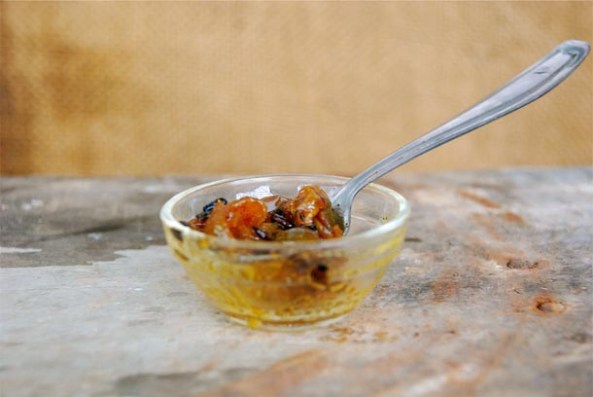
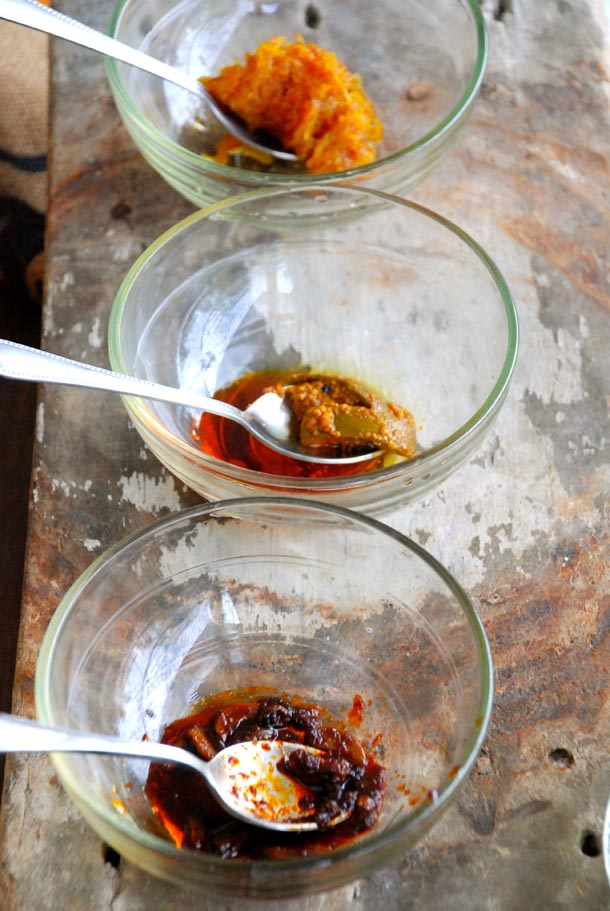
Pickles is to Indian Culture is what Cheese is to French Culture (read here). While from tomorrow I’ll be posting a pickle recipe a day till my Mum-in-law’s pickle jars are exhausted, for today you may go into a photographic journey into the world of pickles in my Photo-gallery. Do enjoy a mini photo-journey into Pickles below. These are from my personal album, so I would request you not to use them. You may also scroll down to read more about Pickles – its’ history and geographical variations, however gathered from the internet.
In the mean-while keep smiling and say ‘Pickle’ whenever you are being clicked. It will bring the best smile in you – that is why perhaps everything is served with a Pickle in a restaurant. Think about it. While I think on my. my next post… which is on Hot Garlic Pickle!
Unblogging it all… Ishita

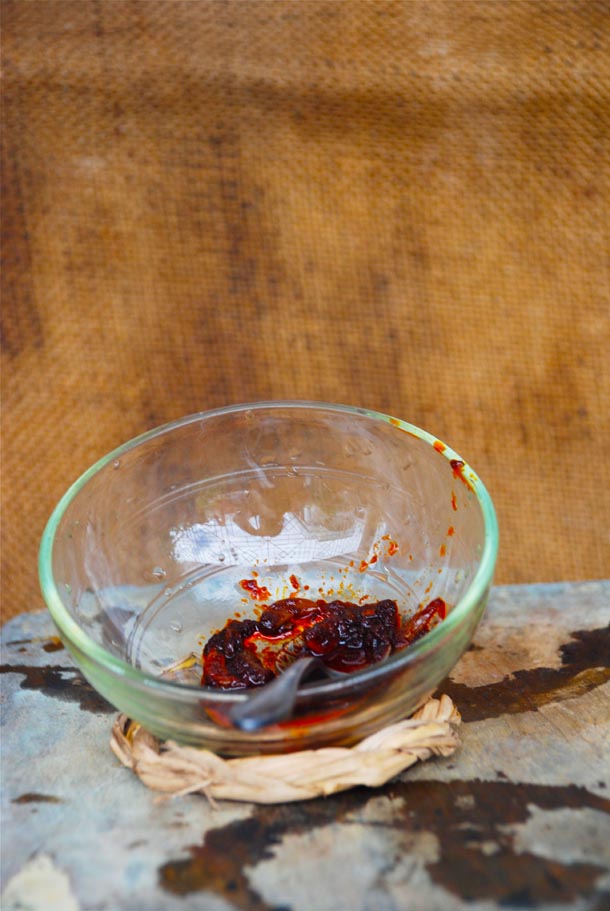
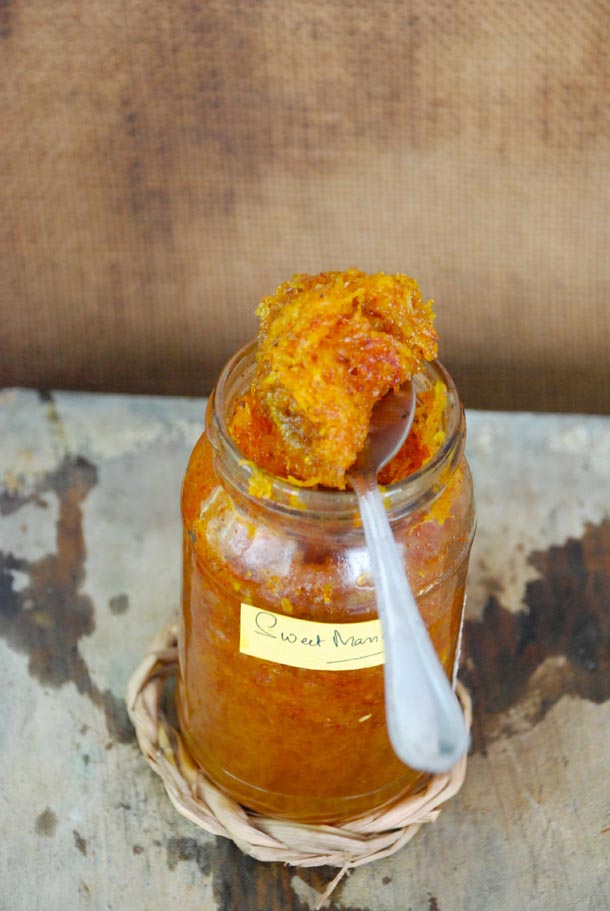
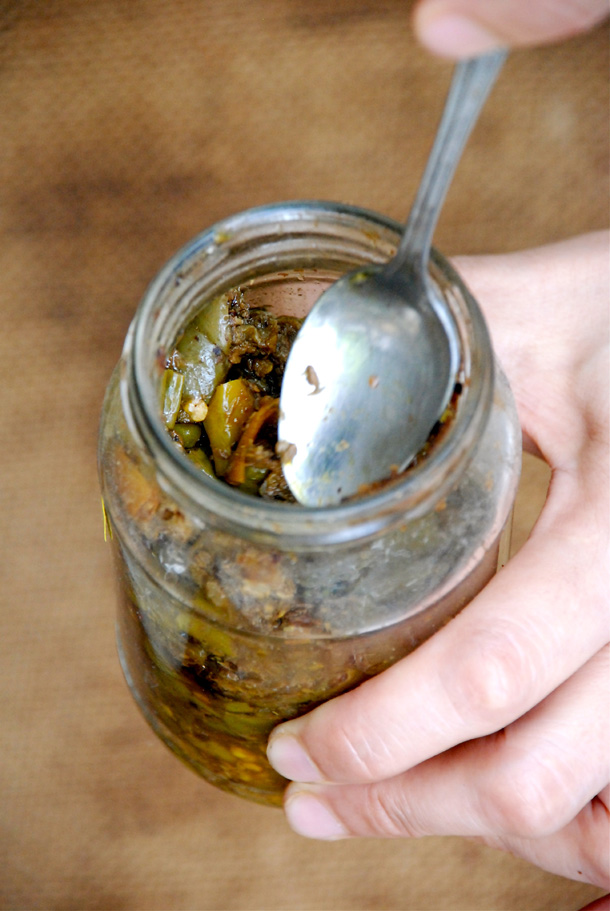
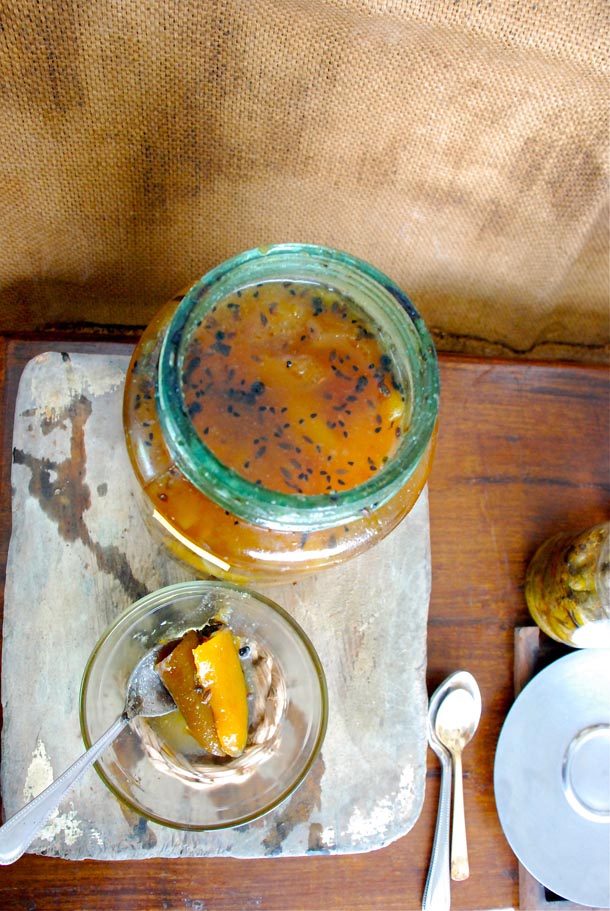
History of Pickles
Pickles seem to date back to as early as 2,000 BC. Pickles have been a part of regional culinary history all across cultures, though there is a difference in the way Pickles are made in different countries. Cucumber Pickles are the earliest examples of Pickles and can be traced back to Mesopotamia. From Cucumbers originating from India and which were brought to Mesopotamia by the inhabitants.
Pickles have also been mentioned in the Bible while the a few secrets to Cleopatra’s beauty are also attributed to the effectiveness of pickles! Apart from Cleopatra, other notable pickle-lovers were Emperors Julius Caesar and Tiberius, King John and Queen Elizabeth I of England, Amerigo Vespucci (after whom America has been named) George Washington, Thomas Jefferson and Napoleon Bonaparte. In-fact, Amerigo Vespucci was a pickle merchant before he became an explorer!
The English word ‘pickle’ derives from the Middle English pikel, first recorded around 1400 and means ‘a spicy sauce or gravy served with meat or fowl’. Some believe it is derived from the Dutch word pekel, which also means brine.
The Jewish too loved pickles. A wide variety of Pickles were produced in ancient Egypt and Mesopotamia. Until recently, sauerkraut (pickled fermented cabbage) was a mainstay throughout Central and Eastern Europe. Over the centuries, Ashkenazi Jews filled wooden barrels or ceramic crocks with cabbage, cucumbers or beets, leaving them in root cellars to ferment in salt brine seasoned with spices. (Info Courtesy: Pickle Guys)
The process of Pickling
Pickling is an art, a time-consuming art. In less romantic words it is the process of preserving food by anaerobic fermentation in brine (a solution of salt in water) to produce lactic acid, or marinating and storing it in an acid solution, usually vinegar (acetic acid). The resulting food is called a pickle. This procedure gives the food a salty or sour taste.
Pickling can preserve perishable foods for months. In-fact, the process was invented to preserve food. Cultural differences give rise to different pickling techniques. Once a pickle has been made, it’s storage is equally important. It has to be kept in air-tight containers and moisture shouldn’t creep in.
Though Pickles do form an integral part of Bengali kitchens, they are definitely not taken with every meal as is done in many parts of North India or South India.

Pickling around the world… Asia, Middle-East, Europe (Info Courtesy: Wikipedia)
In India, Pickles form an important part of regional cuisine and the hierarchy of importance also differs from one state to other. Pickles in India are known by different names – Achar in Punjabi and Hindi, Uppinakaayi in Kannada, Lonacha in Marathi, Oorukai in Tamil, Ooragaya in Telugu. Pickles are made from mango, lime, amla/Indian gooseberry, chilli, vegetables such as egg plants, carrots, cauliflower,tomato, bitter gourd, green tamarind, ginger, garlic, onion, citron etc. These fruits/vegetables are mixed with other ingredients – salt, spices, vegetable oils and is set to mature. A special variety of mango pickle prepared in India’s Andhra Pradesh State called Avakkaya is very popular. This pickle, often described as king of all pickles, is a fine blend of cut mango pieces, red chilli powder, mustard seed powder, salt and sesame oil each ingredient used in specified proportion all raw and allowed to mature for few weeks in porcelain containers in hot summer.
In Sri Lanka, achcharu is traditionally prepared out of carrots, onions, and ground dates. Mixed with mustard powder, ground pepper, crushed ginger, garlic and vinegar, these items are seasoned in a clay pot.
In Pakistan, Pickles are known locally as Achaar (in Urdu) and come in a variety of flavours. Amongst some of the most popular is the traditional mixed Hyderabadi pickle, a common delicacy and staple prepared from an assortment of fruits (most notably mangoes) and vegetables blended with selected spices.
East Asia
Indonesian pickles, açar, are typically made out of cucumber, carrot, bird’s eye chilies, and shallots, these items being seasoned with vinegar, sugar and salt. Fruits, such as papaya and pineapple are also sometimes pickled. In the Philippines, achara is primarily made out of green papaya, carrots, and shallots, with cloves of garlic and vinegar. In Vietnam, vegetable pickles are called dưa muối (salted vegetables) or dưa chua (sour vegetables). China is home to a huge variety of pickled vegetables, including radish, baicai (Chinese cabbage, notably suan cai, la bai cai, pao cai, and Tianjin preserved vegetable), zha cai, chili pepper and cucumber, among many others. Japanese tsukemono (pickled foods) include takuan (daikon), umeboshi (ume plum), gari & beni shoga (ginger), turnip, cucumber, and Chinese cabbage. In Korea, Pickles are called Kimchi and is a very common side dish. Kimchi is usually made from pickled cabbage and radish, but is also made from green onions, garlic stems, chives and a host of other vegetables. Kimchi is popular throughout East Asia. Jangajji is another example of pickled vegetables.
Middle East
In Iran, Pickles are called Torshi in Persian are commonly made from turnips, peppers, carrots, green olives, cucumbers, cabbage, lemons, and cauliflower. In Arab countries, pickles (called mekhallel in Arabic) are commonly made from turnips, peppers, carrots, green olives, cucumbers, beetroot, cabbage, lemons, and cauliflower.
Turkish pickles, called turşu, are made out of vegetables, roots, and fruits such as peppers, cucumber, Armenian cucumber, cabbage, tomato, eggplant (aubergine), carrot, turnip, beetroot, green almond, baby watermelon, baby cantaloupe, garlic, cauliflower, bean and green plum. A mixture of spices flavor the pickles.
Europe… East, West, North & South
Romanian Pickles are made out of beetroot, cucumbers, green tomatoes (gogonele), carrots, cabbage, bell peppers, melons, mushrooms, turnips, celery and cauliflower. Meat, like pork, can also be preserved in salt and lard. In Albania, Bulgaria, Serbia, and Macedonia, mixed pickles known as turshi, form popular appetizers, which are typically eaten with rakia. Pickled green tomatoes, cucumbers, carrots, bell peppers, peppers, eggplants, and sauerkraut are also popular. Polish traditional pickles are cucumbers and cabbage, but other pickled fruits and vegetables, including plums, pumpkins and mushrooms are also common. Russian pickled items include beets, mushrooms, tomatoes, cabbage, cucumbers, ramsons, garlic, eggplant (which is typically stuffed with julienned carrots), custard squash, and watermelon. In Ukraine, garden produce is commonly pickled using salt, dill, currant leaves and garlic and is stored in a cool, dark place.
In Britain, pickled onions and pickled eggs are often sold in pubs and fish and chip shops. Pickled beetroot, walnuts, and gherkins, and condiments such as Pickle and piccalilli are typically eaten as an accompaniment to pork pies and cold meats, sandwiches or a ploughman’s lunch. Other popular pickles in the UK are pickled mussels, cockles, red cabbage, mango chutney, sauerkraut, and olives. An Italian pickled vegetable dish is Giardiniera, which includes onions, carrots, celery and cauliflower. Many places in southern Italy, particularly in Sicily, pickle eggplants and hot peppers. Pickled herring, rollmops, and salmon are popular in Scandinavia. Pickled cucumbers and red garden beets are important as condiments for several traditional dishes. Pickled capers are also common in Scandinavian cuisine.
Coriander seeds are one of the spices popularly added to pickled vegetables in Europe.
Americas
In the United States and Canada, pickled cucumbers, often referred to simply as ‘pickles’, olives, and sauerkraut are most popular, although pickles popular in other nations (such as the pickled tomatoes commonly offered in New York City delicatessens) are also available. Giardiniera, a mixture of pickled peppers, celery and olives, is a popular condiment in Chicago and other cities with large Italian-American populations, and is often consumed with Italian beef sandwiches. Pickled eggs are common in the Upper Peninsula of Michigan. Pickled herring is available in the Upper Midwest. Pennsylvania Dutch Country has a strong tradition of pickled foods, including chow-chow and red beet eggs. In the Southern United States, pickled okra and watermelon rind are popular, as are deep-fried pickles and pickled pig’s feet, chicken eggs, quail eggs and pickled sausage. In Mexico, chile peppers, particularly of the Jalapeño and serrano varieties, pickled with onions, carrots and herbs form common condiments.
In-fact, more than half the cucumbers grown in the U.S. are made into pickles!
Info Source: Indian Pickle @Wikipedia, Pickles @Wikipedia
BE SOCIAL. SHARE THIS!

Fooderati Arabia turn 2 today!
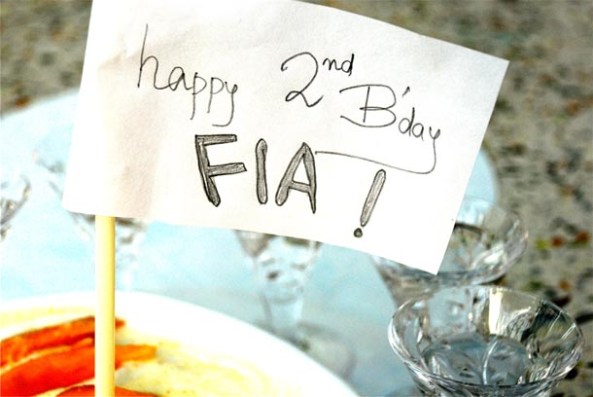
This post is very special, dedicated to Fooderati Arabia as it turns 2 today.
Caesarean or Normal Delivery?
One fateful day in July 2010, two food bloggers – I live in a Frying Pan and My Custard Pie found each other. And flames were put on the highest mark, the ovens were set for pre-heating and Fooderati Arabia (originally entitled ‘Famished in Arabia’) was born. From a group of 8 foodies, today it has more than 100 foodies – all of whom are connected by the passion of FOOD.
This is a group of bloggers who share the issues that I have – OCD (Obsessive Compulsive disorder). These bloggers have similar repeated thoughts (about food), feelings (about blogging), ideas (about why blogging on food give us solace), sensations and obsessions (photographing the food and dissecting it for digestion and the camera). With each day, I am getting to know each and every blogger and welcome the frills and feelers, support and solidarity that I am expecting them to provide in my blogging journey. If you’d like to read more about our journey, visit Fooderati Arabia. We’d love your comments and you can follow and like us (Fooderati) on Twitter and Facebook too.
What makes this group unique?
All the bloggers in the Fooderati are different. We have different styles of writing. We blog on different food matters – some write recipes, some review restaurants, some are earning from food matters, some are spending all their earnings on food matters etc. But one thing is common – we feel that we all belong to the same family – Fooderati Arabia family!
How did we celebrate Fooderati’s birthday?
With the schools closed for the summers, most of us have spread out to different corners of the world. Some of us are enjoying our return to our home countries – all of us are enjoying our summers, yet terribly missing Dubai. So we are celebrating Fooderati’s Birthday ‘virtually’ over Facebook or over Twitter, while we look forward to having an actual birthday celebration once we are all back to Dubai.
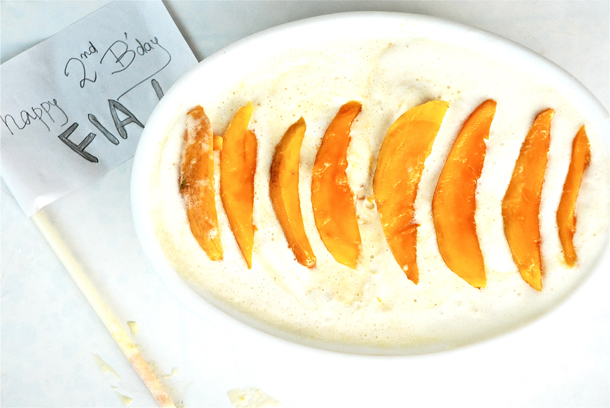
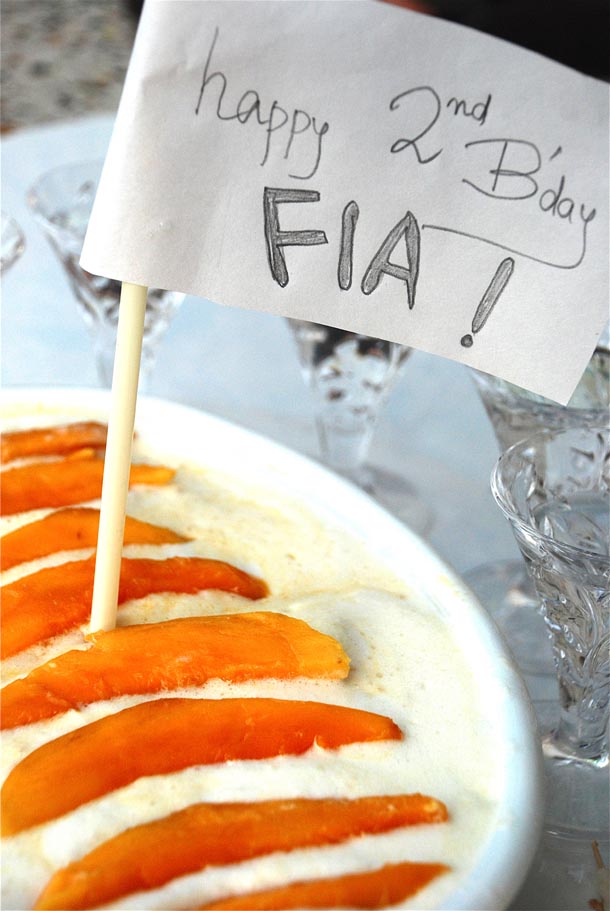
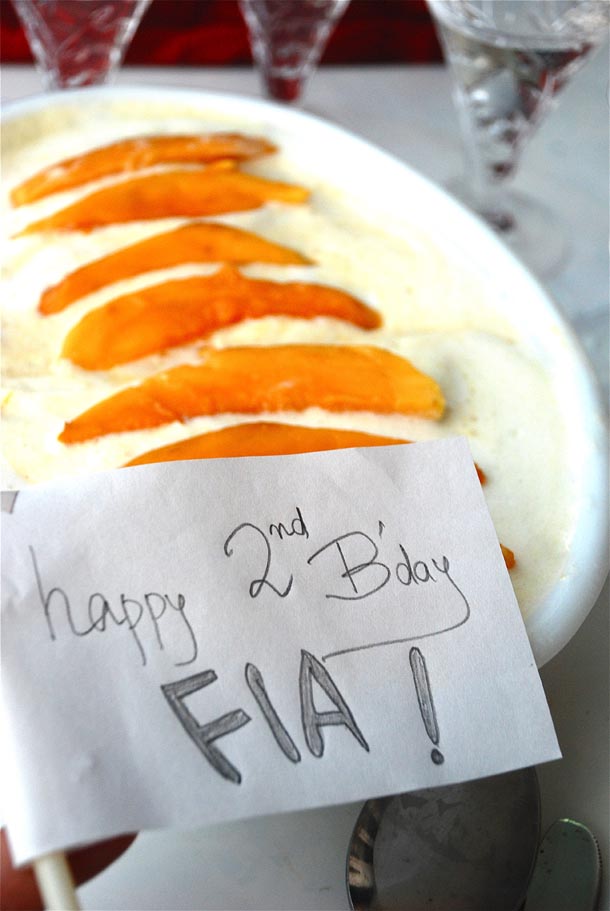
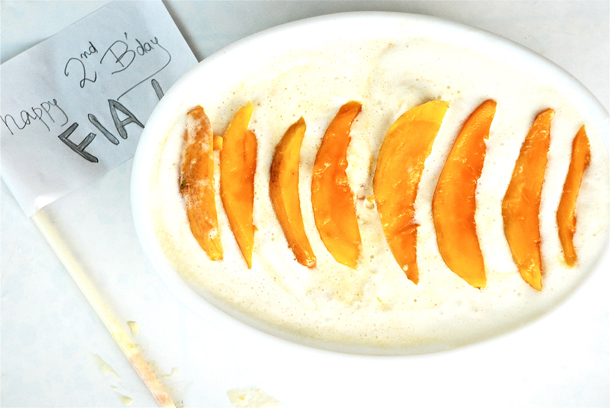
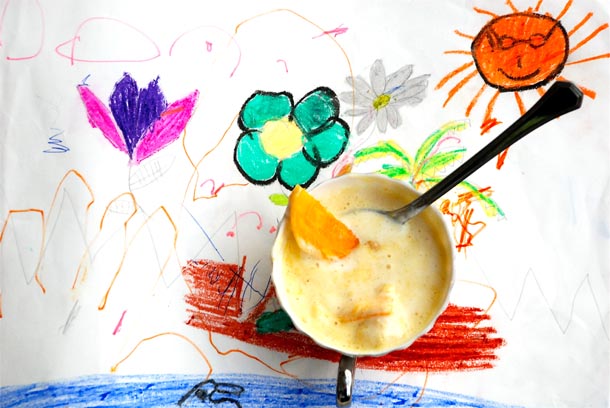
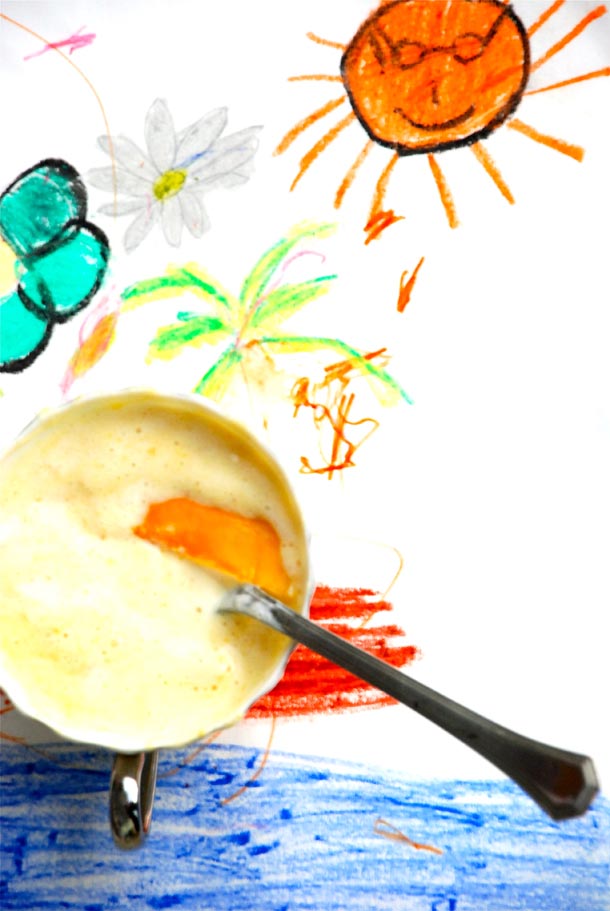
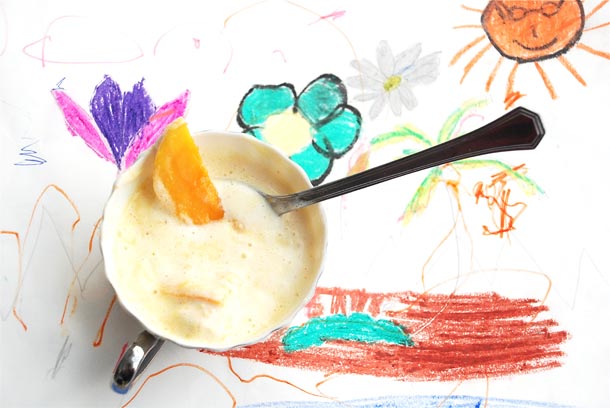
The Z-SISTERS were very excited that we were going to celebrate a birthday. They wanted a cake to celebrate Fooderati’s Birthday but eventually we settled on an Ice-cream to keep us cool in this Kolkata heat. Big-Z even made a special drawing which was used as the background for the photo-shoot!
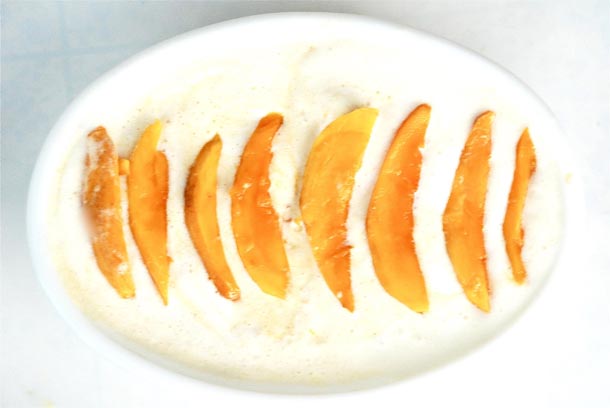
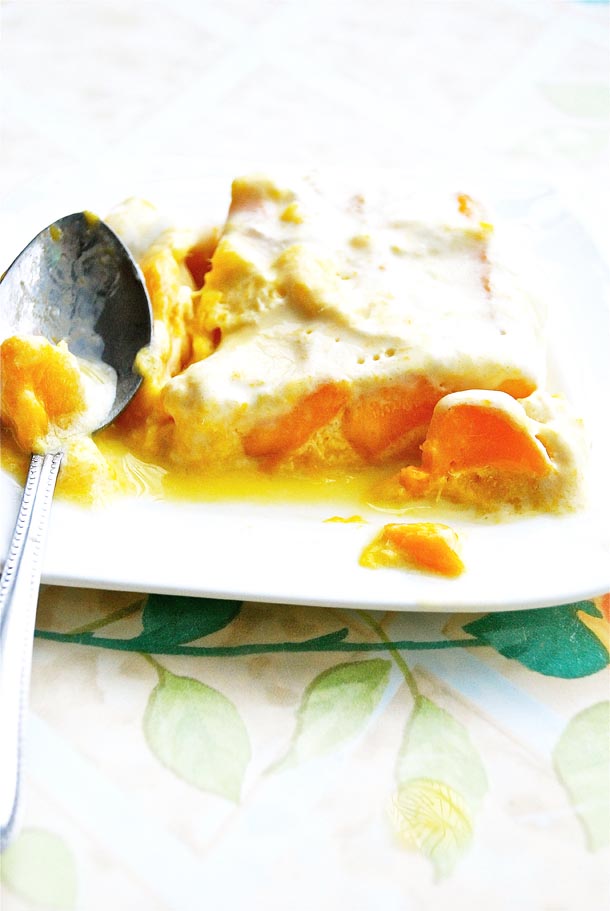
Mango Vanilla Ice-cream
Category – Dessert
Serves 6-8 persons (maybe less if they happen to be sweet-toothed Bengalis!)
Preparation time – 1 hr 30 minutes maximum (Preparation – 20 minutes; setting up – 10 minutes; Refrigeration – 1 hr)
Ingredients
Low-fat Cream – 1/2 lt (Many prefer to use sweetened condense milk – in that case you will need much less cream.
Sugar – 1/4 cup
Ripe Mangoes – 4, squeezed and puréed
1 Ripe Mango – cut into small pieces to be put as random fillings inside the Ice-cream
Vanilla Essence – 1 tsp
Rose water – 1/2 tsp*
* You might prefer not to use Rose water if you want the aroma of the Mango to be stronger
Method of Preparation
– Soak the Mangoes in water for some time and drain out
– Squeeze the pulp out of the Mangoes and purée it with Low-fat Cream
– Add the Sugar and blend it a bit more (you may have to add more Sugar if the Mangoes aren’t very sweet)
– Add the Vanilla Essence, Rose Water and the cut Mango pieces and put the entire Mango Mixture in the Freezer
– Take the Ice-cream out from the freezer and blend it again. This will prevent the Ice-cream from frosting. Set the Ice-cream and let it freeze for the final time.
Enjoy the deliciously, crunchy Vanilla and Rose-flavoured Mango Ice-cream, specially created for Fooderati Arabia’s 2nd Birthday… Don’t forget to scroll down to see all the list of all the bloggers who lend a special charm and aura to Fooderati Arabia!
Melting, melting…
—————————————————————————————————–
Following is a list of passionate food bloggers in the UAE…
Assia Kitchen momentsculinaires.blogspot.com
Bring on the Chef in You http://judyscakesandtreats.wordpress.com/
Foodie Corner http://foodiecorner.wordpress.com/
My Mouth is Full http://www.mymouthisfull.com
With My Eyes Closed http://www.shafeena.me/
DUBAI
According to Dina http://accordingtodina.wordpress.com/
A Food Affair http://www.afoodaffair.me/
All the Calories http://allthecalories.com/
A Life on a Plate http://alifeonaplate.com/
Anja’s Food 4 Thought http://www.anjasfood4thought.com
A Touch of Frosting and other things atouchofrosting.blogspot.com
Ball Park It http://www.ballpark-it.com/
Coffee, Cakes and Running http://coffeecakesandrunning.me
Creating Memories http://creatingmemorieswithtna.blogspot.com/
Culinary Delights by Saba Wahid http://culinarydelightsbysabawahid.blogspot.com/
D for Delicious http://dfordelicious.com/
D’liteful Cravings http://dlitefulcravings.blogspot.com/
Dolce Vita Сладкая жизнь http://juliamaxi.livejournal.com/
Dubai Moves http://www.dubaimoves.com/eat/food-eat/
Food Kissed http://foodkissed.wordpress.com/
Food Lust People Love http://www.foodlustpeoplelove.com/
Food Soldier http://thefoodsoldier.blogspot.com/
Fork it Over Dubai http://forkitoverdubai.wordpress.com
Forks and Folks http://forknfolks.blogspot.com/
Girlieannyen’s Blog http://girlieannyen.wordpress.com/
Gluten Free – U.A.E. http://www.glutenfreeuae.com/
Good Eats http://www.goodeats2day.blogspot.com/
Good Food Ends with Good Talk http://faseelanoushad.blogspot.com/
Hanadi’s Blog http://hanadisaqqaf.posterous.com/
How do I spell the word http://syigimsharif.blogspot.com/
iThink http://gaganjeets.blogspot.com/
It’s My Spice http://itsmyspice.blogspot.co.uk/
Jonathan Castle http://jonathancastle.wordpress.com
Love and Other Spices http://www.loveandotherspices.com/
Mezna’s Culinary Adventures http://mezna.tumblr.com/
Mittu Cooking Love http://easiestrecipes.blogspot.com/
Nadia Masood http://nadiamasood.com/
Naked Plate www.nakedplateblog.com
Never mind the boreks http://nevermindtheboreks.wordpress.com/
Pastry School Diaries http://pastryschooldiaries.blogspot.com/
Paul Frangie http://www.paulfrangie.com/#/blog/4562864182
Pear Tree Food Diaries http://peartreefooddiaries.blogspot.co.uk/
Platetrotter http://platetrotter.weebly.com/
Princess Adventures – princesskristy.com
Rabelaisian Really Gabbles http://frekles.blog.com/
The Real Geordie Armani http://www.therealgeordiearmani.com/
The Word According to Mitzie Mee http://blog.mitziemee.com/
2 Foodies In Dubai 2foodiesindubai.wordpress.com
Vegetarian Tastebuds http://vegetariantastebuds.blogspot.com/
Vindaloo Queen http://vindalooqueen.blogspot.com/
Yum Food Blog yumfoodblog.blogspot.com
FUJAIRAH
A Portion to Share http://aportiontoshare.blogspot.com/
SHARJAH
Enveetu Kitchen http://enveetukitchen.blogspot.com/
Faji’s Hot Pot fajishotpot.blogspot.com
Munaty Cooking http://www.munatycooking.blogspot.co.uk/
—————————————————————————————————–
Other GCC food blogs under Fooderati Arabia (Bahrain, Kuwait, Oman, Qatar and Saudi Arabia)…
Appetite for Discovery http://appetitefordiscovery.com/ Bahrain
Cardamom Hills http://cardamomhills.blogspot.com/ Qatar
Girl on Raw http://girlonraw.com/ Saudi Arabia
Journey Kitchen http://www.journeykitchen.com/Kuwait
Mom de Cuisine http://momdecuisine.net/ Bahrain
Omani Cuisine http://www.omanicuisine.com/Oman
Plateful http://nashplateful.blogspot.com/Bahrain
Slice of my Lyfe http://sliceofmylyfe.wordpress.com/Bahrain
Taste Junction http://tastejunction.blogspot.com/Bahrain
—————————————————————————————————–
Here’s wishing Fooderati Arabia a very happy 2nd Birthday today… Let’s all of us travel our food journeys together virtually, licking our fingers and burping beyond belief, ogling at good food and savouring the invented ones, share with each other all the culinary delights that we unravel while we explore the world and stumble across UAE alleys!
Unblogging it all… Ishita
Related articles
- An Authentic Emirati Food Experience (First Time Ever)! (ishitaunblogged.com)
- Down To Earth Organic & Mutton Chick Peas Curry (ishitaunblogged.com)
- Firni or Ferni, Ramadan or Ramzan, Mallick Bazar or Karama? (ishitaunblogged.com)
- Notun Gurer Payesh/Rice Pudding & My Dida (ishitaunblogged.com)
BE SOCIAL. SHARE THIS!

Whether it is ‘Ramadan Kareem’ in Dubai or ‘Ramzan Mubarak’ in Kolkata, either way this is the holy month for the Muslims the world over. Ramadan has a different effect on Dubai residents – both Muslims and non-Muslims. Everybody is cued in to the holy fervour of the holy month. In the UAE, the non-Muslims too have to refrain from eating and drinking in public during the Roza/fasting hours and Iftar or the fast-breaking-meal can be enjoyed by both the Muslims and the Non-Muslims at lavish IftarBuffets in many restaurants. All ears strain to hear the Cannon boom during Ramadan to signal the end of fasting. In-fact, this is a tradition in Dubai (You may watch here).
This is the first time in many years of our stay in Dubai that I’m outside Dubai during Ramadan. I am off for the summers in Kolkata. And I admit that I’m missing Dubai for more than just the Iftar Buffets. My fellow food bloggers from Fooderati Arabia have been churning out beautiful posts on Ramadan capturing the essence of Ramadan in the lives of local Emiratis, Muslim and non-Muslim residents. Some of them have even created special Ramadan dishes that are now being aired by Noor Dubai TV or Dubai One, 6:30 pm daily with a repeat telecast being aired the following day at 9:30 am and 3:00 pm.
If I may share with you all – I too will be coming on air with my special Bengali Fusion dessert – Rasgulla Macapuno. I will be uploading the episode the moment it is screened.
My journey in search of Iftar in Kolkata this time

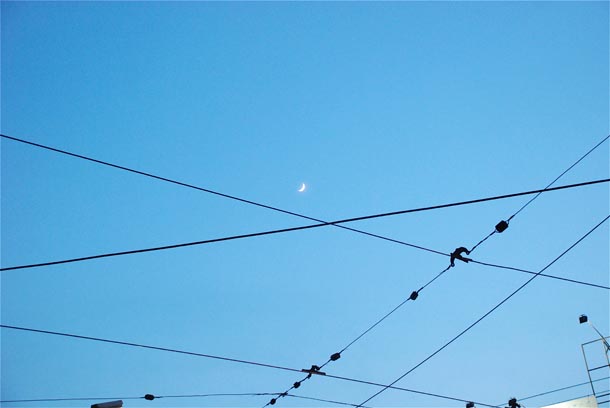

Iftar today was at 6:27 pm (the calculation of the prayer timings is a very laborious process). I dragged the Z-SISTERS to Mallick Bazaar with the intention of having an Iftar meal in one of the many Muslim restaurants that are around in the area. The thin crescent of the moon peeping through the electricity lines of the trams, the faint sound of Adhan or Azaan drifting from the far-away minarets, the prayer-goers flocking to their loved ones so that they can break their Rozas/fast together – yes, I was feeling the spirit of Ramadan.
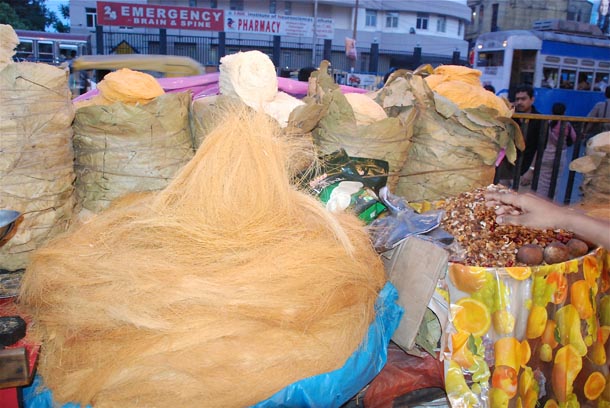
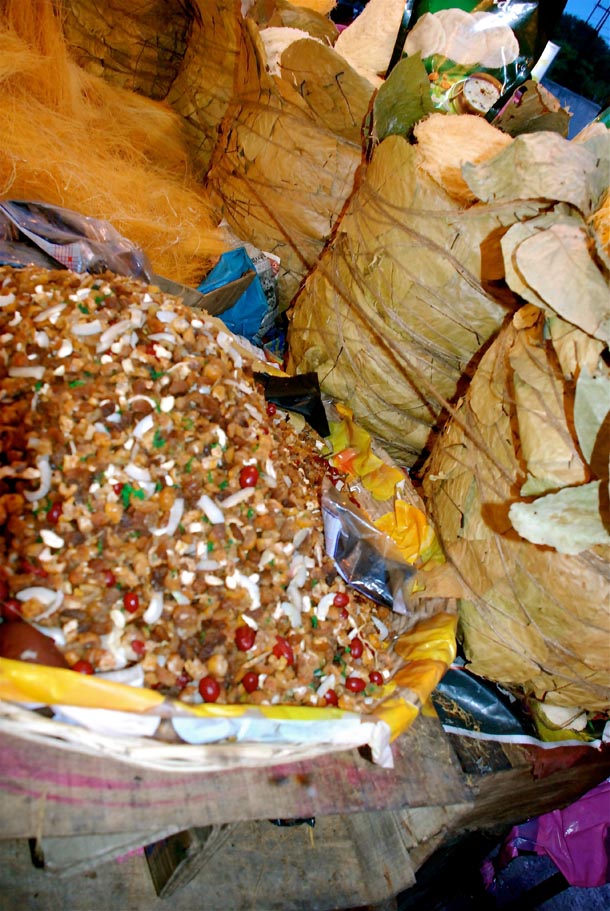
The road-side kiosks of Mallick Bazar was full of Samaiya/Semolina, mixed fruits, Firni mix, glass bangles and mersmerised the Z-SISTERS. They live in a different world and I’m taking them everywhere from Howrah to Kumortuli, just so that they are aware of the world around them – far away from the flower-painted walls of their room.
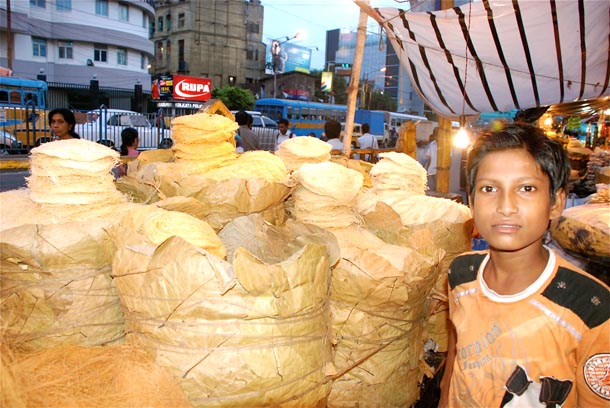
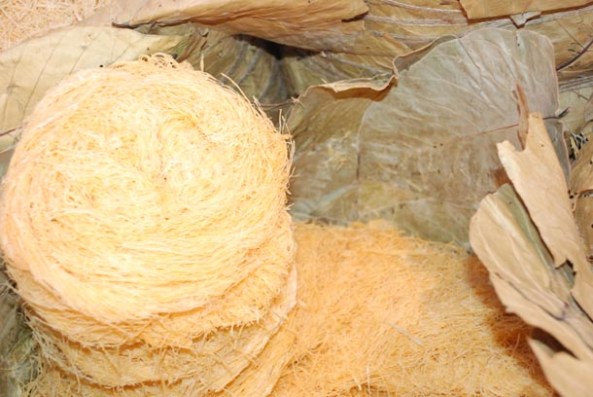

We stood in front of Shiraz Golden Restaurant (yes, the same Shiraz which has a branch in Bur-Dubai). And no, outsiders are not allowed inside the restaurants during Iftar. The shutters are half-closed and only the male staff and family members are allowed into the restaurants to break the Roza. The same holds for Rahmania, another restaurant just across the street. We waited. Big Z looked exasperated. But we had to wait. We were told that the restaurants would open for public at 7:00pm.
As Iftar set in everybody set out to break their Roza. An amazing experience ensued. People formed groups – on the roads, in corners, behind stalls and prayed on the street and started picking on dates and nuts and other savouries from the same plate. Though I didn’t feel like prying into their privacies I have to admit that I almost struggled to keep my camera to myself.
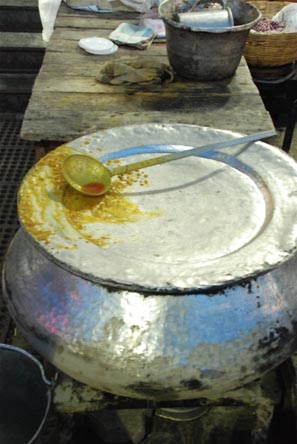
We waited in-front of Rahmania as the staff inside were having their Iftar meals. There was a strong breeze bringing in the aroma of the Haleem being cooked in a huge pot over the slow fame. 
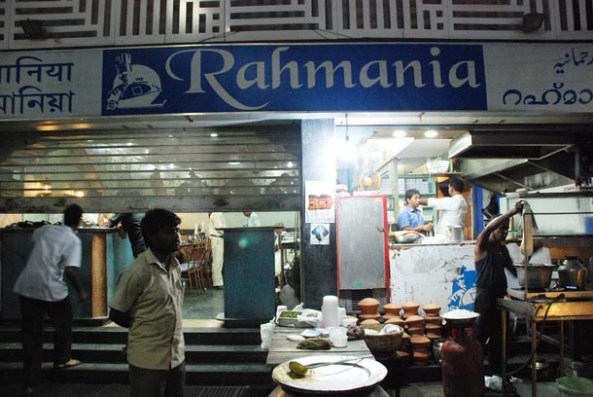
Shutters rolled up noisily. Tea in huge quantities began to be prepared. People started qeueing up with their own containers to take Halim or Haleem, a special Ramadan dish made of wheat, barley, meat (usually beef or mutton, but sometimes chicken or minced meat), lentils and spices. This dish is slow cooked for seven to eight hours, which results in a paste-like consistency, blending the flavors of spices, meat, barley and wheat. Because of the difficult in cooking, Halim is a delicacy and it is cooked in large quantities in a huge aluminum cooking pot. In the Park Circus and Mallick Bazar area, there are many alleys and small restaurants where you’ll find long queues for Haleem. We too queued for Haleem and took a container home.
It was a long wait but worth every second of it. Both the Haleem and the over-boiled milk tea!


After taking Haleem from Rahmania we crossed the street and arrived at Shiraz. Crossing the crowded street with plying trams and many cars zipping past us along with the Z-SISTERS and making sure that the hot Haleem doesn’t spill out of it’s container – well, was a small journey by itself!
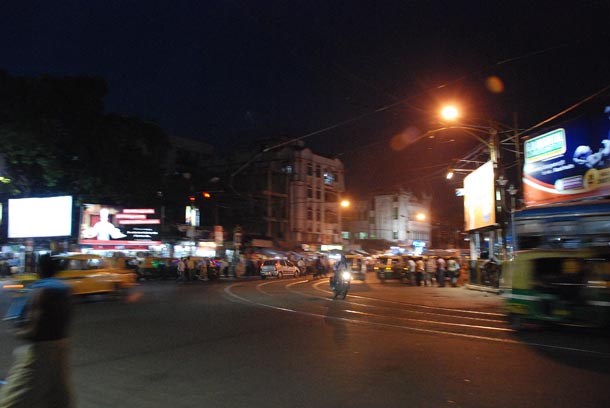
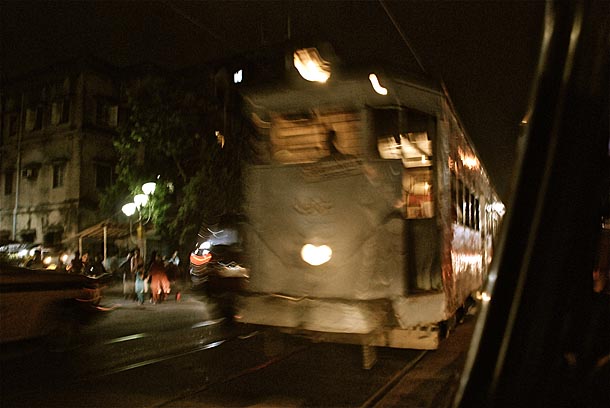

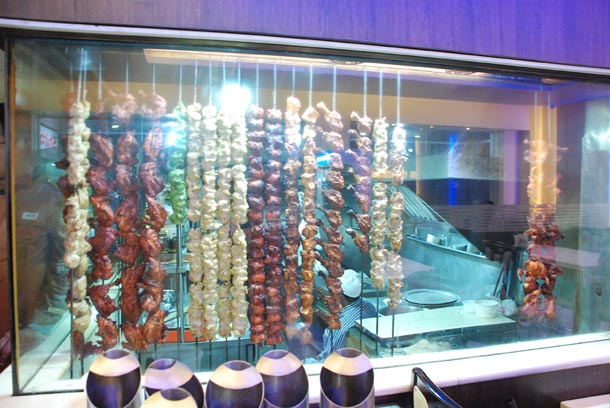
In-front of Shiraz too, people queued up for Haleem. The doors opened much later than 7:00pm. I sneaked inside to take a few pictures so that I could share the photographs of the original Shiraz restaurant with my Dubai readers who are aware of the Shiraz Golden Restaurant, located in Bur-Dubai.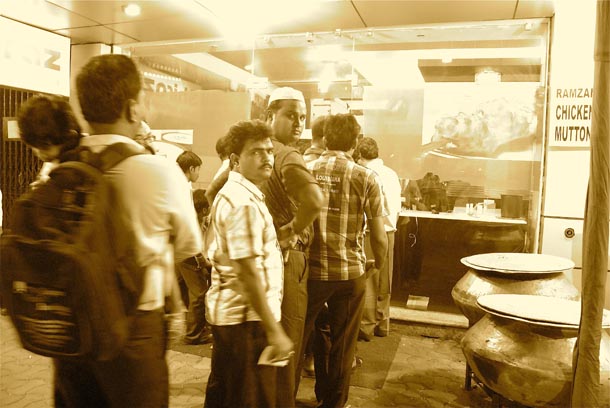


Haleem (both Chicken and Mutton) cost Rs 85/plate in both Shiraz and Rahmania. We took a plate of Mutton Haleem from each restaurant with the intention to compare. But decided at the end not to compare. After all, Ramadan is a time of spiritual reflection, improvement and increased devotion & worship and definitely not the time to partake in activities like comparing between Haleem prepared by two restaurants, located opposite each other and probably strong arch-rivals of each other! 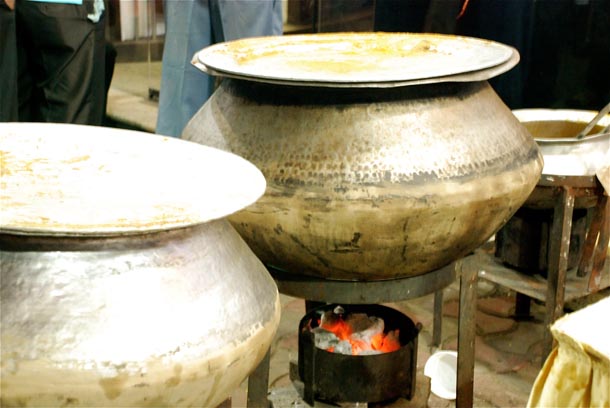
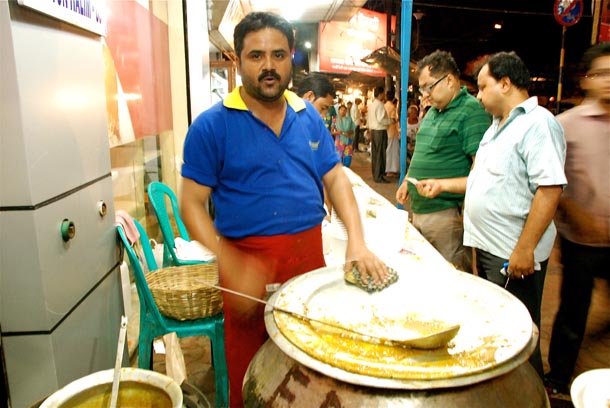
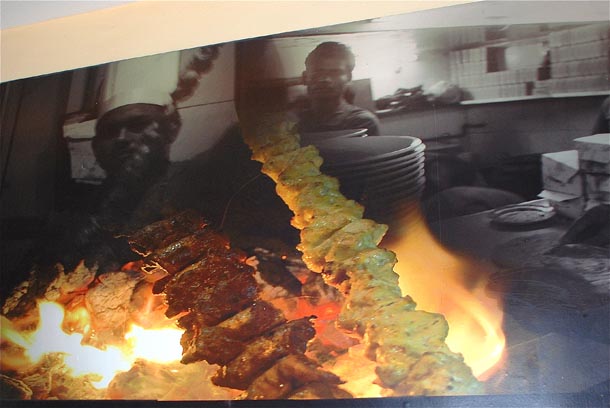
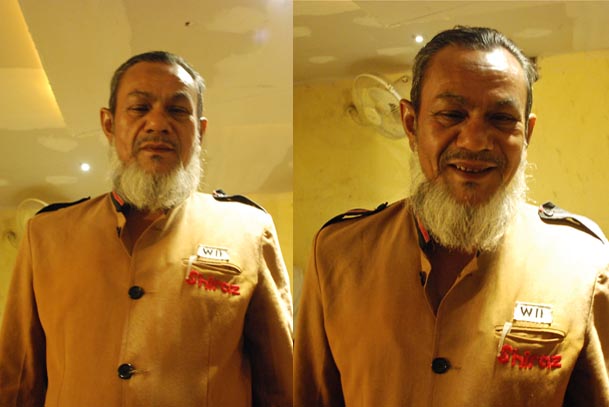
As we were leaving Shiraaz, we bumped into the old waiter who has been serving us since eternity. He did us a favour by smiling for my camera!
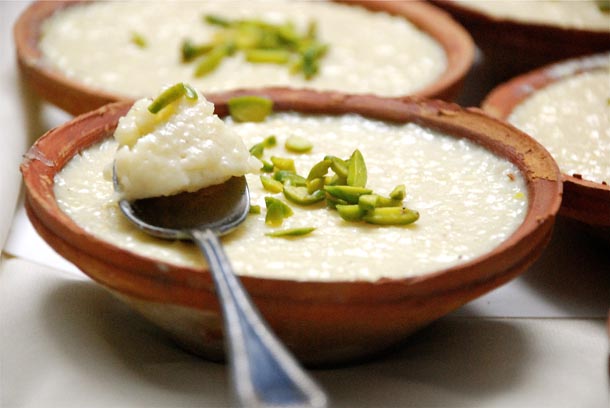
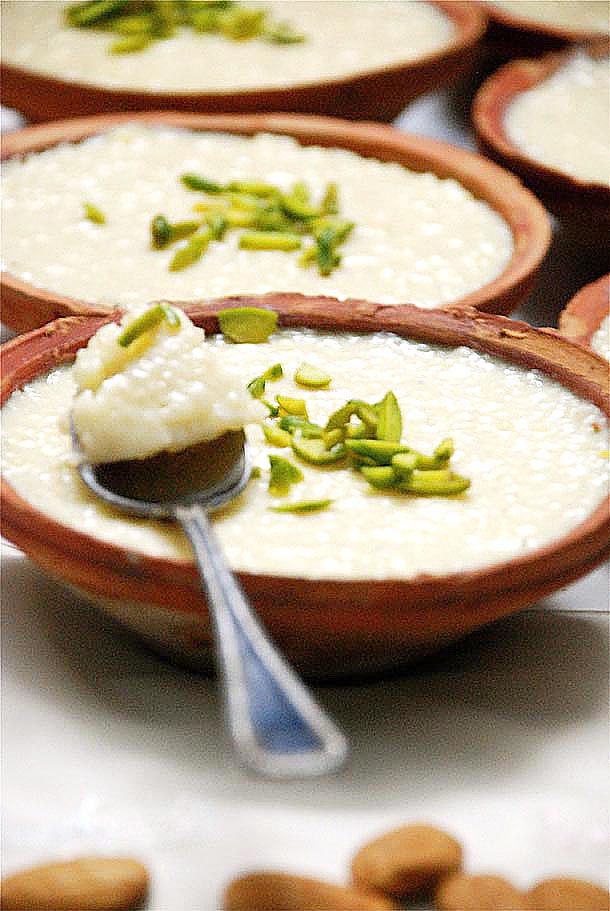
Firni or Ferni/Rice Pudding
Category – Dessert; Cuisine type – Indian
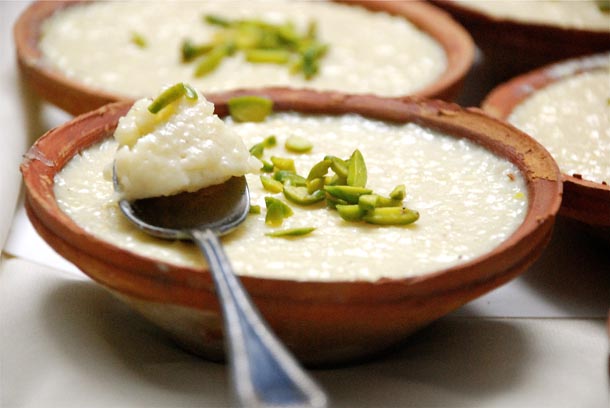
Firni is a traditional Indian Rice Pudding made with powdered Rice and made to set in earthen clay pots. Growing up in Kolkata amidst many religion had it’s own essence – we grew up celebrating every festival from every religion. So we would wait for my Muslim friends to invite us home for Iftar meals. Home-made Dum-Pukht (Dum-Pukht is an old cooking technique where food is cooked on very low flame in sealed containers) Biriyani and many types of desserts of which Firni reigned supreme.
We make Firni very often at home. But following my Mum-in-law’s recipe – which is quite basic but absolutely delicious. But probably the method varies everytime she makes it. And though everytime it tastes equally tasty she can never re-tell me the exact recipe. Hence, resorting to one of my favourite bloggers eCurry, who has compiled a beautiful post on Firni along with the different variations that it is known as around the world – starting from Arroz con leche (Spanish) to Moghlie (Arabic)
——————————————————————————————
Recipe of Firni from eCurry…
Ingredients:
3/4 Cup Raw Basmati Rice
3/4 Gallon Whole Milk
1/2 Quart Half & Half or Evaporated Milk
3/4 Cup Almonds
7-8 Small Green Cardamoms
1.5 Cup Sugar
1/2 Teaspoon Saffron
Unsalted Raw Pistachios for Garnish
1 teaspoon Rose Water
Method of Preparation:
– Wash the rich thoroughly & soak in water for about 2 hours. The grains will get longer & whiter. Drain the water & spread all the rice on a paper towel. Set aside till completely dry to touch. The best way would be to leave it overnight
– Soak the Almonds in the water overnight. Peel the almonds. Separate 1/2 Cup and slice them fine. Set the sliced almonds aside
– Peel the cardamoms & take out the seeds
– Take the dry rice, & the cardamom seeds & dry grind till the rice becomes a powder. It should NOT be as fine as confectionary sugar. It should be grainy like regular sugar or like rawa/semolina. Keep aside.
– Take 1/2 cup of milk, saffron & the rest of the unchopped almonds & blend till the almond is all blended with the milk
– Take a thick bottomed pan. Combine all the milk (including the part blended with saffron & almond) & half & half and boil at low heat till it reduces a little bit in amount
– Add the sliced almonds. Now its time to add the dry rice powder. This has to be done in little batches.
– Take a tablespoon of rice powder & slowly add it to the boiling milk, while stirring vigorously to prevent the powder from forming lumps. It should all blend it smooth with no lumps at all
– Continue the same process till all the rice powder is added to the milk
– Boil the milk with everything in it while frequently stirring it, till it starts getting thick & the rice is all cooked. Once cooked the rice grains will look like small cooked semolina/rawa
– Add the sugar & boil some more. If you want the Firni thicker, keep on boiling till it reaches the desired consistency
– Switch off the heat, & add the Rose water
– Top it with more saffron strands if you want. Chill or atleast 4-5 hrs(overnight is better) before serving it
——————————————————————————————
Do enjoy my Mum-in-law’s Firni set in earthen clay pots. While the photographs are there for you to enjoy my sweet Firni journey and prodding through the crowded Mallick Bazar area, I request you not to use them. Whether it is ‘Ramzan Mubarak’ or it is ‘Ramadan Kareem’ or whether it is Mallick Bazar in Kolkata or Karama in Dubai, the essence of Ramadan is the same everywhere amongst all Muslim household the world wide. Iftar get-togethers with family and friends and enjoying the bonhomie and togetherness. So here’s wishing you and your loved ones a very Happy Ramadan!
Unblogging it all… Ishita


BE SOCIAL. SHARE THIS!

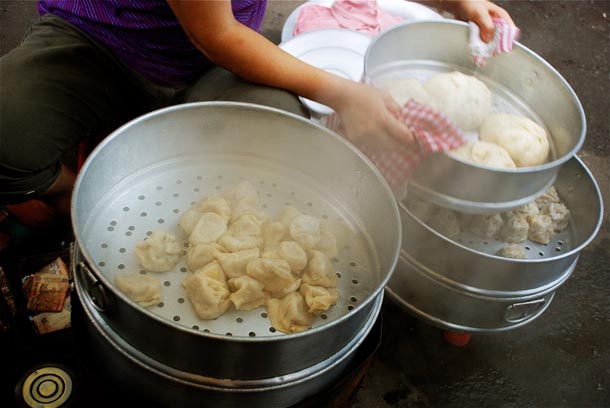
Tiretti Bazar – a buzzing Chinese Bazar which starts as early as 5am in the morning and disappears sharp at 8:30 am, just before the offices start and the roads turn into parking spaces for the day – is a story that needs to be told fast before it disappears. Kolkata is the only Indian city with an official Chinatown known as Tangra and the unofficial count of the number of Chinese stands at 5,000 – 200,000. An interesting read on the history of Chinese immigration in Kolkata will explain how the Chinese have contributed to many areas of the social and economic life of Kolkata. And this history dates back as early as 5th Century A.D.!
Bengali language has borrowed the most important ingredient in their lives from the Chinese – Sugar in Bengali is called Chini which means ‘Chinese’!
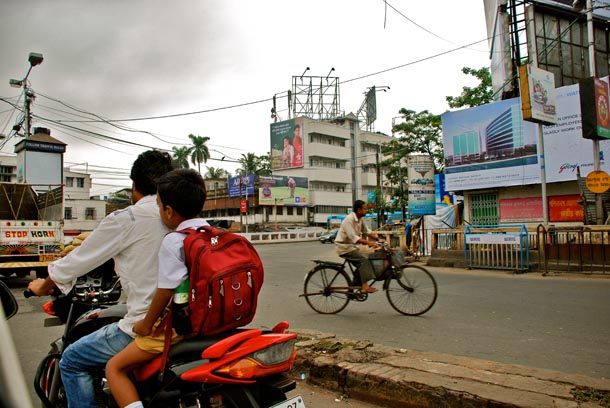

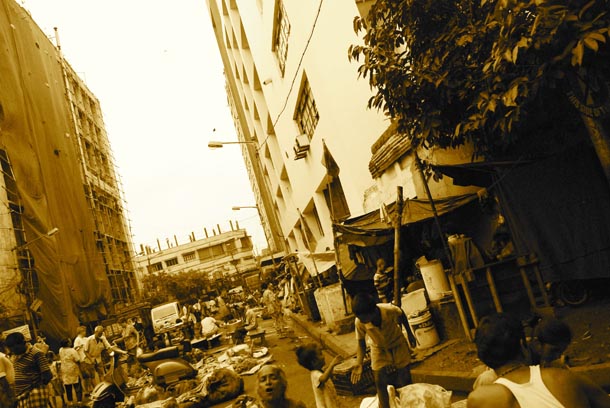
Tiretti Bazar, near Poddar Court in North Kolkata is a Chinese Bazar in the mornings till 8:30 am, after which it is hard to believe that this place was ever a Bazar full of Chinese migrants selling Chinese food products and various Chinese stores selling from Sauces to home-made Noodles. When we were in college, we would visit this place often. Have authentic Momos and Dimsums for breakfast and reach college perfectly on time, smelling of garlic Momos and chilli sauce!
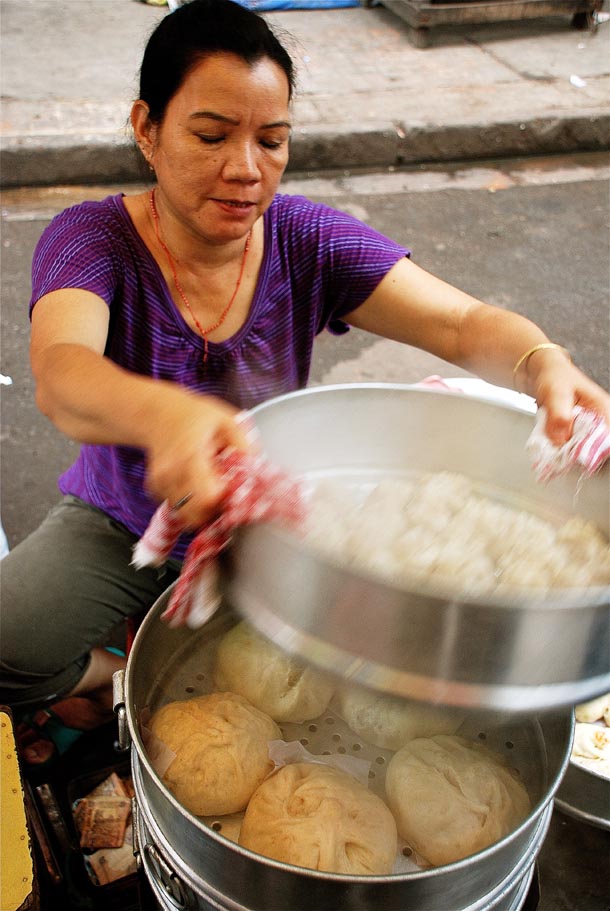
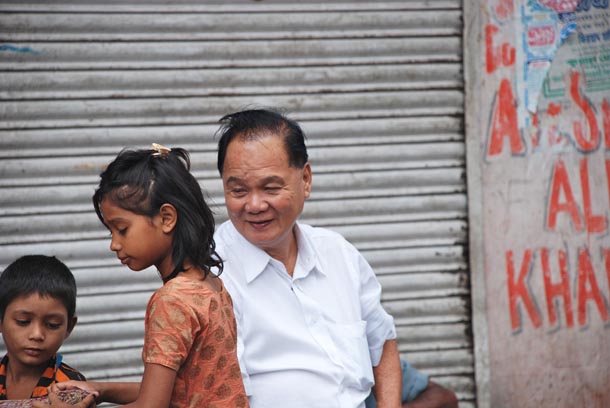
However, my journey back to Tiretti Bazar this time with the Z-SISTERS in tow brought only disappointment. Disappointment because there were hardly any Chinese around. There was only one lady selling Momos – the lady whom we used to call Aunty. Aunty and her husband looked the same even decades later. And the crowd gathered around them also seemed familiar – college students, office goers – but all of them had to be real foodies. Who else would wake up at 5 am in the morning and rush to Tiretti Bazar, just to have Momos!
Kolkata at this hour looks surreal. Empty roads rustling up as the cleaners start sweeping the roads, the birds chirping slowly as they wake up along with the other sleepy residents of the city…
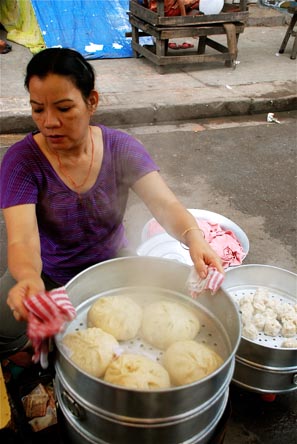

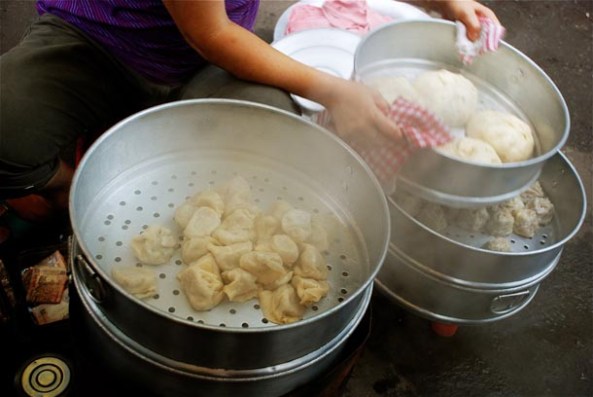
Aunty and her husband serving up Chicken Paos (above) and Pork Paos (below left) – the strong aroma drifting out of the aluminium containers and hitting you once the lids are opened!
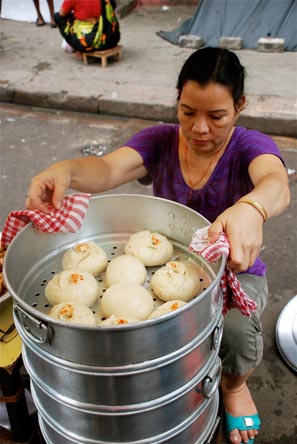

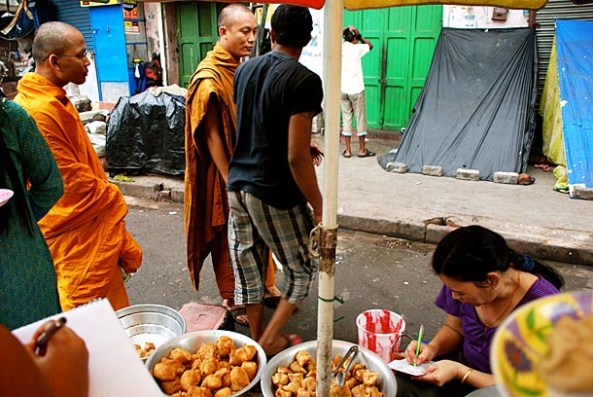
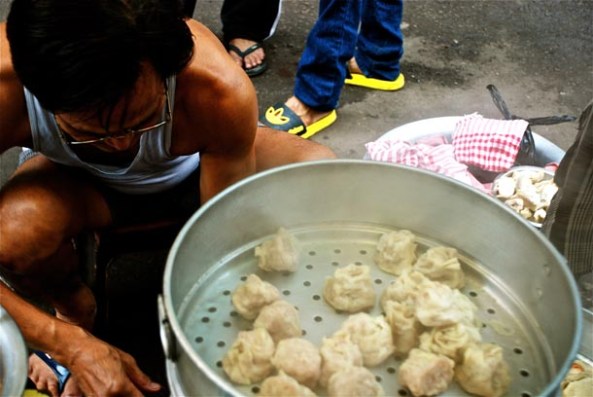
Fish Dumpling (above), Pork Momos and Pork Paos (below)
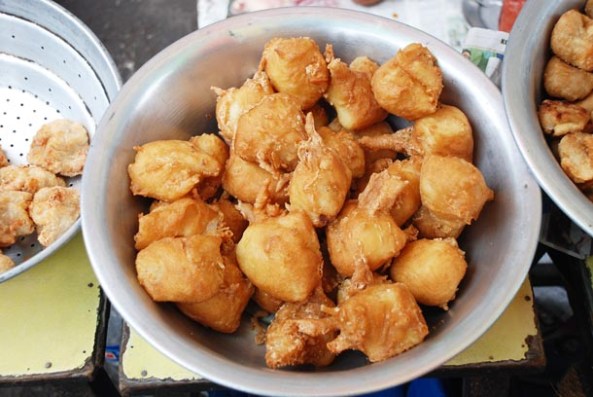
Fried Rice balls – definitely high Carb and high Calorie, but worth every paisa spent!

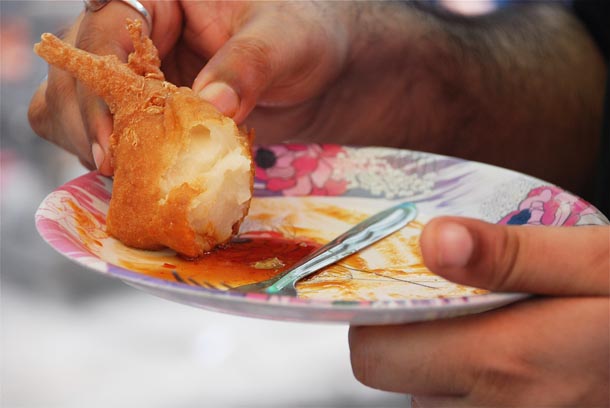
Why am I not surprised? I met Sayan – the Lonetrotter, another Food and travel Blogger – up and awake early (like us) just to EAT! Dear Lonetrotter, you made me feel so good that I am not the only loonie roaming around in the streets at various hours sniffing for food. Lonetrotter’s comment that ‘after this Aunty there will be no more Momos in Tiretti Bazar’ brought me into the grim reality of the dwindling Chinese Community in Kolkata. When I asked Aunty where were the other Chinese who use to sell Momos here, she bluntly told me that ‘ everyone else had gone abroad!’
A reality that is a part of many social structures in many parts of the world. A word of thanks to my friend Yummraj whose post on Tiretti Bazar had stirred up my desire to go back to the place which had been our frequent breakfast haunt as permitted by our student budget.
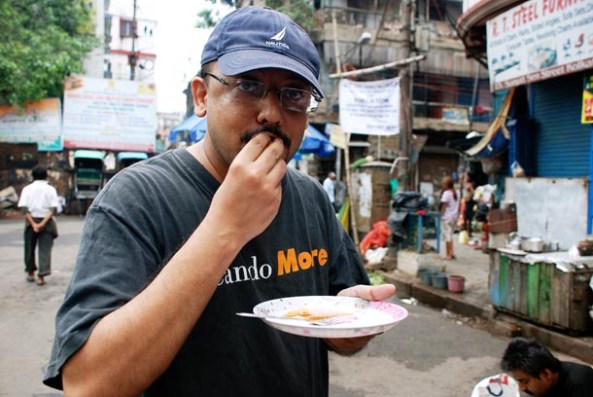

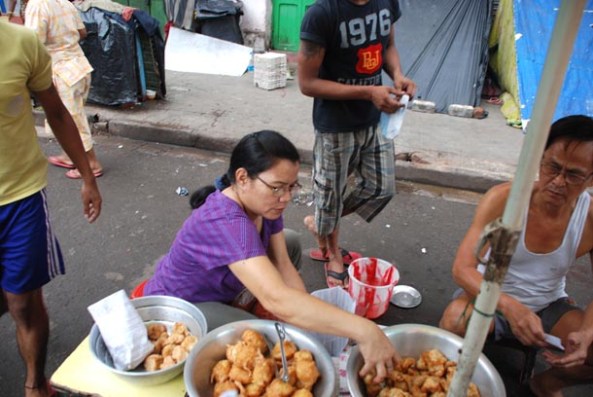
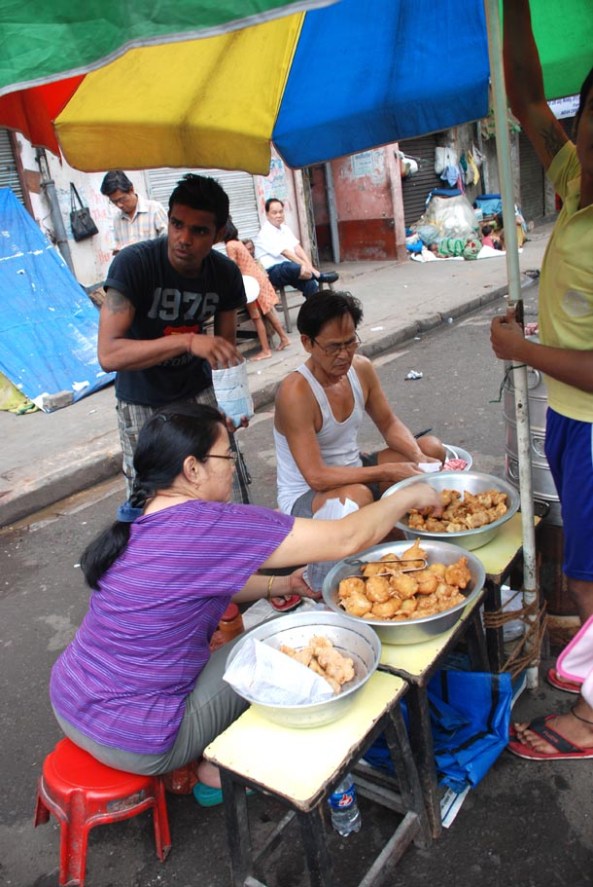
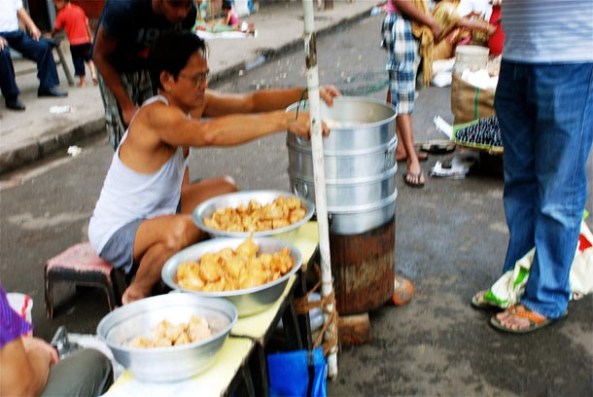
Holding on to the last remnants of home-made Momos in Tiretti Bazar, we had a brilliant morning. The rates are as follows –
Pork Pao – Rs 20/small Pao; Rs 25/big Pao
Chicken Pao – Rs 25/piece
Rice Ball – Rs 10/piece
Steamed Momos – Rs 10/plate
Fried Momos – Rs 20/plate
Pork Dimsum – Rs 12/plate
Timings: 5am – 8:30 am (closed on Mondays)
Location: Sunyet Sen Street, near Poddar Court behind LalBazar Police Headquarters and near the Central Metro Station in Bowbazar. If you drive to this place you have ample parking in front of Poddar Court. But please make sure you go early so that the Momos are still available and the Bazar hasn’t turned into a Parking lot for vehicles of the office-goers. If Cinderella lost her glass slippers exactly at midnight, here the crazy transformation happens exactly at 8:30 am – 9:00 am in the morning!
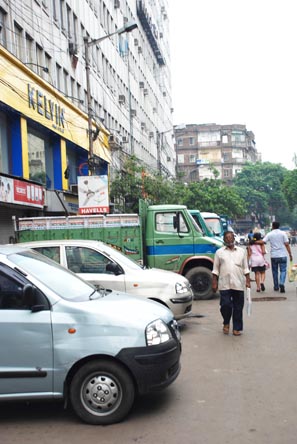
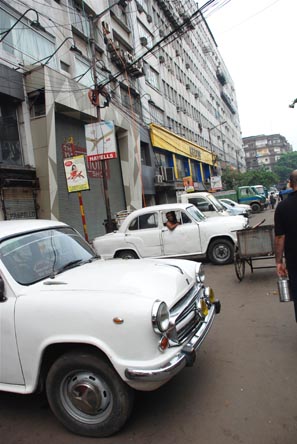
The Chinese Bazar (below) before it transforms into a parking space as the office hours begin…
Holding on to the past… The following are a few posts that I have come across done by my fellow bloggers on Tiretti Bazar. One common feeling prevalent amongst all of us is Tiretti bazar is unique and definitely shouldn’t be let to become just a chapter in history. A collaborative blog post with the help of media, perhaps? Is someone willing to give us that opportunity?
1) Yummraj – Tiretti Bazar: Home-made food sold by Chinese migrants on the streetside (near Poddar Court, Kolkata)
2) Finely Chopped – The Fading Chinese Whispers of Kolkata … Kim Ling Tangra, Tiretti Bazaar breakfast
3) Times of India – Breakfast at Tiretti’s
4) Itiriti – Breaking fast on a Rainy Day
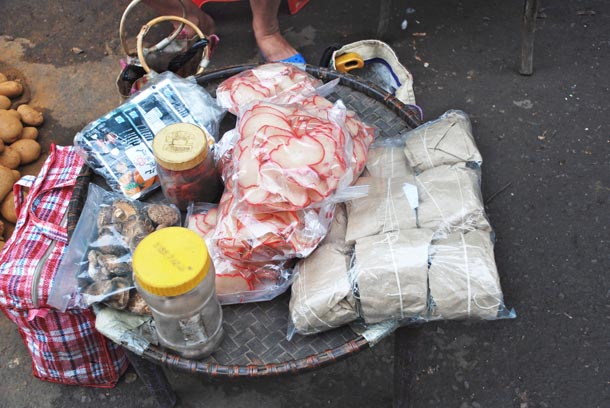
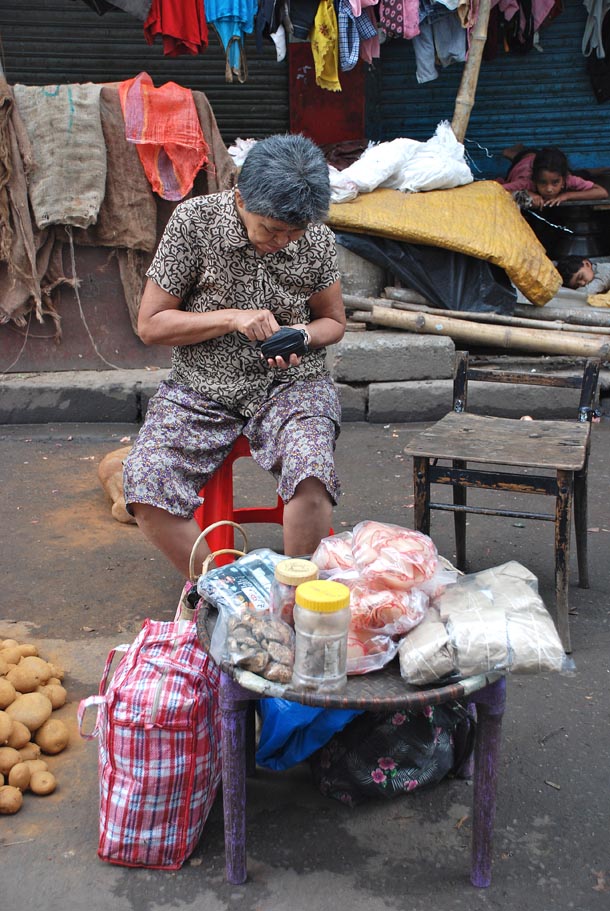
A few things that one must do so that the memories of Tiretti Bazar lasts a bit longer is to buy the home-made Prawn Papads, home-made sausages, Chilli Sauces and many other Chinese savouries that you can buy from here and take back home. Although I wish a better future for all the Chinese migrants who used to throng this Bazar once upon a time who have ‘gone abroad’, at times I wish if time had stood still then Tiretti Bazar would still look like what my earlier memories recall it as… Do visit the lone Aunty of Tiretti Bazar to have her incredible Momos, Dimsums and Paos – before she too decides to ‘go abroad’!
Unblogging it all… Ishita
BE SOCIAL. SHARE THIS!

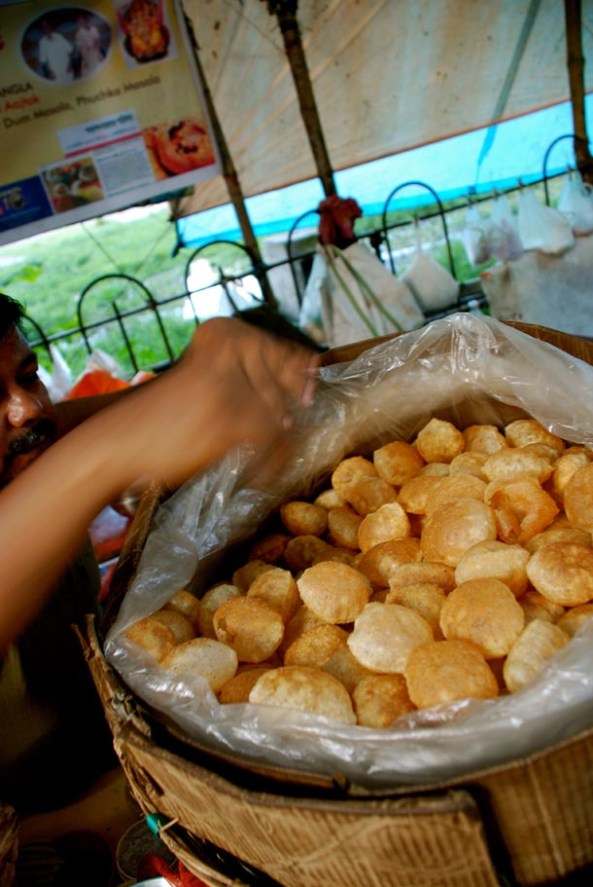
Parar Phuchkawalah
Each Para/neighborhood in Kolkata has their local celebrity Phuchkawalah/Phuchka-seller. They are the most sought-after street food. Phuchkas, also known as Golgappas or Panipuris elsewhere, are not only a popular street food in many places in India but also in Nepal and Bangladesh. Though we get Panipuris in many places in Dubai, the Bengali variant Phuchka is very different. And obviously not so easily available elsewhere.
I’m glad that Wikipedia considers Kolkata’s Phuchka to be ‘the king of this variety of snacks, compared to its cousins like Golgappas or Panipuris. The filling is made by lightly mashing boiled potatoes with black salt, salt, some spices, a generous portion of tamarind pulp (made by mashing ripe tamarind in tamarind water), chilli (powder/chopped/boiled & pasted). The Tetul Jol/Tamarind Water is made by mixing tamarind and spices/salt and making a light and tart liquid with water’.
The filling of Phuchka in Kolkata is different with Aloo/Potato, so is the Tetul Jol/Tamarind Water which smells of Gondhoraj Lebu/Bengali Lime. This Gondhoraj Lebu or the Bengali Lime remains elusive in the shores outside the shores of Bengal. Even visits to the Bangladeshi market in Sharjah doesn’t bring much success. So I try to substitute the Thai Kaffir Lime leaves for the faint aroma of Lime.
Panipuris in Dubai:
We get Panipuris in many places in Dubai. Obviously they are not sold at every street corners like they are available in Kolkata. And the ones that are sold are more palatable to the Indians hailing from other Indian states but Bengal. The following are a few restaurants where you’ll find Panipuris –
– Bombay Chowpatty – Trade Centre Road, Karama, Dubai; TEL: +971 4 396 4937/ Bombay Chowpatty has also opened in Dubai Media City and has a stall in the Food Court in Lulu Hypermarket Al Barsha
– Bikanerwala – Karama; Tel: +971 4 3968813/ Food Court, Lulu Hypermarket, Quasis; Tel: +971 4 2987030/ Al Wahda Street, Sharjah; Tel: +971 6 5537933/ Also opening in Al Barsha
– Chhappan Bhog – Trade Centre Road, Karama, Dubai; TEL: +971 4 396 8176
– Puranmal – Bur Dubai, Dubai (Opposite Dubai Museum); TEL: +971 4 351 1466/ Trade Centre Road, Karama; Tel: +971 4 3968486/ Website: Puranmal Sweets (Puranmal has been added on the suggestion of a reader). Also read Burp and Belch’s roundup of the 5 best places in Dubai for Chats.

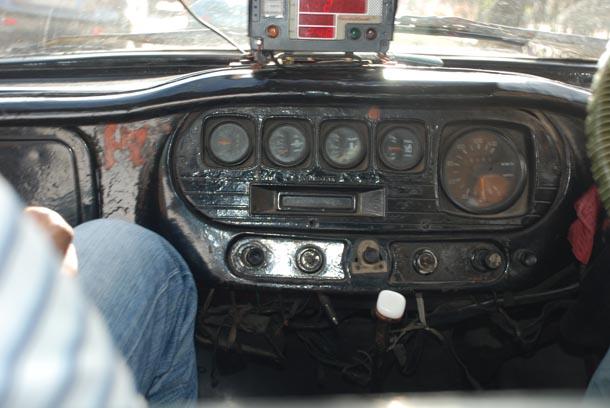

Phuchka in Vivekananada Park – World famous in Kolkata!
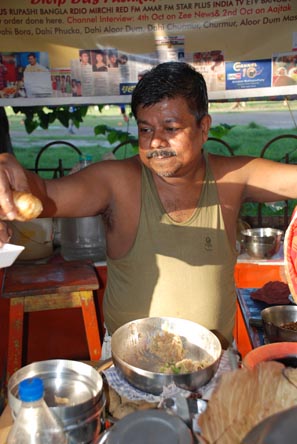
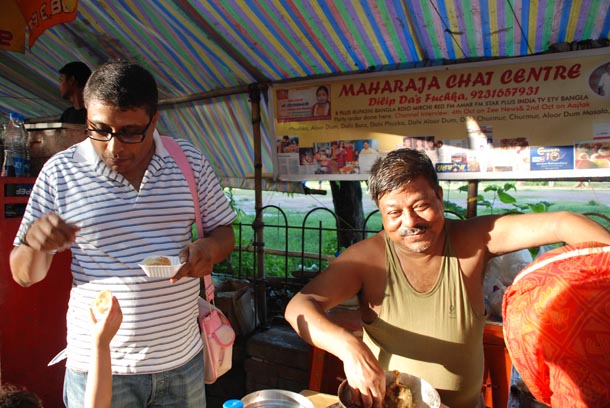
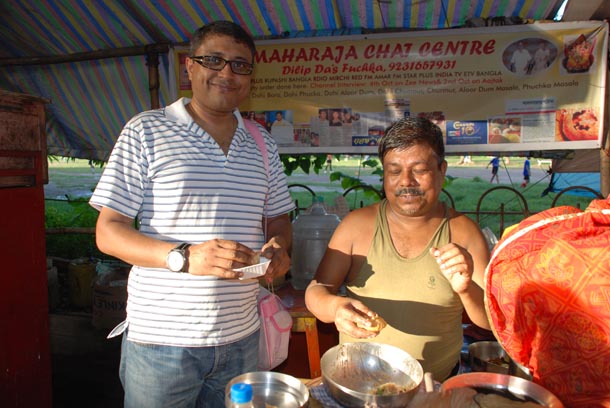
Phuchka for me has to be in Vivekananda Park in South Kolkata. And from the one and only one Dilipda. This doesn’t take away the credibility from other Phuchkawallahs who are almost like local celebrities of each locality. This time I set out with my gang – the Z-SISTERS, husband, also Mum-in-law in tow to capture Dilipda’s Phuchka in pen, paper and picture! Damn the car breakdown in Easter Bypass and hopping into a Taxi – the interiors of which were to fall apart even if we half-sneezed. Obviously a little bit of drama added to the taste explosion that Dilipda’s Phuchka always bring in.
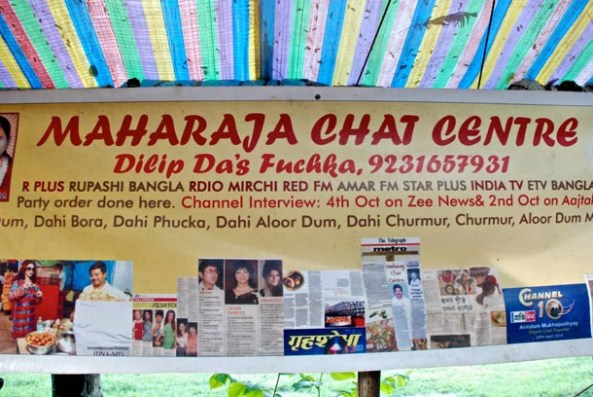
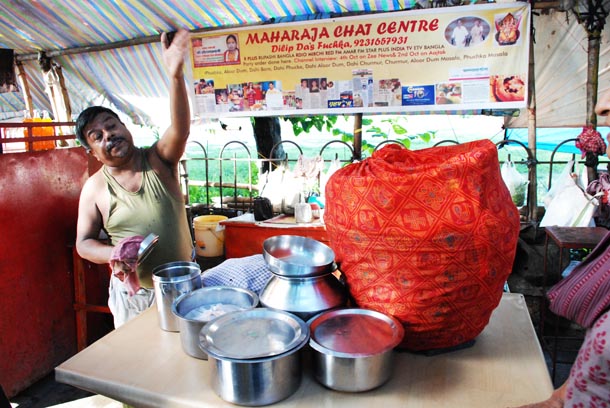

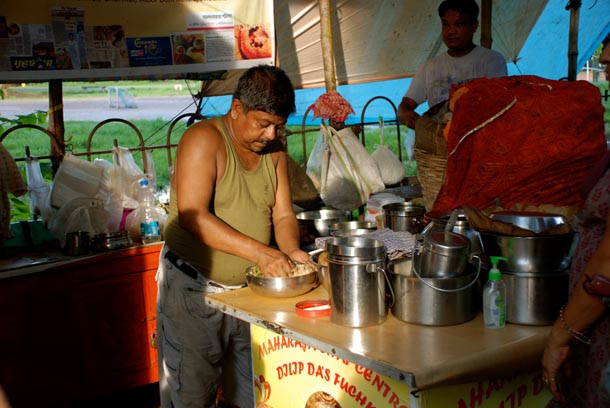
Dilipda, The Celebrity
Dilipda is very famous. He’s also the epitome of name-dropping! ‘Ei to Bipasha Basu bollo aar NDTV eshe hajir!/Bipasha Basu mentioned me and NDTV came running!’ or ‘Debosree to kurita Phuchka khabeyi khabe!/ Debosree will definitely eat 20 Phuchkas!’ or ‘Konkona amar kaach theke Phuchka Moshla niye jay!/Kankana takes the Phuchka Masala from me!’
Bipasha Basu, Konkona Sensharma being famous Bollywood film stars while Debosree is our star from home – Tollywood film industry. Clippings of many more stars and starlets, newspaper cut-outs adorn the backdrop of Dilipda‘s stall. It’s like a little indigenous Wall of Fame!
This clipping from The Telegraph reveals that this is the most sought-after street food haunt for most of Kolkata’s celebities. A place where they are not disturbed and enjoy their ‘common man’ escapades in peace!
Dilipda, The Beginning of History
Dilipda is the 3rd generation of Phuchkawallas settled in Kolkata. His great grandfather had hailed from Bhagalpur in Bihar, a neighbouring state of Bengal. His food stall – Maharaja Chaat Centre has been serving Phuchkas exactly at the same spot for the last 35 years. Before that his stall was in the Safari Park inside the Lake that adorns the Southern Avenue. When Kolkata Municipality banned them from selling there in 1980, all the street food vendors shifted base to Vivekananda Park. Even today the kiosk looks the same and smells of the same spice that used to explode my senses when I used to go all the way to Vivekananda Park to satiate my Phuchka craving!
At a rate of 1,000 Phuchkas served daily to 100 people, he has been feeding atleast 12,500,000 Phuchkas so far! No mean task at all. Deserves a standing ovation. And I owe this to him – for all the Phaos/Free Phuchkas that I have demanded from Dilipda in my lifetime!
Dilipda arrives daily at his stall at 3pm in his small blue cycle van which he terms a as his BMW-Mercedes. Back in his Tollygunge house his family helps in making around 2,000 fresh crispy Phuchkas every day. And the different types of water that accompany the Phuchkas and the other snacks that he serves – the Telul Jol/Tamarind Water and the Phuchkar Jol/Phuchka Water. Along with the minute detailing in the variety of fresh garnishes. The water is prepared fresh daily, he says. And he also prepares it with Mineral water if informed earlier for all his NRI (Non-Resident Indian) customers who are very fragile in their digestion capabilities where road side food is concerned! He also warns ‘Ota oto kintu tasty hoyna!/It is not that tasty though!’… probably because some dust and grime has to get into street food to make it what it is – non-replicable!
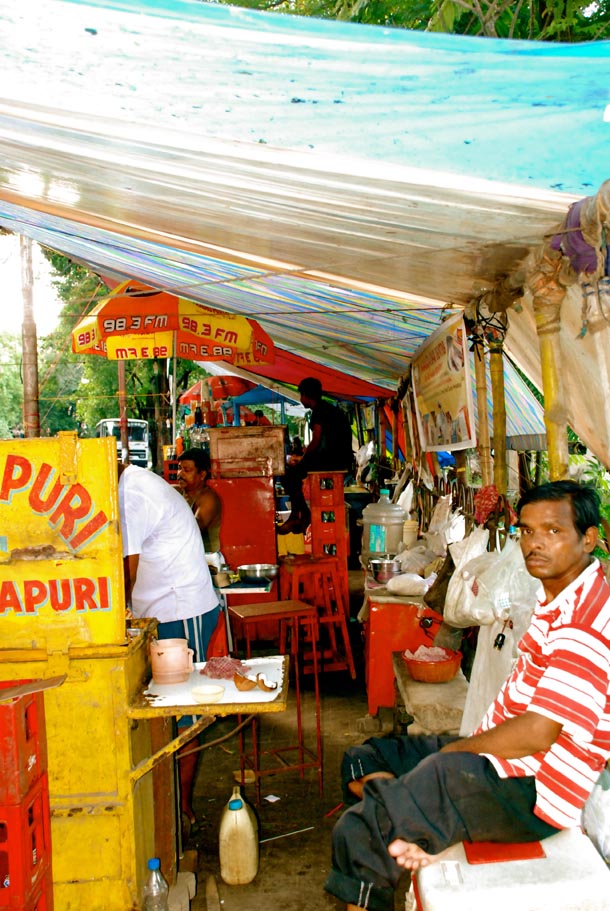
Phuchka
Phuchka
Category – Snacks; Cuisine type – Indian Road-side
If there can be a category like that!
Phuchka Masala
Coriander seeds – 1 kg
Cummin Seeds – 200 gm
Cloves – 10 gm
Cardammom Sticks – 50 gm
Mouri/Fennel Seeds – 200 gm
Jowan/Ajwain/Carom Seeds – 50 gm
Dry roast the above and pound them/grind them coarsely to a powder.
Tetul Jol/Tamarind Water
For 1 lt water –
Salt – 1tsp
Black Salt – 1/2 tsp
Phuchka Masala (the above) – 1 tsp
Red Chilli Powder* – 1/4tsp
Tamarind Paste – 10gm
Lime Juice – 2tsp
Raw Mango Paste – 1tsp
Gondhorjaj Lebu/Bengali Lime – 1 tsp (You may use Kaffir Lime for the aroma)
Coriander leaves – chopped – a bunch
Mint Leaves – chopped (optional)
*Red Chilli Powder – Dry roast Whole Red Chillis with Salt and then grind them into a powder
Papris
Flour – 500gm
Baking Soda – 1/2 tsp
Ajwain/Jowan/Carom Seeds – 1/2 tsp
Salt – 1/2 tsp
White Oil – 1 tsp
Knead the above into a dough and make small flat cakes from this dough and fry them in white oil till crisp.
Phuchka
Atta/Whole Wheat – 800gm
White Flour – 100gm
Shuji/Semolina – 100gm
Salt – 1/2 tsp
Knead the above into a smooth dough, make small round balls and flatten them into thin circular sheets with rolling pins and fry in white oil till they are fried into crispy and hollow Phuchkas/Puris.
The Filling
For 6 potatos –
Phuchka Masala (the above) – 2 tsp
Boiled Chickpeas – 1 cup
Crumbled Phuchkas – 6 pieces
Crumbled Papris – 6 pieces
Green Chilli Paste – 1/4tsp (optional)
Salt – a pinch
Black Salt – a pinch
Tetul Jol/Tamarind Water – 150ml
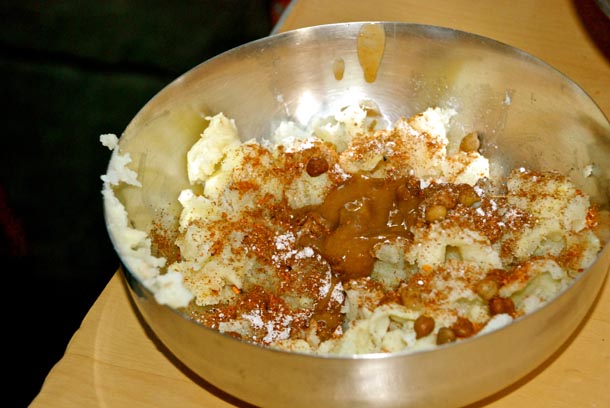
Boil Aloo/Potato with skin. Peel off and mash thoroughly with Phuchka Masala and Green Chilli Paste (optional – depending upon taste), Salt and Black Salt, Tetul Jol/Tamarind Water along with the crumbled Phuchkas, Papris and boiled Chickpeas.
The Method of Eating Phuchkas
A small hole is made into the fried crispy round Phuchka and the filling is put inside. Then the Phuchka along with the filling is dipped into the Tamarind Water and served to the Phuchka-hungryyyyy onlooker! Bite into it crunchily, spilling the Tetul Jol/Tamarind Water along the line of your mouth and anxiously wait for more. It’s perfectly okay to salivate a bit!
Enjoy the pictorial journey into some historic Phuchka eating… Dilipda making Phuchka, Mum-in-law turning assistant and writing down the recipe, the famous Aloo Makha/Mashed Potato that go into the Phuchkas as filling…
The Cost
Dilipda’s Phuchkas are relatively more expensive than other places. After all he’s a local ‘brand’!
Phuchkas come at a cost of Rs 2:50/piece; Dahi Phuchka comes at Rs 40/plate (6 pieces of Phuchka); Aloor Dum comes at Rs 40/plate (10 pieces of Aloo/Potato) or Rs 20/half a plate (5 pieces Aloo)
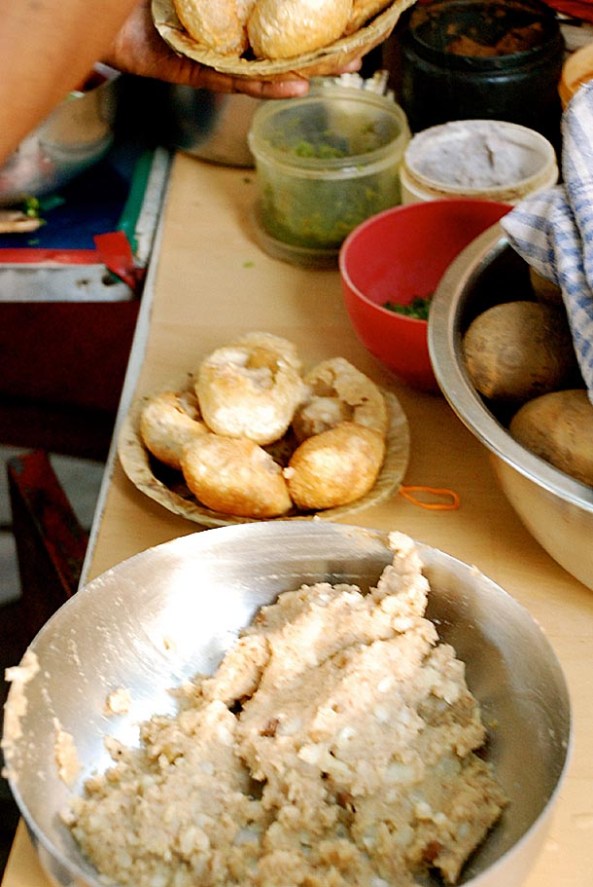

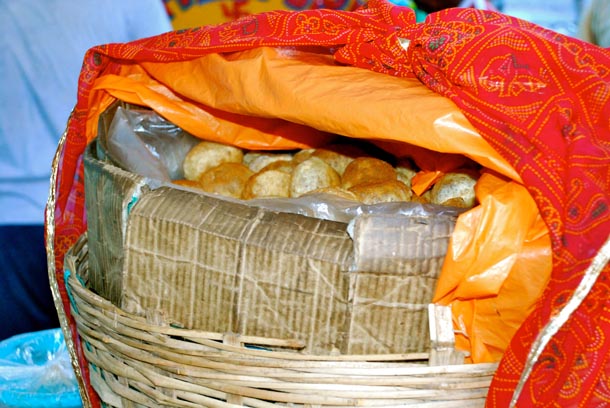
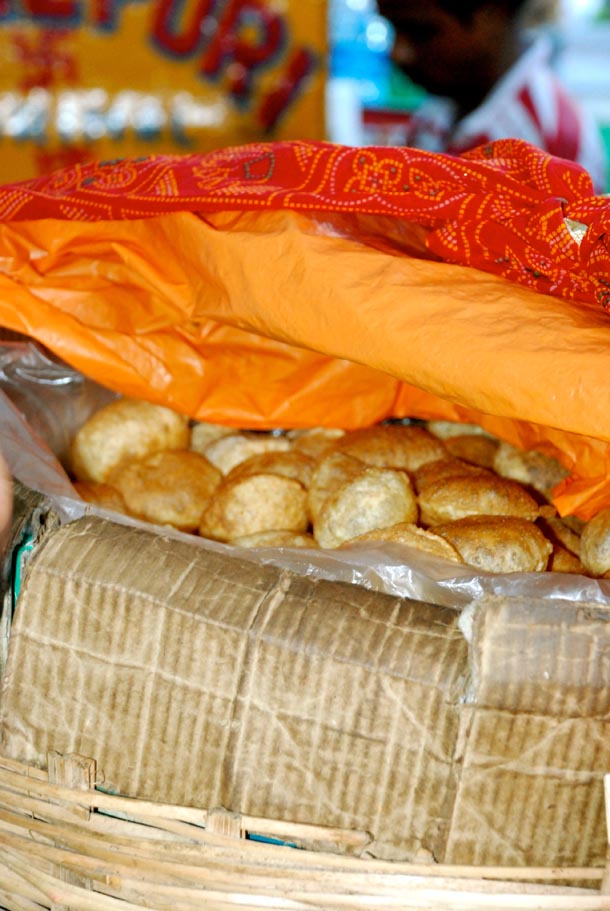


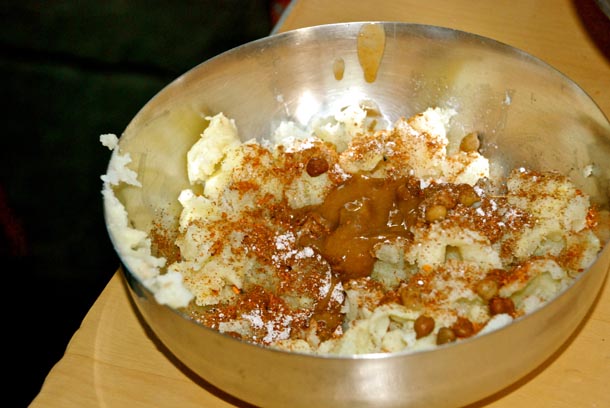


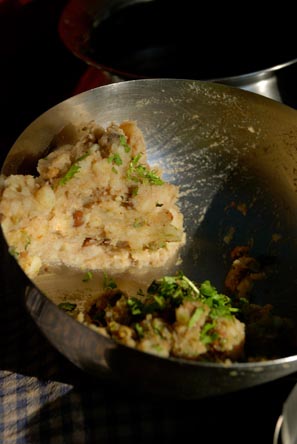
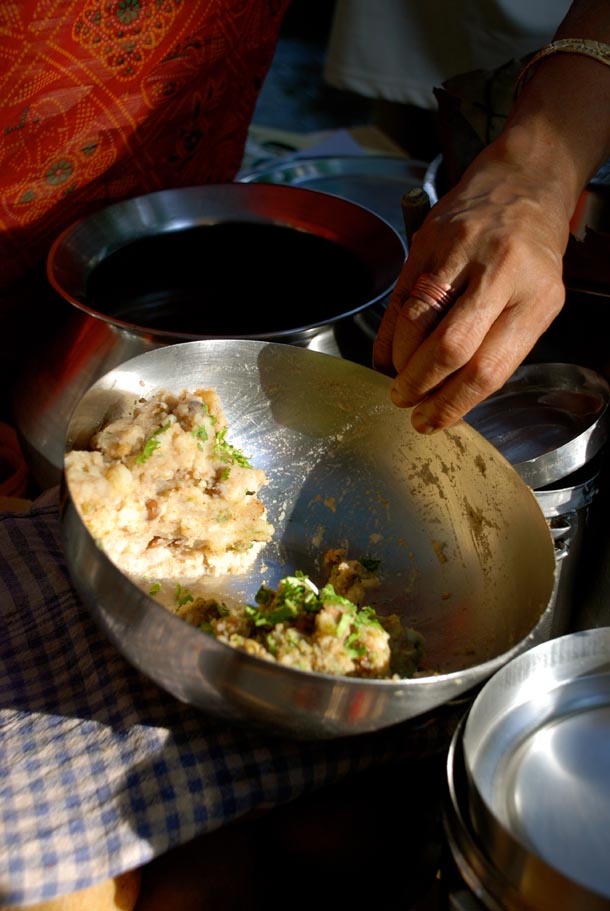
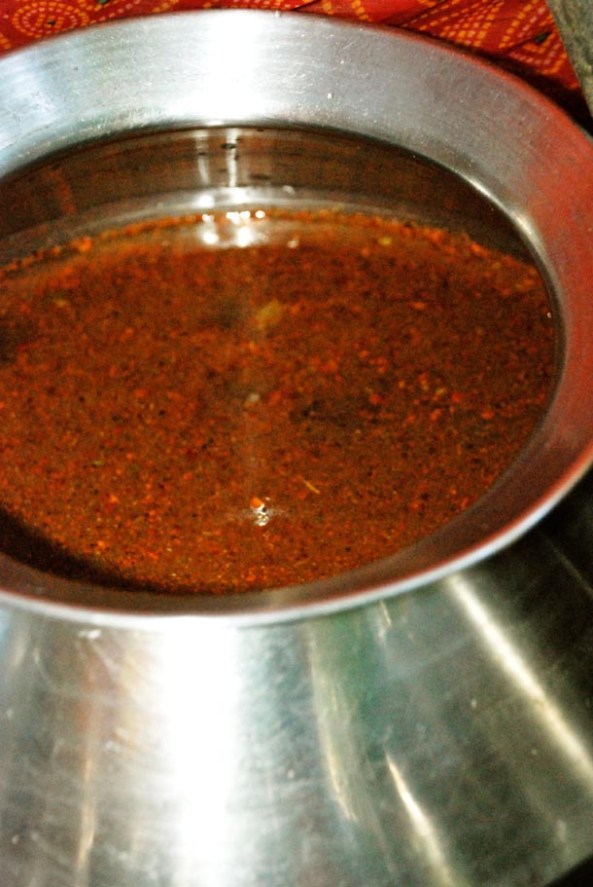
The famous Tetul Jol/Tamarind Water… ‘Arektu jol dao pleaseeeeeee…../Please give me more Water!‘ This is the ultimate. The taste of this Water can make or break the Phuchka. Like I have mentioned before – he also prepares it with Mineral water if informed earlier for all his NRI (Non-Resident Indian) customers who are very fragile in their digestion capabilities where road side food is concerned!


Dahi Phucka
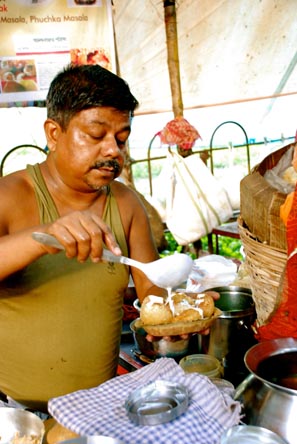
This is also a very popular variant – Dahi Phuchka – where Dahi or Yoghurt is poured on top of Phuchkas with filling!

Churmur
Churmur is the crumbled version of Phuchka. It is an appropriately spicy sign-off to the Phuchka – broken down into pieces so as to reach each and every cell and every core! This dish must have originated from utilising the left-over Phuchkas, but now have earned it’s reputation as a main dish by itself.
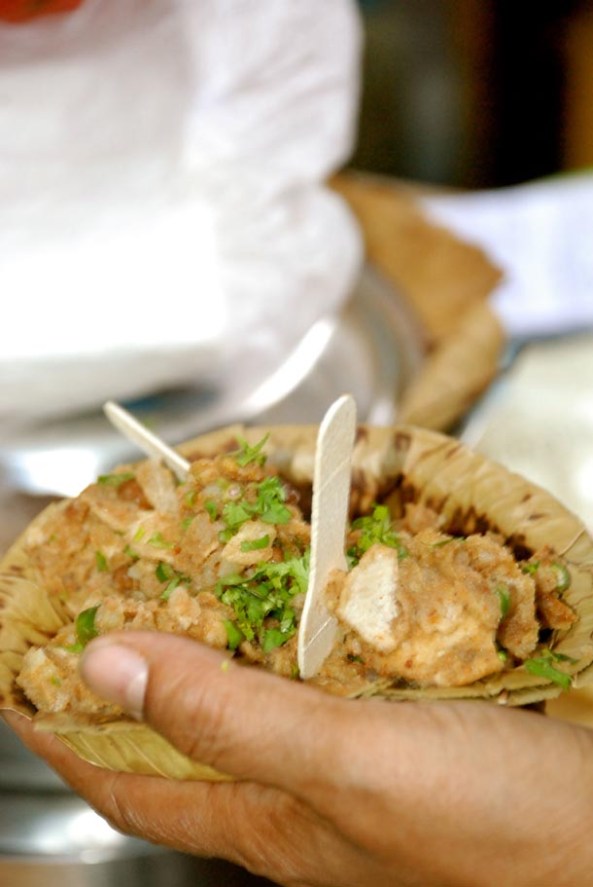


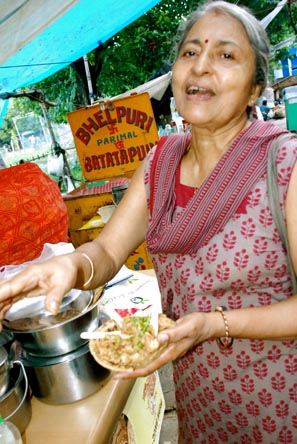
Aloor Dum/Spicy Potato
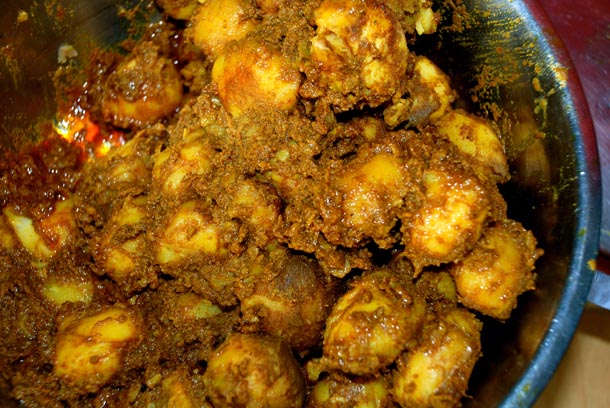
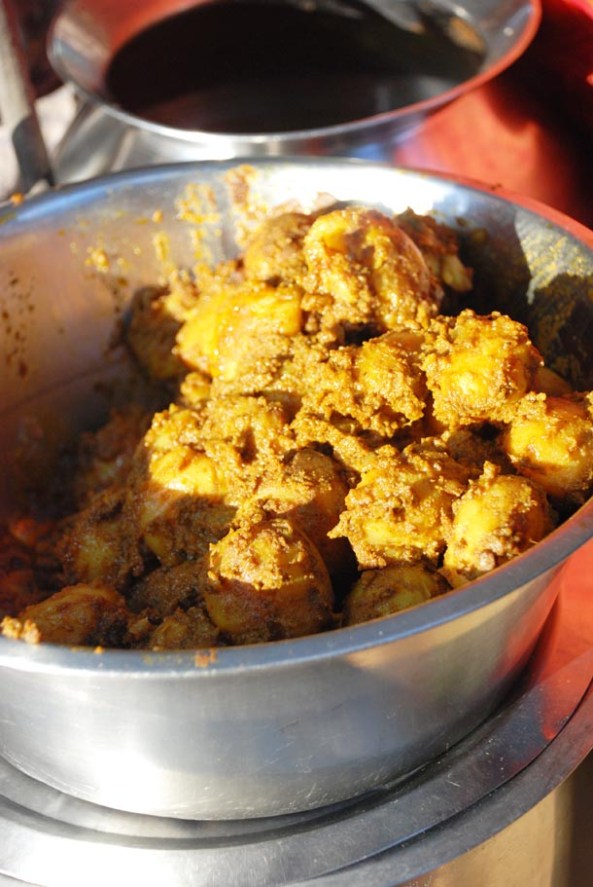


The sign-off… Debt Repaid!
When we used to eat Phuchkas in our childhood, we always hankered for Phaos or free Phuchkas. The number of Phaos determined the generosity of the Phuchkawallahs. Dilipda must have given many such Phaos to my friends and to me. I hope my article repays all my debt to him. You can reach him on his mobile on +919231657931 and he can dumbfound your guests in any party or a wedding reception. When Kolkata is engulfed by the festivities of Durga Puja, Dilipda’s stall is open throughout the night and feeds upto 2,000 Phuchka-cravers.
He may be a Bihari from Bhagalpur but he’s a pride of any Bengali Kolkatan. Time has stood still as he’s been feeding his Phuchkas and Aloor Dum to a generation which includes my parents to the IPad generation that includes the Z-SISTERS. He hasn’t changed. His next generation is equipped to carry on the mantle that was passed to him from his grand father. Thank God for that!
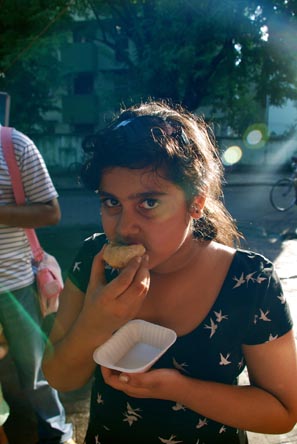
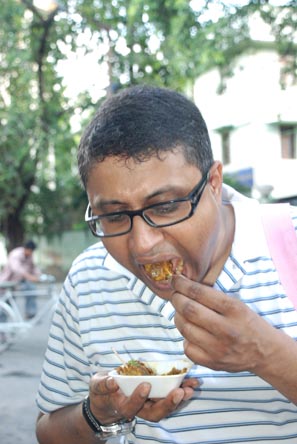
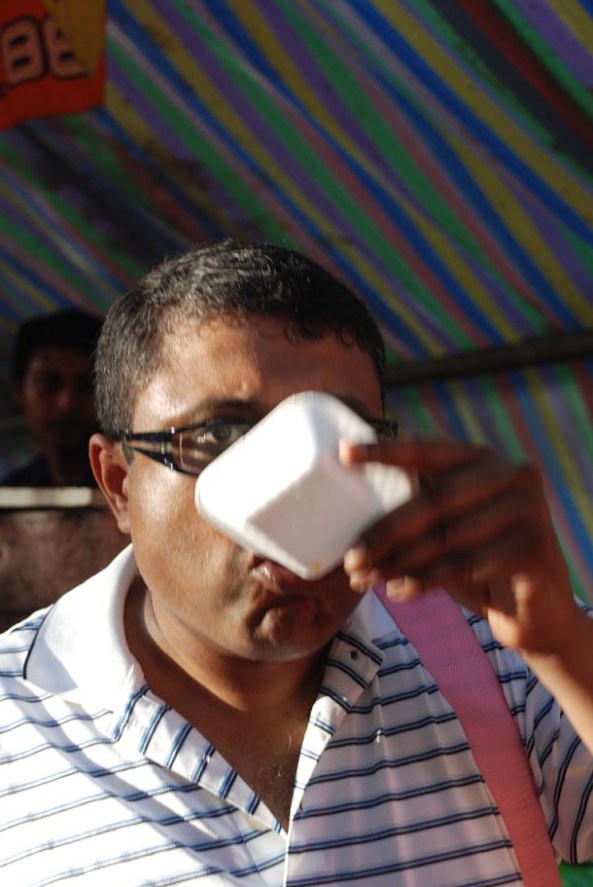
While you enjoy seeing the photographs, I request you not to use them. Somethings don’t change with regards to Phuchkas – for example, the expressions. They are always the same when one gulps the Phuchka down. You are always wide-eyed with the lips forming an unbelievable ‘Oh’. Even if you eat Phuchka everyday of your life, each Phuchka still gives the same sensation – as if you are hit by it for the first time! Or the 2 common sentences that follow this gulping down mechanism –
‘Dilipda, aro jhaal dao please/Give more spice Dilipda!’ or ‘Dilipda, aar jhaal diyona baba!/Don’t give any more spice Dilipda!’
Unblogging it all… Ishita
PS: You might be interested in the Spicy Baby Potatoes or Aloor Dum – Kolkata Street Style!
Disclaimer: All pictures have been taken by me unless mentioned otherwise. Please note that this post is not a sponsored post and the subject, story, opinions and views stated here are my own and are independent. While you enjoy reading the posts with lot of visuals, please do not use any material from these posts. You can catch my daily food and travel journey on Instagram, Facebook and Twitter.


BE SOCIAL. SHARE THIS!

At any point of time the story of my life revolves around 2 cities – the city that we are living in at that point in time and which we refer to as our home and Kolkata – the city which has shaped my life and which has brought me up. Again which I also refer as home. Lucky to have two homes at any point in time!
Right now these two cities are Dubai and Kolkata. It has been for the last one and a half decades with a gap of 3 years in between when when Frankfurt had replaced Dubai. Or in the beginning of my married life with S when Colombo had become the other home.
Each summer has the same story. The months of July and August are spent in Kolkata – when the Z-SISTERS are off from school for two long months. The Z-SISTERS and I – the three of us, make Kolkata our summer base. I call this period my ‘Summer Hibernation’. Amidst make-shift arrangements in the homes of two set of grand-parents – both maternal and paternal, the Z-SISTERS adjust themselves like match-sticks thrown into a new match-box containing a different set of match-sticks. So far they have been adjusting admirably and light up with equal fervor.
What about me? Well, I still continue my work from here – sometimes typing on my Macbook from the verandas, sometimes lying on the drawing room sofa, sometimes using the dining table as my desk, post lunch while I continuously nibble on some hand-made savoury or snack. Though working but my mood is very different – it’s like I am in the middle of a long noisy holiday.
And I’ll continue to do this as long as the Z-SISTERS don’t complain about going back to Kolkata every summer or as long as the parents and a few dear friends are around. And I know that a time will come when probably the Z-SISTERS won’t like to be uprooted from their friends and the life they are used to for so long – but I’ll write about that story when the time comes…
But for now, my story probably resonates the the story of most expatriate Dubai-ites!
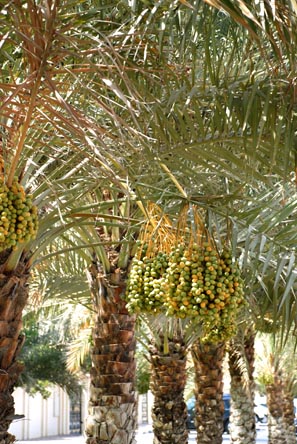
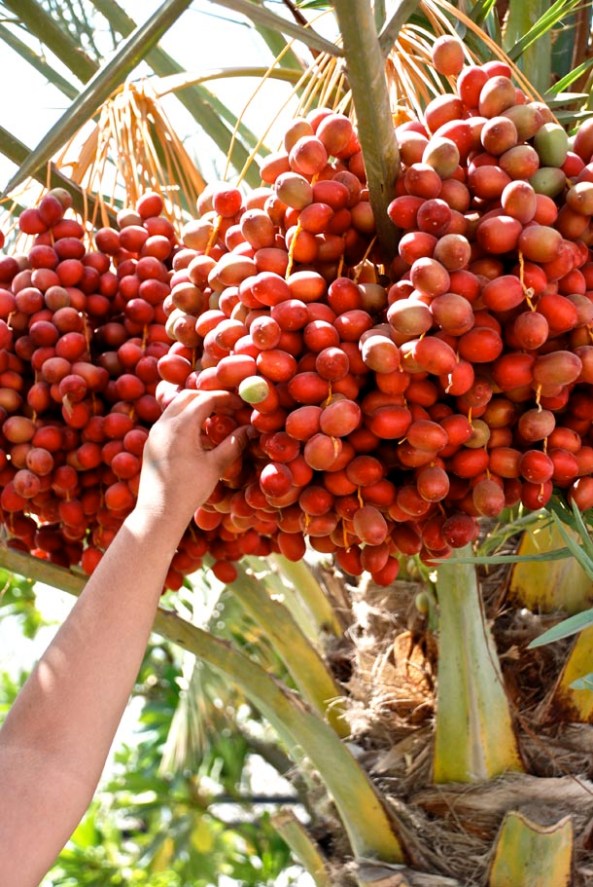
As I was packing for Kolkata, I started looking at Dubai with a renewed love – as if I am leaving my current lover with whom I have the perfect understanding to stay with my ex-lover for some time…
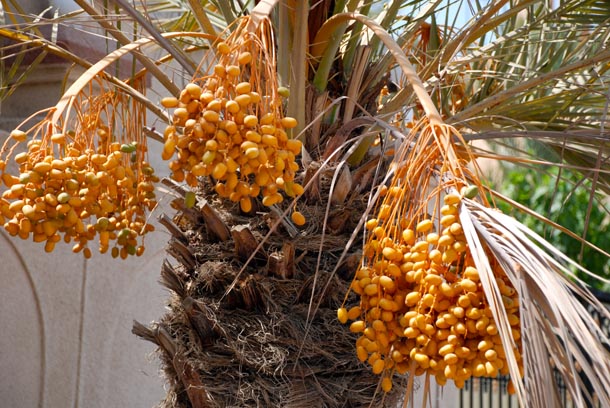
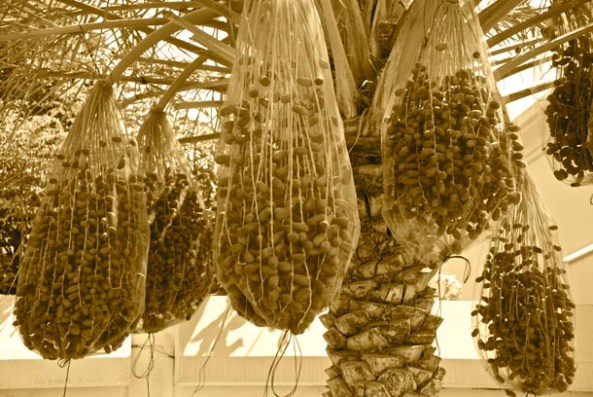
The date palm trees lining the streets of Dubai at this time of the year are filled with dates – the colour of the dates reflecting whether the dates are ready to be plucked or not. Some of the date bunches are covered with nets – these dates are the ones which are not ready to be plucked. Plucking these ones could be legally offensive.
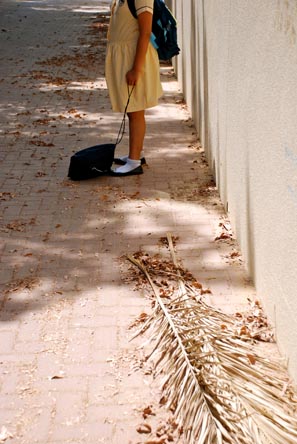
At this time of the year, picking up Big Z from her school and walking down to the place where my car is parked – is a big task. Not only is the temperature hovering around 45 degrees but also the branches of the date palm trees are stooping down – perfect for Big Z to pluck some dates. Perhaps, snatching a few moments of child-hood innocence in this blingy artificial city of Dubai. Blingy and artificial – that’s how a lot of people describe Dubai to be. But not me. The proof is my last article on Dubai – where I’m wandering through the streets Things To Do In Dubai – Like A Tourist In My Own City! The article is an ode to the city of Dubai which I’ll miss a lot in the next two months.
Flashback to my childhood in Kolkata… the connection being dates, dates syrup and obviously some FOOD!
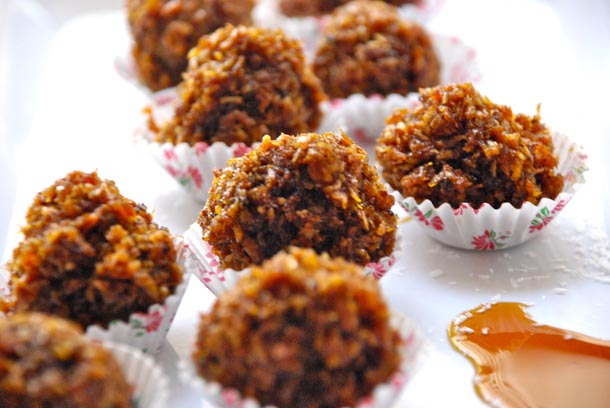
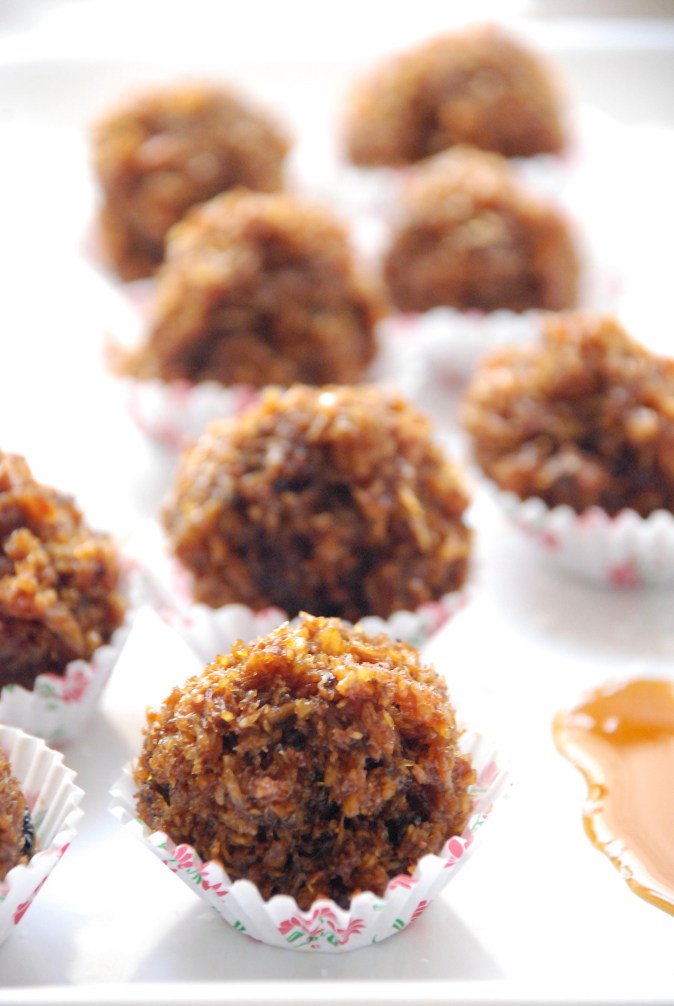
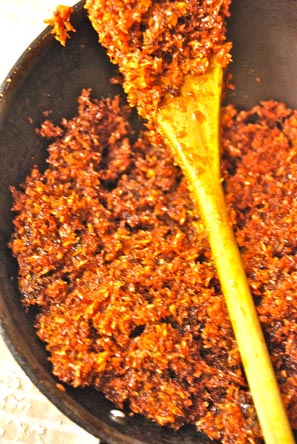
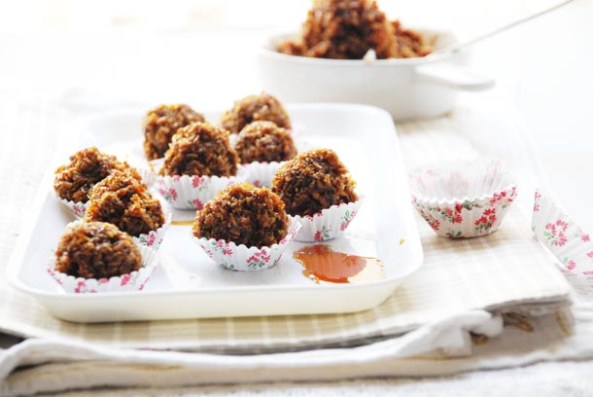
My paternal grandmother would distribute her whole year by staying amongst 7 of her kids – 5 sons and 2 daughters (yes, this was before the concept of Family planning set in India!) So that would translate into one to one and a half months at each of her child’s place. We would eagerly wait for our turn to come and would pray that her stay at our home coincides with our school holidays. And this period would be my earliest summer hibernations. She would make traditional Bengali sweets called ‘Gurer Naru’. The aroma of Coconut and Jaggery would float around the entire house. There would be unexpected trails of ants lining into the shelves where my Granma would keep these Narus! Narus are special sweets made during various festivals. It always seemed easy to make these Narus as Grandma and other relatives and Aunties would make them so effortlessly. This myth was broken when I started making Narus myself much later on and introduced them to the Z-SISTERS as Coconut Jaggery Truffles!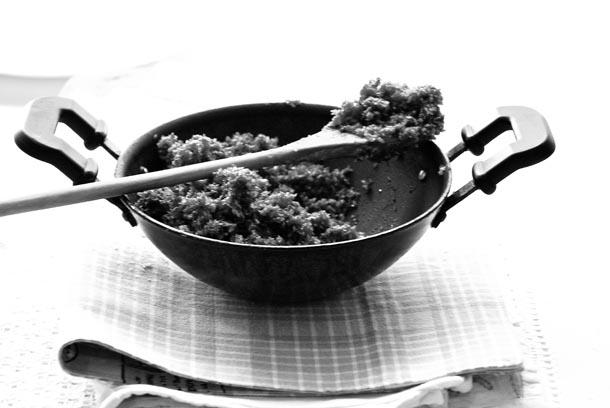
Who will sleep with my Granma – my brother or me? That was the entire focus of our lives when Granma made her prestigious appearance. She would read out bedtime stories from Thakumar Jhuli, which is a collection of Bengali folk tales and fairy tales. Thakumar Jhuli translates literally into Grandma’s Sack! Stories would pour out from the sack – horrifying battles, deadly demons, incredibly beautiful princesses and the most valiant princes. All Bengali children have grown up hearing these tales from Thakumar Jhuli. Even the children belonging to the IPad and Kindle generation. Because the stories have left the pages of hardbound books and migrated into the Amazon bookshops as well. I’m always thankful to technology for that.
While at night these bed-time stories from Thakumar Jhuli shaped my imagination, the days were spent watching her sit at the edge of the bed, doing embroidery on Bedsheets – an art-form that has become a signature of Bengal. This form of stitching is known as Kantha Stitch and is very similar to run stitch. Bengal is known for it’s Kantha Stitch. Different stories – from religion, from epics or plain poetry, are re-told on textiles through this Kantha Stitch. This rural folk stitching artform has migrated into urban Bengal and now catapulted the form commercially into an export industry.
————————————————————————————————–
To see my Grandma creating yards and yards of story with her embroidery or her reading out the bed-time tales from Thakumar Jhuli must have infused some story-telling ability in me. Or so I would like to believe. And that’s why when in a span of two months I’m nominated again for The Food Stories Award for Excellence in Stort telling, I not only feel excited but absolutely lap up to the nomination. It’s like offering a lollipop to a child who’s addicted to candies. The child never says NO to a lollipop, irrespective of the size and frequency.
But what makes my Lollipop special is the fact that it comes from 2 persons – The Hedonista & The Food Soldier. While The Hedonista weaves food stories around people and places effortlessly in her articles, the Food Soldier is on her own food tirade. The last time I was nominated I had nominated My Custard Pie , I live in a Frying Pan , Dima’s Kitchen, The Hedonista and In Persuit of More.
So the nomination again this month gave me the opportunity to read and explore more blogs to find 5 different story-tellers who have started to enthrall me lately with their food stories. And they are –
1) The Food Soldier – Priyanka, the Food Soldier is the only one who believes in the most fundamental of food theories – No good meal is complete without dessert!
2) Sips & Spoonfuls – Sukaina, whose pictures make me drool and drift myself into world so light and airy that most of the times it makes me think that I’m exactly that – light and airy (something that I would like to see myself to be)!
3) Eat, Write, Think – Rajani Mani makes me do exactly that – eat, write & think and I really thank her for that because most of the times I stop thinking after I eat!
4) Never mind the Böreks – James who made me wander through the streets of Middle East as he frolicked through his posts!
5) Life in the Food Lane – Francine who writes about her gluttonous food trips so vividly that I feel less guilty with my gluttony!
By the way one random fact about myself that I want to share this time – I have learnt to accept that Food that I enjoy the most can never be ‘too much’, ‘too sweet’, ‘too cheesy’ and ‘too healthy’. And If you want to change my opinion I don’t mind any of my Fellow Food Bloggers to take me out for a food outing!
————————————————————————————————–
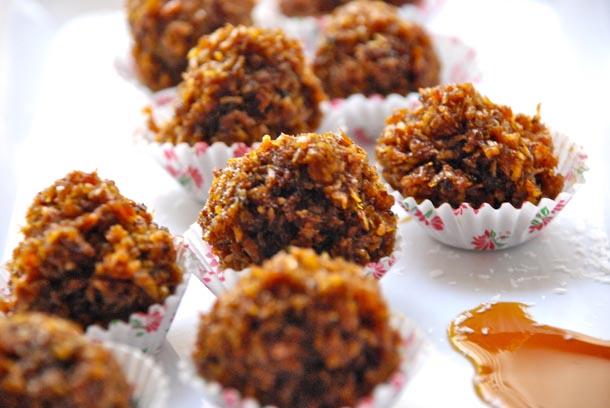
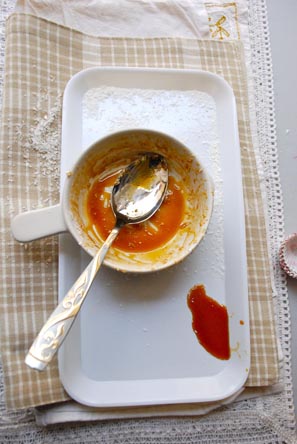
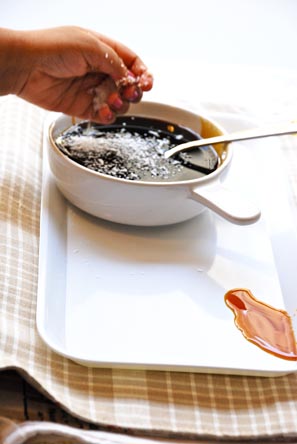
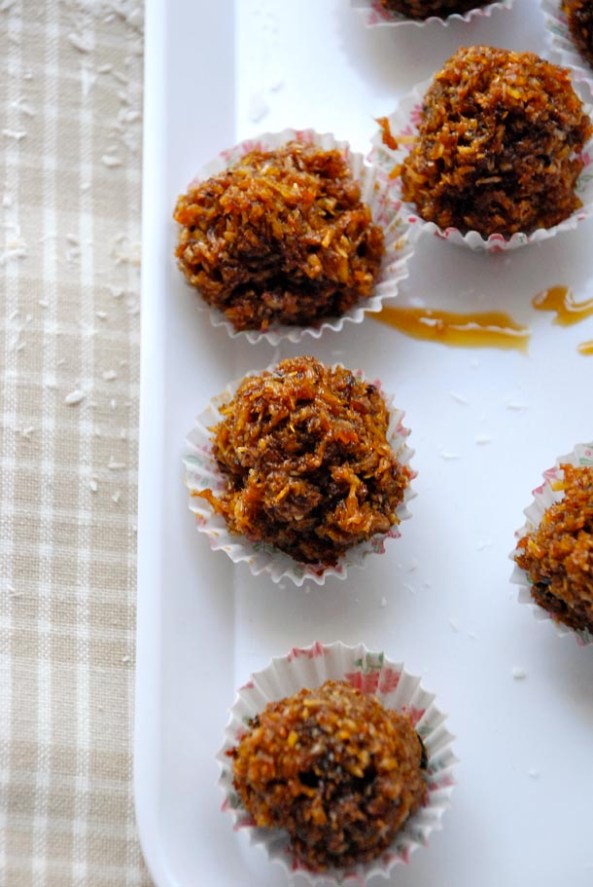
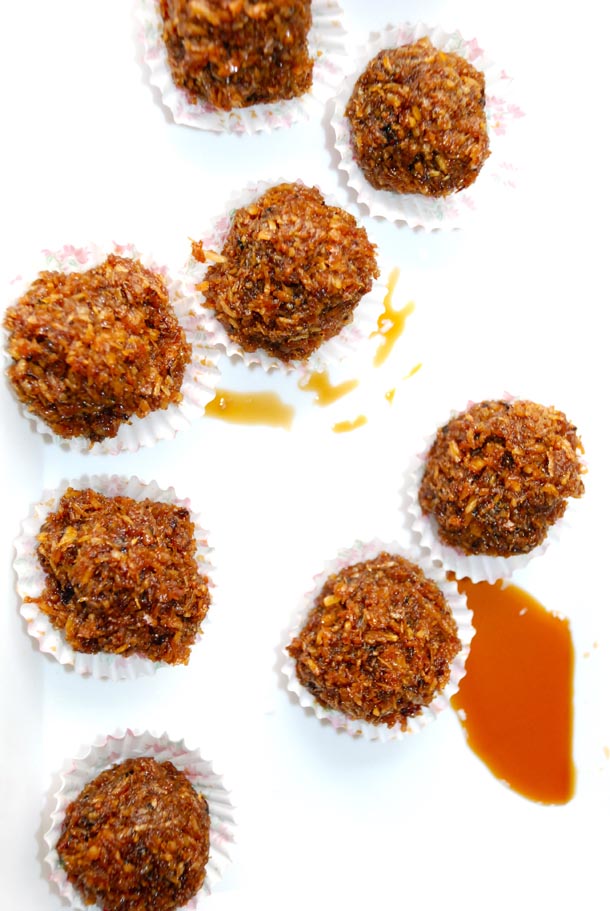
Gurer Naru/Coconut Jaggery Truffle
Category – Dessert; Cuisine type – Traditional Bengali
This is a traditional Sweet – Savoury where Notun Gur or Nolen Gur/Date Jaggery is used as the sweetener instead of sugar. In Bengal, this Jaggery is traditionally available fresh during the winters, hence Notun Gur (literal translation is New Jaggery) or the season fresh Jaggery is something that everyone would wait for. The smoky aroma of Notun Gur is something that one looks out for.
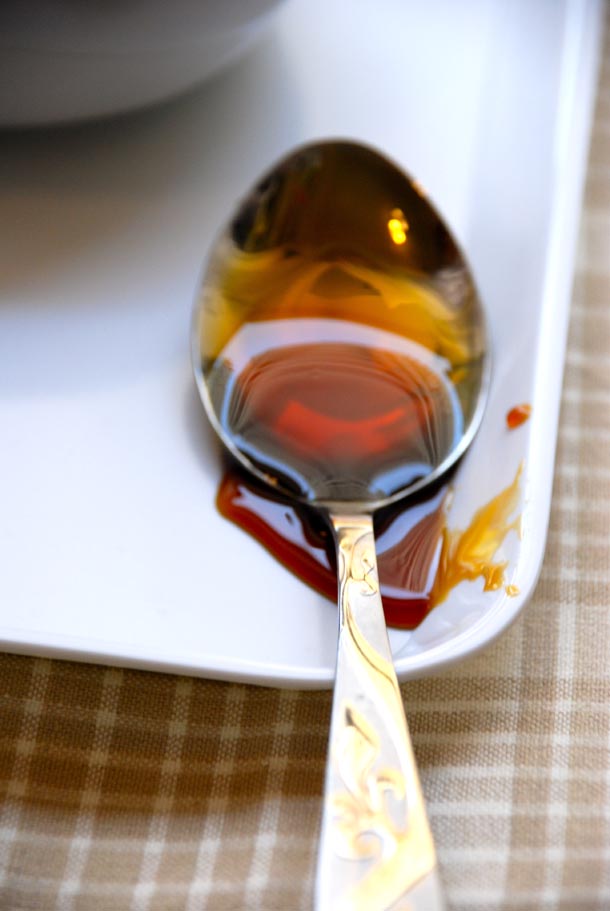
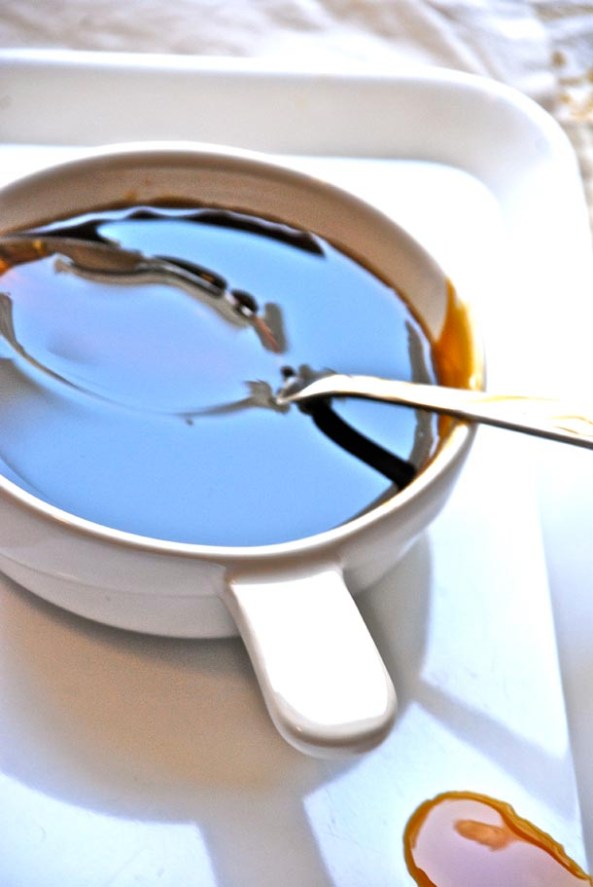
Here, in Dubai the Date Syrup is available in abundance – they are available in bottles in most supermarkets. Needless to say that this syrup suffices for Notun Gur almost perfectly!
Following are the characteristics of all recipes doling out of our little hands big hearth –
♥ Easy to cook
♥ Regular canned products off the shelf may be used (However, we advocate using fresh products)
♥ Goes well both as a regular or party dish
♥ Children can easily help in making the dish (My two little sous-chéfs are aged 8 and 3 years!)
♥ And lastly, guaranteed to be tasty!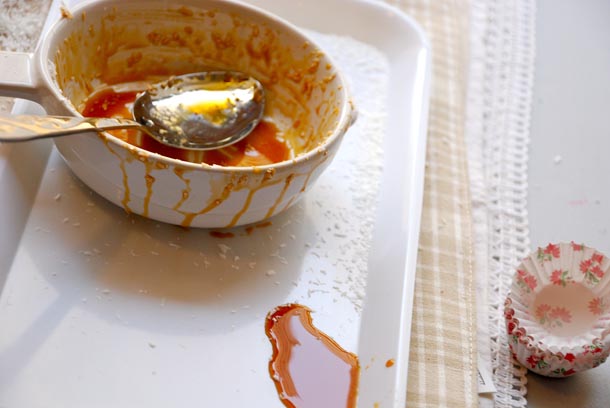
Serves 6-8 persons (maybe less if they happen to be sweet-toothed Bengalis!)
Preparation time – 1 hr (Constant stirring of the Coconut and Jaggery– 45-50 minutes; making small truffles – 10 minutes)
Ingredients
– Dessicated Coconut Powder/Grated Fresh Coconut – 2 cups (You’ll get Dessicated Coconut Powder in the frozen section of most supermarkets in Dubai, or available in packets – ex Maggi. If you are using Dessicated Coconut Powder then just soak it in very little milk for a while. Grated Fresh Coconut is available in most Asian stores in Dubai – like Lulu Supermarket and in many well-known supermarket chains in Bur Dubai and Karama area)
– Jaggery/Date Syrup – 1 Cup (Date Syrup is available almost everywhere in Dubai!)
Method of Preparation
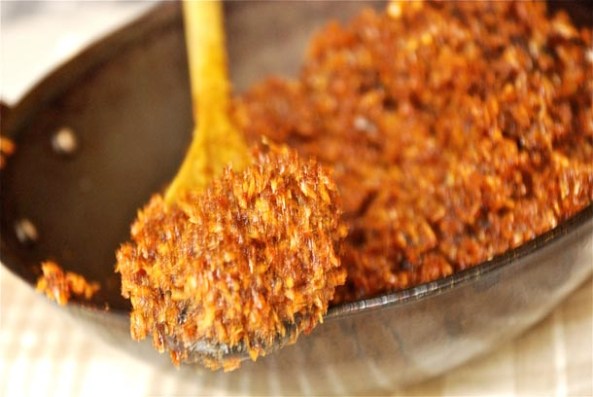
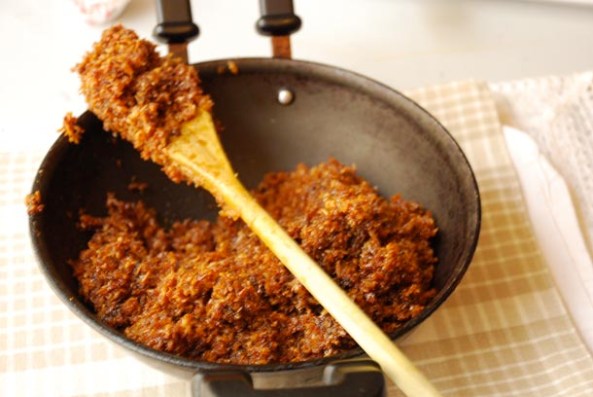
– Pour the Jaggery/Date Syrup and the Grated Coconut in a flat bottomed wok and work on a high flame initially
– Keep on stirring continuously till a strong aroma of Coconut and Jaggery fills up your senses and the entire Mix comes can be taken off from the sticky wok with ease
– Roll them into small balls and put them in air-tight containers while Refrigerating them
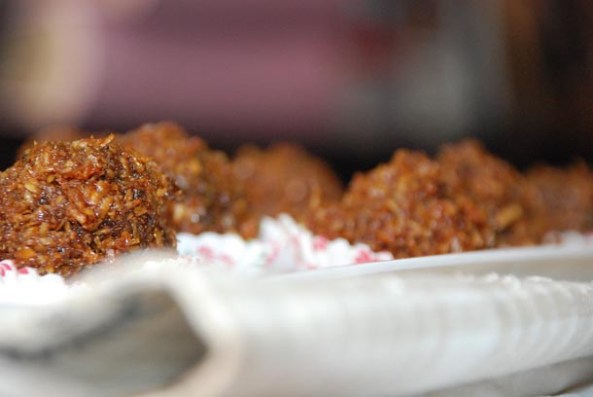
Try to ignore the stickiness of these sweets… the stickiness is an essential part of this legendary Bengali Sweet that is called Naru or if I may introduce them as Coconut Jaggery Truffles! Hoping that the same aroma of Coconut and Jaggery drifts through your house as well when you read my post… and while you enjoy viewing the pictures this is a gentle reminder not to use them. Have a wonderful Summer. Keep connected for more posts of my Summer Hibernation in Kolkata and my drifting tale of 2 cities – Kolkata and Dubai!
Unblogging it all… Ishita

BE SOCIAL. SHARE THIS!

Like A Tourist In My Own City (Once again!)
Dubai, my home for almost the last decade, is a quintessential tourist’s haven. It’s a shame that the only thing that comes to mind when one hears Dubai is Shopping. But, walking through the art alleys of Bastakia and the old quarters along the Dubai Creek, watching the sun go down the beautiful and never ending beaches of Jumeirah, catching the stars in a moonlit night over the desert sky… there’s so much more to Dubai. Dubai is a juxtaposition of extremes – the world’s tallest tower to the old Creek where still the Iranian vessels anchor their moors and trade goes on as it did at the beginning of the history of the city. It’s a vibrant and growing city where expatriates from all over the world are striving to make it a true international city. Modern technology is pitted here against absolute consumerism. Zero carbon footprint is a concept that Dubai-ites are trying to learn after emitting gallons of carbon in the air!
That was a bit from my earlier version of The Diary Of A Dubai Resident… As Home Turns Into An Inn! This is a subject which will probably come back all the time as I’m always wandering with my guests like a tourist in my own city! This is the only post in my blog that is updated every now and then to incorporate all the new things that enter my list (updated last on 18th December, 2014).
While in Dubai you could have the world’s most expensive cocktail priced at US$ 7,438.13 or AED 27,321/drink (moved down to second in the ranking recently – what a pity!) or dine in the highest restaurants in the world, swim with the dolphins or watch the sun go down sipping your drink from a terrace lounge in an expensive hotel, the following are the things that I do with my guests – experiencing the city in its different shades and textures. A run down of it in brief – the write ups for each place is pretty brief, the list isn’t it. I have also chalked out the different routes in different colours in Google Map along with my preferred parking spaces – so that you can see Dubai unhurriedly, without the stress of where to park and ultimately see Dubai as I see it and alleviate it from the tag of a ‘city with only shopping malls’!
The Old Dubai
1) The Art Alleys of Dubai Bastakiya
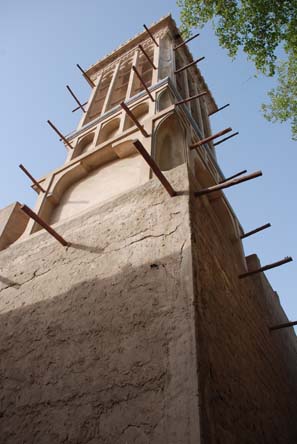
The old quarters of Bastakiya on the Bur Dubai side of the Dubai Creek dates back to the 1890s. Bastakiya is named after the Iranian town of Bastak – many of the original traders here, mainly pearl traders were from Iran. The quarter is filled with traditional courtyard houses with wind-towers. These towers acted as cooling mechanisms for the houses in the sweltering UAE summers.
Today, these historic buildings houses MUSEUMS – the Coin Museum, Bait Al Wakeel which is the first office building in Dubai built in 1934 by Sheikh Rashid bin Saeed Al Maktoum, Sheikh Mohammad Centre for Cultural Understanding (SMCCU); GALLERIES – Majlis Gallery, Mawaheb from Beautiful People etc; RESTAURANT & CAFÉs – Basta Art Café, Orient Guest House, Local House Restaurant who very famously serve the Camel Meat Burger etc; SPICE & SOUVENIR SHOPS.
What you must do:
- Walk and explore the art alleys – maybe an outdoor exhibit of canvases await you in the corner
- Stun yourself as you enter the art exhibitions in one of the galleries
- Walk into the quaint museums and wonder at the architecture of the wind-towers or the courtyards
- Get your names calligraphed by local artists in the art studios hidden in some alley
- Enjoy sniffing into traditional spice & perfumes in spice shops (ex- Royal Saffron Spices Shop) and end up buying them
- Unwind as you grab a little munch or a refreshing tea or beverage in one of the cafés
Cost: Free if you do it on your own. Feel free to just hang around – this is one place which is unlike the rest of Dubai. [SMCCU also organises traditional UAE breakfast, lunch and Walking tours of Bastakiya on specific dates at a cost. You’ll get more information on the SMCCU website]
Opening Hours: While you can enjoy walking through the old wind-towered houses or cool down in the cafés and restaurants housed in these restored quarters on all days till late at night when the entire Bastakiya is lit up in subdued up-lifters, the museums and galleries are closed on Fridays.
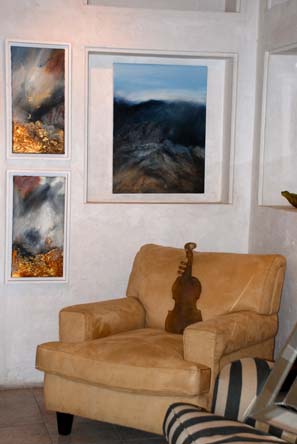
Majlis Gallery – Villa 19, Bastakiya
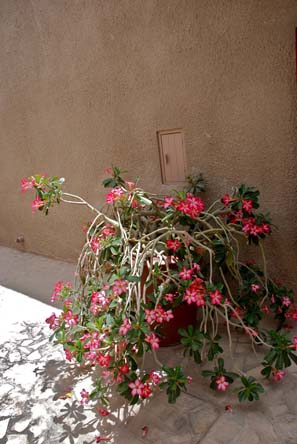
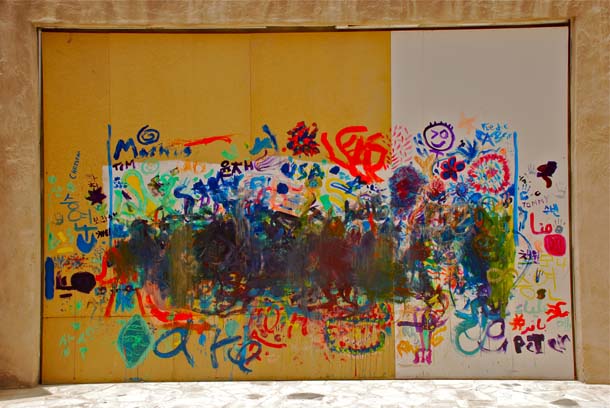
An expat by the name of Alison Collins came to Dubai in 1976 to work as an interior designer. She fell in love with the architecture of the old wind-tower houses in Bastakia and ended up securing the lease on villa number 19. Over the next ten years, she raised her family here and built herself a home and hosted many informal soirees in their Majlis. Majlis is an Arabic term meaning a place of sitting and describes various types of special gatherings – and this Arabic word eventually lent its name to the gallery. Today Majlis is a haven for creative minds – both professionals and amateurs and holds art exhibitions, workshops and much more.
Opening Hours : 10am – 6pm, Saturdays – Thursdays; Closed on Fridays.
Website: The Majlis Gallery; Tel: +9714 3536233 Fax: +9714 3535550


 ………………………………………………………………………………………………………………………………….
Mawaheb from Beautiful People – Villa 28, Bastakiya
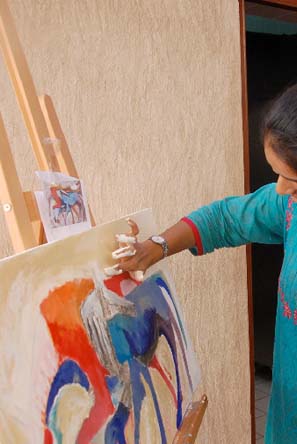
This is one very special place – a must visit for everyone. Mawaheb from Beautiful People is an exclusive art studio for young adults with special needs with the objective of making them independent and confident members of the community. They also sell products like Coffee Crockery, Corporate Gifts, Christmas Cards/Festive Cards, Gift Bags, Shopping/Pool Bags and more. Check out the lovely shopping bag that Big Z bought for herself!
The Gulf New’s Friday magazine has featured the art studio in a beautiful article Enriching the lives of those with special needs.
Opening Hours : 8:30am – 3pm, Sundays – Thursdays, September – June; Closed on Fridays.
Website: Mawaheb from Beautiful People; Tel: +971-4-3532100 Mobile: +971-50-4213070
Location: Directly behind the SMCU and close to Dubai Culture and Arts Authority

 ………………………………………………………………………………………………………………………………….
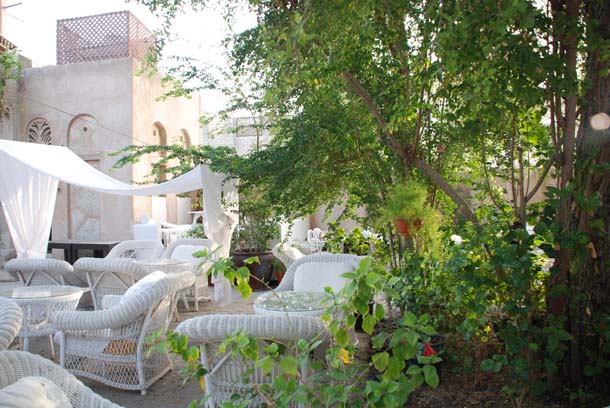
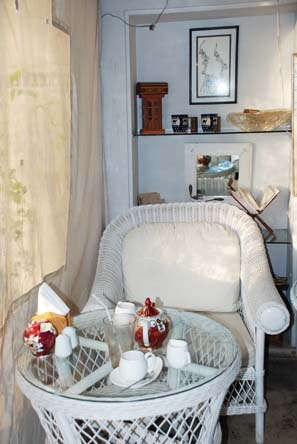
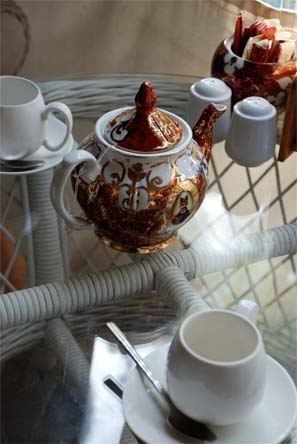
Basta Art Café, recently renamed into Arabian Tea House... but in my memory it will always remain Basta in my mind! The cafe has a wide range of loose teas, which is categorized according to their types; Black Tea, Green Tea, White Tea, Phu-Er Tea, Blooming Tea, Rooibos Tea and Chai and you can also experience and taste their own Tea Blend, which is a combination of teas, fresh fruits and herbals.
This is my favourite joint to cool down. When you enter the courtyard surrounded by potted plants and white canopy shaded sitting arrangements or perch yourself down on the white wickers – please carry all the time in the world! You’ll get sandwiches, pastas or an occasional lunch grab and an extensive assortment of fresh juices, teas and beautifully served Arabic coffee.
TimeOut Dubai’s Restaurant Awards 2012 confers Basta Café as a ‘Highly Recommended Best Café‘ that every Dubai-ite should try out at least once!
Opening Hours : Open daily from 8am – 10pm
Tel: +971-4-3535071
Location: Just beside the Majlis Gallery on Al Fahidi Street
 ………………………………………………………………………………………………………………………………….
Parking in this Old Bastakiya area could be quite a challenge. If you get paid public parking available along the crowded roads – you are lucky, otherwise there are a few paid private parking spaces available around this region. I prefer to park in the following parking slots.
2) Dubai Museum & walking through the Dubai Old Souq
Dubai Museum
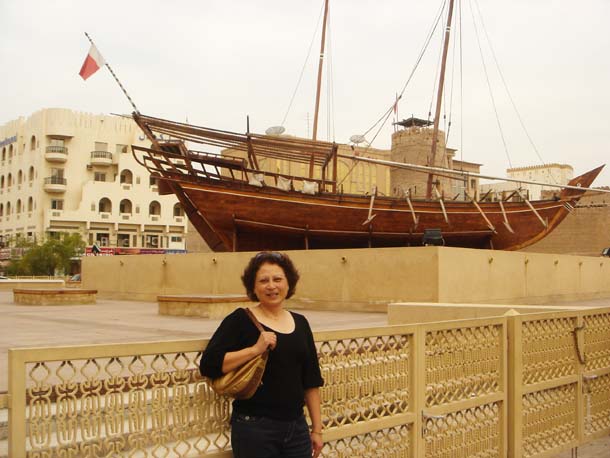
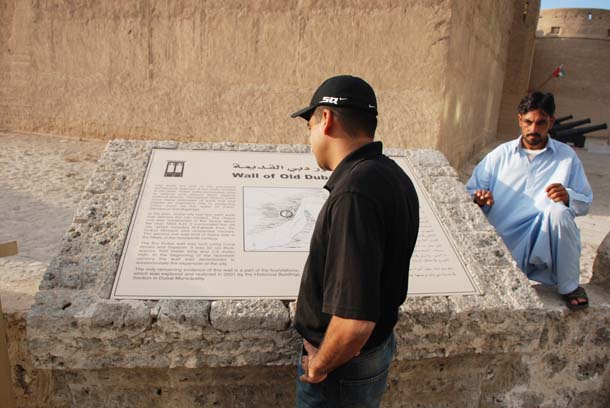
Al Fahidi Fort now houses the Dubai Museum. This the oldest building in Dubai, dating back to 1799 and reflects the archaeology and history of Dubai. This was home to Sheikh Maktoum bin Hasher al Maktoum in the late 19th century and was restored only in 1993. The Museum visit is cute, short and full of little surprises and traces the little history of Dubai as a small trading town occupied by pearl merchants, pearl divers and fishermen in the 1960s to the modern cosmopolitan city that it is today.
Opening Hours : 8:30am – 7:30pm from Saturdays – Thursdays; 1:30pm – 7:30pm on Fridays;
During Ramadan timings differ. Tel: +971-4-3937151/3531862
Dubai Old Souq
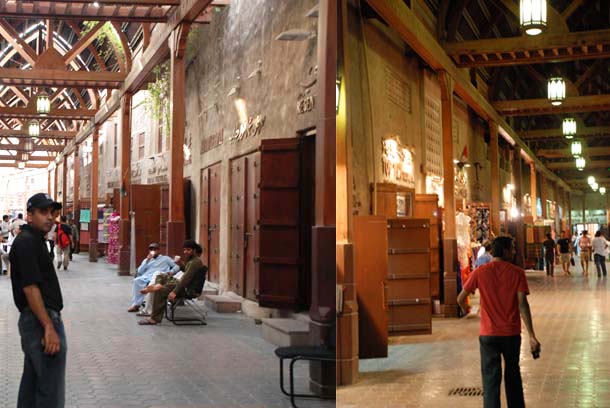
Walk along the parking lot beside the Dubai Museum, cross the Ali Bin Abi Talib Road and you will enter the traditional Textile Souq/Market through the side alley of the Grand Mosque. Dubai has been a trading hub since the 19th century and the textile merchants from far and wide had set up their first shops here. As you rumble through the beautiful laces, silks and pashminas or the animal Afro prints on the standing long rolls containing yards of fabric, don’t FORGET TO BARGAIN!
This is an open Souq, bereft of air-conditioning though individual shops are air-conditioned. The Hindu temple is located along one of the alleys and don’t forget to follow the direction through which a cool breeze enters – you’ll end up by the beautiful creek side with seagulls and traditional wooden Dhows (wooden boats) jostling for attention. If you are a female, please be prepared to be stared at!
Opening Hours: 9:30am – 1:00pm & 4:30pm – 10:00pm on Saturdays – Thursdays; 5:00pm – 10:00pm on Fridays

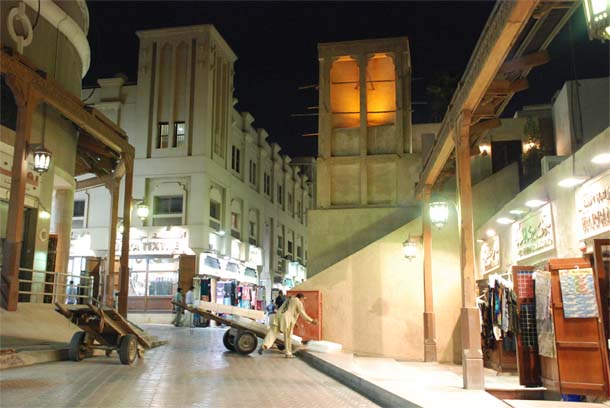
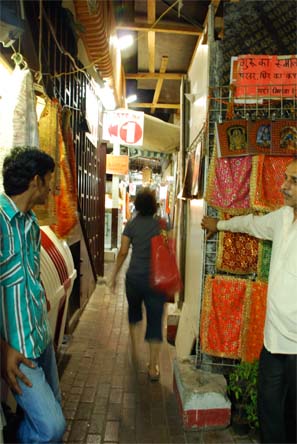
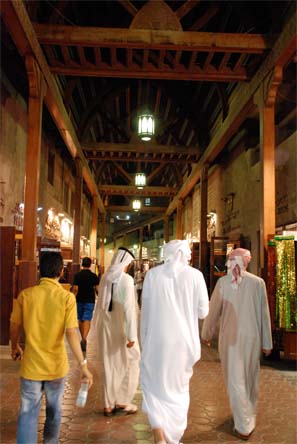
Breakfast at Creekside Cafe
Created by the same team who created the Archive Dubai in Safa Park, the Creekside Cafe is a cafe cum restaurant is also developing as a community space with a focus on the arts and culture of the Middle East and North Africa. Its focus lies primarily on architecture, art, culture, design and heritage. Located in the heart of old Dubai and strategically located by the creekside, this is my top *daytime* venue in Dubai. The Emirati-inspired menu is designed by Chef Allan Briones, the man behind the Archive Dubai menu has deconstructed a lot of traditional dishes… for example, the Ghouzi, which is a big plate of rice, with a whole lamb on top of it. Here this has been made into a burrito, thereby giving it a very modern and cosmopolitan twist. Also, worth mentioning are the Red Velvet Leqaimats (leqaimats are crisp fried golden dough balls coated with date syrup and sesame seeds), which made us bond with a family sitting by the next table. Gaze at the Iranian vessels as long as they are permitted to traverse the Dubai creek… you might just find one day that the traditional vessels are anchored by a modern harbour. Enjoy the flight of the seagulls as long as you can, while enjoying some gourmet food.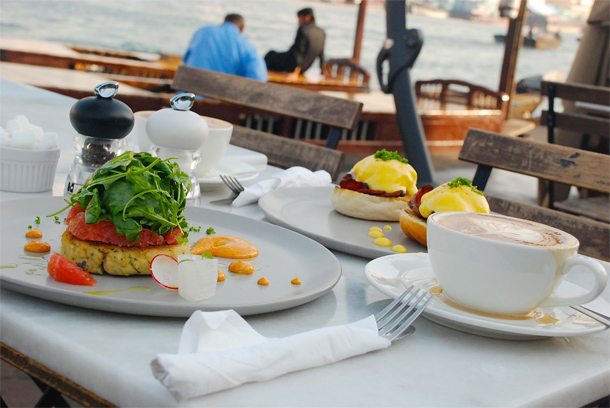
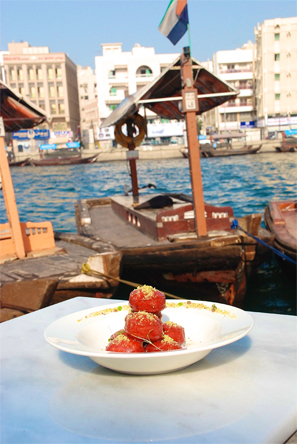
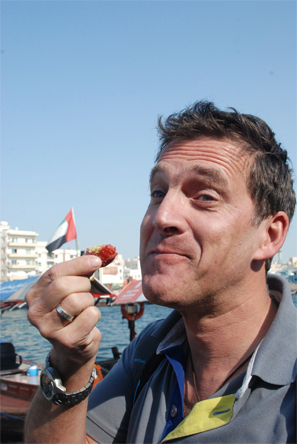
………………………………………………………………………………………………………………………………….
3) Bur-Dubai Creek Side
As I have written in my earlier article before, the Dubai Creek has a lot of historical importance. Whereas most places in Dubai has a history running to as little as 2 to 5 years or a maximum 10 years, Dubai Creek is really the focal point in Dubai’s history. It is a natural sea-water inlet which cuts Dubai into two parts – the old part of the city known as Deira and the relatively modern part – the Bur Dubai. These two parts have their own uniqueness and identities, not to mention their own idiosyncrasies. The residents living in Deira are skeptical of the residents living in Bur Dubai and vice versa. If you ask me the reason I won’t be able to tell you why. Being a resident of Bur Dubai in our early days in Dubai I also belong to this typical Bur Dubai camp. Now, we have moved into a even more new part of Dubai – the Dubai Marina Area and I am realising that another camp is gradually forming, comprising of residents of Dubai’s newer developments.
The Dubai Creek is definitely one of the most amazing features of Dubai. It obviously doesn’t have the promenades, the upper-lipped gourmet restaurants and the exclusive lifestyle that the artificially built Dubai Marina boasts of. The Dubai Creek is real. It mirrors centuries of old trading traditions. Throughout the creek, starting from its initial inlet into the mainland Dubai one can still see the loading and unloading of trading goods from the traditional Dhows. The smells from the the various ports of origin for these Dhows, situated in distant countries like the South-East Asian countries, India, countries from Africa etc seem to pervade the air. Whereas, the trading boats are visible on the Deira side of the Creek, one can only find beautiful luxury private yachts, traditional wooden Dhows promising sunset and dinner cruises, on the Bur Dubai side of the Creek.
The Dubai Creek has been very important in Dubai’s development as well, as Dubai started off as a small trading city, occupying a small dot on ancient trading routes connecting Asia-Europe-Africa. It still does.
I have always wondered whether we could actually sail along the Creek as it pierces into Dubai for 15kms after which it finally gets absorbed like a sponge at Ras Al Khor Wildlife Sanctuary. Well, I guess I must find that out.
What you must do –
– An Abra/local Ferry ride is absolutely essential to experience the creek. So many times we have taken a small water bus for a private sail along the Dubai Creek till the Makhtoum Bridge which still splits open at night to let the ships pass! This should cost you Dhs 25- Dhs 50 if you don’t fancy something extra-ordinary like sailing on a yacht
– Feed the seagulls – The seagulls engulfing the anchored Dhows, flying at a jet’s speed and trying to snatch away the breadcrumbs from your hands… walk along the creek, feed the seagulls and the fish and feel the fast-paced Dubai slow down a bit
What we have done in the past –
– Smoking Sheesha (Hubble-Bubble) at the Creek Restaurant (which unfortunately doesn’t exist anymore), taking all our guests for a Creek-side drive and a long walk past the anchored yachts, luxury boats, traditional Dhows – we have done it all. We have actually over-done the Creek a bit!
– Being in the crowd – We have also stood for hours amongst thousands of people thronging the Creek side to watch the dazzling firework displays during the inauguration of the DSFs (Dubai Shopping Festivals) year after year. We have also spent many a dirham buying mostly unnecessary stuff in the Night Souq that used to come up along the Creek when we had just come to Dubai. We have also sat on the super giant Ferris Wheel (oh the mushy-mushy days of romance when we were the just the two of us) and held hands as we went up and down and promised sweet nothings to each other with the Creek waters flowing by as a witness!

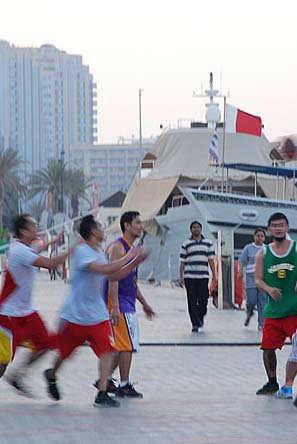
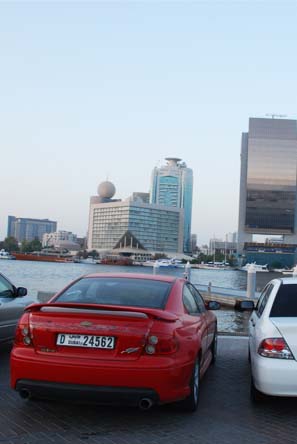
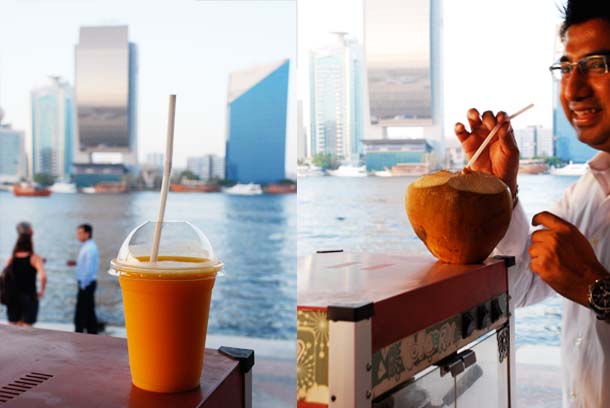
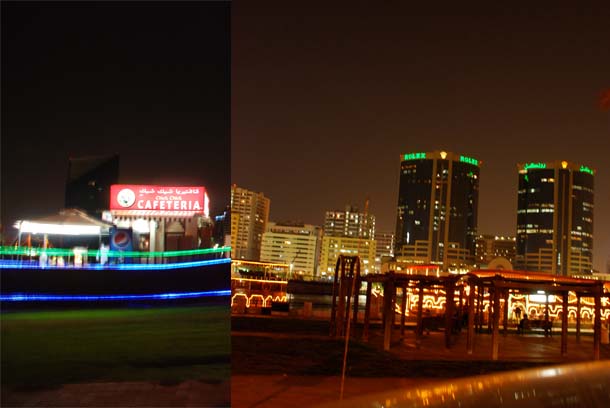
Where will you park your car? Follow the signs directing you to the Ruler’s Court just as you come down from Makhtoum Bridge on the Bur Dubai side or if you are driving into Bur Dubai along Oudh Mehta Road. Take the first exit which takes you to Al Seef RTA Water Station. Park here along the edge of the water, watch the traditional Dhows and the modern yachts jostle for anchoring space. Watch the Iranian Dhows lining the Deira side of Dubai Creek. Watch the evening walkers walking pass you by – while you watch adults and children play basket ball in the make-shift net hanging from a port-a-cabin.
You may also reach the Creek Side by heading along the Trade Centre Road from Burjuman (Burjuman will towards your left)
Take a juice and and tender coconut water break at Chik Chik Caféteria!
Sally Prosser aka My Custard Pie writes more on how to explore the Dubai creekside.
………………………………………………………………………………………………………………………………….
3) Taking a small boat ride along the creek, along the Heritage village and onto the Sea
What you could do –
The Dhow Cruise:
Sailing into the sunset with the two shores gradually fading by as you sail on a traditional dhow into the sea. The traditional wind towers of the old quarters of Bastakiya and the Heritage area of Al Shindagha on one side and the old souqs on the other side look absolutely breathtaking – a page out of some traditional Arabic folklore. These heritage buildings are historic monuments and have stood the test of time. The call for the evening prayer, Adhan by the Muezzins from the innumerable mosques scattered around the area, the setting sun – everything makes this Dubai landscape so ethereal. Sailing back from the sea into the Dubai Creek on your journey back will definitely make you feel like the triumphant fisherman or the successful pearl diver coming back home after toiling the whole day in the sea with the priciest catch! You’ll find many type of Dhow cruises – the Sunset cruises with or without dinners. Expect to pay around Dhs 145 – Dhs 250/person
or
Catamaran Ride from Al Ghubaib water transport station:
Dubai RTA conducts 4 daily rides in their stylish Catamarans rides from here almost up to the famous Burj-Al- Arab hotel. You’ll get more information here. This one hour ride costs around Dhs 50- Dhs 75/person. If you don’t want to miss the sunset, take the 5pm ride during the winters and 7pm ride during the summers.
Don’t forget that you’ll be sailing over the Shindagha Tunnel. The Shindagha Tunnel is a tunnel in Dubai which goes under the Dubai Creek. Constructed in 1975, it is the only underwater crossing in Dubai Creek. I always put the music on full blast and drive through the tunnel. At the point where the tunnel is deepest under the creek, the transmissions stop. ‘Oh no, we are under the water’, I shout! If you happen to be in the Revolving Restaurant in Hyatt Regency, Deira (once upon a time the only high-rise hotel) it indeed is a scary feeling when you see a queue of cars coming in and going under water (as they go into the tunnel) and gradually come out of the other side, almost like some magic!
or
WonderBus Tour:
Wonderbus is an amazing amphibious bus which starts from Burjuman, drives along the Mankhool area, slides into the Dubai Creek near the Heritage Village. Apart from it’s uniqueness, the route gives a brilliant tour of the Dubai Creek upto the Makhtoum Bridge. The entire journey lasts 1hr 30minutes and it’s very enjoyable.
Cost: Dhs 145/person; Dhs 95/child (Online booking promises to give a Dhs 10 discount!)
Website: Wonderbus Tours; Tel: +971 -4-359 5656
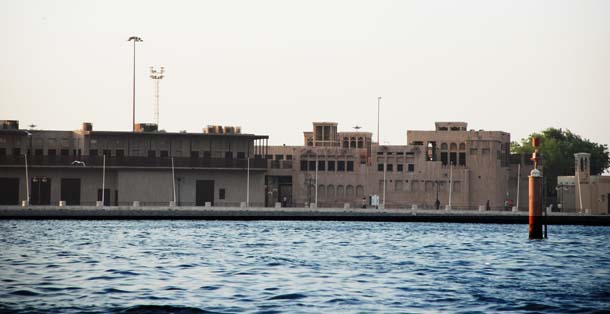

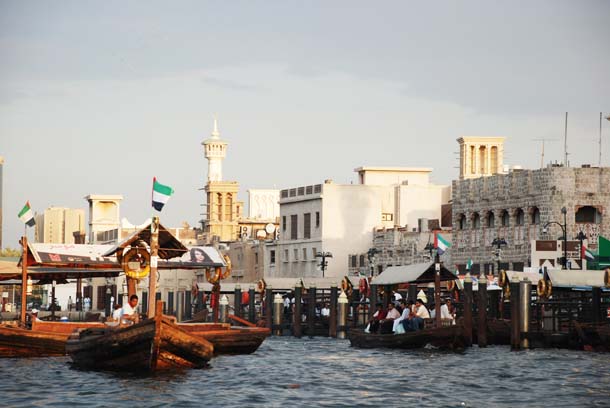

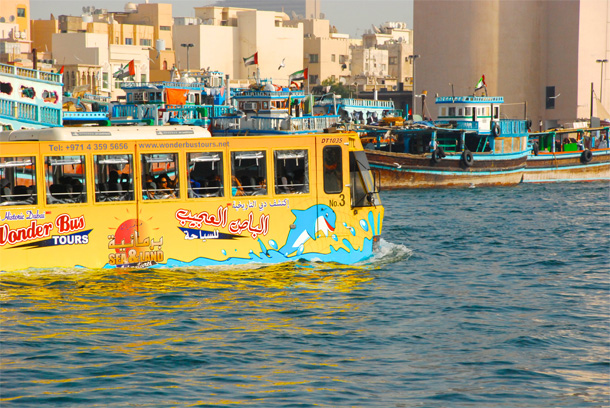 ………………………………………………………………………………………………………………………………….
4) Ride an Abra to cross the creek while going to Spice Souk and Gold Souk in Deira
Taking the Abra/Water-taxi across the Dubai Creek to go to the Deira Gold Souq – this is one of my all-time favourite touristic deeds in Dubai. An Abra costs only Dhs1 for a one-way commute – the cheapest thing that you can get in Dubai probably, since a can of coke too costs more than that!
Deira Gold Souq:
You must visit the Deira Gold Souq, even if you are not fond of jewellery or do not plan to buy one. The sheer magnitude of gold hanging inside the shop windows for a stretch of almost a kilometre is something to be seen to be believed. It is like the Textile Souq, but imagine the textiles to have been converted to Gold! The souk consists of over 300 retailers that trade almost exclusively in jewellery. Retailers include both well established stores like Damas, ARY Jewellery, Joy Alukkas as well as smaller stores that operate mainly in the gold souk. By some estimates, approximately 10 tons of gold is present at any given time in the souk! (According to Wikipedia)
The Spice Souq:
The Spice Souk is located just adjacent to the Dubai Gold Souk. Stores in the Spice Souk sell a variety of fragrances and spices from frankincense (an aromatic resin used in incense and perfumes and Sheesha/Hubble-Bubble to herbs used in Arabic and South Asian food. You’ll also find incense, rugs and artifacts and also strangers appearing from the dark as they ask you to follow them if you are interested in ‘good copy branded bags’. And if you get lured you’ll find yourself sitting in a dingy room scouring for a Louis Vuitton bag from a heap of fake branded bags which should cost you Dhs 400 – expensive, yes! But not Dhs 40,000 that you might have to pay for the original LV bag.
Ironically, these traditional stores trading spices in the Spice Souk are being hit by the growth of modern supermarkets and shopping malls. But cling on to history – before the subject itself gets buried into an archive!
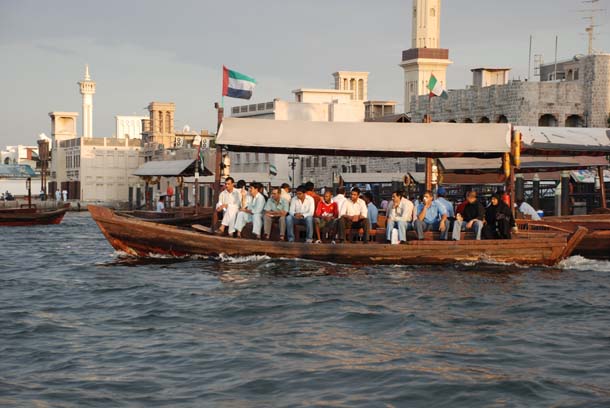

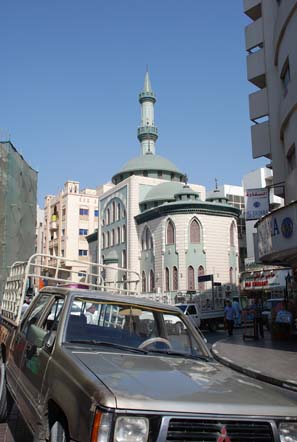
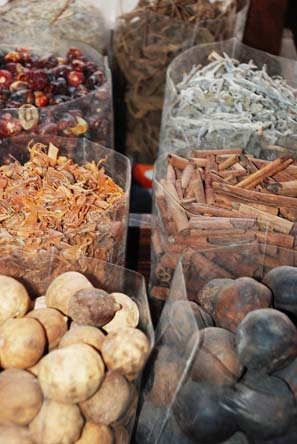
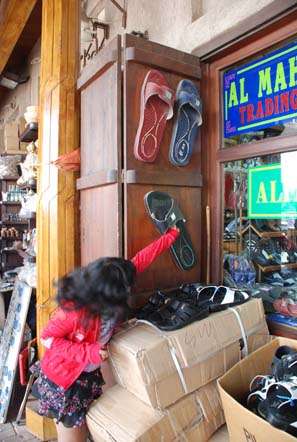

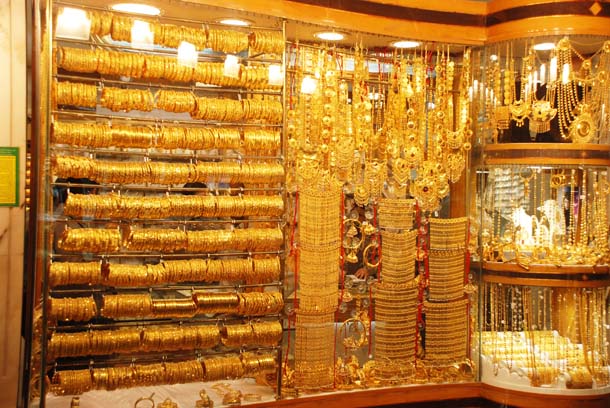
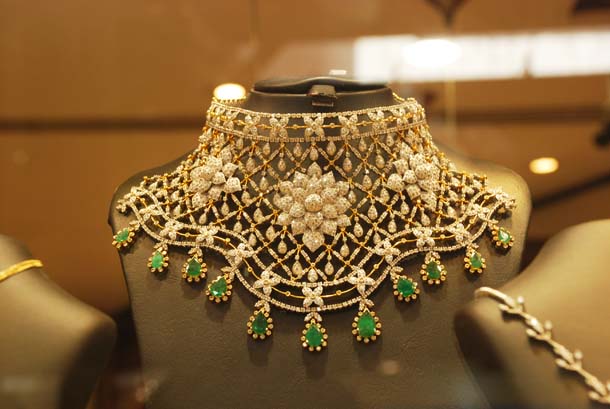
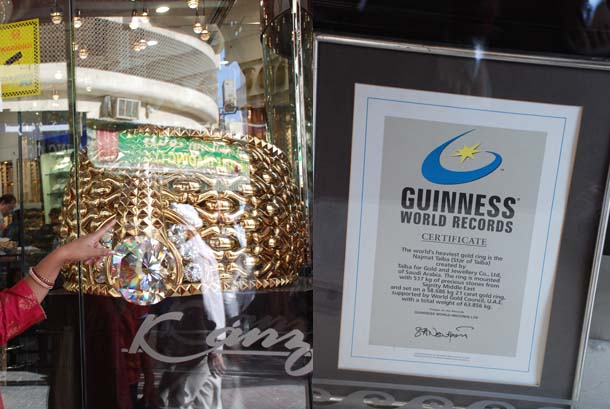
If you prefer to drive, then try to park in a Building allotted to parking on Baniyas Street. You can see the entrance to the Spice Souq from here while walk along the Sikkat al-Khali Street to come to the Gold Souq. It is a 10 minute walk from the parking lot or the Abra station.
Opening hours: 9:30am-10:00am and shops shut by 1:00pm; Re-opens at 5:00pm and continue till about 9:30pm-10:00pm; 2:00pm till midnight on Fridays
………………………………………………………………………………………………………………………………….
5) Explore the eating holes of Old Dubai with Frying Pan Adventures
Culinary journeys and food tours reflect culture, heritage and personality of a city… so don’t leave the city without booking into a food tour with Frying Pan Adventures, the only food tour company offering such tours in Dubai. Food blogger Arva Ahmed has been digging up the alleys in the old parts of Dubai and writing about ‘hole-in-the-wall ethnic eats of old Dubai’ even before she had set up her company to organise food tours in a city that is mostly associated with bling and glamour. It is here that a treasure chest of culinary experience and gastronomical thrill awaits the tourist. You can read more on my experience here. My food tour that lasted 4 hours, 23 minutes and 1 second and it seemed to zip by in a blink.
Location: Depending upon the food tours that you book into, there will be a designated meeting point. After that its all a cake walk (or a falafel walk in this case).
Cost: Starts at Dhs 350/person and varies with the different tours. Another must-buy is the mini handbook on Deira Spice Souk that Frying Pan has released after months of spice research. You can buy the pocket-sized guide on Dobazaar.com (world-wide delivery available) or get a 50% discount if you buy it on one of their trails.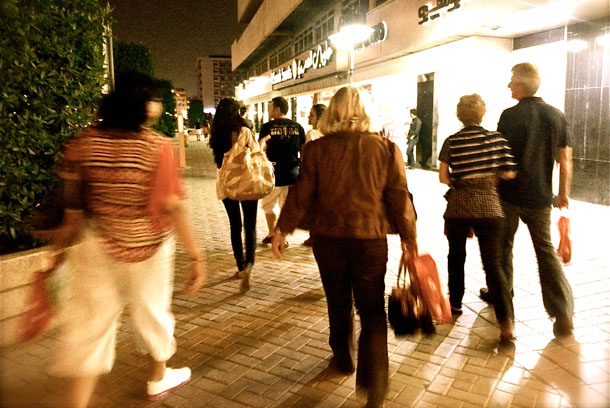
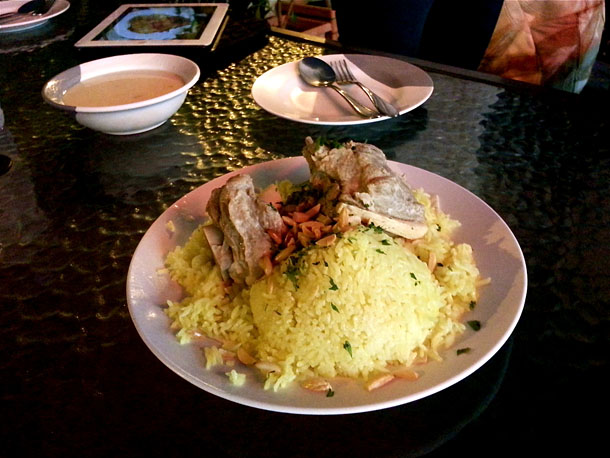
6) Meena Bazaar at night
Traditionally, Meena Bazaars were special Bazaars/markets organised to sell items to raise money for non-profit organizations. During the Mughal era Meena Bazaars were exclusively held inside the palace courtyards resembling a Bazaar for the women of the Royal courts who were not allowed to go out to shop.
Contrary to the glitzy shopping malls, Meena Bazaar has a different charm altogether. From glaring lightnings to the blaring horns from cars struck in perennial traffic, from the snaky lanes and by-lanes to the crowded main-road, from Indian and Pakistani stores selling traditional clothings to Iranian spice shops, from haute-couture fashion Boutiques (selling mainly traditional Indian and Pakistani ethnic attire) to stores selling high-street fashion, branded watch-houses to shops – the ’10 Dirhams shops’ selling inexpensive models, from electronics to home products, from computers to spare-parts, from quick-fixers like cobblers and menders to expensive tailoring shops – you’ll find Meena Bazaar a kaleidoscope of opportunities.
Originally known as Cosmos lane, it is interesting to note how this area acquired the name Meena Bazaar. According to an article in the Gulf News – the residents and the taxi drivers started calling the area Meena Bazaar because of the decorated mannequins lining the shops just like in India and Pakistan.
You have to visit Meena Bazaar at night, only to be blinded by it’s glitter (if not convinced yet, see this photo-heavy blogpost of mine). Please plan to walk. Driving into a crowded Meena Bazaar can be worse than a nightmare. You may check my Google Map for the most convenient private parking spaces. This is just adjacent to the Dubai Museum and the Bastakiya quarters and you may walk along 50B Street near Dubai Museum or approach the area from Khalid Bin Walid Street/Bank Street in Bur Dubai.
Opening hours: 9:30am – 10:00am and shops shut by 1:00pm; Re-opens at 5:00pm and continue till about 9:30pm – 10:00pm; 2:00pm till midnight on Fridays

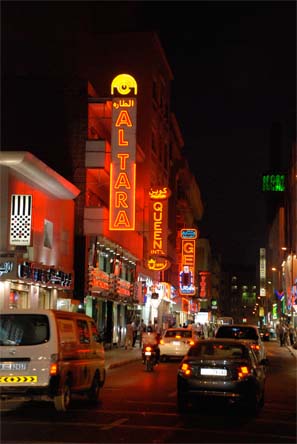

………………………………………………………………………………………………………………………………….
The Karama Chapter
Satellite dishes with wires trailing into their respective dish owners, window air-conditioners hanging from the balconies and windows in colony type of residential blocks – Karama is a different chapter in Dubai. Shops and stores occupy the shaded corridors of the interconnected ground floors of residential blocks selling almost everything.
What will you find here?
– Cheap or second-hand furniture, counterfeit branded goods such as handbags, watches, sunglasses and perfumes (yes, yet again you can be lured by these ‘branded’ accessories just like Gold Souq and Meena Bazaar), cycle shops, souvenir shops, toy shops, cheap and blingy Fashion stores, art framing shops, ethnic grocery shops, fresh fruits and vegetables also fish (Karama Fruit & Vegetable market), second-hand book stores and magazine vendors and many more
– A huge variety of good and affordable restaurants offering authentic cuisines from India, Pakistan, Philippines, Sri Lanka, China, Thailand, Singapore in addition to Arabic food and fast food outlets. Also, bustling coffee shops, Shisha cafes, confectioneries, bakeries and popular tea stalls in almost every nook and corner of Karama
The area, which was planned on a tight grid system, is home to thousands of people even though it is only two square kilometers in size. Karama is the most populous residential area in Dubai and according to Wikipedia it even has its own magazine – ‘The Karama Buzz’!
Again, don’t forget to bargain here!
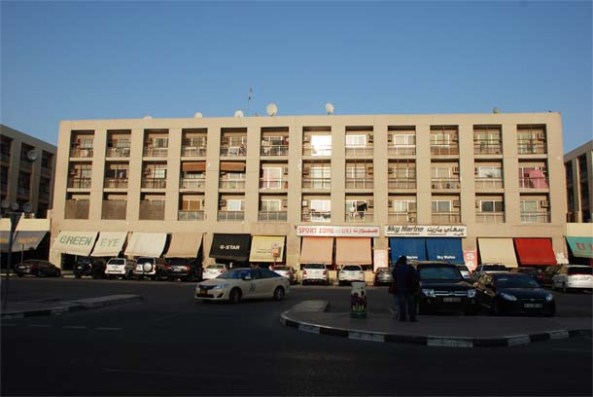


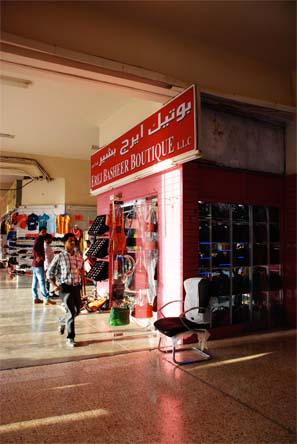

Opening hours: 9:30am – 10:00am and shops shut by 1:00pm; Re-opens at 5:00pm and continue till about 9:30pm – 10:00pm; 2:00pm till midnight on Fridays
————————————————————————————————————————–
The Jumeirah Journey
1) Jumeirah Mosque and driving along the Jumeirah Road/Beach Road starting from the Union Flag Post
Jumeirah Mosque:
This is the only mosque in Dubai which is open to the public and non-Muslim guests. The Sheikh Mohammed Centre for Cultural Understanding (details on SMCU already given in the Bastakiya tour) hosts visits of the Grand Jumeirah Mosque every Saturday, Sunday, Tuesday, and Thursday at 10.00am. No reservations are required for this 75-minutes tour but do make sure you are there by 9:45am. Follow up on the mosque tour with an Arabic breakfast at the Majlis Dubai, the camel milk cafe housed in the adjoining SMCCU building. For Dhs 50, one can avail of the mosque tour and an Arabic breakfast in Majlis Dubai, definitely a hidden gem that I have written about.
Location: Intersection of Jumeirah Road (D94) and 17B Street in Jumeirah 1
Where will you park? There is a public parking (paid parking) lot directly across the street from Jumeirah Mosque on 17B Street
Majilis Al Ittihad/Union Flag House:
The gigantic UAE flag (40 by 20 metres) was hoisted to mark the 30th anniversary of the UAE on 2nd December 2001. In 1971 all the It’s quite a beautiful sight to see the huge UAE flag fluttering in the wind against the backdrop of the blue sea. This was the biggest flagpole in the world until 2003. Do read this fascinating article in The National ‘The day of union’ – a recount of the day of the formation of the United Arab Emirates in 1971!
Rumour has it and many tour guides proclaim that the outside of the flag pole is made up of gold and costs approximately US $ 1.1 million!
Location: Intersection of Al Diyafah Street and Jumeirah Road

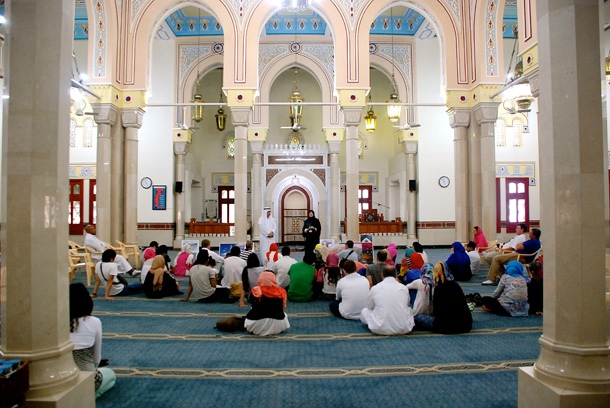
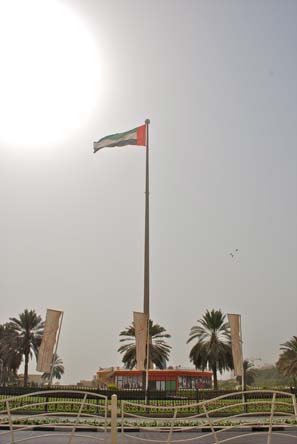

………………………………………………………………………………………………………………………………….
2) Driving along the Open Beach/Russian Beach
Take the immediate right after the Palm Strip Mall on Jumeirah Road and you come to the best public beaches in Dubai – the Open Beach. The Open Beach is also lovingly called the Russian Beach because of the number of sun-bathers belonging to the East European and Russian contingent (according to TimeOut Dubai magazine)! Just enjoy sun, sea and the sands, feed the sea-gulls (yes, here too!), cycle or skate along the beautiful cycle tracks that have been made on the sand which stretches for for more than 4 kms or simply swing in the play area. No barbeque-ing allowed.
Jumeirah Road has it’s share of surprises when you see a small sailing boat being driven past you as you drive your car. Some people just prefer to sail!
Opening Hours: 24 hours
Cost: Free

………………………………………………………………………………………………………………………………….
………………………………………………………………………………………………………………………………….
3) Barbecue in the Jumeirah Beach Park, visit Majlis Ghorfat Um-Al-Sheef and watch some Para-sailing
Jumeirah Beach Park:
This is a beautifully landscaped verdant green park with a beach front occupying almost 12 hectares of land. An ideal place if you plan to spend the day on the beach or for family picnics. There are rescue boats, a helicopter pad in case of emergency, lifeguards on duty, constructed children’s play areas, organised barbecue sites with grills, picnic tables, food kiosks, volleyball areas and most importantly restaurants and cafeterias serving up snacks and cold drinks in-case your icebox becomes empty!
Opening Hours: 8am – 10:30pm daily. Open till 11pm on Thurdays & Fridays; Mondays are exclusively for Ladies and children (Please don’t forget otherwise Daddies and Hubbies will wait outside while Mummies and Kiddies can have some fun!)
Cost: Dhs 20/Car and Dhs 5/person
Location: Just before the intersection of Al Athar Road and Jumeirah Road (if you are coming from Union Flag House) and next to Jumeirah Beach Club; Tel: +971-4-3492555
Majlis Ghorfat Um-Al-Sheef:
This was the summer house of the late founder of modern Dubai, Sheikh Rashid bin Saeed Al Maktoum. Traditionally built in 1955 from coral and stone, the two-storey Majlis has an open veranda on the ground floor while the upstairs is furnished with cushions and Arabic antiques. In the it’s gardens, Arabic irrigation system is reproduced for the visitors.
The Majlis suddenly stand out as a traditional Islamic architecture in the midst of modern villas donning the Jumeirah landscape! You can drive on to the sand, park your car and watch the jet-skiing or para-sailing against the sunset and the warm blue waters of the Persian Gulf. You may of-course join in, but I was talking from the perspective of Couch Campers like us!
Opening Hours: 8.30am – 1.30pm and from from 3.30pm – 8.30pm on Saturdays – Thursdays, ; Fri 3.30 – 8.30pm
Cost: Dhs 1/person
Location: Take the right at 3A Street after the intersection of Al Athar Street and Jumeirah Road (this is just after the empty sand plot that you’ll find after Jumeirah Beach Park); Tel: +971-4-3946343


………………………………………………………………………………………………………………………………….
………………………………………………………………………………………………………………………………….
4) Juices & Falafels in the Jumeirah Beach Road cafeterias
Roadside Cafeterias:
Small cafeterias and food joints don the Jumeirah Beach Road. Stopping and tasting sandwiches and a fresh juice is an absolute must not for the ‘food’ factor but for the novelty of introducing a concept to Dubai – you can park your car till wee hours of the morning and all you have to do is give out a minor honk. Your food and your juice will come out packed if it’s a take-away or served in a tray and you can eat in the comfort of your car without having to come out. This saves their seating space – which they lack anyway. All you need is occupy a small chunk of the road and put on your ‘hazards’ or ‘blinkers’.
If the names of the cafeterias are varied – Sea Shell, Al Izaja, Barakat (Barakat has already earned it’s reputation of selling fresh bottled juices in most of the Dubai supermarkets) so are the juices served here – Apple, Mango, Orange, Lemon, Lemon Mint and Cocktails. Mind you these Cocktails are actually Mocktails with no alcohol in them. And yet they are called as Cocktails and remember, each cafeteria has its’ signature Cocktails.
A humorous account of these cafeterias has been written in Gulf News by Mishaal Al Gergawi, an Emirati commentator on socio-economic and cultural affairs in the UAE. He writes about some more cocktails – Aboud cocktail, Burj Al Arab cocktail, Dubai cocktail, Emirati cocktail, Al Nasr cocktail, Al Ahli cocktail, Jumeirah cocktail, Talyani cocktail, Computer cocktail, Blackberry cocktail, Mercedes cocktail, Ferrari cocktail!

………………………………………………………………………………………………………………………………….
5) Burj-Al-Arab and photo-shoot in-front of the Um Sequim Park
Burj-Al-Arab photo-shoot:
This is perhaps the most sought-after touristic deeds – photo-shoot in front of Burj-Al-Arab. The closest view of the famous hotel is from the beach in front of the Um Sequim Park (until and unless you stand in-front of the hotel gates near Wild Wadi Water Park – but I’m sure your camera cannot capture you and the entire hotel in one frame). I’ve overdone this bit – having driven my guests at various hours of the day – in the morning, in the afternoon, during sunset and at night. This photo will surely make it to the Facebook Status Update – hence has to be deleted and clicked till it is perfect.
Notice how my guest is checking her photo just before uploading it on her status message on Facebook. Her Facebook Status Update? ‘In-front of Burj-Al-Arab! I love my life!’

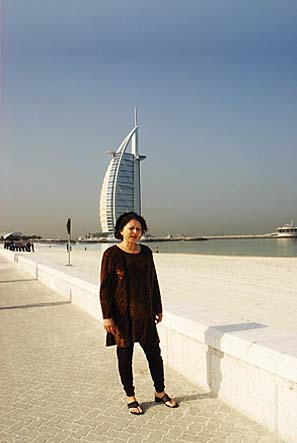
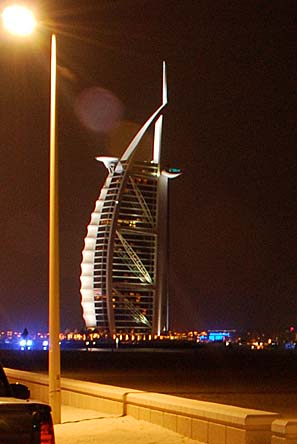

………………………………………………………………………………………………………………………………….
………………………………………………………………………………………………………………………………….
6) Souq Madinat Jumeirah & the Abra Tour in Madinat Jumeirah
Souq Madinat:
Styled after an Arabian Souq with wind towers, lantern lit hallways and narrow waterways Souk Madinat Jumeirah in the Madinat Jumeirah Hotel is bound to surprise your guests. And if you have been to the real Souqs in Dubai you’ll realise how authentic the architectural design is. Unlike the other real Souqs however, this is not a place for bargaining. The Souq houses 95 specially selected boutiques and shops, restaurants and bars. This shouldn’t scare you – you’ll also find Costa or a few other popular food chains here. Watching the Sand Artist creating sand art inside the bottle or ink your name in these bottles should convince you to visit Souq Madinat once!
Opening Hours: 10:30am – 8:30pm for the shops while the restaurants and bars are open till late
Website: Souq Madinat Jumeirah; Tel: +971-4-366 8888
Abra Tour in Madinat Jumeirah:
Take an Abra ride through the meandering waterways of the hotel. As you sail under arched bridges and along the beautiful architecture of the luxurious Malakiya Villas – this is really magical. If Venice ever turns into Dubai, it will probably choose to look like this – houses styled in Arabic architecture with wind-towers, date palm trees dotting the banks of the canals. Let your Captain (or should I say Abra-driver) tell you stories of where Goerge Cloony has stayed or Sharon Stone. Or if Bollywood beckons you more then hear about the 7-roomed villa that Indian superstar Shahrukh Khan hires when he visits Dubai. On second thought – I thought he always stayed in the ‘Bridge of Sigh’ Chambers in the Atlantis Hotel. Or wait, didn’t he own a villa on the Palm Jumeirah. Never mind, take your guests for an Abra ride for sure if you cannot house them in one of the Malakiya Villas.
I don’t work for this hotel. I am not being paid to write all this. But if you want to enthrall your guests with Arabian luxury and magic within tight budget – this is it.
Timings: daily from 4:00pm – 11:00pm; The Abra tours depart every 20 minutes
Cost: Dhs 70/adult and Dhs 40/child
You can access the Abra stations near Toscana and Barzar at Souk Madinat Jumeirah
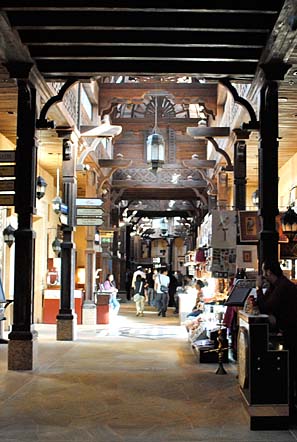
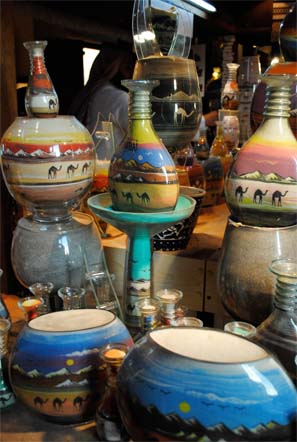

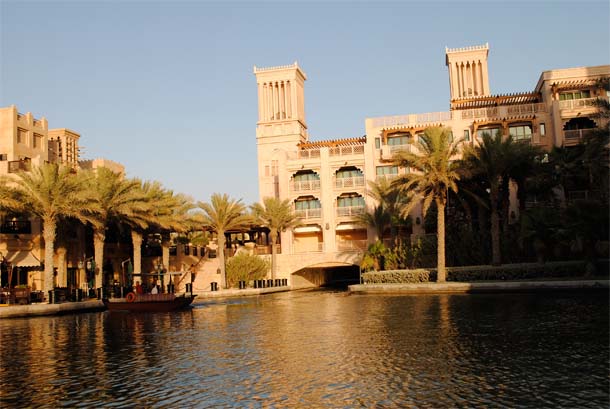

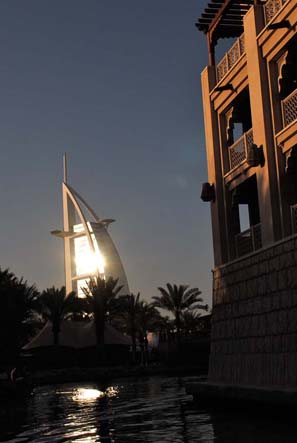
………………………………………………………………………………………………………………………………….
New Dubai & Dubai Marina
1) Burj Khalifa and ‘At The Top’ experience, Dubai Mall & the Dancing Fountain
Burj Khalifa:
‘At The Top‘ experience or scaling the world’s tallest building (well, standing at 828m it is till now) is a must if not for the fact that you will be standing on the world’s highest outdoor Observatory Deck at 124th floor but also for the fact that the journey will reveal the beauty of the architecture of the building. And the design is as complex as you perceive it to be or as simple as one petal of Hymenocallis – a regional desert flower whose harmonious structure is one of the organizing principles of the tower’s design.
By the way, Tom Cruise is supposed to have scaled the Burj Khalifa building on his own for his movie Mission Impossible – The Ghost Protocol. Phew! Watch the making of Tom Cruise’s scaling here.
Timing: 10:00am – 10:00pm on Sundays – Wednesdays ; 10:00am till midnight on Thursdays – Saturdays (Last entry 45 minutes prior to close)
Website: Burj Khalifa; Tel: +971-4-8888124 (At The Top); Location: 1 Emaar Boulevard, Downtown Dubai
Cost: Dhs 400/person for immediate entry; With online reservations – Dhs 100/adult and Dhs 75/child (Please note that the tickets are dated and timed. And the evening slots like 5:30pm – 7:30pm are sold out months in advance. So please plan if you wish to be ‘At The Top’ during sunset!
Where will you park? Getting a parking space in Dubai Mall can be like searching for Dinosaurs (yes, you will find that too – mentioned later on. Seriously!). As you take Burj Khalifa exit from Sheikh Zayed Road, enter the Emaar Boulevard, take a U-turn at the first signal and enter the Fashion Boulevard Parking lot and drive upto the 5th floor. You’ll be close to the ‘At The Top’ front-desk.

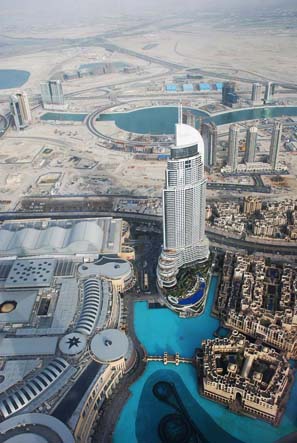

Dubai Mall:
I like to take all my guests to Dubai Mall once just to let them know that they are in one of the world’s largest shopping malls. If you happen to be a shopaholic – good for you. But if you aren’t then who has stopped you from stimulating your senses or be inspired by the world’s leading designers – all under one roof? Consider the window display of these brands as a canvas by itself. For example – Chanel, Alexander McQueen, Christian Louboutin, Ellie Saab, Herve Leger, Donna Karan, Sonia Rykiel, Stella McCartney… the list is endless!
Do you fancy Chocolates instead? Visit Hershey’s Chocolate World – the store offers more than 300 Hershey’s products including giant chocolate bars, Hershey memorabilia, and even customized products! Or say Candylicious – a 10,000 square feet store offering millions of candies! Or say, you are interested in cars. Then Exoto Tifosi is for you where you can purchase collectible model cars and varied products – all themed around motor cars and racing.
Again, it’s not about shopping. Choose a concept and let your guest explore that. And that brings us to the Dinosaur subject. Where else can you find a real dinosaur skeleton in a shopping mall, but in Dubai! Yes, this is the Dubai Dino… an original skeleton of a sauropod that is over 155 million years old, air freighted from the Houston Museum to Dubai! Its going to be a Dubai resident forever and brought to you by Emaar. Not for sale though:(
Timing: 10:00am till midnight daily though the Reel Cinemas or Sega Republic, Kidzania etc may have different timings
Website: Dubai Mall; Tel: +971-4-362 7500
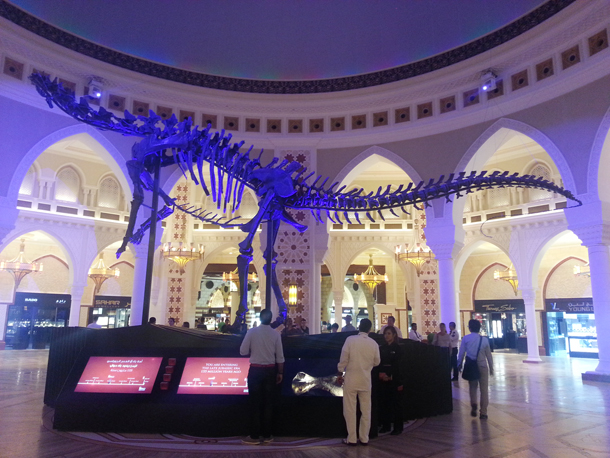
Dancing Fountain:
Set in Burj Khalifa Lake, right outside The Dubai Mall on Lower Ground Waterfront Promenade is the world’s largest dancing fountain (the water spray shoots upto 50 stories). The fountain dances to the music of Sama Dubai; Baba Yetu, an award-winning song in Swahili; Shik Shak Shok – a peppy Arabic dance number and the signature piece of Andrea Bocelli’s Con te partiro/Time to Say Goodbye.
At this moment the first show in the evening is dedicated to Whiteny Houston’s iconic ‘I will always love you’. At the end as the her voice soars to the words ‘…and I will always love you…’ the water jets up high into the sky as a moving and an emotional tribute to a great singer. A YouTube peep here if you need to be convinced.
Timings: 1.00pm and 01.30pm, 6:00pm – 11:00pm every 30 minutes on Saturdays – Thursdays; 1.30pm and 2.00pm, 6:00pm – 11:00pm every 30 minutes on Fridays
Cost: Free
Where will you stand to get the best view? The moment you come outside the Dubai Mall onto the promenade, start walking right till you climb up an incline. Place yourself somewhere here so that you can view the entire width of the Fountain against the backdrop of the Old Palace Hotel. Why not walk to the Old Palace Hotel side and view the next show against the backdrop of Burj Khalifa?
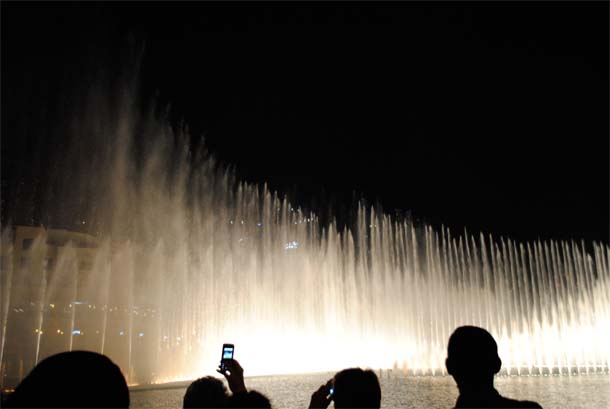
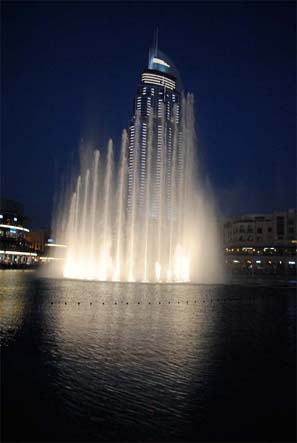
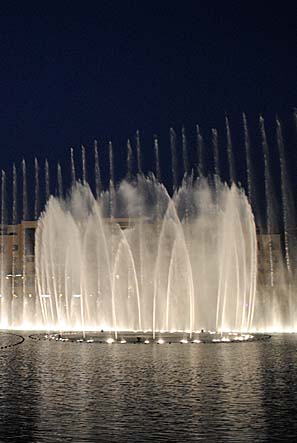
………………………………………………………………………………………………………………………………….
2) Take the Palm Mono-rail, visit Atlantis Lost Chambers Aquarium
The Palm Mono-rail ride:
The Palm Mono-rail ride to the Atlantis Hotel gliding above the Palm Islands is a brilliant introduction of Palm Islands itself. The Palm Mono-rail runs along the trunk of the Palm Jumeirah connecting the Gateway station situated just at the entry to the Palm Islands to the Atlantis hotel at the far end. You can see the entire Palm from the top – how the fronds come out from the trunk and how each villa on the Palm Island claims to have its private beach!
Where will you park? There’s a huge parking building at the Gateway Station itself. If you are coming from Jumeirah towards Dubai Marina, the Jumeirah Road becomes Al Sufouh Road after the Madinat Jumeirah Hotel. Just 100m after the exit towards Palm Islands from Al Sufouh Road is this Gateway Station.
Timing: 10:00am – 10:00pm Daily at fixed intervals
Cost: Dhs 15/person for single trip; Dhs 25/person for return trip
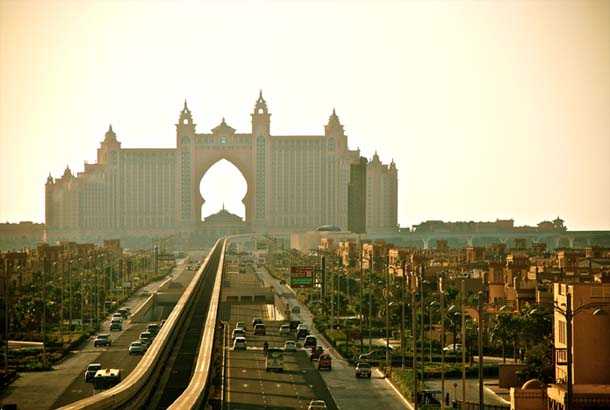
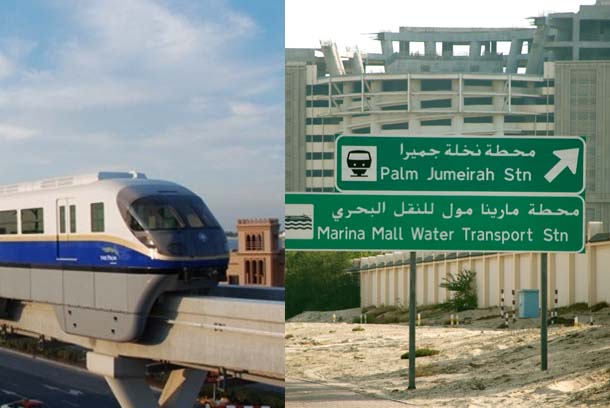
Atlantis Lost Chambers Aquarium:
If I have to choose between the Aquarium in The Dubai Mall and the Atlantis Lost Chambers, I will choose the latter. Simply because the Lost Chambers is aesthetically more beautiful. Their website has also come out with a story – ‘During the construction of the resort, a complex series of passages was uncovered, thought to have been buried thousands of years ago by the waters of the Arabian Gulf. Upon further investigation, an ancient street system was discovered and the theory came into being that these were in fact remains from the Lost City of Atlantis.’ Really? Never mind – story or no story I am sold!
Timings: Daily 10:00am – 10:00pm; For more information on guided tours, fish feeding etc here.
Cost: Dhs 100/adult and Dhs 75/child [Dhs 75/adult and Dhs 50/child if you are an UAE resident. So please carry your UAE ID Cards or UAE Dirvers’ License so that your guests can also avail this]
Do we go in everytime whenever we accompany our guests? No we don’t. We all go for the Mono-rail ride and thanks to the Starbucks there we hand around eating muffins and Cappuccinos while our guests are enthralled in the Lost Chambers. In-case you are hungry and want to munch on some burgers – you have The Burger Joint where the fillers of the burgers come from the famous steakhouse – The OutBack. But then priced at Dhs 45 -Dhs 65/burger, how much are you saving by not going into the Lost Chambers with your guests?


………………………………………………………………………………………………………………………………….
2) Drive along the Palm Jumeira and watch the sunset over the Persian Gulf
Palm Jumeirah Drive:
Apart from the Palm Mono-rail, I also like to drive my guests along the Palm Islands. Once reaching the tip I like to drive to the end of the West crescent from where the skyscrapers of Dubai Marina and Jumeirah Beach Residence (JBR) seems to float on water. Time for a photo-shoot and a sandwich break. Then drive to the tip of the East crescent and show them the Burj-Al-Arab from the Palm Islands. On our way back take a pause in front of the Atlantis to get the perfect photo.
Time for some story-telling – The Palm Jumeirah is an artificial archipelago created using land reclamation… it is in the shape of a palm tree. It consists of a trunk, a crown with 16 fronds, and a surrounding crescent island that forms an 11 kms long breakwater… and more from Wiki.
Along with the Great Wall of China, Palm Islands too can be seen with the naked eye from the Moon! Do I support the environmental hazards or the marine life that must have been destroyed while creating the Palms, I’ll never discuss these in my blog. But am I mesmerized with the concept of creating the Palms? Yes, I am. And this is the reason that makes me take my guest for a Palm drive.
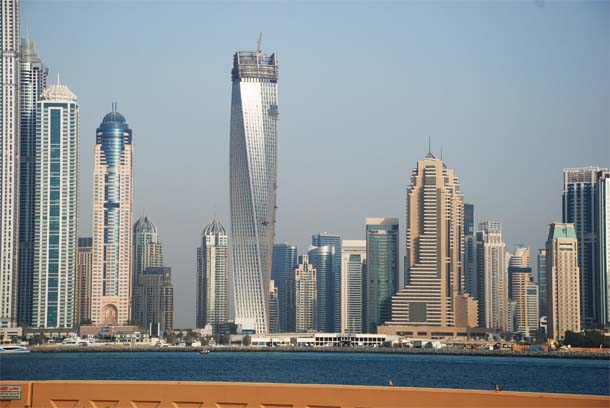

………………………………………………………………………………………………………………………………….
-………………………………………………………………………………………………………………………………….
3) Breakfast in The Walk at JBR, also visit The Walk at night and visit The Covent Garden
The Walk at JBR:
The Walk at JBR is a 1.7 kms stretch of beach promenade or a boulevard dedicated to open air dining – Al Fresco dining with reputed restaurants and shopping strip. This is located at the ground and the plaza level of JBR or Jumeirah Beach Residence. JBR is the largest single phase residential development in the world!
You’ll find a variety of restaurants offering a variety of cuisines – ranging from fine-dining to casual dining. You’ll find the staggering list of restaurants here. If California decides to convert itself to Dubai, this would be it!
The opportunity to have breakfast served by the beach in this city full of bling and brick structures, The Walk is a welcome break, though it is adjacent to JBR which has 40 towers, each towering higher than 40 floors! My favourite breakfast haunts here are Kösebasi, a Turkish restaurant. Try their Turkish breakfast spread – Menemen (scrambled eggs with tomato and bell peppers) or the Sucuklu Yumurta (fried eggs and sliced Turkish sausage). Other favourites are Breakfast at Paul’s or the Buffet Breakfast at Il Café de Romo. While Paul’s is expensive but worth the last fil that you spend, the Buffet Breakfast at Il Café de Romo is priced at Dhs 49/person and satisfies the mind as well as your hunger!
Only tormenting factor could be the serious morning walkers jogging by as you munch on shamelessly on your Sucuklu Yumurta – I am used to feeling guilty like this. You choose your feelings.
Covent Garden Market
Lonely Planet lists this to be a ‘Must See’ when in Dubai. And rightly so. Borrowed on the concept of open air European flea markets (unfortunately the prices of the products sold haven’t borrowed the same concept!) the Covent Garden Market has small kiosks selling unusual and unique knick-knacks like imitation and junk jewellery, silk kaftans, paintings on canvases and much more. The Covent Garden Market takes place from October until the end of May. So if you are visiting Dubai in Summers this is something that you’ll miss out on.
Writing about Parking in The Walk can be a full essay. If you are coming for Breakfast you’ll get convenient parking opposite Rimal. However, if you are coming during the weekends or in the evenings and night, then please carry your house in your car. You’ll need much more than just relax. The access to JBR is jam-packed all the time and once you enter the roads leading to The Walk – there’s no point of return. It’s a one-way route all the way along The Walk. All said and done to enjoy The Walk after sundown is a thrill. Amazingly dressed people and equally amazing cars – all out on a fashion parade. And if you are lucky to visit The Walk during DIFF (Dubai International Film Festival) or say, the Dubai International Jazz Festival – sitting on bean bags by the beach and watching a movie with thousand other film enthusiasts on a open-air screen or listening to a Jazz group performing live while you juggle yourself into an empty spot found after many searches can be – well, a step closer to the attainment of Nirvana!
It’s okay to get stuck in the traffic for such a pleasurable cause. To ease frustration, sing Hotel California in your heads – ‘You can check-out any time you like, But you can never leave!’
Timings: 5:00pm till midnight on Wednesdays and Thursdays; 10:am – 10:00pm on Fridays and Saturdays.
Website: Covent Garden Market; Tel: +971-50-4250543
Location: The Walk at JBR by Rimal Sector (between Hilton Hotel and Sheraton Hotel)

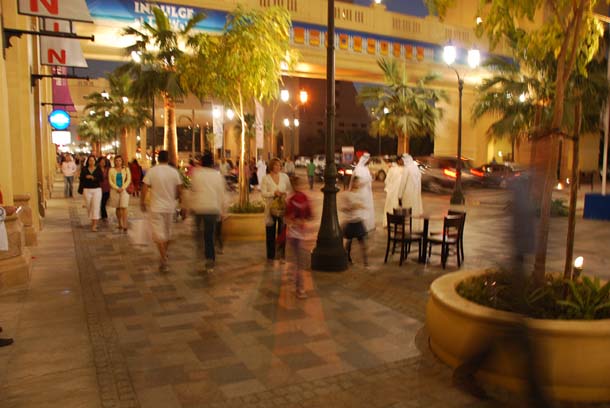


………………………………………………………………………………………………………………………………….
4) Catamaran ride from Dubai Marina, preferably during the sunset
Catamaran ride from Dubai Marina:
It was only in 2004 that I used to drive my guests all the way from Bur Dubai to this place which seemed like beyond all frontiers – to show them how the Marina is being cut from the sea and how Dubai would soon have it’s Riviera. Since 2010 I’ve been taking my guests for a sail in the so called Dubai’s Riviera. If it surprises your guests when they see sailing boats occupying garage space along with sedan cars and 4 WD in Jumeirah, Dubai Marina will probably shock them – there are rows and rows of private yachts and quays for anchoring these.
Sailing on a private yacht into the sunset sounds heavenly, but you could have the same experience for much cheap – take the Catamaran ride from Dubai RTA for a round trip from Marina Mall water transport station up to the Atlantis on Palm Jumeirah. You’ll get more information here. This one hour ride costs around Dhs 50- Dhs 75/person. If you don’t want to miss the sunset, take the 5pm ride during the winters and 7pm ride during the summers.
Where will you park your car? Park in the Dubai Marina Mall and walk into the ground floor of the Mall, walk into the Marina waterfront from Yo Sushi and you’ll find directions to the Marina Mall water transport station.
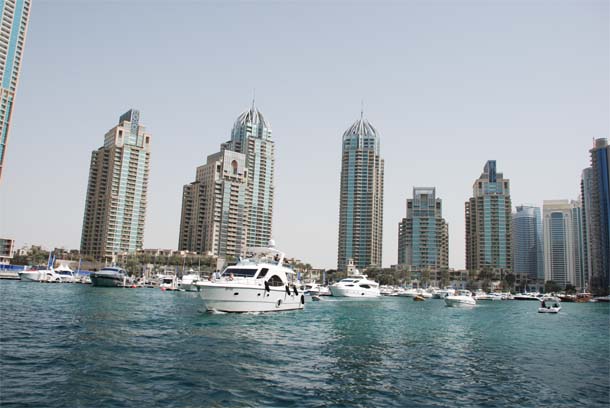
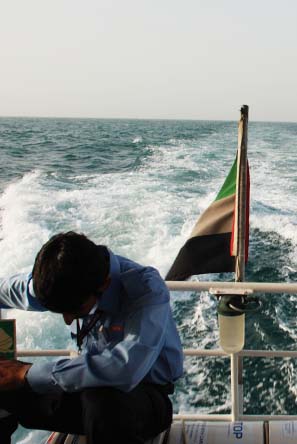
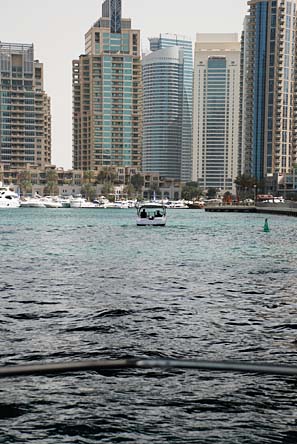

………………………………………………………………………………………………………………………………….
5) Visit Ibn-Batuta Shopping Mall and ride the Buggy
Ibn Batuta Shopping Mall:
Another shopping mall? Oh, not again! No, please take your guests, I insist. The Mall has been designed in honour of the Moroccon explorer, Ibn Batuta who over a period of thirty years visited most of the known Islamic world as well as many non-Muslim lands and his journeys included trips to many parts of Africa, Europe, Middle East, Asia, Central Asia, Southeast Asia and China in the East. Ibn Battuta is considered one of the greatest travellers of all time and has journeyed more than 75,000 miles (121,000 km) in his lifetime!
This is the world’s largest themed shopping mall. Each region that Ibn Battuta had explored – Andalusia, Tunisia, Egypt, Persia, India and China – is reflected in the architecture and theme of the mall’s six courts. Take a buggy Ride (Dhs 5/person) if you are too lazy to walk. And I hear there is a bigger version that is being built right now!
Timings: 10:00am – 10:00 pm on Sundays – Wednesdays, 10:00am till midnight on Thursdays – Saturdays
Location: Ibn Battuta is located adjacent to Sheikh Zayed Road between interchanges 5 and 6; Tel: +971-4-362 1900
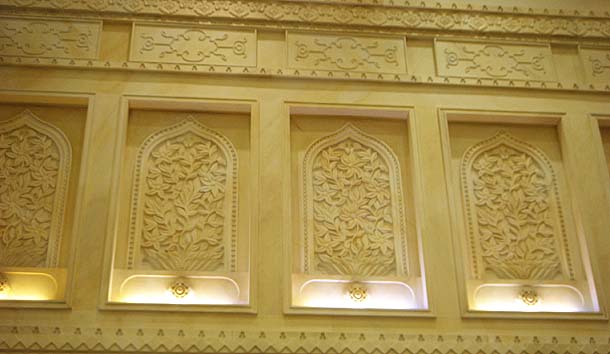
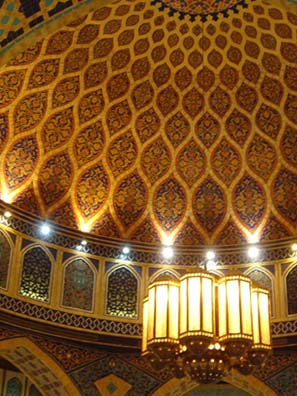

6) Visit Ski Dubai at MOE
Ski Dubai
Well, a visit to Dubai will remain incomplete if you haven’t seen the indoor ski resort in a Shopping Mall (Yup, the protagonist of the story of Dubai is Shopping Mall for sure!) If Swiss ski-slopes ever wanted to be trapped indoors – this would be it. You could be skiing, snowboarding or just fool around. I know the skeptics will thrash this concept of indoor ski resort but tell me where else would you be finding something so spectacular?
My German friends who are hard-core ski-lovers vouch for Ski Dubai. The reaon? Well, you don’t have to climb up all the way to the mountain top and be disappointed with the weather condition and poor visibility. Or say, hear that the slopes have been been blocked by avalanches. Here, you have perfect weather, perfect slopes, perfect snow all the year around. You don’t have to trudge your own ski-equipments even – everything comes with the price you pay for the tickets.
And if you don’t know how to ski? You can still go into the Snow Park and play with the new residents of Ski Dubai – the penguins. Or, better still, you could do what I do – sit at St. Moritz Café by the electric fire place sipping some hot coffee.
New Facebook Status Update? ‘At St. Moritz!’
Website: Ski Dubai gives you all information about the timings for various programmes that you may opt for – Snow Park, Ski-slope etc as well as the different prices. There are too many options for you to choose from, hence not segregating them out.
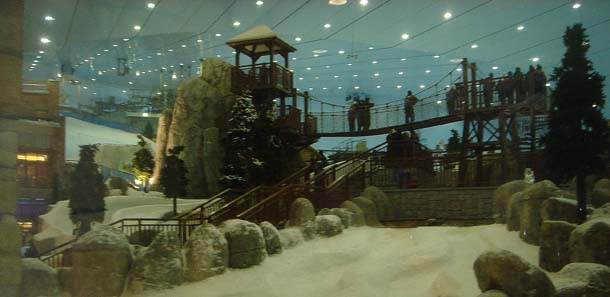

Some Random Surprises
The following are some random surprises that you might enthrall your guests with, even if you haven’t managed to do anything of the above.
Show them the Gold ATM – At Galeries Lafayette in The Dubai Mall, At The Top in Burj Khalifa or the Atlantis Lost Chambers etc there are Gold ATMs – where shoppers can chip in the corresponding amount of money to receive nuggets of fine gold! To be honest I am yet to see the nuggets come out – neither my guests nor me have chipped in any money. And remember there are edible gold on the menu in a lot of places. Gold dust on the lips – sigh!
Show them a few twisted buildings – some modern buildings have mind-boggling designs requiring the best in mathematical precision!
Show them rains in the desert – Yes, if you are lucky Dubai does witness some rains – when, where, how – I do not know much!
Show them some greenery & blooms – Yes, Dubai may be a desert but it always gives me a lot of pride when I show my guest how much effort is being made to turn the city green!
Show them real dates – Fresh dates that can be plucked from the roadside – yes, the urbane city still hasn’t forgotten it’s roots! But don’t pluck them when the dates have been netted – you might end up paying huge fines.
Show them air-conditioned bus-stops – If the entire city could have been air-conditioned, probably it would have been done or may be plans are there. But so far having air-conditioned Bus-Stops are good enough!
Show them the sea of sand – A 5-minutes drive out of the city and you reach the sand. Bring them back to the fact that Dubai actually grown on this sand. Everything – the electricity that switches on our Air-Conditioners to the water that we drink – almost everything is meticulously planned and brought into the city!
Show them the Dubai Supercars – Dubai Police has has a number of supercars in its fleet, enabling cops in the city to drive around in a much-admired luxury vehicle (according to their FB page). The fleet includes a limited edition Aston Martin One-77, a Bentley Continental GT, a Bugatti Veyron, Camaro, Ferrari FF, Lamborghini Aventador, Mercedes Brabus G-wagon, a Ferrari FF, a BMW 5 series, a Chevrolet Camaro, a Dodge Charger and several other exotic sports cars. All of them are available for your *selfie* pleasure! Present daily from 9:00 am until evening at Downtown area, JBR and Burj Al Arab (prompt reply from Dubai Police when I tweeted!)
Finally, show them the city being built – I always tell the Z-Sisters that they will never see this anywhere in the world – a city being built – brick by brick, just like Lego!
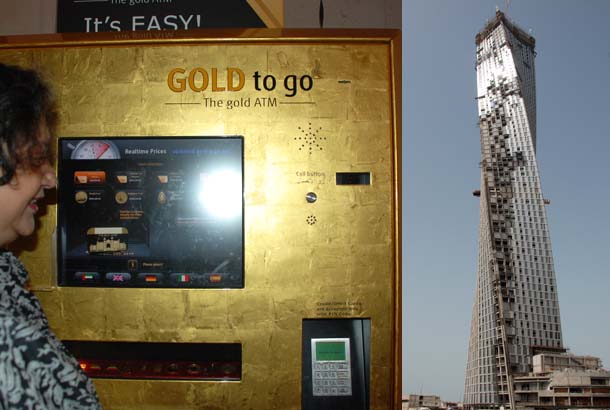

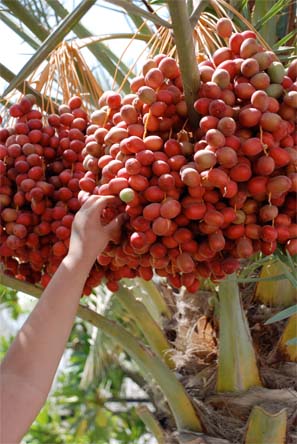

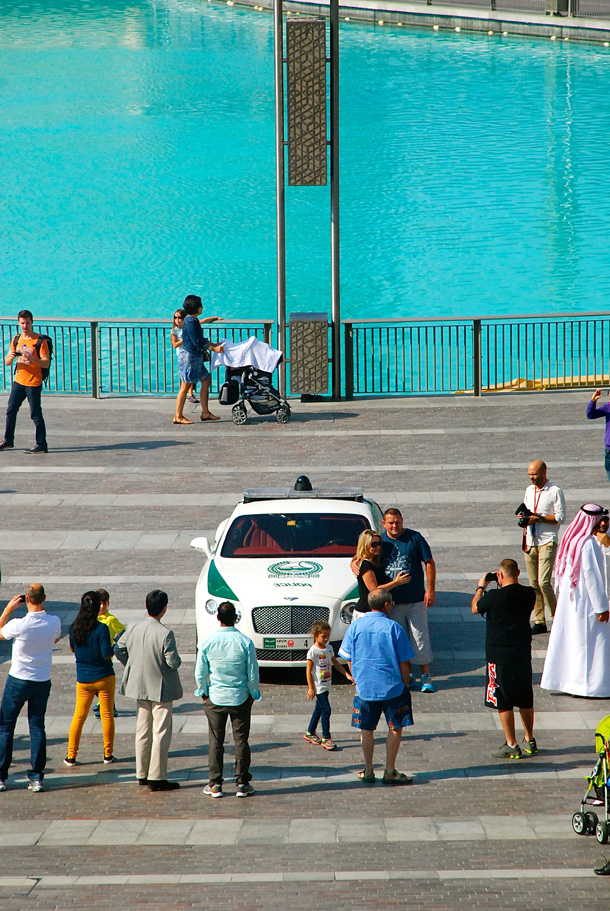
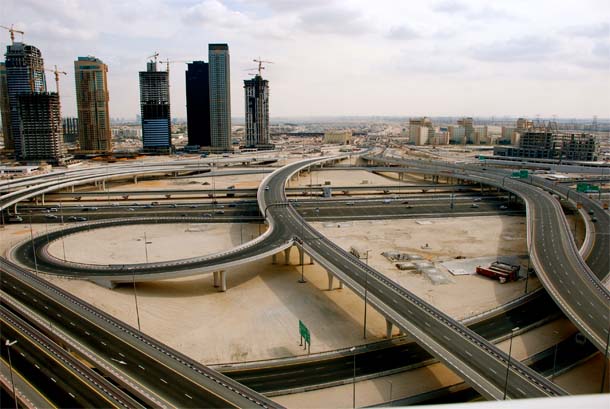
What do you do when you cannot keep your guests in the Atlantis Hotel or the Burj-Al-Arab? The maximum you can do is to find the perfect parking spaces and drive them to each place at various hours of the day to give your guests the perfect photo-ops and lots of opportunity for Facebook status updates!
And never mind the fact that Li’l Z tires herself out in the car or Big Z has to do her home work sitting by the Creek (its the same thing even today – two years after my article was written) – our home is still welcome to our guests. And I still drag myself to show them Dubai in my way and tag along with them – Like a tourist in my own city!
Unblogging it all… Ishita
Other Dubai articles in my blog that you may like to hop into:
- Hidden Gems of Dubai | My Pick of Restaurants
- My Best Brunch Experiences | Exploring The Friday Heritage
- The Golden Dishes of Dubai | Countdown To 2015
- Countdown To 2015 | Gobbling Up Some Of The Best Views In Dubai
- Bu Qtair Fish Restaurant | Capturing A Hidden Gem In Jumeirah. A Video Too!
- Dining Concept | Dining Around Dubai With Foodiva
- Hidden Gems of Dubai | The Majlis Dubai And Jumeirah Mosque
- Masqouf in Bait Al Baghdadi | Tasting Iraq’s National Dish
- The 7 Tastiest Fast Feasts Of Dubai | Introducing Chowzter to Dubai
- A Connoisseur’s Guide To Eating Out In Dubai
- An Authentic Emirati Food Experience (First Time Ever) | Al Fanar Restaurant
Dubai articles from my blogger friends blog that you may like:
- I don’t want you to come to Dubai …. {Coffee Cakes & Running}
- Where to take visitors to eat in Dubai – on a budge {My Custard Pie}
- Dubai – For One Night Only {The Hedonista}
- Budget Eats Dubai – Part 1 {Pear Tree Diaries}
- Budget Eats Dubai – Part 2 {Pear Tree Diaries}
Disclaimer: Please note that this post is not a sponsored post and the subject, story, opinions and views stated here are my own and are independent. While you enjoy reading the posts with lot of visuals, please do not use any material from these posts. You can catch my daily food and travel journey on Instagram, Facebook, Twitter and Pinterest.

BE SOCIAL. SHARE THIS!

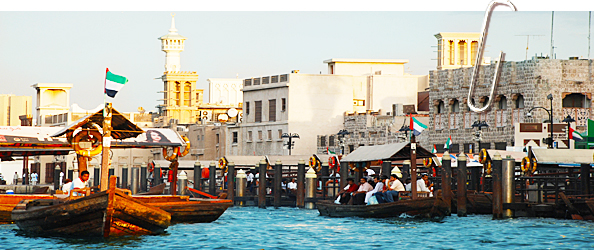
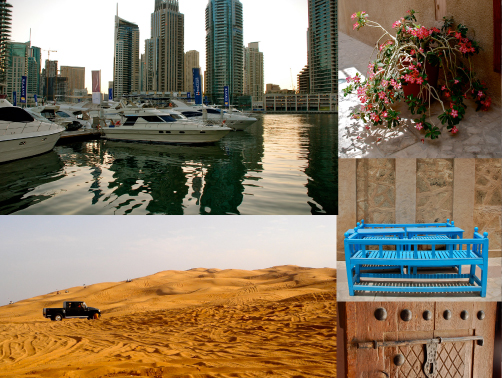
An excerpt from an earlier post… Dubai, my home for almost the last decade, is a quintessential tourist’s haven. It’s a shame that the only thing that comes to mind when one hears Dubai is Shopping. But, walking through the art alleys of Bastakia and the old quarters along the Dubai Creek, watching the sun go down the beautiful and never ending beaches, catching the stars in a moonlit night over the desert sky… there’s so much more to Dubai. Dubai is a remarkable place; a vibrant and growing city where expatriates from all over the world are striving, to make it a true international city. It has the best of modern technology pitted against absolute consumerism. Zero carbon footprint is a concept that Dubai-ites are trying to learn after emitting gallons of carbon in the air!
 Not everyday one has to travel far away to distant lands. Today was one such day. I wanted to dig out all funny memories associated with roaming in and around Dubai. The places that have given us immense pleasure and where we have shared so many lovely moments with our visiting family and friends. Since traveling always brings the best out of me, so here I am teasing my guests a bit, by narrating those moments when I have been wandering with them, like a tourist in my own city! Another version spun from this post – Things To Do In Dubai – Like A Tourist In My Own City! This is perhaps one of the most ‘shared’ post in my blog. I am digging out this post from the archives only because I had spent lots of humorous hours penning it down and now it’s time to showcase my love for Dubai with the 41st UAE National Day lurking around the weekend.
◊——————————————————————————◊
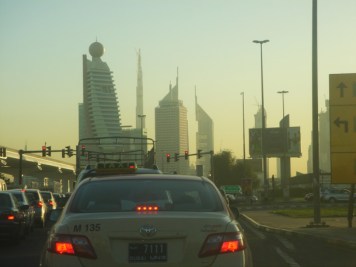 From my Lodge Diary…
May 6, 2011, Friday – Ma (my Mum-in-law) leaves for Kolkata; 9:30am – Leave for Dubai Airport to drop Ma
May 6, 2011, Friday – Jüta and Jürgen arrives from Frankfurt; 6:30pm – Leave for Dubai Airport to pick up the new set of guests
May 8, 2011, Sunday – Jüta and Jürgen leave for Egypt; 6:30am – Leave for Dubai Airport to drop them
May 10, 2011, Tuesday – Seema and family arrive from New York only for 8 hours, en-route to Kolkata; 1:30pm – Leave for Dubai Airport to pick them; 10:30pm – Leave for Dubai Airport again to drop them…
In between, many things needed to be done. Before Ma leaves on Friday, on our way to the Airport we pick up a packet of Zatar, a local spice which from now on is going to be sprinkled upon Ma’s Chappatis during her daily breakfast; we also pick up a small box of Saffron which will be used as a garnishing on Indian sweet dishes like ‘Rasmalai’ that Ma is promising to make with her own hands when we camp ourselves for 2 months in Kolkata over the summer.
After Ma leaves, we transform ourselves into super fast House-Service personnel. The used bed sheets whacked out of the mattress with super-fast lightning speed and changed into another set of crispy white bedsheets spread promptly in the guest bedroom. Other things that are immediately re-organised in a fast-forward mode for our new guests – Water jugs, fresh flowers, welcome candies and a long list of little but important things included in the long ‘things-to -do’ list.
I know Jüta only eats organic fruits and vegetables and is allergic to pulses and legumes. She feels sick if onion and tomato peels come her way while eating! So I run down to the building grocery downstairs to buy a new sieve. And Jürgen? He demands only spicy Indian food when he sees me. His only criterion is that his Beers needed to be chilled 24×7 (24×2 this time as they stayed only for 2 days!). And oh, we drove here and there just to get a few fizzy mineral waters for our German friends – most of our German friends like drinking their water with fizz only – wasser mit Kohlensäure! I was also wondering whether the bed mattress was too hard for them.
 There is a long history behind the bed mattress in our guest room. My parents-in-laws are used to sleeping on hard mattresses. Our guest bedroom is more or less adhered to their needs. A hard orthopedic mattress has been accordingly designated in the guest room. Guests flying from the USA face a challenge while sleeping on this bed. There are two comforters which have been permanently assigned to the job of lying on top of our hard mattress so that our American guests may sleep comfortably! After a long debate we decided to place these special comforters for Jüta and Jürgen as well. Then the hotel slippers that we whack on our travels (we are not ashamed of our act as we do this for a greater cause – so that our house guests may snuggle comfortably in the warmth of the velvety hotel slippers while roaming around in our home. I hope you understand our act of thoughfulness!) had to be taken out and we played the usual guessing game of which size of slippers were actually going to fit them. Since Jüta belonged to the ‘allergy-type’ category and exuded a high-maintenance tag she got to wear a new pair of slippers. Poor Jürgen was not all that poor. He got a pair of slippers from the set of slippers which have been worn a few times by our various house guests but have been scrubbed clean and sanitised!
I sincerely hope that the above paragraphs did not sound like a list of complaints! We simply adore guests. Staying away from one’s own country we become so emotionally vulnerable that we readily welcome any member from our fraternity of friends and family. So what if I put lots of coriander leaves in a dish and realise that my guest is allergic to them; so what if I cook lots of potatoes and realise that my guest eats everything but potatoes; so what if I cook ‘whatever’ because my guest can eat ‘whatever’, only to realise that my guest absolutely needs rice with ‘whatever’ pasta that I have cooked; so what if I have transparent drapes hanging in the guest bedroom in order that my guests have a beautiful sea-view the moment they open their eyes, only to realise that their eyes were open throughout as my guests needed absolute darkness while sleeping; so what if the dessert turned out to be the best that my kitchen has ever produced, only to realise that my guest is acutely diabetic!
And so the list goes on…
We are used to bigger storms associated with guests. I am very city-proud (applies to whichever city we are living in at that point in time). I almost drag my guests from one end of the town to the other, forcing them to enjoy Dubai (my city) my way! If you happen to have an encounter with me in one such fateful trip of mine where I myself have become a tourist in my own city, you will really be impressed. My eight-seater 4×4 is stacked with unhealthy snacks (in case the healthy fruits get rotten in the hot car), crisps (in case we over shoot our lunch time while on a city tour), cartons of water (to keep us hydrated all the time, plus to keep the little hands naturally germ -free), a huge mat that can house a family (in case we make a stop by the beach), newspapers (in case we need to light some fire, wipe our dirty feet, wipe the windscreen, or we need some make-shift clothes, hats – you name it!)… the list is actually endless. I am absolutely equipped to face any situation.
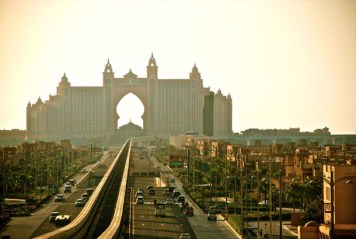
I like to show-off a bit. Hence my tour of Dubai starts with the most popular Palm Islands and the Atlantis. I have illustrations of the Palm Islands torn from magazines which I have kept almost sacredly. These illustrations are absolutely important when I explain to my guests how the Palm Islands were built. They are also important when I explain to my guests whether we are driving through the trunk of the Palm or whether we are in the Fronds, whether we are on the western end or the eastern end of the crescent that ultimately envelops the Palm Islands. Maybe, my guests don’t care, but I surely do! Actually, I have a whole lot of pamphlets and have a knack of picking up all the Dubai Guide leaflets from wherever I can.
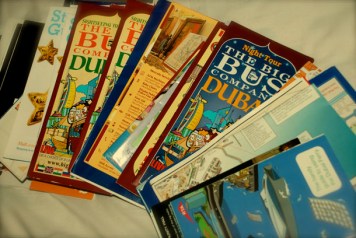 If you happen to be one of my guests, please note that I am not an one-way fact-blurting-out-machine in operation. At the end of our trip I would be taking an oral test, on the basis of which my next day’s trip would be based. Usually, my adult guests fair poorly to my oral tests. And their children always happen to be their saviors. The latter are too excited to be able to seek me, the Dubai Aunty’s undivided attention and love which would ultimately earn them big popcorn packets and dollops of ice creams from Baskin Robbins or Håagen Dazs later on! What the heck, am I an Aunty already? I always thought irritating Aunties belonged to my childhood only!
I prefer to do Palm Island and Atlantis trip during the sunset. Ideally, I should be driving my guests through the Dubai Marina, explaining how back in 2004, these buildings didn’t even exist, that so proudly dot the Marina skyline today. The history of this area dates back to 2004. Yes, as recently as 2004! 2004 was the year when the construction of the Dubai Marina was finally completed.
‘WOW-W-W-W!’, my guests seem visibly excited. My mission is accomplished. I take a sip from my bottle. After all I have been speaking and speaking over the last few minutes – ‘You know guys, Dubai Marina (below) is a canal city, like Venice, carved along a two-mile stretch of the turquoise Arabian Gulf. Luxury condominium towers and villas along the waterfront – a modern day VENICE!’ Yessss, I’ve sold Dubai to my guests. And incase if you have been wondering – No! I don’t get paid to show-off the city. I generally do all these for free!
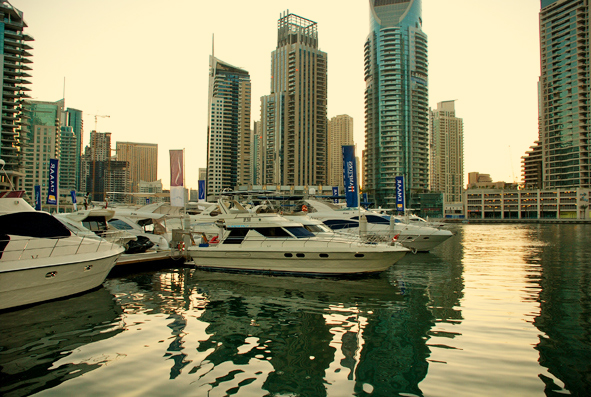
As we drive along the various parts of Dubai, it is unbelievable to think that Dubai was just a small port on the Arabian Gulf even 40 years ago! Over the past decade, Dubai has snowballed into a dream bubble which people feared would burst at any single opportunity. Though it did burst a bit, I am here to mend it with super glue and highlight only those memories about places which have made our stay in Dubai absolutely eventful and an ever-long dream vacation.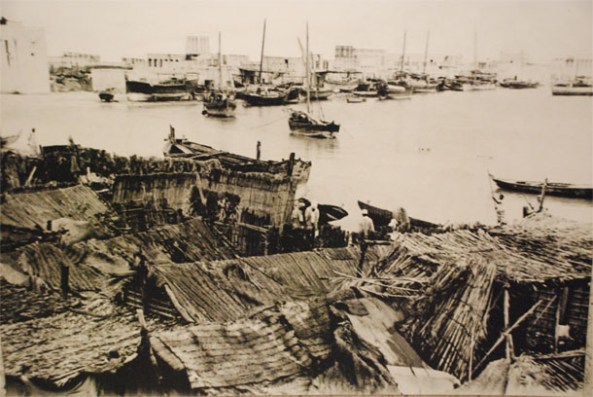
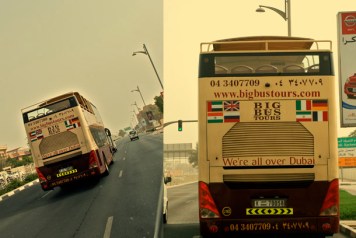 Big-Z is always excited when we have guests around. This gives her a break from her normal routine of studying, piano practice and strict bed-times. She is also very proud of me as the open air Double Decker bus ‘The Big Bus Company’ carrying tourists from all over the world doing the city tour follows her Mama’s car. We call our little tour company ‘Big Mama’s Tour’ and our loyal Dodge Durango the ‘Big Mama’s Car’! Big Mama seems to be doing a good job really as the ‘The Big Bus Company’ and its tourists follow wherever Big Mama goes.
After the Dubai Marina tour, we proceed to the Atlantis Drive, explaining the formation and technicalities of the Palm Island in great detail. The Palm Island is a vision of HH Sheikh Mohammed Bin Rashid Al Maktoum, the Ruler of Dubai. Imagine, an island in the shape of a palm tree! Each leaf (frond) having individual beach area and water front! I still cannot fathom the massive technicalities that must have been braved to realise this vision. Or the disruption of marine ecology for that matter.
The Palm Islands are the only man-made construction after the great wall of China to be able to be seen from the moon! ‘REAL-L-L-L-Y?, shouts my guests… I feel absolutely satisfied! I don’t think that there is a bigger level of land reclamation on sea taking place anywhere in the world as here. Not even in the Netherlands.

There is a crescent which acts as a breakwater that promises to protect against the sea storms, yet offer uninterrupted views of the sea. And the Atlantis Hotel sits right in the middle of this crescent, just like an undisputed crown. The view of the sunset (left) over the vibrant turquoise of the Persian Gulf, as you stand on the natural rocks, is to cherish forever. As if one is watching a panoramic 3-D view of the shoreline with water all around and pinned at the base of Atlantis!
People naturally live along the 16 fronds of the Palm Jumeirah and everytime I am asked ‘Who lives here?’
Newspapers regularly come out with long updated lists of celebrities investing in Dubai real estate. So I do throw in a few names just to add a bit more ‘wow’ factor to our trip. Yeah, like Shahrukh Khan. I think even the Beckhams are contemplating staying on the Palms or had contemplated once – or something like that. A bigger WOWWW from my audience!
Such is my passion to show around the city to my guests in my way, that sometimes my guests pretend to be ‘not upto it’ all the time. I am known to be an otherwise sensitive human being, but these are the moments when I am a bit blind and become insensitive. I cannot imagine that my guests will go back without having seen all the places in Dubai that I would have wanted them to see. And don’t forget the tagline – ‘In My Way’!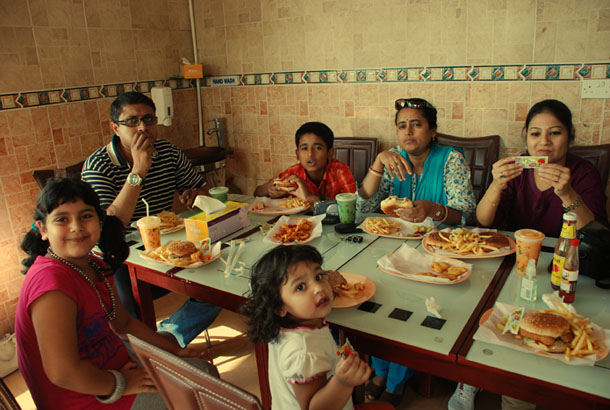
Last December, our house was totally full with two groups of guests which I’m going to address as Group A and Group B.
Group A – My cousin with her two girls (aged 10 years and 8 years) had come from Mumbai; Group B – my husband’s cousin with her son (aged 10 again) had come from Kolkata. Both groups joined us over the New Year’s Eve.
We were together all the time – together in the same house, together in the same car! We had to hire a minivan (left) so that we could be accommodated as we arrived upon our friends’ pad who were hosting the New Year’s Party!
 In 2008 New Year’s Eve, four of our close friends from good old college days landed from Bangalore with family (left; Photo Courtesy – Srikanth, my friend who’s a brilliant photographer). The hotel apartment (Exclusive Hotel Apartment in Golden Sands Area – I still remember the name) where they were booked in was rumoured to have shut down its operations after the chaos and the mayhem left by our 6 days long continuous partying! There were rumours too that we sold off our sedan after that New Year’s Eve since we were ashamed that our Sedan couldn’t accommodate our friends. The 8-seater Dodge Durango came in the sedan’s place. Though it still cannot accommodate 16 guests, it does save ourselves from some amount of guilt sometimes – at least 7 guests can squeeze in… Maybe our hearts and home may not be big enough to accommodate so many guests but we do have a very big heart!
Coming back to last December… Besides Group A and Group B, my own two little brats – the Z-Sisters had to be accommodated as well. Luckily, the timing was appropriate which means that the schools were closed and I didn’t have to squeeze in school – runs in between Big Mama’s city Tours! I had a separate list of itineraries for both set of my guests.
Exclusive itinerary for Group A comprised of Desert Safari; visit to the Gold Souq; climbing the Burj Khalifa (the world’s tallest towers); visiting Carréfour for souvenir shopping and chocolates; visiting the crowded Meena Bazaar for original perfumes but at a discounted rate; and finally, trying out Sushi for the first time!
Exclusive itinerary for Group B comprised of visiting glitzy Shopping Malls that Dubai was famous for; again visiting glitzy Shopping Malls that Dubai was famous for and lastly, once again visiting glitzy Shopping Malls that Dubai was famous for… hence Dubai Mall, Mall of Emirates, Burjuman, City Centre Deira etc. The Dubai Tourism board would have been pleased with my Group B guests!
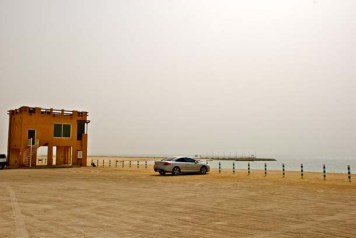
There was also a common itinerary for both Group A and Group B which included the following –
Frolicking in the sun and sand in the beach; visiting Dubai Museum; a drive along the Creek side and strolling in the Bastakia quarters (Yes, they had no choice over this. They had to do this part because Big Mama wouldn’t let them otherwise!); eating more than 2 meals at Mc Donalds and Burger King (who can fight the decision of 6 adamant kids joining hands for their ‘meal cause’); watching the Dancing Fountains at Dubai Mall; experiencing glitzy fireworks across the Dubai sky; see the Burj al Arab as the sun set; and lastly experiencing snow in Ski – Dubai!
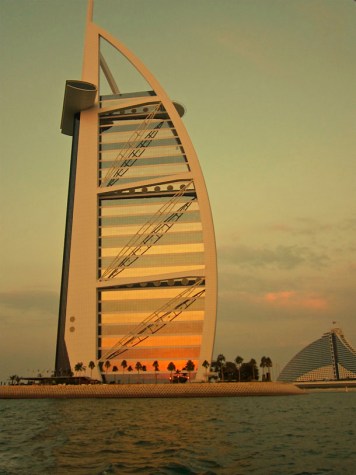 Everyone managed to do everything. At the end of the day while stock taking I was happy knowing that I was ticking away points from both the list of Itineraries. And they were getting to see Dubai ‘my way’! The only challenge lay in organising all the eight people from the composite group (Group A and Group B plus Big Mama’s own little kitties) to get ready by a decent time so that the city tour went off decently! Each kid getting up when they are already switched onto their holiday mode; finishing the ‘Breakfast Hurdle’ by the last permitted hour of Breakfast timing and that too when one kid had toasted bread with only butter; the other demanding sugar on buttered toast; jam please and not jelly on toasted bread for the third one; and my own girls demanding all of these on ‘soft’ toast! And the Mamas? One Mama needed only skimmed milk, another Mama apparently could not stand the smell of skimmed milk! Tea for one and coffee for the other… and then the decision time for choosing clothes and shoes -probably the most difficult part if the entourage is more inclined towards the fairer sex! There was only one boy in the composite group and the rest of us were all women and ladies and girls of various ages – ranging from 2 years to 40 years! So the debates were many – stilettos vs Crocs, sunblock vs foundation, sleeveless vs sleeves, skirts vs shorts, Indian attire vs Western… the temporary decisions before one single final decision of ‘what to finally wear’ were also too many!
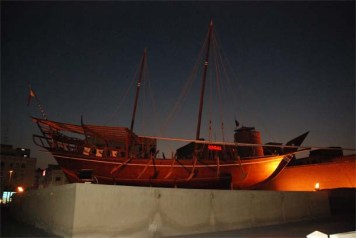 However, the final decision would ultimately be based on how they wanted their friends to see them on FaceBook under their albums titled ‘Winter Vacation in Dubai’! They obviously couldn’t have been caught dead with the same clothes that they wore to their previous vacation in Singapore or Hongkong, could they?
FACEBOOK reminds me of a funny incident too. Thanks to FACEBOOK we are again connected to so many of our school friends – friends who were culprits or siblings-in-crime in various sinful acts in our golden childhood days. One such friend was visiting Dubai for a week en-route their journey back to Canada from Kolkata. We just had to catch up, but how? She was busy with her interesting itinerary. Big Mama’s tour spared her and her family because she was seeing my Dubai, in my way, although on her own!
I was busy juggling with my 2 group of guests. The only evening she could possibly spare was one Thursday evening. There was a typical Dubai-ian display of fireworks as well on the same day at Festival City, a shopping Mall situated a bit far away from where we stayed. There was no way I would let Group A and Group B miss out on this grand display of Dubai’s generosity.

I asked my friend to meet me at the Walk (leftt), just below our house at 5pm so that I could personally take them (her 2 sweet little girls, her hubby and my friend) for a drive to Atlantis and the Palm Islands. Please note the time – I was planning to drive them along the long drive along the Crescent of the Palm Islands exactly at sunset, so that by the time we reached the western end of the crescent they could marvel at the night lights breaking out of the sky-scrapers dotting the Dubai Marina and the JBR.
But before I could take them out, I had to meticulously plan, so that Group A and Group B could take a taxi on their own and go to Festival City to watch the Fireworks. I emotionally blackmailed Big Z to take an afternoon siesta so that she could enjoy and let us enjoy when my friends and family came home later in the evening for dinner.
I managed to do a super fast grocery shopping and then managed an even faster cooking of ‘okay’ standard Mutton Biriyani and Tandoori Chicken (or was it some other Chicken, I am confused now). I put the numbers of all the Taxi companies in Dubai on my speed dials, so that I could co-ordinate the taxi for Group A and Group B, while Big Mama could take her new set of guests for the Palm Island Drive. And after this meticulous planning, ‘Big Mama Tour’ started her evening city tour over the Marina, and then the Palm Island… the FAQs being tackled by Big Mama with great ease and practice. Big Mama herself beaming with pride as her new tourists blurted out the countless ‘WOW-W-W!’s and ‘REAL-L-L-L-Y?’s…
Everything was going according to the tour plan till Big Mama’s mobile rings.
‘There is no taxi’, ‘No taxi is stopping’, ‘Oh, we are going to miss the Fireworks’ – my guest kids called up as they were waiting at the main road in front of JBR for an hour. Apparently not a single taxi stopped for them. This is the reason Big Mama likes taking control of all the movements of her guests. Missing the fireworks was definitely not an option at all.
Not a single taxi company could be connected. It was a weekend plus New Year’s Eve was about to set in… everybody was putting everyone and everything on hold, let alone the taxis! Suddenly there was this empty taxi at the side of the road. The taxi driver was probably taking his time off to do a lot of things that were basic necessities I guess – like smoking, having a cold drink, making some personal calls…
“Please ‘Bhai-saab’, please follow me – I have got a few guests waiting at JBR and they would like to go to the Festival City… Please, please, please follow me!’
The taxi-driver was naturally too happy to follow me – he would have got paid around 40 Dirhams just to follow someone… was there an easier way to earn money? So I almost dragged the taxi to the door, so that Group A and Group B could ride the taxi from almost their doorstep. It is as good as driving them myself, wasn’t it? And then when I narrated to my husband how I got the taxi to follow me, he got so nervous regarding the capabilities of our guests to get a taxi for themselves that he went out of the office all the way to pick them up, in case 5 people went missing from the face of Dubai!
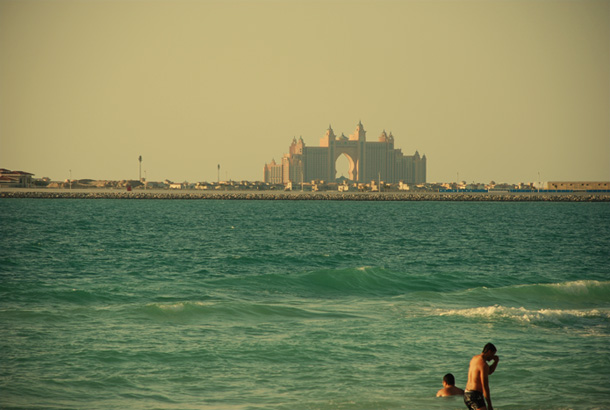
I also remember the time when I was carrying my first baby and one of my best friends had moved into Dubai. I was dangerously pregnant, with my huge belly steering my car into the next lane every now and then. My friend still remembers how I bullied her into seeing everything that Dubai has to offer. I even showed the Gold Souq to her in ‘My Way’. We were staying in Bur Dubai at that time. Both she and I, we walked all the way from our home to the Abra Station and took an Abra (traditional ferry) to cross the creek and reach the Gold Souq. As we would board the Abra, all the other passengers would stare at me – a hugely pregnant lady with camera hanging from her neck, jostling for space! Was I a pregnant tourist or a pregnant Photographer, they would perhaps wonder. Either way, I looked a total misfit in the crowded Abra, looking like I belonged exclusively to the Maternity Ward!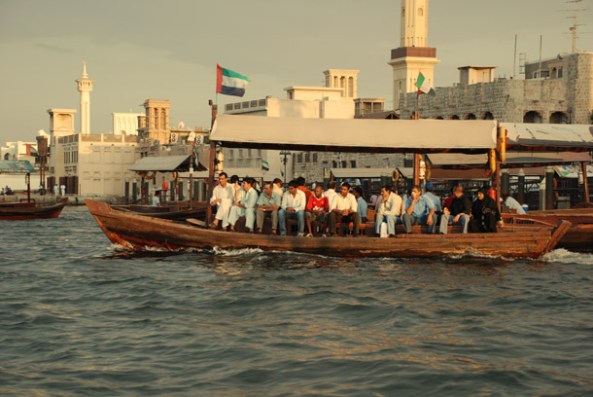
Taking the Abra across the Dubai Creek to go to the Gold Souq – this is one of my all-time favourite touristic deeds in Dubai. An Abra costs only Dhs 1 for a one-way commute – the cheapest thing that you can get in Dubai probably, since a can of coke too costs more than that!
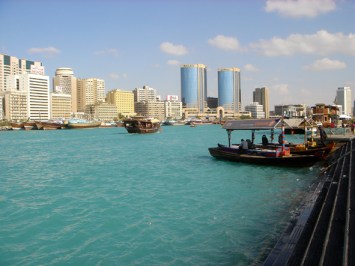 The Dubai Creek has a lot of historical importance. Whereas most places in Dubai has a history running to as little as 2 to 5 years, for example – the Burj Khalifa, The Palm Islands, The Dubai Marina, the Dubai Metro, the massive shopping malls etc, the Dubai Creek is really the focal point in Dubai’s history. It is a natural sea-water inlet which cuts Dubai into two parts – the old part of the city known as Deira and the relatively modern part – the Bur Dubai. These two parts have their own uniqueness and identities, not to mention their own idiosyncrasies. The residents living in Deira are skeptical of the residents living in Bur Dubai and vice versa. If you ask me the reason I won’t be able to tell you why. Being a resident of Bur Dubai in our early days in Dubai I also belong to this typical Bur Dubai camp. Now, we have moved into a even more new part of Dubai – the Dubai Marina Area and I am realising that another camp is gradually forming, comprising of residents of Dubai’s newer developments.
The Dubai Creek is definitely one of the most amazing features of Dubai. It obviously doesn’t have the promenades, the upper-lipped gourmet restaurants and the exclusive lifestyle that the artificially built Dubai Marina boasts of. The Dubai Creek is real. It mirrors centuries of old trading traditions. Throughout the creek, starting from its initial inlet into the mainland Dubai one can still see the loading and unloading of trading goods from the traditional Dhows. The smells from the the various ports of origin for these Dhows, situated in distant countries like the South-East Asian countries, India, countries from Africa etc seem to pervade the air. Whereas, the trading boats are visible on the Deira side of the Creek, one can only find beautiful luxury private yachts, traditional wooden dhows promising sunset and dinner cruises, on the Bur Dubai side of the Creek.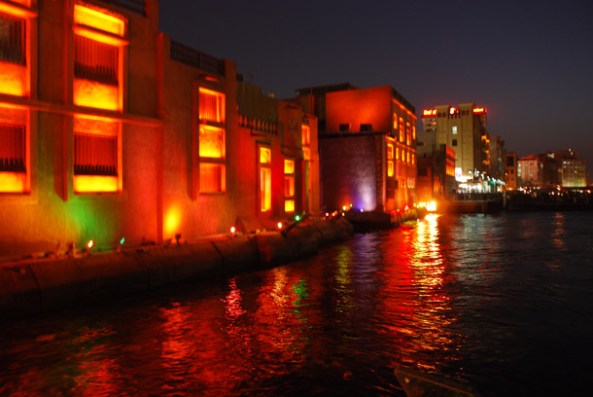
The Dubai Creek has been very important in Dubai’s development as well, as Dubai started off as a small trading city, occupying a small dot on ancient trading routes connecting Asia-Europe-Africa. It still does. An Abra ride is absolutely essential to experience the creek. So many times we have taken a small water bus for a private sail along the Dubai Creek till the Makhtoum Bridge which still splits open at night to let the ships pass!
I have always wondered whether we could actually sail along the Creek as it pierces into Dubai for 15 kms after which it finally gets absorbed like a sponge at Ras Al Khor Wildlife Sanctuary. Well, I guess I must find that out.
Anyway, I love this Creek for various emotional reasons –
Shindagha Tunnel: The Al Shindagha Tunnel is a tunnel in Dubai which goes under the Dubai Creek. Constructed in 1975, it is the only underwater crossing in Dubai Creek. I always put the music on full blast and drive through the tunnel. At the point where the tunnel is deepest under the creek, the transmissions stop. ‘Oh no, we are under the water’, I shout! If you happen to be in the Revolving Restaurant in Hyatt Regency, Deira (once upon a time the only high-rise hotel) it indeed is a scary feeling when you see a queue of cars coming in and going under water (as they go into the tunnel) and gradually come out of the other side, almost like some magic!
The Dhow Cruise: Sailing into the sunset with the two shores gradually fading by as you sail on a traditional dhow into the sea. The traditional wind towers of the old quarters of Bastakia and the Heritage area of Al Shindagha on one side and the old souqs on the other side look absolutely breathtaking – a page out of some traditional arabic folklore. These heritage buildings are historic monuments and have stood the test of time. The call for the evening prayer, Adhan by the Muezzins from the innumerable mosques scattered around the area, the setting sun – everything makes this Dubai landscape so ethereal. Sailing back from the sea into the Dubai Creek on our journey back makes us feel like the triumphant fisherman or the successful pearl diver coming back home after toiling the whole day in the sea with the priciest catch!
 Feeding the seagulls – The seagulls engulfing the anchored Dhows, flying at a jet’s speed and trying to snatch away the breadcrumbs from our hands… walking along the creek, feeding the seagulls and the fish, taking an occasional boat-ride along the creek, smoking Seesha (Hubble-Bubble) at the Creek Restaurant (which unfortunately doesn’t exist anymore), taking all our guests for a Creekside drive and a long walk past the anchored yachts, luxury boats, traditional Dhows – we have done it all. We have actually over-done the Creek a bit!
Being in the crowd – We have also stood for hours amongst thousands of people thronging the Creek side to watch the dazzling firework displays during the inauguration of the DSFs (Dubai Shopping Festivals) year after year. We have also spent many a dirham buying mostly unnecessary stuff in the Night Souq that used to come up along the Creek when we had just come to Dubai. We have also sat on the super giant Ferris Wheel (oh the mushy-mushy days of romance when we were the just the two of us) and held hands as we went up and down and promised sweet nothings to each other with the Creek waters flowing by as a witness!
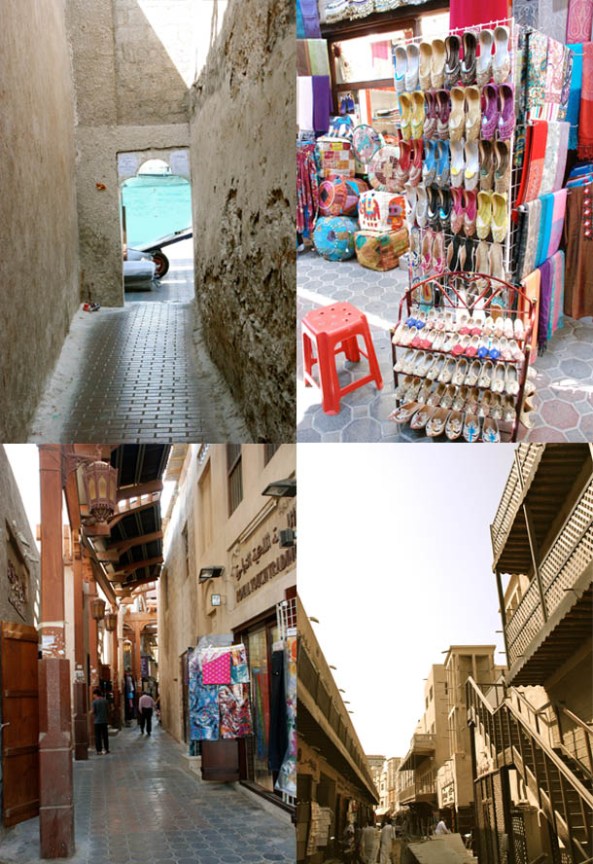
I love the walk upto the Abra Station as well, from the ‘managed-a-parking-atlast’ spot in the over crowded Meena Bazaar area. We walk through the traditionally styled Souqs which promise to sell everything real – from real Prada and Gucci bags, Bvlgari sunglasses, Chanel and Christian Dior perfumes, Lous Vitton shoes, Armani scarfs… If you have a brand in mind, all you have to do is just name it. There are hidden shops in the small dark alleys and a fairy God-father will pop out from the middle of nowhere. He would have heard your wish and would promise to provide you with the ultimate retail therapy of your life, without even costing an earth! Interestingly, though idol-worship is not permitted in Islam, it is here in one of the alleys near the Bastakia that you will find Sunni mosques, Shia mosques, Hindu temples – all snuggling into each other.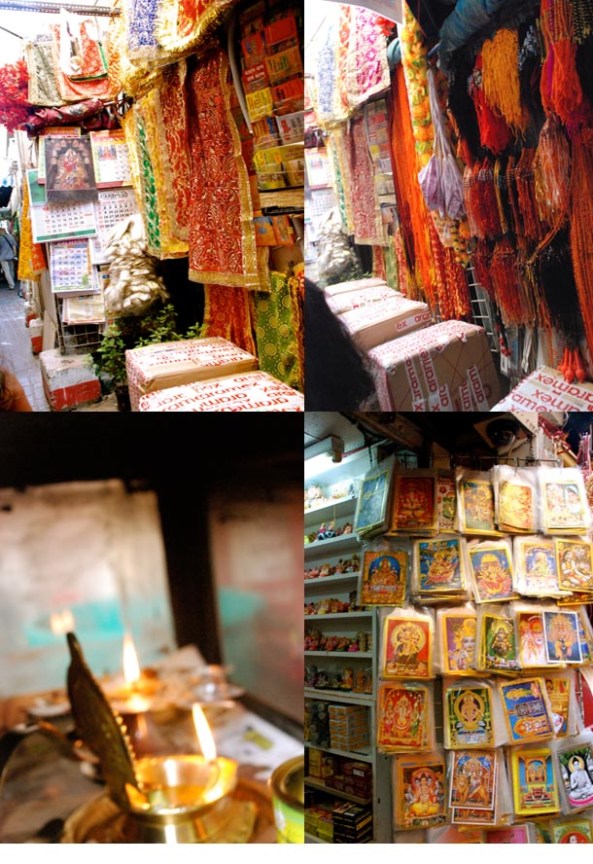
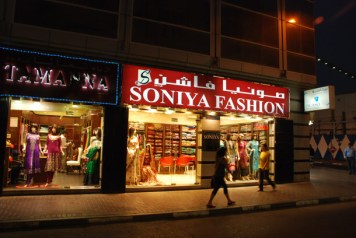 Contrary to the glitzy shopping malls in Dubai, Meena Bazaar has a different charm altogether. From glaring lightnings to the blaring horns from cars struck in perennial traffic, from the snaky lanes and by-lanes to the crowded main-road, from Indian and Pakistani stores selling traditional clothings to Iranian spice shops, from haute-couture fashion Boutiques (selling mainly traditional Indian and Pakistani ethnic attire) to stores selling high-street fashion, branded watch-houses to shops – the ’10 Dirhams shops’ selling inexpensive models, from electronics to home products, from computers to spare-parts, from quick-fixers like cobblers and menders to expensive tailoring shops – I love Meena Bazaar. Specially when the narrow dark alleys suddenly open up and you are hit with the bright sunlight and the sparkling sea-green waters of the Dubai Creek!
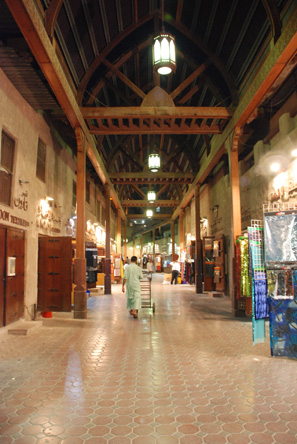
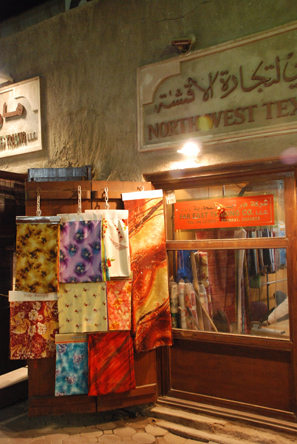
The souq (above) has many handicraft shops selling almost everything – spices, traditional Arabic clothes, Indian shoes and pashminas, beads, old coins, utensils, Indian and Pakistani ethnic attire and shoes, and lastly, not to forget the ‘branded’ stuff! This area also promises absolutely delicious traditional local delicacies vendoring out of small kiosks and small cafeterias. But, you have to know the exact location. Otherwise finding anything for the first time could be quite a nightmare!
Spice Souk station across the Creek on the Deira side, is less than a 5 minute walk from the Gold Souk. This is the where we disembark from our Abra. Soon you will be transported to a tourist’s heaven. The Gold Souk can be recognised from far as the enormous wooden gates framing the entrance greet you and promise to lure you to the dazzling world of gold.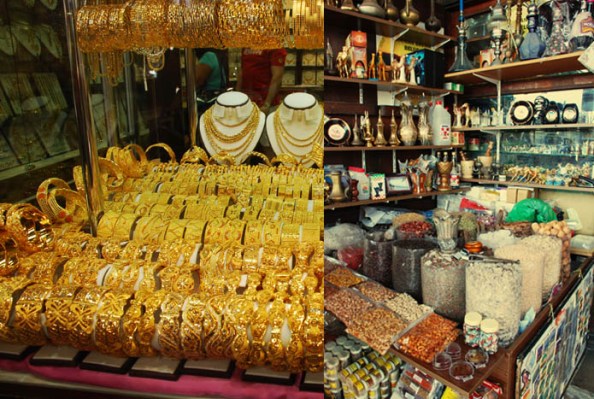
Traditional wooden frames support the entire walk-way into the Gold Souq (above left) from the Spice Souq (above right). The smell of Attar floats in the air. The beautiful Sheeshas on display, the aroma of exotic spices, the lure of the cheap silk kaftans, the dazzling imperfectly embroidered tops – it is indeed very difficult to resist the temptation to buy, if not a lot but atleast some small thing.
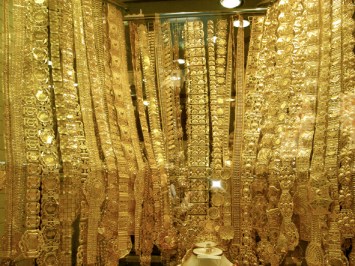 And then when you come to the Gold Souq, it hits you like you have just been hit by the fire from the oven. Is it real? The entire stretch of the jewellery shops displaying gold chains and jewellery as if they were clothes hanging from raisl. Who buys all these gold, I wonder. Obviously, someone does. Otherwise, how do these shop manage to exist day in and day out, season after season, year after year, displaying kilos and kilos of gold! No wonder, one sees pages and pages in various Dubai magazines, advertising jewellery for any occasion – Mother’s day, Daughter’s Day, Valentine’s Day, UAE National Day, the Holiday Season, The Festive Season, For Simple Reason, For An Unique Social Cause… You may also donate an event name for the jewellery industry to ponder!
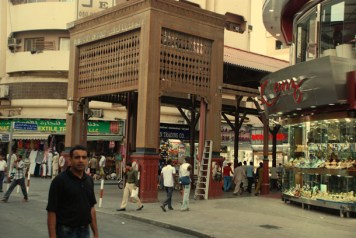
Haggling is as part of tradition as buying gold is. Shops are wide awake until 10pm. And don’t worry about the type of currency you are carrying – you can pay in British pounds, US Dollars, Australian Dollars, Indian Rupees, UAE Dirhams…and of course your credit card! Only, take your time and choose wisely. Gold is a very serious business, more lucrative than Real Estate, I hear! The Gold Souq dazzles in the true sense and it’s a short of miracle if you are not blinded by what you see – windows full of every imaginable piece of jewellery!
The Gold souk is the heart of Deira. It has more than 300 retailers trading almost exclusively in jewellery. The history of Gold Souq dates back to the 1940’s and runs parallel to Dubai’s history.
 I feel very proud as an Indian to share the fact that India is Dubai’s largest buyer of gold, accounting for approximately 23% of the emirate’s total gold trade. (Yuhoooooo!) Also, India accounts for approximately 68% of all diamond-related trade in Dubai! 68% of diamond-related trade in Dubai? I cannot even fathom the actual figures. Unfortunately, these figures alone cannot pull up the millions of people in India living under the poverty line over this dreaded line.Once you are done with the ‘Wows’ and the ‘Unbelievable’s and the ‘Oh My God!’s, and can take it no longer, please take a taxi back home. A stroll in Gold Souq is pretty much fatiguing. And you need lots of energy to overcome the sheer opulence of the tourist spot. Big Mama’s Tour has no more suggestions for the day. Even Big Mama’s Tour gets fatigued once in a while!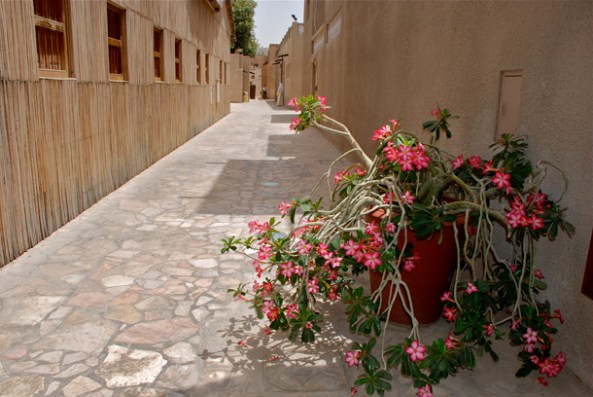
In the future, I would have to share a few more places in Dubai, without which this entry is incomplete. Plus, a sequel is the order of the day. Every movie has a sequel. Every novel has a sequel. So in modern times, a Blog should also have one. And that sequel should be covering the following…
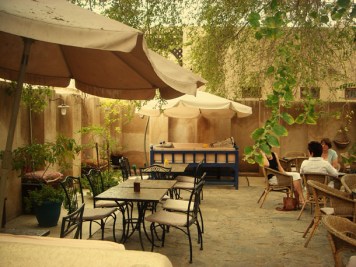 – The art alleys of Bastakia (above) and the old quarters
– Sitting for an Arabic coffee in Basta Art Café (right)
– The drive along the Jumeirah Beach Road
– The Meena Bazaar in greater detail
– The Barbecue on the Beaches
– The fresh fish offered by the shack hiding on Jumeirah Beach Road
– And much much more…
There are obviously many a thing that I haven’t yet done in Dubai. If you have, please do tell me so that I can update my emotional vacation in Dubai. Till then Tchüs!
Unblogging it all… Ishita
Glossary:
Abra – Water taxis
Dhow – Traditional wooden boat which used to
be used for transporting goods for trading from
across various countries
Seesha – The Hubble-Bubble or the Hookah is a traditional Smoking Pot
Souq – Traditional Arabic markets
isclaimer: While you enjoy reading the posts with lot of visuals, please do not use any material from this post. Please note that this blog is not a sponsored blog and the subject, story, opinions and views stated here are my own and are independent. You can catch my daily travel and food journey on Instagram, Facebook and Twitter.
◊————————————————–◊
A few picks from my Dubai Diary:
♦ Things To Do In Dubai – Like A Tourist In My Own City – Showcasing the city I love to call my home!
♦ My First Authentic Emirati Food Experience!
♦ Bu Qtair Fish Restaurant | Capturing A Hidden Gem In Jumeirah. A Video Too!
♦ Masqouf in Bait Al Baghdadi | Tasting Iraq’s National Dish
♦ The 7 Tastiest Fast Feasts Of Dubai | Introducing Chowzter to Dubai
♦ Locavorism, Friday Market | Tok Palong/Sour Spinach Chutney
♦ Semaiya Kheer/Vermicelli Pudding, Eid in Dubai | Eid Mubarak!
♦ Meena Bazaar At Night | Introducing DubaiUnblogged… Dubai In Instagram♦ Arabian Pilgrimage Food Tour With Frying Pan Adventures
BE SOCIAL. SHARE THIS!

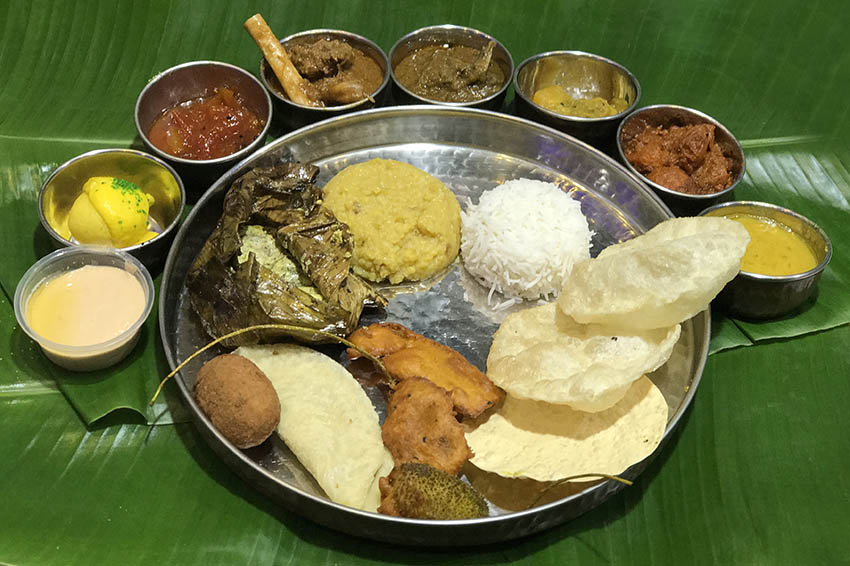
An etymological explanation of our extreme Food-Fetish… I would simply say, ‘Blame it on our Bengali genes’!
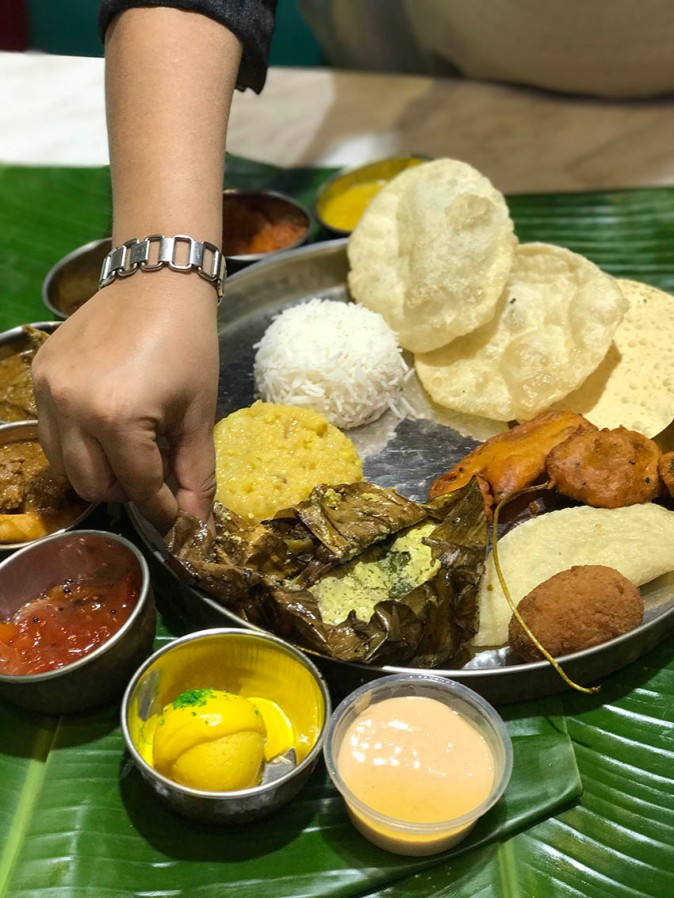
[Note: This post was originally written on 15 October, 2012 during Durga Pujo. I’ve changed the date of publishing in order to feature it on my homepage in a certain order]
This is an emotional post for me, tugging at all the nostalgic nerves that I have in my body. It has taken me long to gather my thoughts, photographs etc – to explain as simply as I can, the nuances of traditional Bengali Cuisine. It is a cuisine that is vast and elaborate, but every time someone asks me, ‘What comprises Bengali Cuisine?’, I falter for a while as there is no simple answer to that. There are so many layers to the cuisine, so many regional variations and if we probe into the evolution of the cuisine, it will also reflect the history of Bengal.
Most people I have come across are pretty much aware of Indian food. This awareness however stops at Biriyani, the Chicken Tandoori or a Butter Chicken. Or perhaps, the Dosas and the Idlies, which are completely different to North Indian food originating in the Southern states of India. Bengali food belongs to neither of the above categories and definitely not in between. An Indian map will certify that. Bengal is situated to the East of India and borders Bangladesh. And that’s where all the food stories begin.
 India comprises of 29 states (regional classification, officially) and 7 Union Territories (the union territories are ruled directly by the federal government, unlike the states which have their own elected governments) which are further subdivided into districts and so on. And the food is as diverse as it gets (read here) with each regional cuisine significantly differing from each region. (Map Courtesy: here)
Talking about myself (you can read more about me here), I am a true-blue Bengali or a BONG to the core, the latter being the colloquial equivalent to describe a modern Bengali – the urbane and the cool version. Born and brought up for the most part in Kolkata, FOOD has shaped my personality and character. My Bengali genes are to be blamed not only for my relentless creative pursuits but also my unsatiated taste-buds. FOOD is also our most important travel companion. If there is one thing we as a family, always agree upon unanimously, then that is this – ‘WE ARE HUNGRY!’ And yes, we are proud to have been able to transfer our genes to our little ones – the Z-Sisters!
Annaprashan or the ‘First Rice’

But how and why did this food fetish start? For a Bengali, this food fetish begins quite early – almost at infancy as you can see from the picture above.
The first ceremony or celebration that a Bengali child witnesses is Annaprashan or the ‘First Rice’. This Bengali tradition initiates an infant of barely 6 months to his/her first intake of food other than milk (the child is six to eight months old when the ceremony takes place, odd months for girls and even months for boys). Dressed up in the finest traditional attire (the girl child or the boy child resembling a mini bride or a groom respectively), it is a cute little sight to watch. Provided the little ones do not break into howling (see above how Lil Z reacts while our little nephew seems to be enjoying the adulation) which usually is the case considering the kind of spotlight the child is under! Usually, the Mama/Maternal Uncle or the Dadu/Grandfather according to some family tradition, does the honour of feeding the child a spoon of Payesh, the traditional Bengali Rice Pudding.

An excerpt from my earlier post explains the significance of Payesh…
The only other way to explain the importance of a traditional Payesh/Rice Pudding to a Westerner is to probably compare it with Champagne. If one can understand the importance of the Champagne to bring on a family celebration, then one can probably understand the importance of Payesh. Or say, cutting a cake on a birthday. For a Bengali, a spoonful of Payesh is a must on any special occasion. Also, the first spoon of non-solid food that goes into a Bengali child during Annaprashan or the First Rice is the same auspicious Payesh.
In effect, Payesh is the celebrity dish that cuts the ribbon in an opening ceremony!

What follows there after is a royal initiation (shown above) into food. The first vision of ‘solid food’ comes in the shape and size and form –
• Drops of Ghee (traditional Indian clarified butter)
• Payesh (a sweet dessert made with rice, milk & sugar – traditional Rice Pudding)
• Shukto/Bitter vegetable preparation
• 5 types of Bhaja or fries – Aloo bhaja/Potato fries, Potol bhaja/Parwal fries, Kumro bhaja/Pumpkin fries, Begun bhaja/Eggplant fries, Uuche bhaja/Bitter-gourd fries
• Torkari or an assorted vegetable dish
• Daal or lentil soup
• Of course, a variety of fish preparation accompanied by yes-you gotta-believe-me, a FISH-HEAD and a FISH-TAIL!
• Chutney, a palate cleanser and an informal initiation into a formal dessert tasting
As you probably can understand by now, the groundwork for a Bengali’s taste buds’ perpetual yearning for FOOD is built at almost his/her infancy!
Bengali tradition is reflected by two colours – Red & White
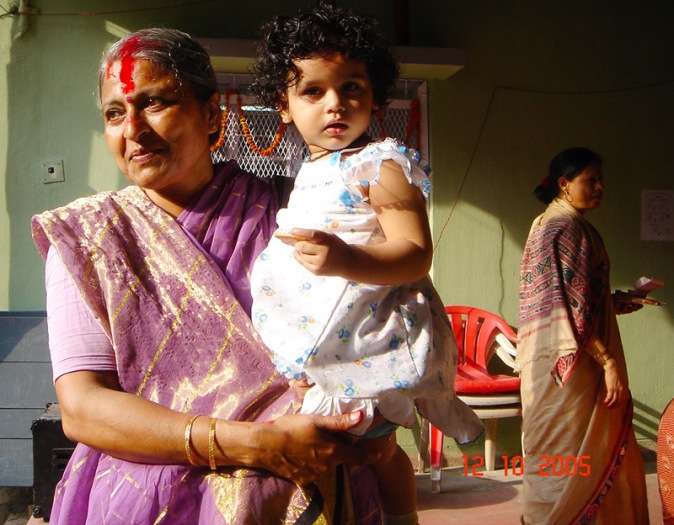
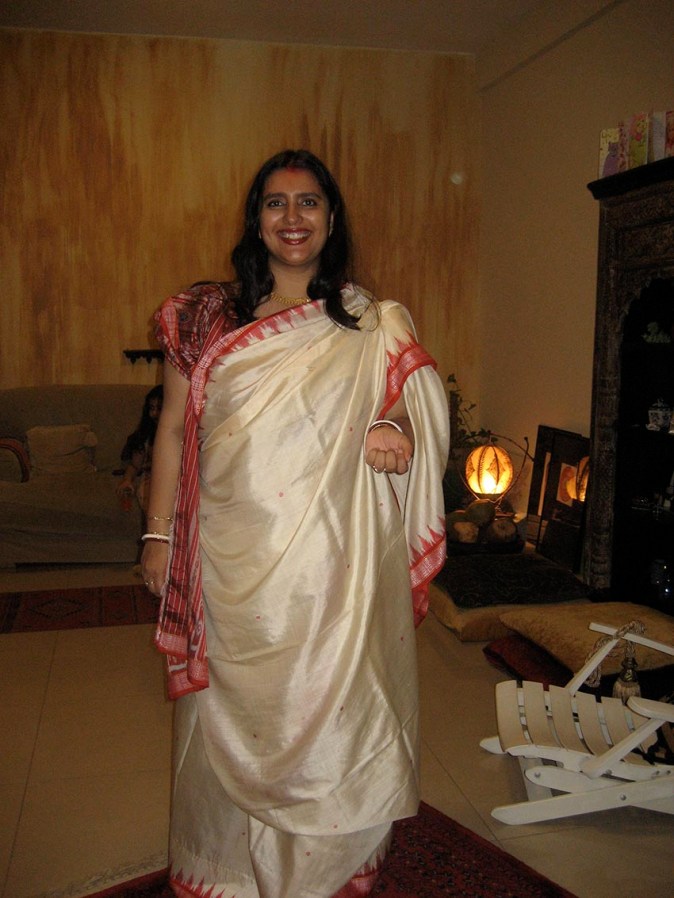
Bengalis world-wide are at this moment caught up in a festive frenzy. Every autumn a festive mood hits Kolkata as if Goddess Durga, comes to life. Thousands of Pujo Mandaps are built all over the city and there are thousands of ‘themes’ on which these Mandaps are built. The lightings, the structures, the extravaganza… the atmosphere is electrifying, almost carnival-like. The Durga Pujo or Durgotsav, as it is called continues for 5 days. Goddess Durga with her two sons (Ganesha & Karthika) and two daughters (Lasksmi & Saraswati), is believed to come down to earth from her heavenly abode in Mount Kailash. On the last day of the worship, the married women wear their traditional white saris with red borders and perform the Sindoor Khela where the married women smear each other with sindoor or vermillion. Well, I miss all these in Dubai although I try to replicate a few things at a special Bijoya gathering at home (yes, that’s me in the above picture and my mum-in-law during sindoor khela in 2005).

During our Kolkata visit on our summer holidays this time, we visited Kumortuli – the place where the idols are made. The artisans at this time were busy making the idols, only a few of them had been given a poach of paint. But it was still a long way to go for Pujo at that time (above).

Bhog, the food dedicated to the idol during Pujo is very special – it feels divinely aromatic and traditionally served in banana leaves. The picture below is from a special Pujo dinner at our home and probably shows the extent that we go to in-order to replicate the things and moments that we have grown up with! [Here’s a glimpse into a Bijoya dinner at our home, edited in 2017]
What comprises a traditional Bengali meal?
What follows below is an elaborate and a very traditional Bengali meal – a thing that can be conjured up only in my dreams – only because in reality how many of us are being able to cook up such elaborate and traditional meals on a daily basis?
Rice – plain white rice is the main accompaniment to all dishes, unless it’s made into a Mishti Polao. Firstly, Rice is eaten with starters (mainly vegetables) with Ghee or Daal. Rice is eaten in the Main Course too, either with fish, meat or chicken. Traditionally, Bengali dishes, specially the fish, are cooked in Mustard Oil. Rice is also the main ingredient in the preparation of some Mishti or desserts – for example, the Payesh – the rice pudding, or the Pati Shapta – rice crepe with a filling of kheer.
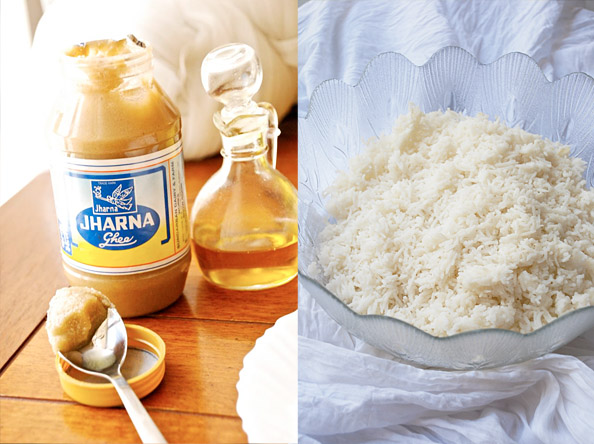
Squeezing a bit of Gondhoraj Lebu or the Bengali Lime (shown below) in Dal/Lentils, specially Mushurir Dal/Masoor Dal or Bhaja Moonger Dal/Fried Moong Dal is very unique to lunches at Bengali homes. These limes have their own aroma and something that I haven’t been able to find beyond the shores of Bengal. although we have found substitutes for many things that we miss from Bengal as we continue to lead our Bengali lives in non-Bengali shores. The closest I’ve come to the aroma of Gondhoraj Lebu is the leaves of Thai Kaffir Lime!
Kancha Lanka/Green Chillis, Gondhoraj Lebu/Bengali Lime and a pinch of Salt in the corner of plate is a trademark of traditional Bengali food serving!

Starters
• Bhaja or Fries: Crispy vegetables deep fried in oil. Examples – Aloo bhaja/Potato fries, Potol bhaja/Parwal fries, Kumro bhaja/Pumpkin fries, Begun bhaja/fried Eggplant, Uuche bhaja/Bitter-gourd fries. Sometimes fried fish may also accompany the white Rice
or
• Bhaaté or mashed steamed vegetables – Examples – Kumro bhaaté/Mashed Pumpkin, Aloo bhaaté/Mashed Potato, Uuche bhaaté/Mashed Bitter-gourd
• Shukto: A bitter vegetable preparation using Korolla or Uuche/ Bitter-gourd
• Shaak: Steamed or lightly cooked leafy vegetables. Examples – Palong shaak/Spinach, Methi shaak/Fenugreek, Lal shaak/Red Leafy Vegetables
• Torkari/ Mixed Vegetables
• Dal or lentil soup: Sometimes Dal contains various seasonal vegetables or fruits in it. Very famous is Aamer Dal/Mango Lentil Soup or Amrar Dal/Dal with Gooseberry. It may also be cooked with fish pieces or fish head and fish bones in it!


Bori Bhaja/Fried Lentil Balls (left) and Aloo Bhaja/Fried Potato (right)
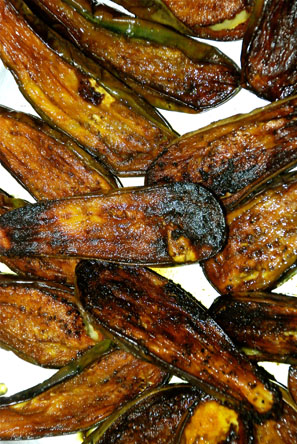
Begun bhaja/Fried Eggplant (left) and Jhurjhure Aloo bhaja/Potato Fritters Bengali Style (right)
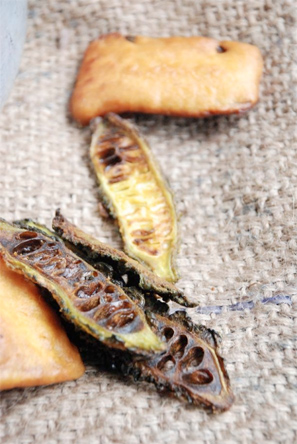
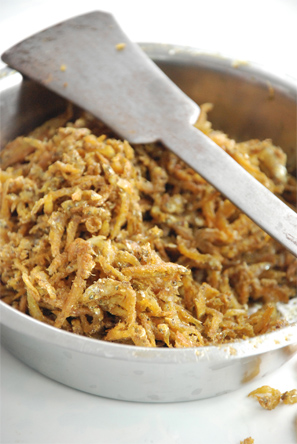
Uuche bhaja/Bitter-gourd fries, Beguni/Eggplant batter fried in Besan/Gramflour (left) and Mourala bhaja/Mourala Fish fritters (right)
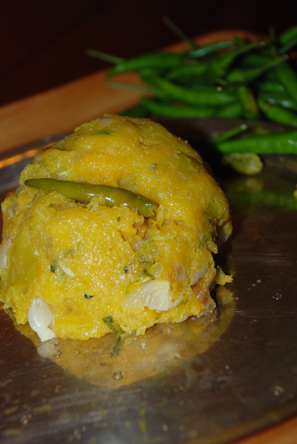
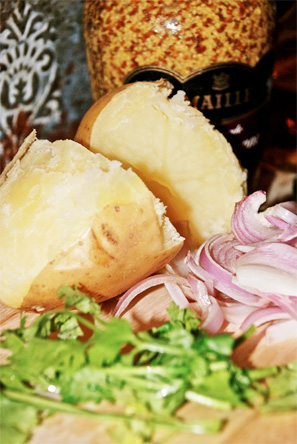
Kumro bhaaté/Mashed Pumpkin (left) and Aloo bhaaté/Mashed Potato (right)

Shukto or the Bengali ratatouille as I like to call it
Beguner Dorma/Stuffed Eggplant (left) and Potoler Dorma/Stuffed Parwal (right)

Aloo-Potoler Torkari/Potato Parwal (left) and Paanch Meshali Chochori/Assorted Mixed Vegetables (right)


Maacher maatha diye bhaja Moonger Dal/Fried Moong Dal with Fish-head (left) and Aam diye Musurir Dal/Mango Masoor Dal (right)

Kaancha Moonger Dal/Moong Dal (left) and Karai Shuti – Phul Kopi Diye Moog Daal/Moong Dal with Green Peas & Cauliflower
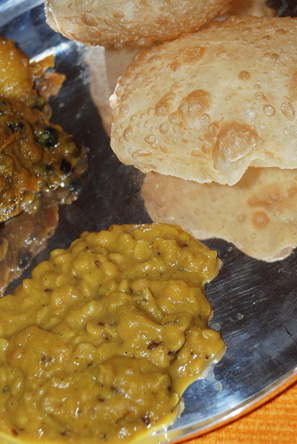

Cholar Dal diye Luchi/Bengali Puri with Bengal Gram Dal (left) and Aloo-Potol-Kumror Chokka/Potato-Parwal-Pumpkin Mixed Vegetable (right) is another popular food pairing.
While making Luchis, a dough is prepared by mixing Maida/Flour with water, a spoonful of Ghee/White Oil and a pinch of Sugar and Salt. Small balls are made out of these dough and flattened flattened and individually deep-fried in Oil or Ghee. When Maida/Flour is substituted with Atta/Wheat Flour, it is called a Poori. And a stuffed Luchi is called Kochuri. Karaishutir Kochuri/Kochuri stuffed with mashed green peas is an absolute delicacy.
Another Bengali delicacy that I miss very much and is not available in Dubai is Posto or Poppy Seeds as it is banned in the UAE because of its addictive quality (read here). However, Poppy Seeds also known as Khaskhas in other parts of India is widely used in cooking. In some regions of Bengal, Posto forms a part of daily meal. Aloo-Jhinga Posto/Potato & Ridge Gourd with Poppy Seeds (below left) or simply Aloo-Posto/Potato with Poppy Seeds is one very popular Bengali preparation. Another very simple yet very delicious Posto preparation is to stir in the Poppy Seed Paste in a bit of Mustard Oil with a slit green chilli thrown in. This is known as Bati Posto (the first picture below).

Main Course
Fish is still cooked daily for main course in most traditional Bengali households (do read my write up A-Z of Bengali Fish). Bengali cuisine is famous for it’s Maacher Jhol or Maacher Jhaal. Maacher Jhol is where the gravy of the dish is made with ginger, turmeric, cumin powder, green chillis (the ingredients may vary from one region of Bengal to another) and Jhaal is where the gravy is hot and spicy and made with mustard paste, turmeric, chilli. Shorshe Maach/Mustard Fish is a very popular fish dish.
Shown below are various Bengali fish delicacies (starting from top left) – Chitol Maacher Muitha/Chitol Fish Dumpling Curry, Pabda Maacher Jhaal/Pabda Fish Spicy Curry, Tel Koi/Koi Fish in Oil, Rui Maacher Kalia/Rohu Fish Kalia. There are obviously many many more types of fish preparation – Doi Maach/Fish cooked in yoghurt, Bhapa Maach/Steamed Fish, Maacher Paturi/Fish marinated in different spices and wrapped in Banana leaves and then steamed.

Special mention has to be made to the Hilsa fish. The Hilsa is synonymous with Bengal and is considered the ‘queen’ of all Bengali fish. Hilsa is also of political importance. It is a serious bone of contention between India and it’s neighbouring country Bangladesh. Which Hilsa is better – the Hilsa that is found in the Padma river in Bangladesh or the Ganga river, the last phase of which flows through Bengal before it merges into the sea-waters of Bay of Bengal?
The entire month of July and August, that is during the Monsoons, Kolkata is gripped by Hilsa. Hilsa festivals and special Hilsa lunches are organised in different clubs and hotels. Each conversation revolves around Hilsa. This year had been hard-hitting for the Hilsas with the prices shooting upto as high as Rs 1,500/kg (Dhs 100/- approximately!). The fish markets in Kolkata are in itself a subject for immense discussion – perhaps better kept for another future post (the image below shows a fishmonger showing his Hilsa catch with a lot of pride). The bony Hilsa is a delicacy and is prepared traditionally in many ways – the Shorshe Baata/Mustard Hilsa, Kalo Jeerar Jhol/Black Cumin Curry, Bhapa/Steamed etc.
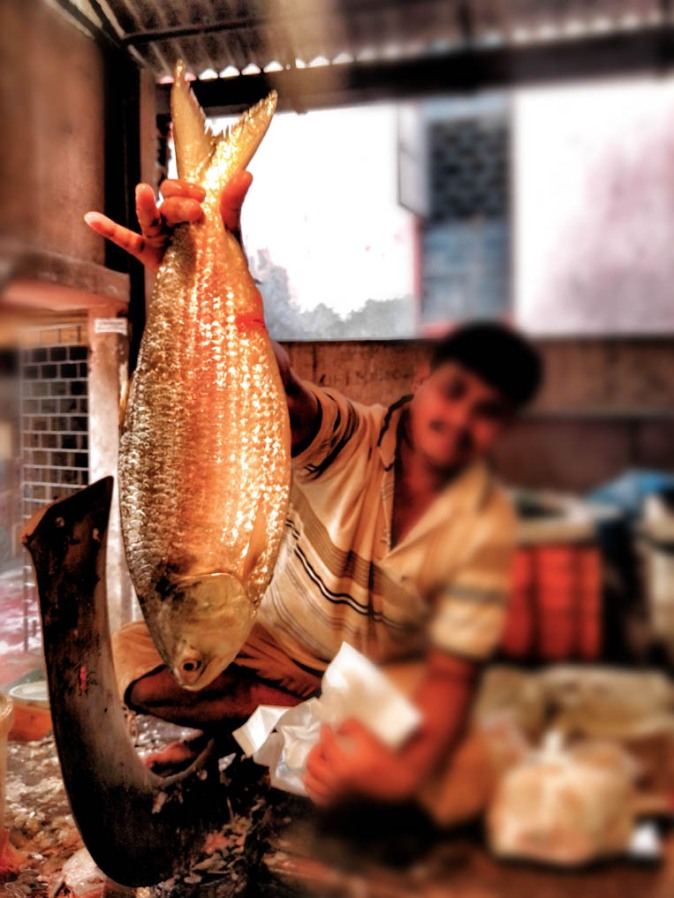
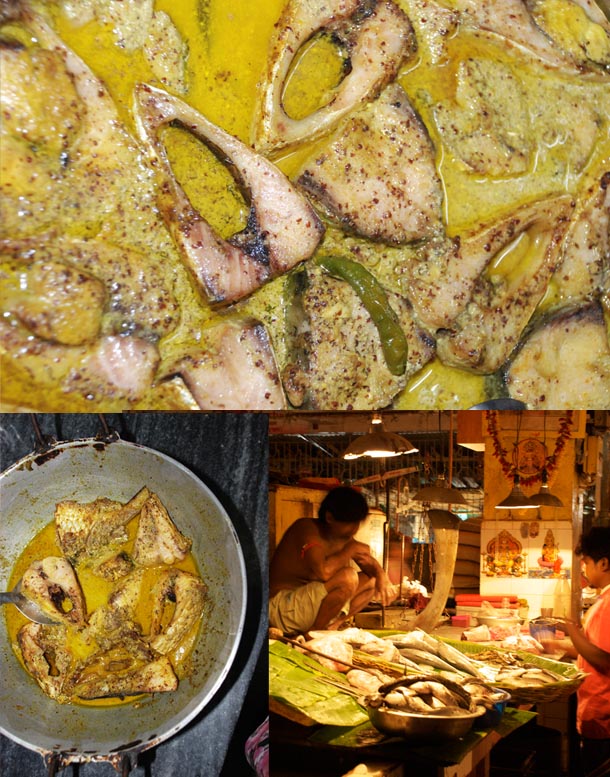
The discussion of Bengali fish can go on for ever. To cut it short we bring in the topic of Prawns. Bagda Chingri/Tiger Prawns and Golda Chingri/Indian Scampi go into making exquisite Bengali delicacies – Shorshe Chingri/Mustard Prawn (below right), Prawn Polao (below left), Narkel Chingri/Coconut Prawn and the famous Chingri Maacher Malaicurry/Prawn Curry where Coconut milk is used to make the gravy and is made on very special occasions.
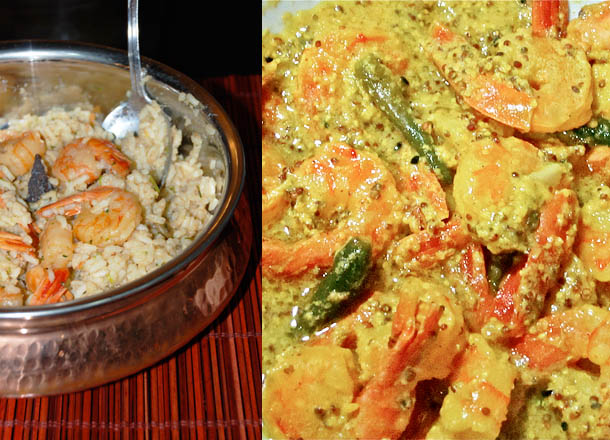
Meat or chicken substitutes fish occasionally. Generally, Rice accompanies the fish, meat or the chicken. On special occasions, Rice can be substitued by Polao/Bengali Fried Rice. ‘Luchi’ and Radhaballavi/Paratha stuffed with green Peas may also be served. Luchi is famously paired with Kasha Mangsho/Mutton cooked on slow fire.
Sunday afternoons at some Bengali houses are still reserved for Kochi Pathar Jhol/tender Goat Meat Stew Bengali Style (all pictures below excepting the extreme below right which shows Chicken Curry) cooked likely in a Pressure Cooker. Equally important is the Mangsher Jhol/Mutton Gravy and Mangsher Aloo/Potatoes cooked in the Mutton Curry!
And finally when Fish or Meat or chicken is unavailable, the Bengalis would also cook up a delicacy out of Eggs – the Deemer Dalna/Egg Curry!
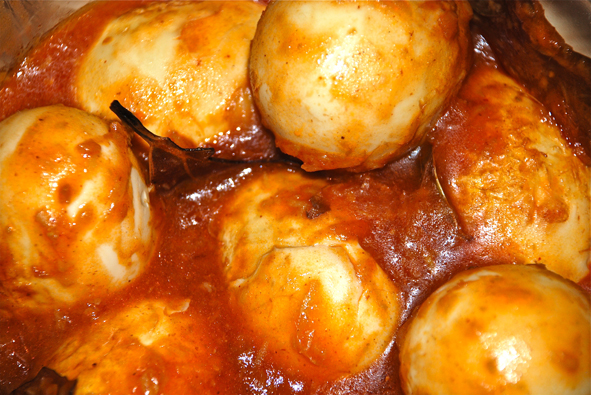
Rice – the perfect Meal Partner
I have already stated earlier that plain white Rice is the main accompaniment to all dishes. However, different types of Rice dish are made for different occasions. Polao, the Bengali version of Pilaf is traditionally cooked in occasions and compliments splendidly with Kasha Mangsho or Mutton/Lamb cooked on slow fire, in the Bengali way. Another Rice dish is Khichuri – a combination of Rice and Lentils cooked together and is an absolute must on a typical rainy day. Unlike Khichuri cooked in other parts of India, the Bengali Khichuri is not a comfort food during illness but is an absolute delicacy when accompanied by various types of vegetable fritters (below).
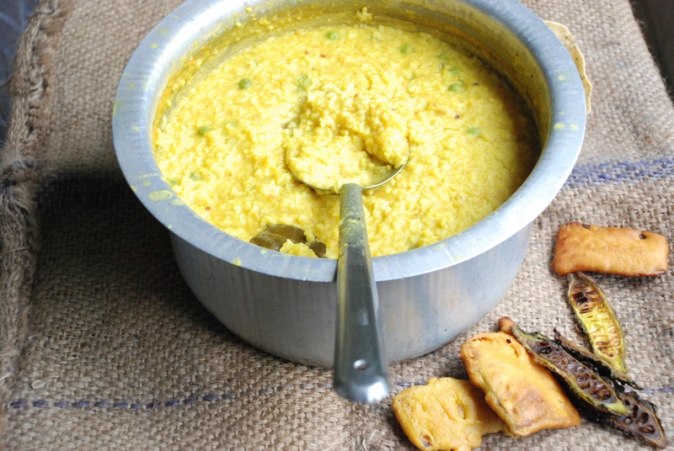
Though Biryani is not a traditional Bengali dish (but an integral part of Kolkata cuisine), but if ever a Bengali craves for Biryani…. and a majority of Bengalis do crave for Biriyani quite often, then it is mostly Mutton/Lamb Biriyani and must be essentially cooked in the Awadhi or the Lucknowi style!
Sweets/Dessert:
Sweets are a necessary sign-off for a traditional Bengali meal. You end your meal with Chutney, only to move onto the more formal session of dessert tasting. Chutney is a sweet, tangy paste and can be made with every conceivable fruit and even vegetables! For example – Aam/mangoes, Jalpai/Olives, tomatoes, Anarosh/pineapple, Tetul/tamarind, Pépé/papaya and various other type of fruits. Dry fruits like Khejur/dates, Kishmish/raisins may also be added to it the Chutney which is also splashed with Phoron/Mustard seeds cooked slightly in oil or Paanch-Phoron/5 seeds cooked in oil). The Bengali Chutney slightly differs from the other Indian Chutneys in the sense that hey are not eaten as dips with snacks and savouries but as a mini sweet sign-off before the actual desserts. Papad/Big chips like flakes made up of Potatos or Dried Dal usually accompanies the Chutney. Below is the
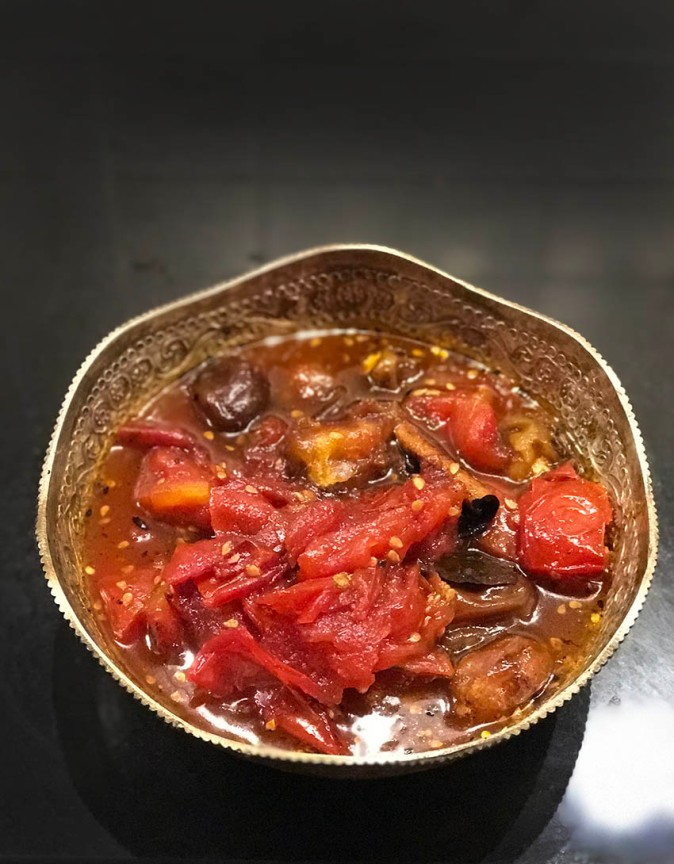
After the Chutney comes the formal dessert tasting! After Fish, Bengali Sweets is a quintessential Bengali topic of discussion. The choice in Mishti/Sweets is absolutely endless. This is a category that has catapulted Bengal into a different quotient of sweetness. Mishti Doi/ Sweet yogurt, Bhapa Doi/Steamed Yogurt, Payesh/ Sweet dessert made with rice-milk-sugar, Rôshogolla/Rasgulla, Rasamalai, Pantua, Lyancha, Chamcham, Chitrakoot, Chanar Jilipi, Kalakaand, Mihidana & Shitabhog, Rajbhog, Rasakadambo, Shondesh… the list is endless!
Perhaps the most famous of Bengali Sweet is the Rôshogolla or the Rasgulla (below) – inspiring me to write an entire post on it.

Shondesh is another unique Bengali sweet that is not very easily available in Bengali Sweet shops outside Bengal. Prepared with Chena/Paneer or Indian Cottage Cheese along with a variety of garnishing is very quite easy to make at home. Below are the famous Shokho Shondesh resembling the shape of a Conch or a Shonkho.
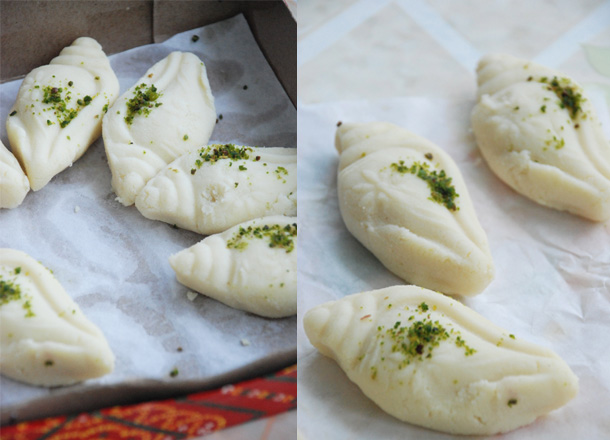
You’ll find a sweet meat shop in every alley and every lane in Kolkata – whether they are small locally known shops or big branded ones – a topic that will probably come revisit my blog again. Sweets like Mishti Doi/Sweet Yoghurt and ones dipped in Sugar syrup – for example Rasgulla, comes in a clay pot as shown below. The sweets that follows (clockwise starting from the Mishti Doi) – Nikhuti, Komlabhog or a type of Rasgulla made with Orange rinds giving out strong aroma of oranges; Kalo Jaam and the Bengali Rabri. This famous version of the Rabri hailing from Kolkata is a bit different from the other Indian varieties. As the sweetened milk starts boiling, a layer of cream begins to form on the surface of the milk. That is taken off and kept aside. Repeated process of the same results in the Calcutta Rabri. Needless to say this is extremely rich and creamy and is bound to be heavy on the stomach and extremely fattening.

Shown below (clockwise from top left) are Mishti Doi/Sweet Yoghurt in a clay pot; Gujias, a traditional festive sweet and the Jibe Goja (Jibe means tongue and these sweets are elongated tongue-shaped ones, hence the strange name!); Pantua which is not the same as the famous Indian sweet Gulab Jamuns and Jolbhora Shondesh which literally means ‘filled with water’!
An except from an earlier post on Bengali Sweets…
Opening sweet boxes opened the floodgates of my childhood nostalgia. I started telling the Z-SISTERS everything about Bengali sweets and tried explaining to them how each sweet shop in Kolkata or a region and town in Bengal has it’s own signature sweet, a comprehensive list of which has been brilliantly done here.
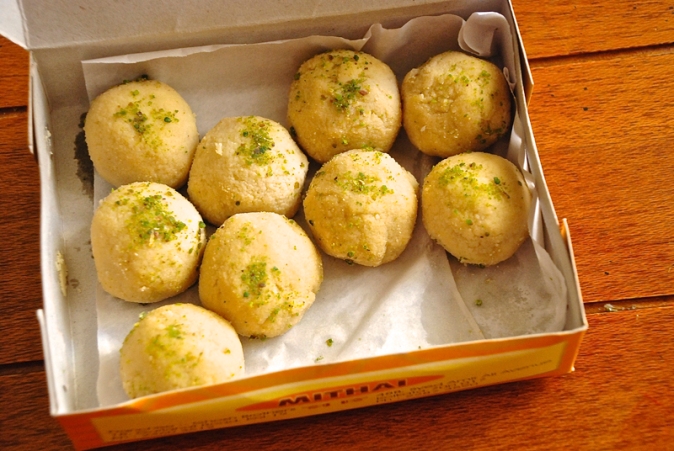
Apart from the never-ending lists of sweets easily available in sweet shops, some Bengali Sweets are traditionally made at home. Or rather used to be made at home. Needless to say that there are many varieties of these as well and require elaborate skills . Shown below are some of the sweets that are still made at our home in Kolkata… the Pithe Puli – Pithas are primarily made from a batter of Rice flour shaped artistically with a Pur or sweet fillings. Then these Pithas are dipped in milk or other types of sweet preparation. These are specially made during the harvest season and has an incredible number of variations (read here). Taaler Bora/Sweet Palm Fritters (below) is another festive home-made traditional Bengali sweet made during Janmashthami, the day when Lord Krishna’s birthday is celebrated.
While Pickles don’t exactly come under Bengali Sweets, it is also a dying home-art and is being gradually being outsourced to small Pickle factories and is being relegated to a small-scale industry. I am fortunate to have a traditional Mother-in-law who is holding on to the art of pickle-making so painstakingly. I have started tracing out her journey with my first post on Pickles.
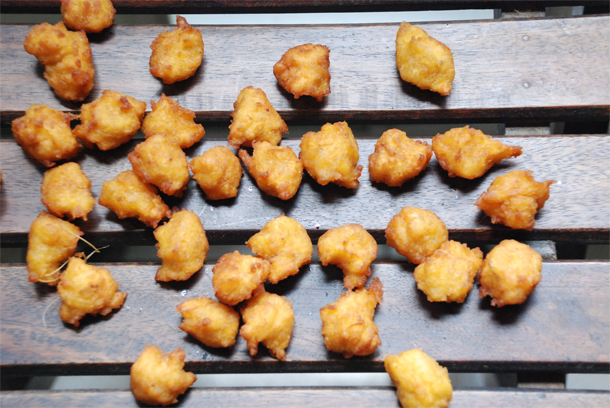
Nitty-gritties of a traditional Bengali Kitchen
In most Bengali households the Rice is cooked in a Dekchi (shown earlier along with Rice Polao). What is a Dekchi? Sutapa, the grand-dame of Bengali food blogging (14 years into food blogging!), describes it as ‘the handleless modification of the sauce pan – the rimmed, deep, flat-bottomed Dekchi which is a hallmark of the Bengali kitchen!’ Most of the cooking is done in a Kadai or an iron Wok (shown below). The Mutton is likely to be cooked in a Pressure Cooker. The ladle that is used to cook up all the delicacies is called a Khunti and the tongs or the Sharashi helps to transfer the hot pots and pans firmly from the fire to the kitchen counter. Haata is the aluminum serving spoon that is used to serve food and you’ll be having Bhaater haata to serve you Bhaat/Rice; Daaler Haata to serve Dal/Lentils and so on. Spices are ground with a Shil Nora – a grinding stone used in most Bengali kitchens to make Masalas Pastes where one rolls the mortar back and forth on a stone slab sitting on the ground. Vegetables are cut using a Boti where a long curved blade on a platform is held down by foot and both hands are used to cut the vegetables by moving it against the blade. The cooking oil used is mostly Mustard Oil though most modern households have shifted to other cooking mediums that are being advertised as heart-healthy! The unique Bengali spice is Panch Phoron/the 5 spice Mix (picture shown earlier along with Chutney).
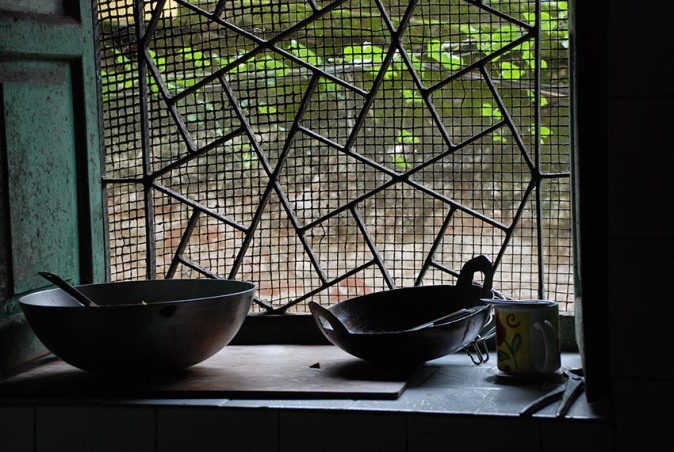
Bengali Kitchens outside the Bengal shores, specially my kitchen in Dubai
Many of us who have now made our homes on the shores beyond Bengal, have substituted various things to complement our Bengali Cooking. We have adapted ourselves and learnt to make good of what is available in the local markets. Most of the Bengali friends of my generation grew up studying for exams and not entering the kitchen that much. We ate what we were served by our Mums. It’s only when we began living our own lives that we started resorting to Bengali Food as our fall back comfort food. Binging on traditional Bengali meals when visiting our parents’ homes on holidays and waiting for someone more experienced in Bengali cooking – were the only ways to experience the meals that we grew up on.
Where do I get Bengali Fish from? Most Bangladeshi markets stock frozen packets of the different fish that are used in Bengali cooking. So you’ll get Koi Fish frozen fresh, packed in Thailand and flown many miles to Bangladeshi markets world wide. While we didn’t find any Bangladeshi market in Colombo, Srilanka, our stay in Frankfurt wasn’t devoid of Bengali Fish! Our stints in Colombo, Frankfurt and Dubai have taught us that if one is looking for Bengali food products that are available outside India, they can only be found in Bangladeshi shops and Asian supermarkets selling Bangladeshi products.
In Dubai, a few Bengali fish is available in the supermarket Citi Mart near Imperial Suites Hotel, located on Rolla Road, Bur Dubai (Tel: 04-3523939). It’s quite likely that on Friday mornings you’ll bump into Bengalis who have come to do their fish-marketing. All varieties of Bengali Fish are available at the Bangladeshi markets in Backet in Sharjah. Rui Maach/Rohu fish is available at Lulu Supermarket in Al Barsha but the sizes of the fish being smaller than 1.5kgs results in a bit if disappointment in taste. And of course, the Backet in Rolla in Sharjah (you can read about my experience here).
Substitutes that I’ve adapted over the years: Gondhoraj Lebu or the Bengali Lime has been the hardest to substitute so far. The closest I’ve come to the aroma of Gondhoraj Lebu is to drop in a few leaves of the Thai Kaffir Lime!
Gobindobhog or the fragrant Rice that is traditionally used in making the Bengali Payeshis a special type of rice. Wikipedia defines it as ‘Gobindobhog is a rice referenced in ancient Indian literature. It was used as an offering to the gods because it was known to be, “The rice preferred by the gods”. It is a short grain, white, aromatic, sticky rice. It is grown traditionally in West Bengal, India. It has many traditional Bengali recipes intended for it specifically. It has a sweet buttery flavor and a potent aroma.’ There is a type of rice which comes from Bangladesh – the Chinigura Rice (similar to Basmati and Jasmine rice but with very tiny, short grains, resembling sushi rice). The latter, though less fragrant than Gobindobhog Rice is easily available in Bangladeshi shops in the Sharjah Backet.
Notun Gur/Season fresh Jaggery can be perfectly substituted by using Date Syrup. One of my blogging friend Yummraj suggests that Maple Syrup works great as well.
Aamshotto/Aam Papar/Dried Mango Bars if not available can be substituted by Dried Apricot Bars easily available in Carrefour and Lulu Hypermarket.
Narkel Kurano/Freshly grated Coconut can be substituted almost perfectly by soaking dessicated coconut in canned Coconut Cream or in the worst case, fresh Milk! Dessicated coconut packets are available in frozen sections of most supermarkets.
The different fish available in local supermarkets in Dubai that I often use to make traditional Bengali fish preparations… Lady fish fried in batter substitutes well as Topshe Maach Bhaja, Sultan Ibrahami cooked with Black Cumin Seeds substitutes well as Pabda Maacher Jhol, Cream Dori fillets wrapped in Banana Leaves substitutes well as Bhetki Maacher Paturi. Salmon steaks cooked in Mustard Paste and Mustard Oil substitutes, well sorry there can be no substitutes for this – the Hilsa! But it works quite well. Almost! Red Mullets can be cooked like Bhetki Maach and Needle fish can be fried crispy like Mourala Maach.
Cookbooks and Bengali Food Blogs
As and when we started craving for Bengali food, we ended up learning from different cookbooks and the all-knowledgeable internet. Some of these Bengali bloggers have now become friends. However, more than the internet my go to guide to any type of cooking is a simple cookbook that has been my trusted guide for the last 20 years – N.I.A.W Cookbook.
Bengali Foodblogs:
• Introduction to Bengali Cooking by Sutapa, the grand-dame of Bengali food blogging (14 years into food blogging!) and her site Bengali Recipes on the Web
• Cook like a Bong by Sudeshna and Kalyan who’s created a comprehensive one stop site for Bengali food
• eCurry by Soma who’s demystifying the magic of Indian Cooking with quite a lot of focus on authentic Bengali recipes
• Bong Mom’s CookBook by Sandeepa whose writing connects to everyone and is doing a brilliant job of ‘passing the legacy of Bengali food to my two little daughters and all the other little ones out there who growing up in a foreign land will find a way to connect to their Bangla roots through the smell and taste of Bangla cuisine’.
• Finely Chopped by Kalyan whose Twitter introduction says it all…”They used to tell me stories to make me eat when I was a kid. Now I look for stories when I eat’. Food & travel blogger. Bengali based at Mumbai. Kalyan has recently come out with his book The Travelling Belly.
• Pikturenama by Madhushree and Anindya. In their words, “We cook, travel and we take pictures. This is our story. This is Pikturenama.”
Bengali CookBooks:
The N.I.A.W. Cookbook ∼ This has been an indispensable resource of recipes by Kolkata’s best ladies-who-cook and my go to guide for the last twenty years on every kind of recipe in this earth… from Burmese to Chinese… and of course Bengali! (couldn’t track it on Amazon or the Net. Available in Bengal Home on Chowringhee Road, Kolkata)
I read a lot on Heritage Cooking and am specially intrigued by the recipes that were followed in the famous Thakur Bari (Rabindranath Tagore’s family) with the ladies of Thakur Bari churning up exotic dishes after having exposed to international cuisine during the times when most Bengali women hadn’t ventured out of their homes. My book shelves are stacked with some of the following cookbooks. These offer great insight into the art of cooking rather than mere recipes… Thakurbarir Ranna by Purnima Thakur, The Calcutta CookBook by Meenakshi Dasgupta, Amish O Niramish Ahaar by Pragyasundari Debi (PragyaSundari Devi, a scion of the Tagore family, used to write a column in a vernacular news paper on various recipes. That perhaps was the first column of its type in the end of 19th Century and the beginning of the 20th Century). Again, I couldn’t track this book to Amazon or online book store but you may read a bit on the first Bengali Kitchen Queens here.
And a whole lot of books by Chitrita Bannerji, whose immaculate writing doesn’t only chalk out food guides but also the cultural history by weaving intricate relationship between food, rituals and art in Bengal.

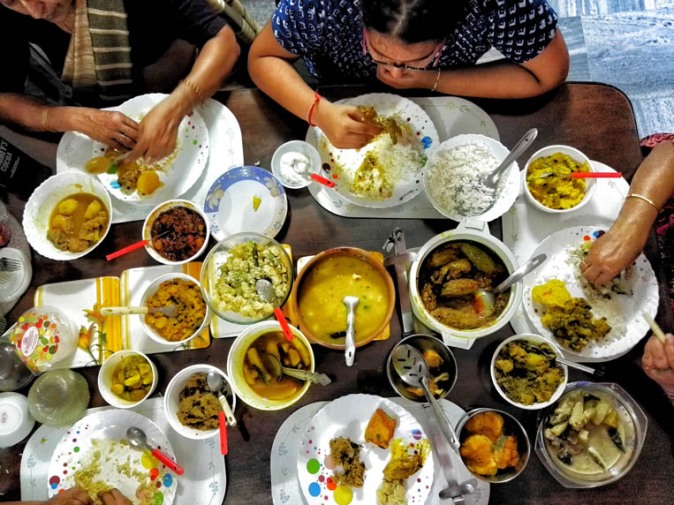
All pictures of Bengali food experiences here are from my very known kitchens – either mine or mum, mum-in-law or other close mums… and a few exceptional Dads’ as well! Sadly, not every dish or delicacy could be captured here – even in the pictures above which are examples of lunches at our homes during our visits to Kolkata (the first one at my mum-in-law’s place and the second one at my ma’s place). But I’m hoping that I have been able to tempt you to Bengali Cuisine and realise how difficult it is being a Bengali and not being a foodie!
Dear Bengali readers, Shubho Mahalaya to you all! I would love to hear from you whether a tiny bit of justice has been done to Bengali Cooking. To the rest of my dear readers – Welcome to my world of Bengali Cooking! I haven’t even mentioned what we eat for Breakfast, or for snacks or on special occasions. Keep pouring in your comments and make my day delicious please!
Unblogging it all… Ishita
Disclaimer: This isn’t a sponsored post, nor are there any affiliated links. The subject, story, opinions and views stated here are my own and all my bills have been self paid. While you enjoy reading my posts with lot of visuals, please do not use any material from these posts. Do join me on my daily food and travel journey on Instagram, Facebook, Twitter and Pinterest.
Do try out these Bengali recipes from my blog:
Shorshe Bata Maach – Mustard Salmon In This Case
Spicy Baby Potatoes or Aloor Dum – Kolkata Street Style!
Luchi Featured In Ahlan! Gourmet | My Ode To Phulko Luchi!
Bhapa Mishti Doi and A Food Safari of Bengal | BBC GoodFood ME
Notun Gurer Payesh/Traditional Bengali Rice Pudding | Remembering My Dida
Payesh or Rice Pudding For My Birthday | Power of Gratitude Messages
Khichuri As Harbinger of Hope & Kolkata Soaked In Rains
And if you are interested in reading more on Bengali food in my blog:
Shubho Noboborsho | A traditional Bengali menu for Frying Pan Diaries podcast
A-Z of Bengali Fish
Pickles… Mother (-in-law) Of All Pickles! – My Pickle Nostalgia
BE SOCIAL. SHARE THIS!



I feel like a Chutney at this moment and hence this special post on a traditional Bengali Green Mango Chutney or Kaancha Aamer Chutney!
Why Chutney?
Well, to be honest Chutney is the only thing that can describe how I feel at this moment. My blog is being featured in this week’s FoodieBlogroll’s Featured Blogs! What does this mean to me? It means that somewhere down the blogging journey, special moments like these will add more spice, more spunk to my writing, bring in more readers. What’s the other alternative? Well, I could be standing in the highway with a poster – Buddies, Please Read My Blog! I’m trying to be different! And I’m working really hard! I might make you laugh! And occasionally I might make you think!
Just like a Chutney. It’s not a regular meal – it doesn’t fall under the category of Breakfast, Lunch or Dinner. However, you can have Chutney with anything, and at any time of the day and upgrade little simple meals to a special mini treat. Sometimes it’s spicy, sometimes it’s sweet or sour – but it does add a lot of momentary zing, suddenly and just like that!
Being featured in prominent blogging forums does bring in that random element of excitement with the anticipation of new readers and expressing my gratitude to all my existing readers. Stand by me, be with me, guide me through – and tell me what you want – I am inundated with a whole lot of mixed feelings – a strong Pickle, a tangy Dip, a sweet Chutney – all rolled into one!
But why a traditional Bengali Chutney?
In many South Asian Cuisines Chutney refers to a wide-ranging family of condiments that usually contain a whole lot of mixture of spice(s) and vegetable(s) and/or fruit(s). There are many varieties of Chutney and may refer to a dip accompanying a savoury or snack etc.
A Bengali Chutney is very different. You end your main meal with Chutney. And this Chutney is a sweet, tangy paste and can be made with every conceivable fruit and even vegetables! For example – Aam/mangoes, Jalpai/Olives, tomatoes, Anarosh/pineapple, Tetul/tamarind, Pépé/papaya and various other type of fruits. Dry fruits like Khejur/dates, Kishmish/raisins may also be added to it the Chutney which is also splashed with Phoron/Mustard seeds cooked slightly in oil or Paanch-Phoron/5 seeds cooked in oil. Papad/Big chips like flakes made up of Potatos or Dried Daal usually accompanies the Chutney.
After the Chutney comes the formal dessert tasting! And the choice in Mishti/Sweets is absolutely endless. This is a category that has catapulted Bengal into a different quotient of sweetness. Mishti Doi/ Sweet yogurt, Bhapa Doi/Steamed Yogurt, Payesh/ Sweet dessert made with rice-milk-sugar, Rôshogolla/Rasgulla, Rasamalai, Pantua, Lyancha, Chamcham, Chanar Jilipi, Rajbhog, Rasakadambo… I can go on! But you want me to stop ranting about these here, then please read about them here, my post on Bengali sweets.
So in effect, A Bengali Chutney breaks the monotony of the main meal by giving a small ‘sweet’ breather before more serious desserts come in. It is a mini sweet sign-off but harbors the hope of a new turn in the meal – the final dessert. That is exactly what being featured in the Foodie Blogroll means to me. And whenever one is happy, he/she can only run to his/her roots.

Green Mango Chutney/ Kaancha Aamer Chutney
Category – Chutney; Cuisine type – Traditional Bengali
Following are the characteristics of all recipes doling out of our little hands, big hearth –
♥ Easy to cook
♥ Regular canned products off the shelf may be used (However, we advocate using fresh products)
♥ Goes well both as a regular or party dish
♥ Children can easily help in making the dish (My two little sous-chéfs are aged 8 and 3 years!)
♥ And lastly, guaranteed to be tasty!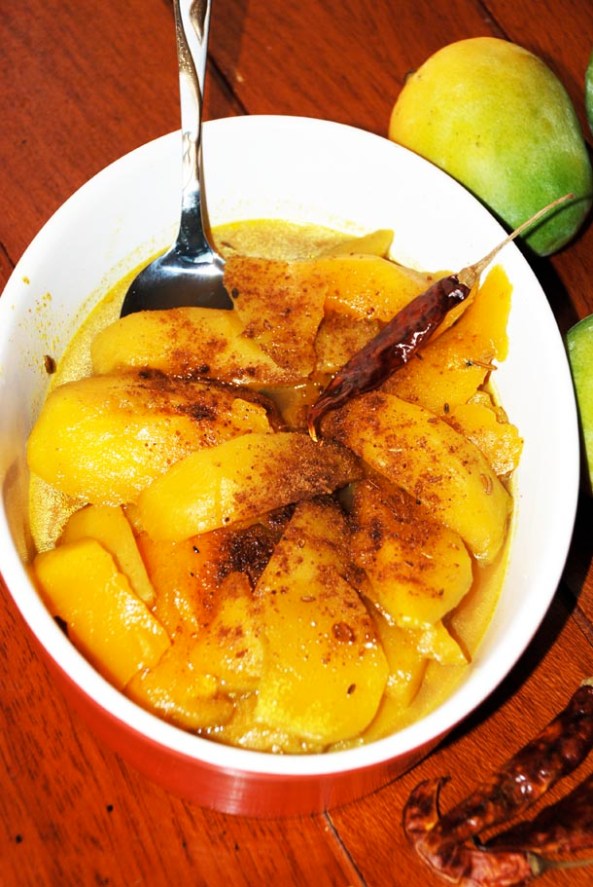
Unripe Green Mangoes are definitely a part and parcel of every jute bag that goes to the vegetable market in Kolkata during the summer heat. Then they turn into accessories either in Mango Lentil Soup/Aam Daal (have been penned down in this blog), or Green Mango Syrup/Aam Paana which is used to make a chilled Summer drink when diluted with water (penning this down is in the plans) or may turn into Green Mango Chutney/Kaancha Aamer Chutney. Or say the ones lying on the terraces of Kolkata homes, marinated with spices, waiting to be dried up and bottled into pickles? Which again brings me back to another favourite topic – Chads/Terraces of Kolkata! If you still haven’t seen my obsession with terraces, I insist that you peep into this…
When we were kids, we would wait for my Mum to get these green mangoes and wash them and slice the. We waited and prayed for her to keep them aside to do other things while we would steal a few slices and eat them raw with some salt sprinkled on them. As I write my jaw is locked – the sour and salty green mangoes – phew! Didn’t our Mum realise a few slices were missing? At that time we thought that we had fooled her. Only now I realise that she let it pass so that these would become sweet memories of our childhood. Writing this post brings back a whole lot of memories in my taste-buds! The green mangoes, their skins blemished with spots on the skins bring back a lot of nostalgia. Hence I am retaining the green mangoes as they are and definitely not airbrushing them, though that would make them more desirable! 



For the printable recipe →
Serves 5-6 persons (maybe less if they happen to be sweet-toothed Bengalis!)
Preparation time – 50 minutes maximum (Making the Chutney – 30 minutes; making the Roasted Masala – 5 minutes; Soaking the mangoes – 15 minutes)
Ingredients
Green Mangoes – 5 pieces, soaked in water for long, peeled and then sliced into longitudinal pieces (4 long pieces + 1 seed from each mango). Peeling the mangoes is optional as many prefer to retain the skin as well.
Dried Red Chilli – 3 whole pieces
Brown Sugar – 1 cup
Panch Phoron*/Bengali 5-Spice Blend – 1 tsp
Turmeric – 1/2 tsp
Bhaja Guro Moshla/Roasted Cumin Seed (powdered) – 1 tsp
Bhaja Shukno Lonkar Guro/Roasted Dried Red Chilli (powdered) – a pinch
Salt – a pinch
White Oil/Mustard Oil – 2 tbsp
Bengali 5-Spice Blend/Panch Phoron
Panch Phoron is a very unique Bengali spice blend and consists of five spices in equal measure. The 5 spices that make up Panch Phoran are –
Methi/Fenugreek
Kalonji /Nigella seed/Black Cumin
Radhuni – Radhuni is similar in appearance to those of Ajwain, celery, and caraway. Because of their similarity in both appearance and flavor, it is often confused or substituted with celery seed. Radhuni is often used in traditional Bengali cuisine but are rarely used in the rest of India. In absence of Radhuni, many substitute this with Rai or Shorshe/Mustard seed – the black or brown flavored one
Saunf or Mouri/Fennel seed
Jira/Cumin seed
The above 5-Spice Blend has been taken from the pages of Bong Mom’s Cookbook.
Bhaja Guro Moshla/Roasted Spices
In a skillet or a flat bottomed frying pan, dry roast the Cumin Seeds. Constantly stir for a minute. Do make sure that the seeds are not burnt while it retains a fresh and strong aroma. Grind the roasted Cumin Seeds to a powder in a spice grinder (I use a coffee grinder) and keep in an air-tight container. This Bhaja Moshla/Roasted Masala is used to temper many Bengali (also Inidan) dishes like Raita, different types of Chutneys etc.
Dried Red Chilli can be roasted in a similar manner and then powdered and kept in air-tight container to use for tempering afterwards. NOTE: The aroma is very strong and if you are not used to making this, you might end up coughing!
Method of Preparation
– Heat the oil in a Kadai/Wok
– Add the Bengali 5-Spice Blend and Dry Red Chilli when the oil heats up (Note: This is going to really splutter so please don’t forget your shield!)
– As soon as it begins to splutter, add the Mangoes
– Add Turmeric and a pinch of Salt
– Add 1/2 lt water and boil the Mangoes in medium heat
– Add the sugar when the Mangoes have become soft and simmer for a while. While the Mangoes should become soft and boiled, they should remain pulpy. This Chutney is meant to be really sweet and syrupy , so you may have to add a bit of sugar
– Sprinkle the Chutney with Bhaja Guro Moshla – the Roasted Cumin Seeds (powdered) and a pinch of Bhaja Shukno Lonkar Guro/Roasted Dried Red Chilli (powdered)
– Serve cold, just after the main meal and before the dessert is served
Enjoy the sweet and tangy Chutney-ish photo-journey…


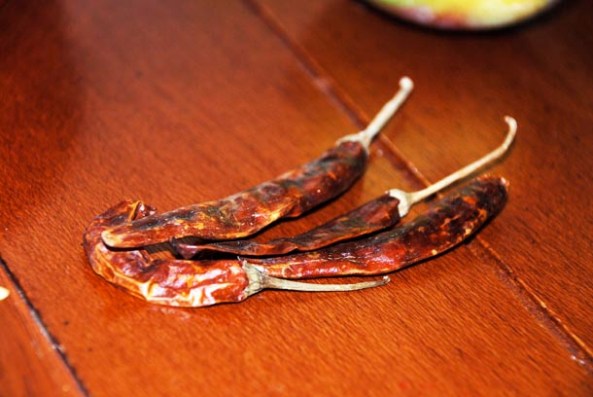

As I have said before, there are mini sign-offs in life’s journey. And these little moments call in for mini treats to stimulate the taste-buds, to tickle the palate just before the formal dessert is served. Just like the Green Mango Chutney. Thank YOU very much for the blog love and all your appreciation!
Unblogging it all… Ishita
All images are from my gallery IshitaPhotoIdeas – it takes a lot of effort to capture a food experience in text and pictures. While it’s meant for you to enjoy them, I request you not to use them!
BE SOCIAL. SHARE THIS!


As I was driving along the Jumeirah Beach Road during sunset, I thought to myself why was I doing this? Leaving the Z-SISTERS at home on a Friday, attending an event organised by Down To Earth Organic for the members of Fooderati Arabia – what was I going to achieve? Visit yet another organic shop promising instant health and longevity? Aren’t the prices going to shock me once again? Always wanting to know more about ‘anything’ organic, I couldn’t refuse to attend this event. So off I went and found myself surprised beyond belief to a world full of spices and teas, pastas and savouries. And many more. This culinary travel blog is all about travel and food journeys inspired by people, places and moments. And here goes another inspired story.
Down To Earth Organic, Dubai
Organic Products Store; Easy-Parking; Prominent Location; Home delivery available
The essence of Down To Earth Organic is captured by it’s very logo – beautiful green stems branching out from the ground. The red bricked walls with the humbling word ‘natural’ written in various languages (even in my mother-tongue Bengali) reflects what the entire shop stands for. According to their official website, ‘Down to Earth Organic Products retain the natural goodness of food and are produced in harmony with the environment. These products are free of all chemical, pesticide and fertilizer residues; hence the perfect instrument to live in harmony with our bio-rhythms, our society and our world.’ But then, don’t all organic products profess the same? How are these any different? Read on…
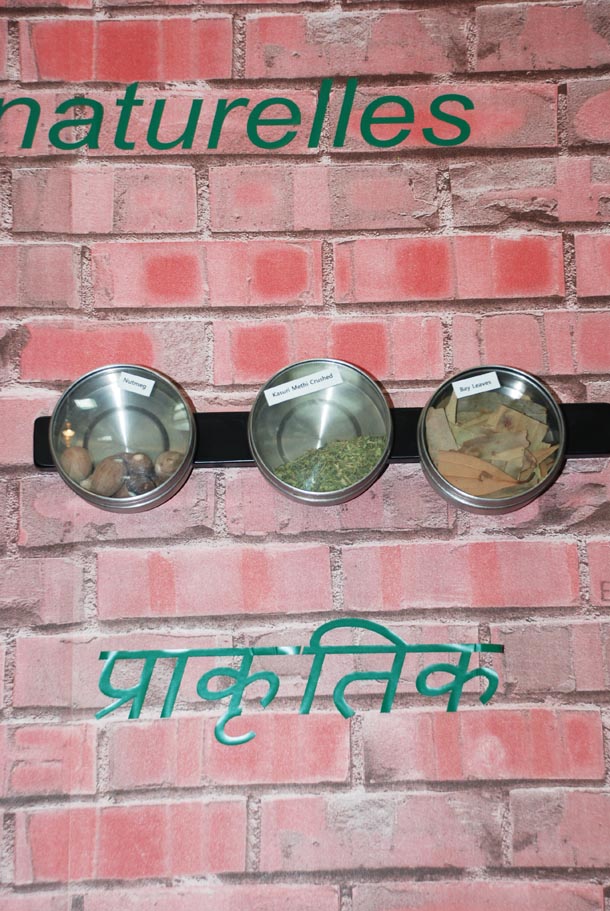
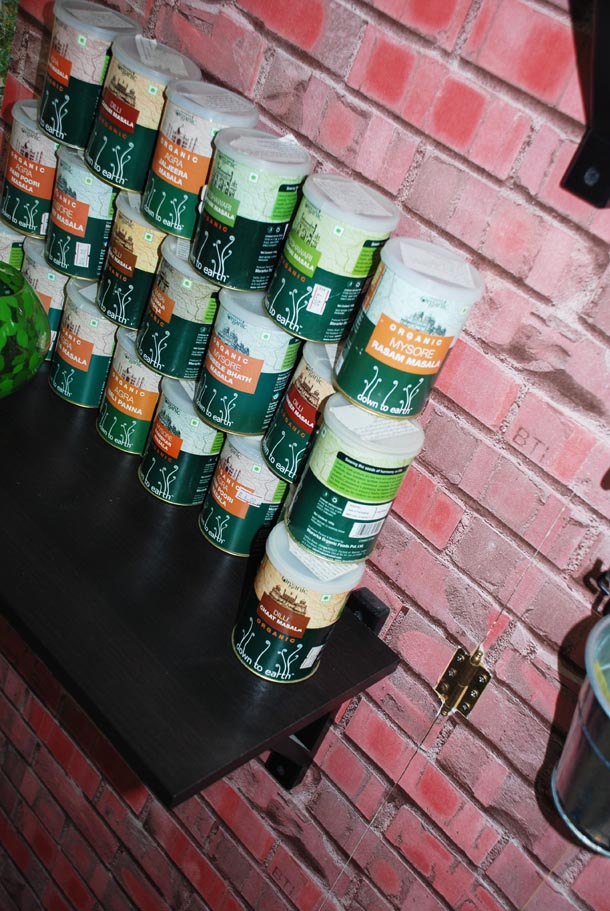
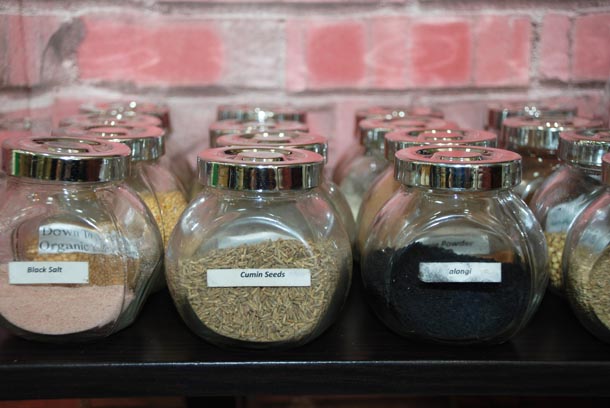
Yin – Yang in Food & Body Balance – the need to go Organic
A casual meet organised by Down To Earth Organic for Fooderati Arabia revealed much more than their own product line. Infact, Mr Lokesh Aswani, the Managing Director of Down To Earth Organic had to be prodded to talk about his products. He wanted the wide range of products to speak for themselves, the very reason why such an informal meet was organised with Fooderati Arabia. A small chit-chat with non-Fooderati member Deepti, a holisitic health coach at Generation Nourished enriched me on how the Fengshui concept of Yin – Yang (Yin meaning dark and Yang meaning light, this concept is used to describe how polar opposites or seemingly contrary forces are interconnected and interdependent in the natural world, and how they give rise to each other in turn) could also be applied to the food that we eat and how balancing them could also bring in body balance. This stems from the Chinese belief that problems arise not because two forces are battling but because there is an imbalance between them in the environment. Naturally, the concept also applies to food, a little brief of which can be found here. And this is precisely the reason why organic products free of chemical and which empower the soil rather than degenerate them, have an important role to play in our daily food need and in maintaining our internal body balance and nourishment.
One thing that struck me as I was exploring the shop was the wide range of Masala/Spices (both powdered and whole) available. And also the prices. Organic products always come with an impression of a very high price tag when one compares the products with its non-organic counterparts. But not here. The prices of most of the products (Rice, Cereals, Spices etc) were quite comparable to any other non-organic products available in normal supermarkets. A reason for suspicion? Yes, indeed. But my suspicions and doubts were laid to rest as Mr Lokesh explained how in most cases the existence of intermediaries between the farmers and the shops add up to the bulging cost of organic products. But Down To Earth Organic products were sourced directly from the farmers, hence there were no hidden costs involved.
The product portfolio is expansive – from Flavouring Masalas to Dehydrated Powders, from regular Powdered spices to Whole spices. There are 28 Flavouring Masala/Spices available stemming from 5 different Gharanas/regional cooking styles – Agra, Mysore, Dilli (Delhi), Munbai in India and Peshawar in Pakistan. And the range is pretty mind-boggling. Spices attract me the most, may be because of the different colours and aroma. Do allow me to dwell a little bit more on Spices than the rest!
 Flavouring Masalas
From Agra Gharana – Aloo Jhol Ka Masala (Potato Curry Masala), Chaat Masala (it is typically used as a sprinkler on fruit salad or other savouries and consists of Amchoor/dried mango powder, cumin, Kala Namak/black salt, coriander, dried ginger, salt, black pepper, hing/asafoetida and chilli powder), Dal Ka Masala (Lentil Masala), Garam Masala, Imli Panna (this makes a tangy refreshing cool drink made from Tamarind), Jaljeera Masala (Kala Namak/black salt is the main ingredient), Pani Puri Masala (Pani Puri is a round, hollow, small Puri/Indian Flat bread, fried crisp and filled with a mixture of water, tamarind, chili, Chaat Masala, potato, onion, chickpeas and is a popular street snack in the Sub-continent);
From Dilli (Delhi) Gharana – Channa Masala (Flavouring for Chick Peas Curry), Chat Masala, Garam Masala, Paneer Masala, Rajma Masala (Flavouring for Red Kidney Beans Curry), Tadka Masala;
From Mumbai (Bombay) Gharana – Mumbai Pav Bhaji Masala; From Mysore Gharana – Bissi Belle Bhath, Curry Masala, Rasam Powder, Sambhar Masala, Vengi Bath;
From Peshawari Gharana – Biryani Masala, Kadhai Masala, Korma Masala, Rogan Gosht Masala, Laal Mans Ka Masala (Flavouring Masala for Red Meat), Sheekh Masala, Tandoori Masala, Tikka Masala, Mutton Curry Masala;
Dehydrated Powders that are available are Garlic, Ginger, Green Chilli, Tamarind, Onion, Tomato, Aamchur/Dried Mango, Fenugreek, Lemon etc.
Indian Cuisine and Pakistani Cuisine
The cuisine of India encompasses a variety of regional cuisines making use of local spices, herbs, vegetables, and fruits. Indian religious and cultural habits have shaped the development of these cuisines. Islamic influence due to years of Mughal and Sultanate rule as well as Persian interactions have influenced North Indian and Deccan cuisine significantly. Agra and Delhi in North India, Mumbai in the West of India and Mysore in the South of India have historical connection with the various powerful dynasties, hence are rich in their cooking traditions as well.
The cuisine of Pakistan too varies greatly from region to region, reflecting the country’s ethnic and cultural diversity. Food from the eastern provinces of Punjab and Sindh is quite similar to the cuisines of Northern India. Food in Khyber Pakhtunkhwa, particularly Peshawar involves the use of mild aromatic spices and less oil, characterizing affinities to the cuisines of neighbouring Afghanistan, Iran, and Central Asia.
So, indeed it’s exciting that the Flavouring Masalas from Down To Earth Organic comes from these cities traditionally known for their cooking prowess!
 Impact of Indian spices outside India
Historically, the spice trade between India and Europe is often cited as the primary catalyst for Europe’s Age of Discovery and Indian cuisine has influenced other cuisines across the world, especially those from Southeast Asia, the British Isles and the Caribbean. This spice trade also forms a major cultural backdrop to the history of civilisations. The Spice route to and from India is marked by Blue and it brought about a cultural and commercial exchanges between diverse cultures as nations struggled to gain control of the trade along the many spice routes. (Ref: Wikipedia)
Apart from the Spices, Down To Earth Organic seemed to have a very wide portfolio of organic food products – Cereals, Pulses, Condiments, Oils, Rubs, Canned soups, international herbs, Chutneys, Seasonings, Baby Food and Cookies. And writing about the cookies, I must mention the amazing Onion Garlic Cookies that were offered to us. I have also tried their Raagi Cookies. In Cookies, many interesting combinations are available and they are surely going to go down well with the Dubai consumers. For example – Semolina Nut, Ginger Ragi, Onion Garlic, Rice Soya Almonds, Rice Soya Cinnamon, Salted Cumin Cookies, Naan Khatai/Butter Cookies, Jeera Cookies/ Cumin Cookies
Range of Flours
Corn Flour/Maize Atta, Maize Dalia/Maize Burghul, Moong Besan Atta/Green Gram Flour, Channa Besan/Gram Flour, Multigrain Atta, Wheat Flour, Wheat Dalia, Wheat Maida, Wheat Suji/Semolina, Buckwheat Flour, Barley Dalia, Missa Atta Punjabi, Missa Atta Rajasthani, Finger Millet Flour/Ragi Atta, Rice Flour/Rice Atta, Soyabean Flour, Bajra Flour/Pearl Millet Flour, Jowar Flour/Sorghum Flour – a range of Flours for consumers with various food allergies and intolerance to choose from.
Ragi/Finger Millet (more info here), Bajra/Pearl Millet (more info here), Jowar/Sorghum (more info here) – these traditional food plants available in Africa and in many parts in Asia are conceived as healthy alternatives to refined flour, improves nutrition and support sustainable land-care.
Back To Basics
Apart from organic food products Back to Basics comprises of an organic clothes and linen products including T-shirts, premium and luxury Towels, Bedroom linens etc. Needless to say, all Down To Earth products undergo the strictest quality standard checks and are certified by the most respected international certification agencies. Here’s the Product Portfolio to have a peep!
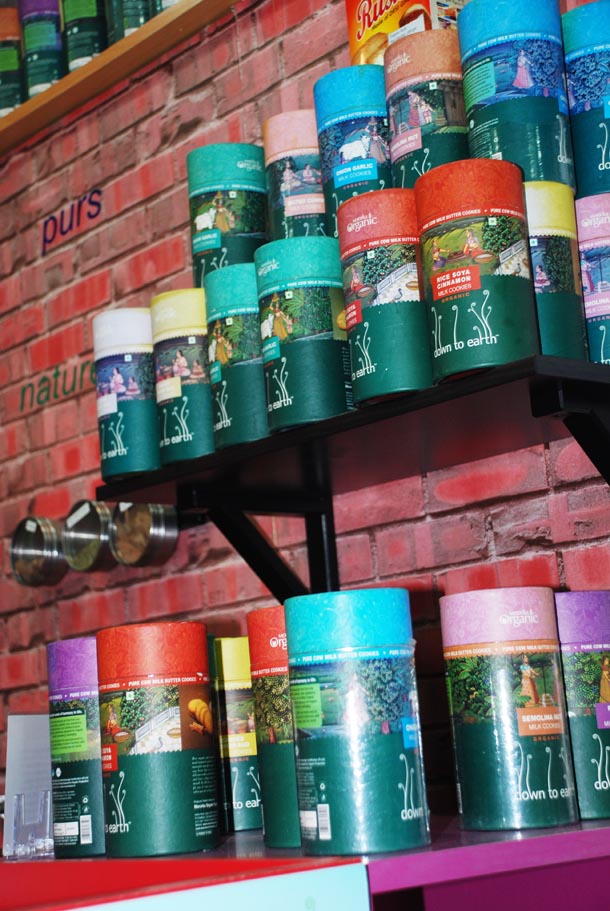
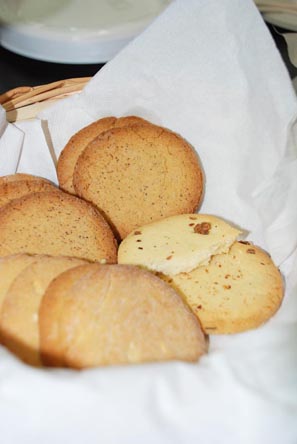
Tea & Coffee Blends
This is another interesting section in the Down To Earth Organic that quite captivated me. I love coffee while my husband is a tea-lover. But definitely not a tea-afficiando like my parents who would do not like experimenting with flavours or blends. So, I am always looking out for something new. Among them the known flavours and blends were perhaps the Jasmine Tea, Chamomile Lemon, Decaf Green Tea etc. But I hadn’t come across these before – Toasted Rice or say Gunpowder Green Tea in Dubai before. The latter definitely caught my fancy as the history of this famous Chinese tea dates back to the Tang dynasty (618 AD – 907 AD). 


Down To Earth Organic Dubai
Location: G 11, Hamdan Awards Complex (Opposite Union Flag), Jumeirah, Dubai, U.A.E
Tel No: +971 4 3863391; Facebook: Down To Earth, Dubai; Twitter: @DownToEarthDxb
You may also call 800-6742642 for home delivery (For specifications regarding this or for more details, please visit the Official Website)
Mutton Chick Peas Curry
Category – Non Veg Side-dish; Cuisine type – Indian
Chick Peas or Garbanzo Beans or Kabuli Channa are full of nutrients and is popularly used in many cooked dishes or used in salads. It is perhaps the most popular ingredient in Arabic Cuisine as well, specially the famous Arabic dip, Hummous. The Chick peas or Kabuli Channa added with Mutton satisfies the Non-Veg soul and can be a brilliant accompaniment for lunch or dinner. For a Bringing you Mutton Chick Peas Curry from our kitchen, tenderly cooked in a mildly spicy curry.
Following are the characteristics of all recipes doling out of our little hands, big hearth –
♥ Easy to cook
♥ Regular canned products off the shelf may be used (However, we advocate using fresh products)
♥ Goes well both as a regular or party dish
♥ Children can easily help in making the dish (My two little sous-chéfs are aged 8 and 3 years!)
♥ And lastly, guaranteed to be tasty!
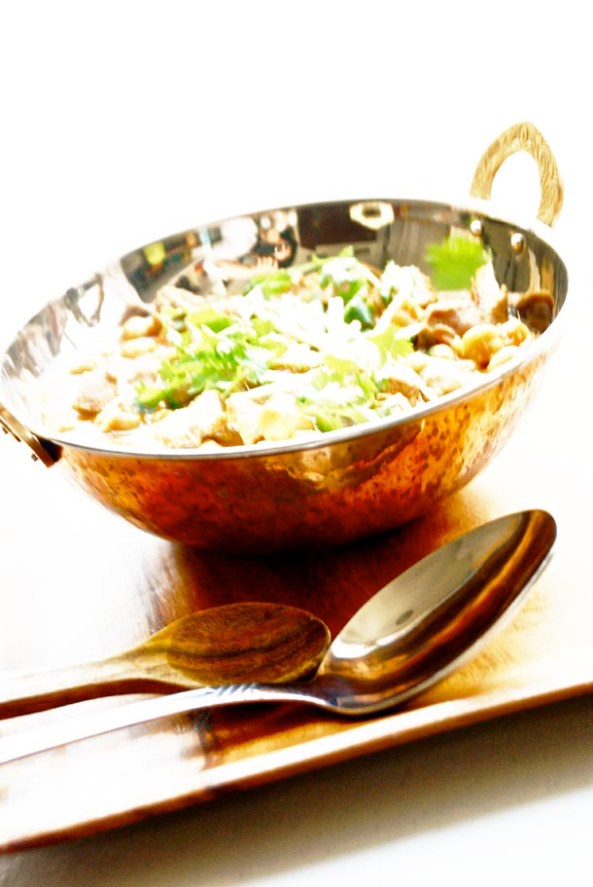
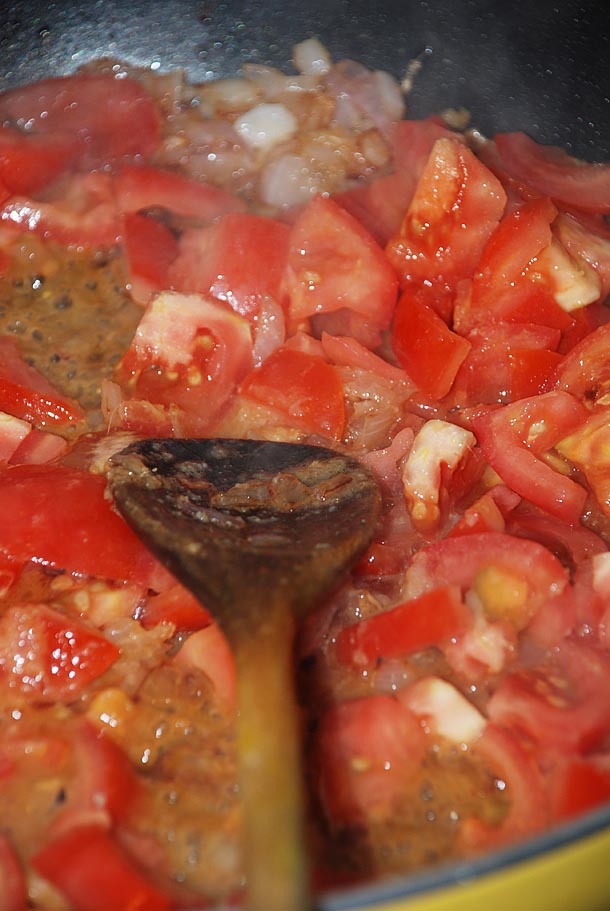
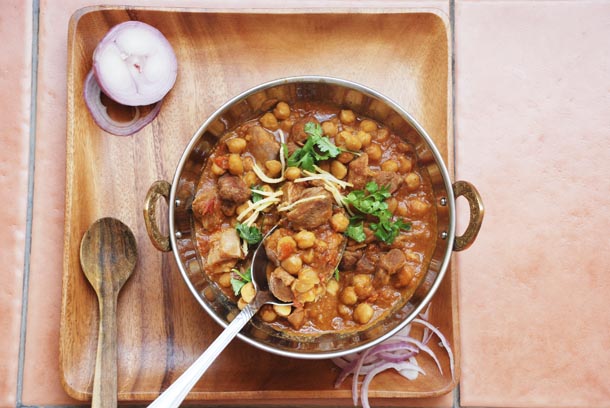
For the printable recipe→
Serves 5-6 persons
Preparation time – 1 hr 45 minutes approximately (boiling the chickpeas – 45 minutes; preparation – 10 minutes; cooking – 1 hour)
Ingredients
Chick peas – 250 gm, soaked overnight in water after washing. Pressure-cooked with a little salt.
Mutton/Lamb – 1 kg, boneless cut into small cubes and marinated with Mustard Oil, Ginger and Garlic
Tomatoes – 4, chopped into small pieces
Coriander Leaves – 1 bunch (2 cups chopped, keep 1/2 cup chopped coriander leaves separately for garnishing)
Onions – 4, cut into slices
Ginger – 1 inch long, finely grated (also keep
Garlic – 8 pods, finely crushed
Channa Masala Powder (Courtesy: Down To Earth Organic) – 4 tsp
Cumin Powder – 1/2 tsp
Coriander Powder – 1/2 tsp
Garam Masala Powder – 1/2 tsp
Turmeric – 1/2 tsp
Chilli Powder – 1/2 tsp (optional)
Salt – as per taste
Mustard Oil – 1 tbsp
Marination
Mustard Oil – 1 tsp
Ginger-Garlic Paste – 2 tsp
Marinate the Mutton with Mustard Oil and Ginger-Garlic Paste for an 20 minutes
Garnishing
Roasted Garam Masala Powder* – 1/2 tsp
Coriander Leaves – 1/2 bunch, the leaves separated out from stalk, soaked in lemon water and dried
[*Garam Masala is a blend of ground spices commonly used in North Indian and other South Asian cuisines. I have come to realise that though some ingredients like Cardamom, Cinnamon, Cloves are common to Garam Masala being used in various regions, each region or culture probably adds its own touch.
Dry roast the following whole spices separately until fragrant:
1 tbsp black pepper Corns
2 tsp Black Cardamom Seeds
2 tsp Ground Cinnamon
1 tsp Whole Cloves
Grind the above roasted spices into a fine powder.]
Method of Preparation
– Heat the oil in a Wok
– Add Onions, Ginger, Garlic, chopped Tomatoes and fry till the onions turn brown and the tomatoes turn tender
– Add the Cumin Powder, Coriander Powder, Garam Masala Powder, Turmeric, Chilli Powder, Cumin Powder and the chopped Coriander leaves (Note: Keep stirring slowly to prevent the Assorted Masala paste from burning)
– Add the Mutton and stir in with the other Masalas over high flame for a few minutes. Turn the heat down to the lowest level and cover the pan. Let the Mutton simmer in it’s own water at slow seam for 10 minutes
– Add 1/2 lt water and let the Mutton cook till it’s almost done
– Add the boiled Chick Peas into the Mutton
– Add Chana Masala Powder and simmer for 10-15 more minutes till the Mutton turns soft and tender and Chick Peas mix well with Curry (Note: Both the Mutton and the Chick Peas should be soft but not over-cooked)
– Garnish with chopped Coriander leaves and Ginger slices
Accompaniment
Serve hot with Chappatis (Indian flat bread made with Atta/Wheat-flour), Tandoori Nan (Indian Flat Bread) or plain white Rice with some hot Mutton Chick Peas Curry. Add a raw Onion Salad for a zing!

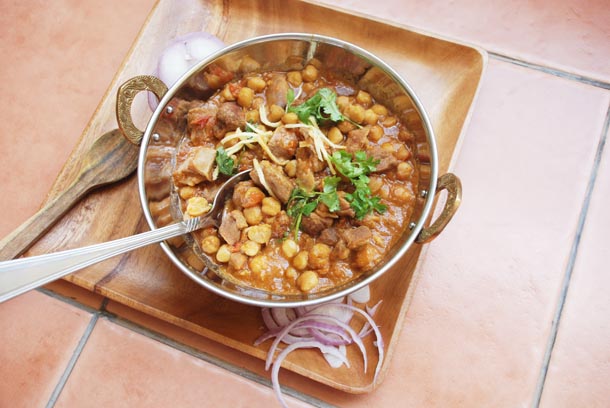
 All I can say is that the feeling of guilt is much less when I use organic products – I feel that I am doing the Z-SISTERS a big favour by giving them food which is not credited with chemical overload and environmental degradation. I would love to bring up the Z-SISTERS on unadulterated love, let them breathe fresh unpolluted air, serve them Granny’s food cooked traditionally at home and provide them with fresh produce grown on virgin lands – just like the patch of land that Mr Lokesh discovered that the farmers kept themselves, to grow crops only for themselves and was free from Ammonia that went into producing the rest of the crops that would end up in the vegetable market for sale! Borrowing the words from Down To Earth Organic, it’s Sowing the seeds of harmony in life… and ultimately going Back To Basics yet again!
Unblogging it all… Ishita
Disclaimer: Please note that this post is not a sponsored post and the subject, story, opinions and views stated here are my own and are independent. While you enjoy reading the posts with lot of visuals, please do not use any material from this post. You can catch my daily travel and food journey on Instagram, Facebook and Twitter.

BE SOCIAL. SHARE THIS!

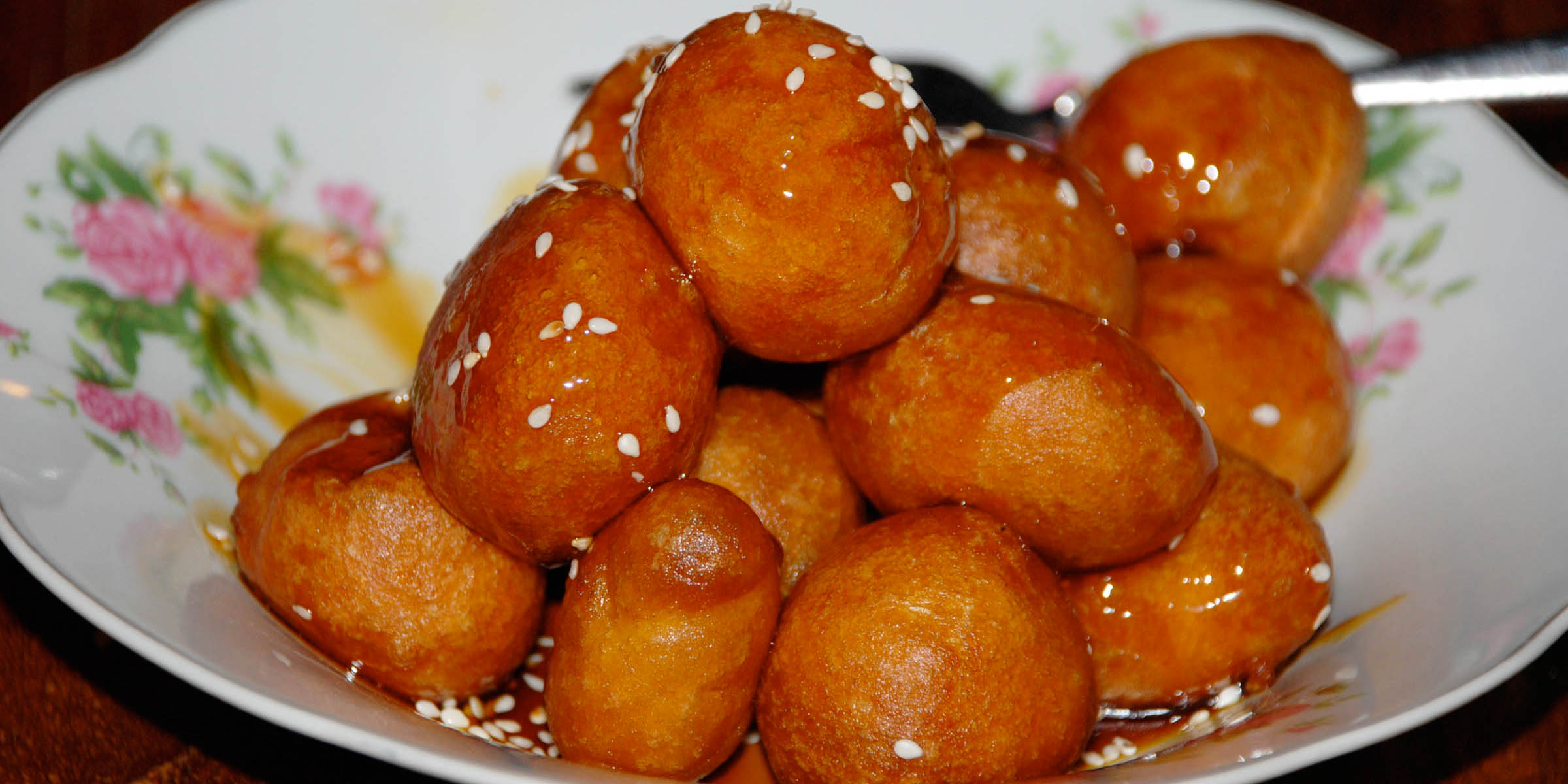
This was officially the first time we were going to experience Emirati food and needless to say we that we were really looking forward to it.

Edited on 16 May, 2020: Al Fanar not only has several branches in Dubai but have also opened up in other emirates, as well as in London and Riyadh.
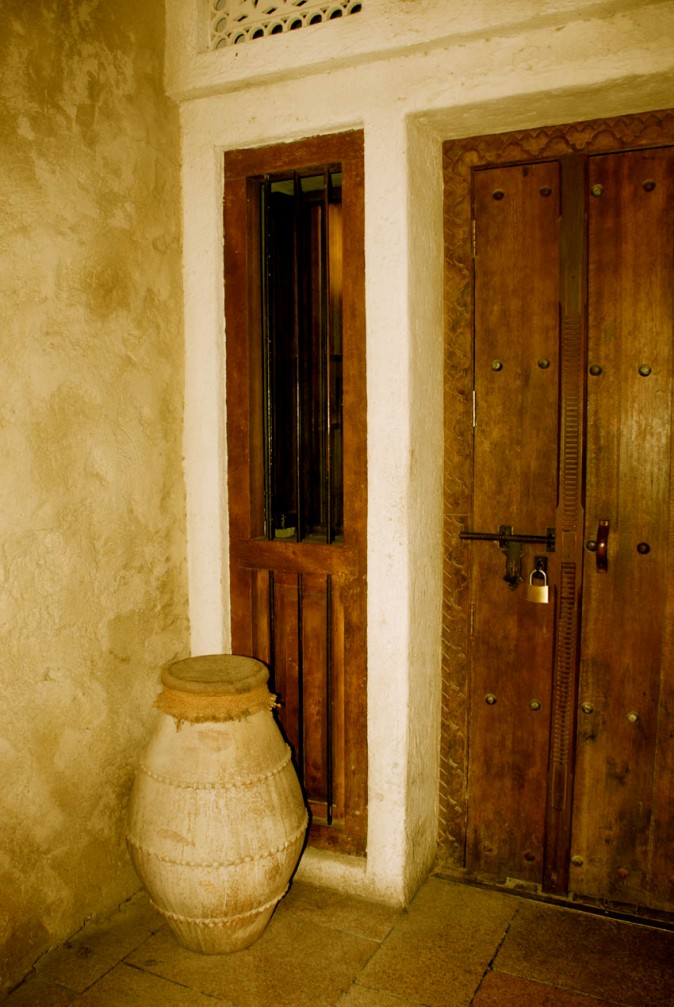
Another favourite blogger of mine, My Custard Pie’s post where she willingly admits to being a guinea pig for for the prototype outing being road-tested for Frying Pan Food Tours made me keep awake the whole night thinking whether I could organise something for my folks in the similar line. Arva did manage to chalk out a few joints that promised a similar food experience that emanates from her own posts. However, being unsure of whether my not-so-old-yet-behaving-much-older-than-they-are parents would have the same levels of energy munching Shawarmas in one joint, crossing the road in this summer heat to another joint to have some Falafels and then off to another to have the Baklava. Come October, we promise to surely hop on to her tours but decided to spare my ‘old’ folks the agony of going ecstatic over hopping, munching, sweating and finding a parking slot – all simultaneously. At the same time my brother’s insistence in taking him somewhere spectacular not in-terms of fine-dining but in terms of a soulful experience kept me on tenterhooks. Finding Al Fanar was indeed a soulful rescue. Not only did it win over my parents but also my little bro and the Z-Sisters.
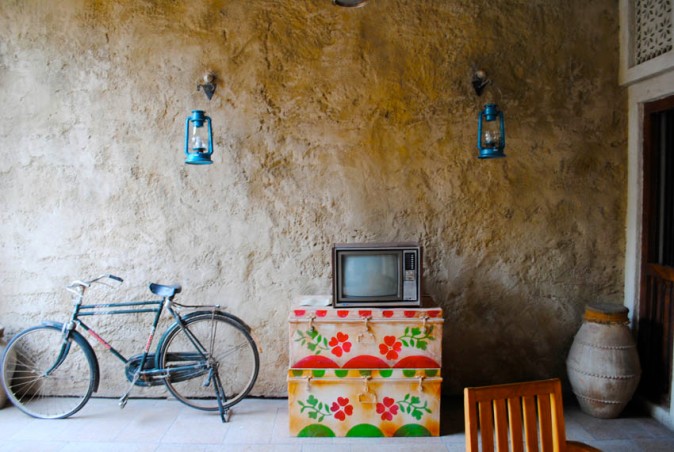
Al-Fanar Restaurant & Café
Al Fanar is the first and the only restaurant in the UAE serving Emirati cuisine. I haven’t yet heard of a restaurant serving Emirati food. Our previous experiences in Arabic food had been limited to mostly Lebanese food, Jordanian food, Egyptian food and Iranian food. The UAE’s expatriate population had till now, a very limited opportunity to know about the Emirati Cuisine until and unless someone has had the chance to be invited by an Emirati into his/her home. We have been living in Dubai for quite a while and every time a guest would visit us and wished to taste local food we would take them to mostly Lebanese restaurants for a taste of Middle Eastern food. The only Emirati food experience we have had till now was the occasional Leqaimat (golden crisp fried dough balls coated with date syrup and sesame seeds) cooked up by the local womenfolk at Heritage Village or the UAE kiosk at Global Village. This was officially the first time we were going to experience Emirati food and needless to say we that we were really looking forward to it.


The concept of Al-Fanar
Al Fanar refers to the kerosene lamps that were used to light up homes in Dubai in the olden times. The ambiance recreates Dubai in the 1960s, when Dubai was just a small town on the Arabian Gulf surrounded by Al Badia Oasis. The out-door seating is amidst tents and Barasti huts and reflects the trading activities of a by-gone era – fishermen, pearl merchants and bedouins. Painstaking details have gone into the making of an authentic ambiance. It is a 4D experience with the smells of freshly burnt Bukhoor (scented bricks that are burned in incense burners to perfume the home and clothing) and oudh drift and hit one’s senses. The remnants of a wooden fishing boat, a blue old Land Rover with goods heaped onto it’s back, an old box television set, pots and pans, traditional wind-towers marking the interiors, grilled wooden windows – each and everything lends to the charm of Al Fanar. It built up an odd sense of drama and a huge amount of expectation on the food that we have come to devour!
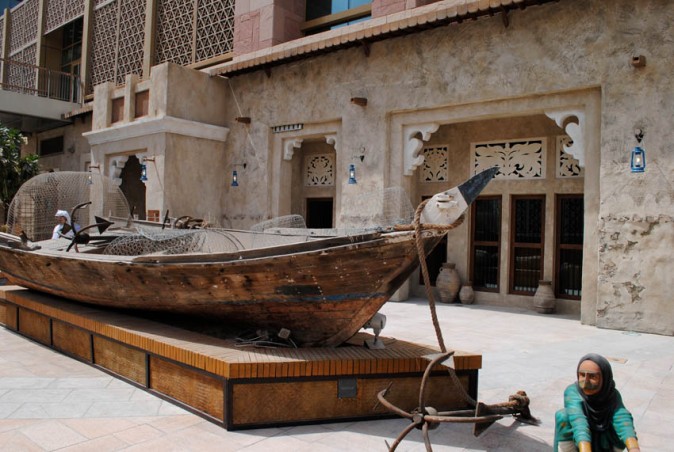
The decor: Contrary to Al Badia, the out-door set-up of a bustling old town, the inside brings us into an inner courtyard of a Tawash, or the traditional home of a Pearl Merchant’s house. This houses the Bait Al Tawash, the main dining area.Like the Reception Area, the walls here too have artefacts and many curios dating back to 1960’s Dubai. Framed Black and White pictures hanging on the walls brings out an elegance and an age-old charm. Sitting under the canopy of a tree, I look around and am mesmerised by every little attention given to the detailing – an old carpet hanging over the railing on the first floor, the real sunlight filters through the grilled windows onto the curved arches and coarse walls along with artificial lightings that bring to bring in the reality factory. After the initial wait (though not much as we had prior reservations), we felt quite relieved to have secured our seats. Being a Friday afternoon and the courtyard was completely packed. The proportion of Emirati diners seem to be much higher than the non-Emirati diners – something that intrigued me. Why would an Emirati come to a restaurant to seek the pleasure of his local cuisine that is probably being cooked daily in his home? Well, it’s the story of the tragic death in traditional home-cooking in most cuisines that have invaded the lives of most modular small families worldwide.


The Courtyard throbbed. From diners, from the waiters running up and down taking orders and serving the hungry diners, from children crying in prams, from groups chatting across the tables. Amidst all these, there was this relaxing atmosphere that pervaded most of the space. This seemed to bring in a sense of enjoyment all around. And No! we were not left feeling neglected. Prompt service satiated our thirsty souls (quite literally!).

The drinks: As we sipped down our drinks like a desert sponge (if there exists something like that!) we realised that our Friday heralded even more better things. Fresh Juices of various colours invaded our senses – Swoosh-and-then-Gone-in-a-minute! Pineapple, Orange, Lemonade with Mint, Watermelon – the juices glasses couldn’t even linger on within our fingers even for a minute. Blame it on the heat, blame it on the distance walked from the Parking to the Canal Walk of the Festival City where Al-Fanar is housed or blame it on our thirst and greed, who cares? Immediately, some more beverages by the name of Namlaits were ordered. These were bottled drinks that were also being sold at the Reception area priced at Dhs 13/bottle.
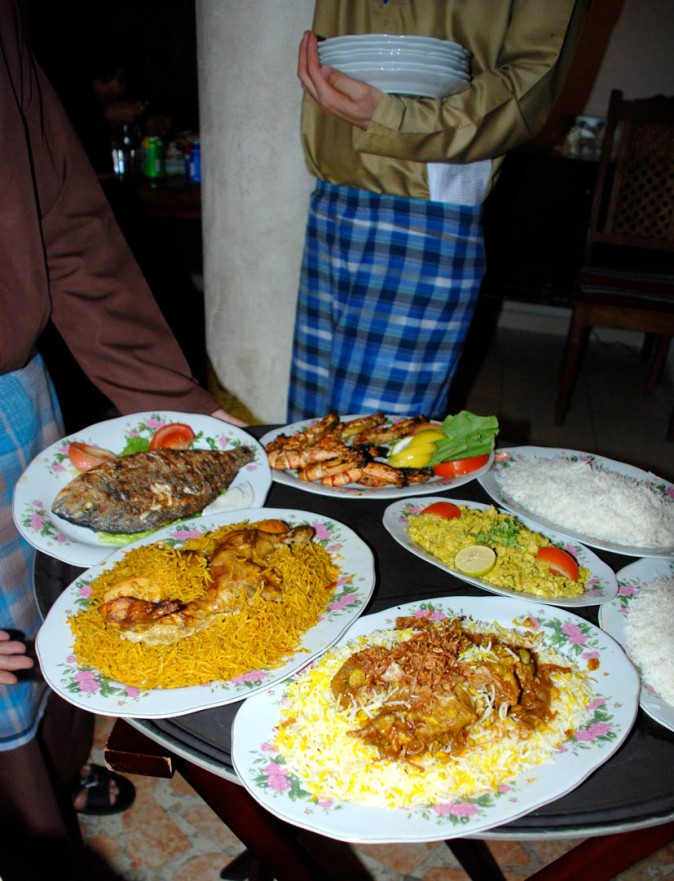
The food: We were slightly famished so the border in our brains that patiently waits for the appetisers to get over and the main meals to start simply seemed to have momentarily vanished. We wanted everything together! Huge trays carrying all our food and resting on a singular hand reached us safely and sound. I have always wondered how the staff in most Arabic restaurants do this. A major feat and an art by itself, I would declare.
Starters: Dango – Chickpeas in bowls awaited us in the table, complimentary – but they lasted only for a while!
Koftat Samak – These are crumbled fish balls (Samak means fish) mixed with onions and coriander leaves mixed in Al-Fanar’s signature spices and then deep fried. We gulped them down like tablets. All that was left was the Al-Fanar Tomato Sauce that was served along with the Koftats. We asked for this Tomato Sauce too, at-least four times, not because they came free, but simply because we loved that too!
Naghar Mashwi – Delicious, grilled squids with a good portion size, enough to serve more than three people. Mashwi refers to Grills.
Robyan Mashwi – Grilled, Tiger Shrimps (Robyan means Shrimps), similar to the char-coaled grilled shrimps available in the Lebanese restaurants.

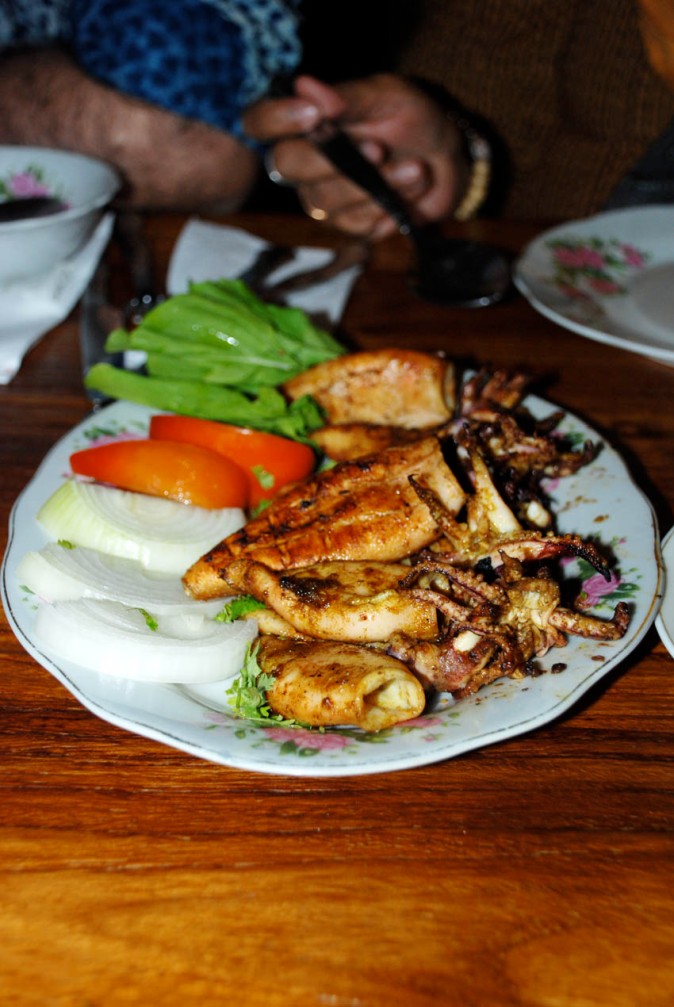
The Mains: I would say whatever we ate from henceforth was, well to be honest absolutely delish and an ultra-sensory experience. However this doesn’t mean that our gastronomical journey so far was any less.
Jesheed – Baby Shark cooked with onions and Arabic spices, crumbled and served with White Rice. This was something I haven’t tried before. But probably I hadn’t heard the word ‘Baby Shark’ when Mr Danish, the Marketing Manager had recommended the dish!
Samak Mashwi – Samak or Fish grilled (Mashwi) with special Arabic spices and served with white Rice. This was specially for my Dad who prefers fish over any other meat.
Machboos Dajaj – Dajaj or Chicken cooked with Yellow Rice simmered in chicken stock and special Arabic spices and dry lemon. Machboos consists mainly of mutton, chicken, or fish placed over or mixed in a large mass of well-cooked and prepared rice. It is popular in many Gulf countries & across Saudi Arabia. Incidentally, it happens to be the national dish of Kuwait.
Beryani Laham – Mutton served with a mix of Rice, onions, raisins and almonds.
Machboos Dajaj and Beryani Laham turned out to be the stars. The Chicken and the Mutton in the respective dishes were so soft, succulent and mildly spicy. The aroma of the fine rice, the tinge of herbs – both the taste of both these two lingers on. What is the difference in the cooking method between Machboos and a Beryani? Or what is the difference between Machboos and the Indian Rice Dish, Pulao? The answer to the latter is nicely explained here. But I am still searching for the answer to the former, while licking on my fingers!


After my last piece of prawn that I managed to hide and savour from my family (well, as such all the members in the family are generous enough except when it comes to sharing food!) got devoured shamelessly I ventured into some photography. A mini-break before the desserts! Honestly, each little detailing held me in awe. And that starts with the pink rose designs on the plates that we were served. Apparently most traditional Emirati households possess similar cutlery collection belonging to either the Grandma or the loving Aunty! The entire ambiance emanated the basic philosophy of Emirati hospitality and generosity. Meals, I have heard are generally large family affairs, with many conversations and notes of daily proceedings taking place over the dining table. On the other side of the courtyard across the corridor was the casual dining area – Souq Mosheq. Souq Merchandises on the shelves and a long table with locals enjoying their meal lent a gay casualness to the air.

Desserts: Well, our fondness for sweets can’t be helped but blamed on our Bengali genes. Our taste-buds wouldn’t be satiated till we signed off our meals with some sweets.
Ferni – My parents ordered Ferni, a Rice Pudding that was a less sweeter version of the Indian Rice Pudding with the similar name, Firni.
Cake Al Tamor – The date cake, deliciously soft and absolutely yummy – this got to be a winner!
Leqaimat – Ah these magical golden fried dough balls coated with date syrup and sesame seeds can be a subject of my food dreams for many more days to come. Luqaimat is a popular Middle Eastern dessert consisting of deep-fried balls of pastry. The Z-SISTERS went berserk and so did we. I am trying to justify their super-fast disappearance into our tummies! You will see in the above photograph below where one such magical ball is anti-gravitating (meaning floating up) and simply disappearing. Where’s the fork? Where’s our hands? Did our tummy magnets just pulled them in? Really, I have no clue to how this happened. All I know was they disappeared in seconds!


The Sign-off: Did we have a satisfying experience – oh absolutely! S declared he was going to come back for Machboos Dajaj and Beryani Laham, specially the latter which he laments didn’t quite reach his plate. Is Al-Fanar very expensive? I wouldn’t say so. For the novelty and experience you are getting, plus the amazing portion size I think Al-Fanar does shine. But prior reservation is absolutely essential considering the number of diners lining up. As we were leaving, Danish, the Marketing Manager who had previously helped us choosing some brilliant items from the menu, led us through Bait Al Serdal, a new section which is about to open soon. While Bait Al Tawash captured the inner courtyard of a traditional Pearl Merchant’s house, Bait Al Serdal will have private rooms where one will be served set menus. Definitely beckoning us to come back for sure!
Unblogging it all… Ishita
Thank you for joining me on my daily food and travel journey on Pinterest, Instagram, Facebook and Twitter!
Disclaimer: This isn’t a sponsored post, nor are there any affiliated links for any of the brands that may have been mentioned in this blogpost. We paid for all our meals at Al Fanar Restaurant & Cafe (www.alfanarrestaurant.com), the lunch cost us approx Dhs 100/person and the portion size was really generous. The subject, story, opinions and views stated here are my own and all images are from my personal album. While you enjoy reading my posts with lot of visuals, please do not use any material from these posts.
You might like reading these articles:
The World of Emirati Cuisine And Culture | A Photo Essay
Hidden Gems of Dubai | My Pick of Restaurants
Hidden Gems of Dubai | The Majlis Dubai And Jumeirah Mosque
Bikers Cafe | Emirati Breakfast Followed by Emirati Desserts
Arabian Pilgrimage Food Tour With Frying Pan Adventures

Other reads:
Emirati cuisine
Arabic Cuisine
BE SOCIAL. SHARE THIS!

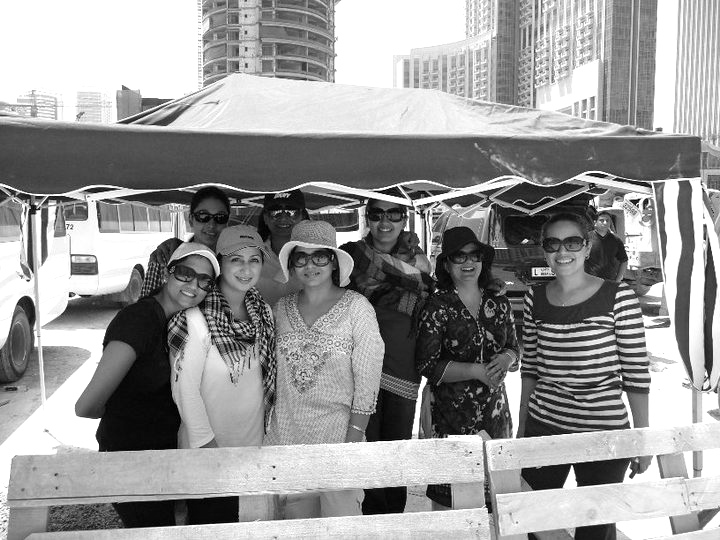
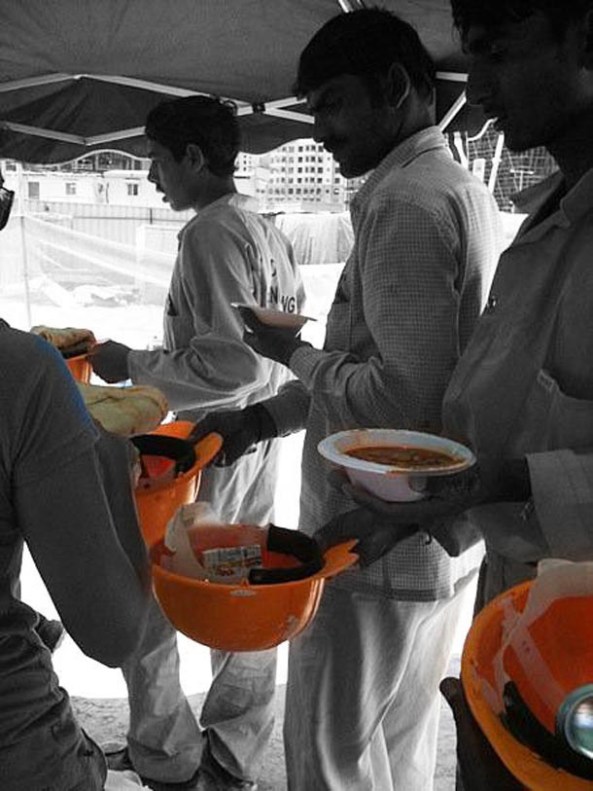
All my associations – with people, places or moments start with the kitchen. This was no different. It was almost 2 years back that my association with Mums Who Share began. A small email from my good friend Priti initiated me into a group of Mums who would cook food in their kitchens and go and distribute the food among the construction workers in a pre-fixed construction site every Thursday mornings. Along with home cooked meals the workers would also get Pita Breads, chilled juices, one fruit like apples, oranges or bananas, biscuits, fruit yoghurts etc. ‘We cook, We Give, We care’ bragged these Mums and they did exactly that – they cooked, they gave and they shared!
My first Thursday of being a Mum who shared was an eye-opener. My contribution was very little – 25 juices of 250ml/each, probably from my stock meant for the Z-SISTERS’ school snack. I accompanied the Mums to a dusty construction site in one of the many on-going construction sites around Jumeirah Beach Residence (JBR). The food was collected mostly at the Ground floor parking of Bahar 4. Cars with individual Mums dropped in various food items. There were collected and stacked into two or three 4-wheel drives along with pots and pans filled with hot home-cooked salans/gravies of Chick peas, Potatoes or an occasional chicken preparation and all the other items like plastic disposable containers, plastic spoons etc that has been collected over the previous week. When we entered the construction site the workers would be instructed to stand in a line. A make-shift tent would be put up in seconds. Thish Thash! Car-keys would be used to slash open the plastics or the cardboard cartons containing biscuit. Slash, slash! Mums would start handing over the food. Jaldi Jaldi – Juice lelo Bhaisaab!/Fast Fast, Go Mister take the juice next… The first Mum hands over the Plastic Plates, bowls and spoons. Onto the next Mum – Pita Bread. Onto the next Mum – Khaboos/Arabic Flat Bread. Onto the next Mum – Chickpeas. Onto the next Mum – An apple or an orange or a banana. Onto the next Mum – A fruit yoghurt. Onto the next Mum – Chilled Juice/Coke can. Onto the next Mum – A biscuit pack. Khalaas/Done? Jaldi Jaldi/Quick Quick! Dusra/Next? All executed in an organised manner, planned to precision. Come hail (or should I say heat here?) or storm (or should I say Shamal/Dust storm?) every Thursday would be the same.
My initial contribution was just 25 juices. But I must have served around 250 workers that day. It was also Diwali, one of the biggest Indian festivals. I felt as if I treated everyone. Though I felt very good but I forgot about this Thursday affair immediately after my first day of volunteering. A month later I remembered suddenly about this. Hopped in once again to help and helped distributing food to around 300 workers. It was Ramadan. Had the same sense of déja vu – felt good again but forgot about this Thursday too! Memory became clear again on Christmas. And after a wild New Year’s Eve, my vision suddenly became clear and memory stopped failing. I don’t know what happened but I became a part of Mums Who Share.
Life through dark Prada glasses and driving around in 4-WD
Living in Dubai has it’s charm. You live amidst bling. Life seems to be comfortable. Shopping Malls profess to sell everything. Here festivals are centred around shopping. You have Dubai Shopping Festival. Tourists throng the beaches even when the temperature outside can house a sauna. We drive around in our shaded cars and see our lives through our dark glasses. School runs, personal aspirations and career goals, week-end socialisings, showing off my beloved city to the guests who join in, either on transit or on visit – describing my life as merely ‘hectic’ would be like describing the peak Dubai summer ‘warm’ when the temperature rises to a sweltering 50 degrees (as shown in the car dashboard and never officially). Initially, I would cook a kabuli chana/chick pea preparation and would accompany the Mums to the construction sites. Then slowly I shifted to contributing 50 chilled juices. Then one day I was told by a worker to bring in chilled Coke cans, not juices! So I began giving Coked cans. But that lasted only for a while. I didn’t feel good contributing towards these chilled ‘real treat’ as the workers would call the coke cans. Then I shifted to fruit yoghurts and it’s been a long time that I haven’t been able to accompany the Mums to the construction sites on Thursday mornings as the timings coincide with Li’l Z’s nursery pick up time. Also, I have resorted to a more make-shift convenient arrangement. Every Thursday the local grocery store send 50 fruit yoghurts to a Mum who stays near me. The fruit yoghurts reach Asra chilled and just in time as she leaves for the construction site. No more storage space needed in my Refrigerator or hers as it was required earlier when I would buy yoghurts on my weekly grocery and store them in my Refrigerator and send them over to Asra’s on Thursday mornings!
I do whatever suits me. Others Mums do whatever suits them – time, food items or volunteer physically. Each does whatever one can. When I felt that cooking a dish was becoming a bit stressful for me, I stopped. When I felt that accompanying the Mums to the construction site was becoming difficult for me, I stopped it. When I felt that dropping the juices all the way to Bahar 5 was becoming too much, I stopped it too. When I felt buying something and storing them in my Refrigerator was becoming too much I stopped that it once again! Every time I figured an easier way out.
What I didn’t stop was severe my ties with Mums Who Share, all because there weren’t any obligation. Just a commitment towards a good cause which has grown from feeding 10 workers to feeding currently almost 400-500 workers every Thursday. Today Mums Who Share organises special drives during Ramadan, Diwali or Christmas when they have managed to donate Blankets, Special Care packs containing personal grooming items, Watches, Rucksacks, Shirts and a lot more. My contribution is very little. 50 fruit yogurts every Thursday and a contribution towards 20 shirts or 15 Rucksacks or 5 watches or 10 blankets – or whatever it may be towards their special cause. What started off as stirring up a small meal in the kitchen has now become a weekly gratification. Lots of effort goes into making individual care packs for so many workers. I remember Big Z and Li’l Z helping me with making around 20 care-packs (our minor contribution) with ribbons and ‘Ramadan Kareem’ written on small hand made cards. Our children have accompanied us to the sites on holidays. They have helped us with our packing the individual care-packs. In-fact, there is a community initiative Kids Who Share which enables the children to be a part of the process of sharing as well.
It all started in the kitchen
Initiated by Saba H Qizilbash and Shahneela Ghafur in 2008, Mums Who Share began as a simple gesture of distributing food on Thursdays on the traditional belief that this would bring in blessings and goodwill for family and loved ones. So, every Thursday a few mums would take time out to cook and pack food to distribute around the neighbouring construction sites with the focus being ‘sharing’ no matter how big or little the quantity. Today, around 400 workers are fed every Thursday and special donation drives during festive occasions strive to collect stuff which might help the workers or bring about some cheers and lots of smile.
Around 8-10 Mums form a core group – Asra, Amal, Priti, Saba, Sara, Shahneela, Sobia, Priti. They chalk out the left-overs from the previous week (not food but all the disposables and beverages etc) and send out a mail with the quantity required for each items. A few additional Mums regularly volunteer in the site including french Mums like Dominique, Beatrice and Orian. Aunty Parhin & Monica frequent the site regularly as well. And there is a bevy of more than 100 dedicated Mums who contribute towards this Thursday distribution. Special mention has to be made to Renu, a Mum who had been part of this initiative for the last 4 years. Nowadays meals are not cooked by individual Mums anymore on grounds of maintaining hygiene and consistency in the food that is going to be served. A very generous lady who prefers to remain unnamed cooks Chickpeas for around 400 workers. Sometimes Biryani Rice or even an occasional treat of Chicken Biryani. This allows the group to gather juices, soft-drinks, biscuits, fruits, Pita Breads, disposable bowls and plates for more than 400 workers, every Thursday!
1 juice can, 1 biscuit pack, 1 fruit yoghurt – any amount helps!


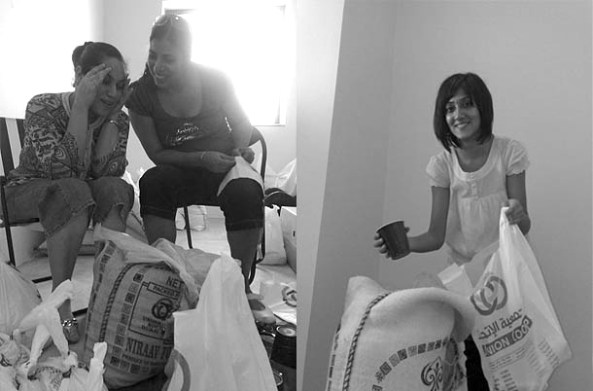


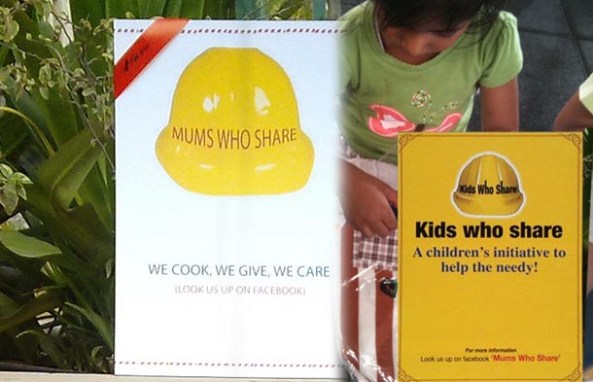






I would love to hear your interpretations of the sporadic colours amidst the B/W photographs. All these photographs have been taken by the other Mums while I take credit for a bit of photo-shopping and choosing them. I wanted to share our story so that anybody living around is aware of this group, so the next time you have ordered too many soft drinks for your weekend party please give us a shout by visiting our Facebook page and we will be too happy to spring-clean your kitchen cupboard. The Gulf New’s Friday magazine featured us once. We are based around the JBR/Marina Area. We are the Mums Who Share!
Unblogging it all… Ishita

BE SOCIAL. SHARE THIS!

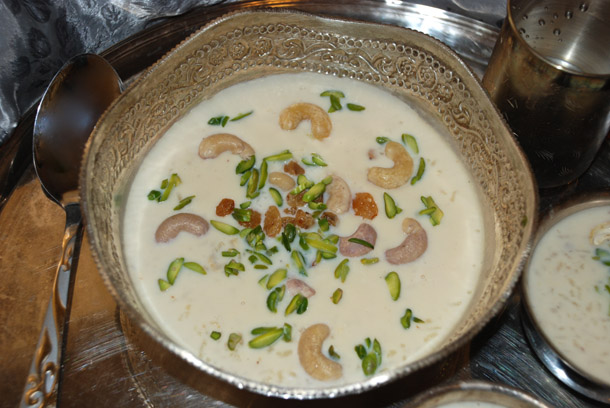

Today’s dish is special and very primitive. The only other way to explain the importance of a traditional Payesh/Rice Pudding is to compare it with Champagne. If you can understand the importance of Champagne to bring in a family celebration then you can probably understand the importance of Payesh. Or say, cutting a cake on a birthday. For a Bengali, a spoonful of Payesh is a must on a special occasion. Also, the first spoon of non-solid food that goes into a Bengali child during Annaprashan or the First Rice is Payesh.
Annaprashan’ or the First Rice
The first ceremony or celebration that a Bengali child witnesses is Annaprashan or the ‘First Rice’. This Bengali tradition initiates an infant of barely 5 months and a little above to his/her first intake of food other than milk. And what a royal initiation it is!
The first vision of ‘solid food’ comes in the shape and size and form –
♦ Drops of Ghee (traditional Indian clarified butter)
♦ Payesh (a sweet dessert made with rice, milk & sugar)
♦ Shukto/Bitter vegetable preparation
♦ 5 types of Bhaja or fries – Aloo bhaja/Potato fries, Potol bhaja/Parwal fries, Kumro bhaja/Pumpkin fries, Begun bhaja/Eggplant fries, Uuche bhaja/Bitter-gourd fries
♦ Torkari or an assorted vegetable dish
♦ Daal or lentil soup
♦ Chutney, a sweet sign-off and ofcourse a variety of FISH preparation accompanied by Yes, a FISH-HEAD and a FISH-TAIL!
So, the groundwork for the Bengali taste buds’ perpetual yearning for FOOD is already built at almost infancy. And Payesh is celebrity dish that cuts the ribbon in an opening ceremony!

Payesh also brings in lots of memories of my childhood, specially Dida, my maternal grandma. Though I have been making Payesh every now and then, I always feel that something is missing in it. Maybe, it’s the additional magic aromas that went into her Payesh as she stood stirring the ladle in a heated up kitchen, in-front of the gas burners. And much before the gas burners came in she would be hovering over an Unun/Small Portable Clay furnace which required probably an hour of fanning just to set the fire right. She was an amazing lady with equally amazing morals and ethics. Probably that’s why her name was Niti which actually means ‘morals or ethics’. Well, this is not really about remembering my beloved Dida who’s no more, but trying to understand the psyche of a woman whose only demonstration of love for her 7 children and their children was through cooking. And cooking here doesn’t mean just a basic meal, but intricately designed savouries and snacks, sweets and pickles and a whole lot of tit-bits. If she made a particular sweet mango pickle for me, she would make also sure she made the other kind which my cousin Swati liked. If Rohu fish was for me, Pomfret was for her. She made sure that each of her grandchildren got a special food. And then she would sit at the end of the green dining table in my Mamar Bari (traditionally the son, the Mama or the Maternal Uncle looks after the grandparents, hence grandparents’ house would be affectionately known as Mamar Bari) and supervise our eating. ‘Aro nibi?/Do you want more?’ and ‘Ne na aaro/Do take some more!’ would alternate between additional servings till we would cringe and roll down our dining chairs.
Dida was beautiful. She came from Bhatpara, which is a suburban town and a municipality under North 24 Parganas, a district in the state of Bengal, India. Situated on the bank of Ganges or the Hooghly river, Bhatpara is known for its rich traditions and renowned for its Sanskrit cultural heritage and learning. There are a number of sweet shops in Bhatpara and the residents and the descendents with any association with this place is famous for their sweet tooth. Rasgullas or Rôshogollas (the most famous Bengali sweet and my favourite topic to write on) from Bhatpara would be coated with actual sugar particles – taking the intensity of the Bengali sweetness to a different category. Hence, it wasn’t unusual that my beloved Dida was an expert in making sweets and sweet pickles. As I have mentioned before, she made elaborate Bengali Sweets which looked and tasted equally awesome. The laborious process in making these took most of her days and probably night too. We would wait to see what sweets she had specially prepared for us. Just to ease the pain of a very serious issue, it is hence not unusual that she took Insulin injections till her very last day along with probably one ‘sweet something’ that followed her meals!
Notun Gurer Payesh/Rice Pudding with Season-Fresh Jaggery
Category – Dessert; Cuisine type – Traditional Bengali
Payesh can be made in many different ways. This is a traditional Payesh where Notun Gur or Nolen Gur/Date Jaggery is used as the sweetener instead of sugar. This Jaggery is traditionally available fresh during the winters, hence Notun Gur (literal translation is New Jaggery) or the season fresh Jaggery is something that everyone would wait for. The smoky aroma and the earthy colour of the Payesh is something that one looks out for. A sweet little note with pictures on how the palm sap is collected to make the Jaggery.
Here, in Dubai the date syrup is available in abundance – they are available in bottles in most supermarkets. Needless to say that this syrup suffices for Notun Gur almost perfectly!
Following are the characteristics of all recipes doling out of our little hands, big hearth –
♥ Easy to cook
♥ Regular canned products off the shelf may be used (However, we advocate using fresh products)
♥ Goes well both as a regular or party dish
♥ Children can easily help in making the dish (My two little sous-chéfs are aged 8 and 3 years!)
♥ And lastly, guaranteed to be tasty!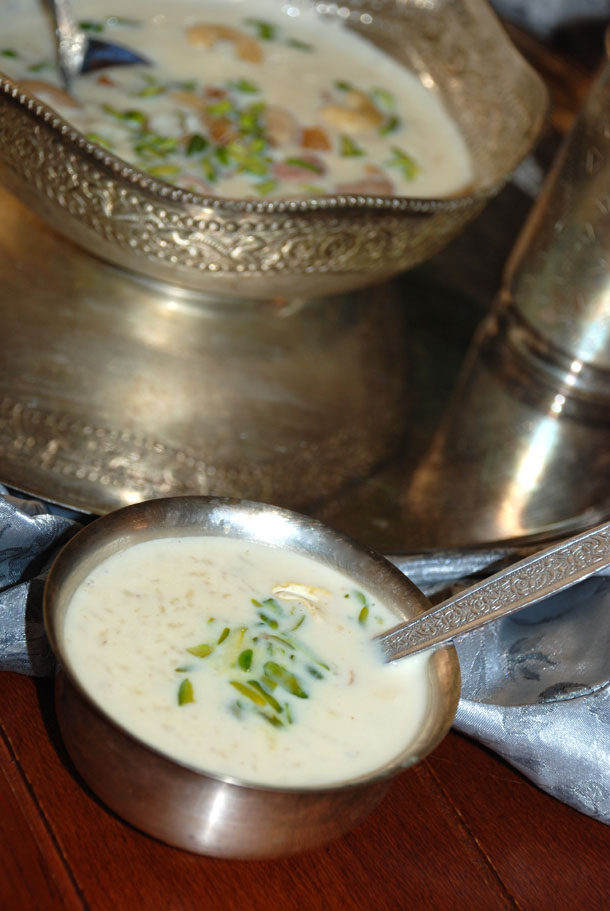
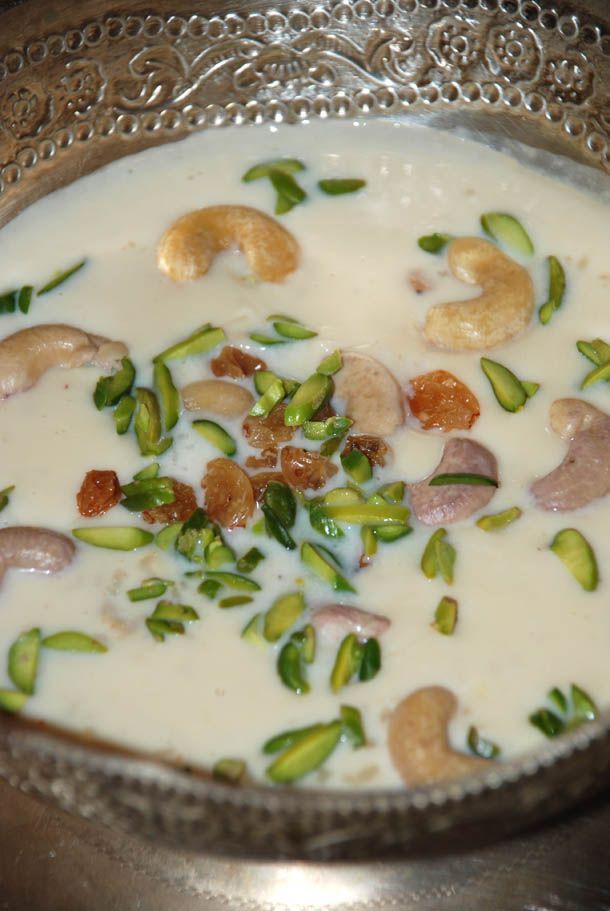
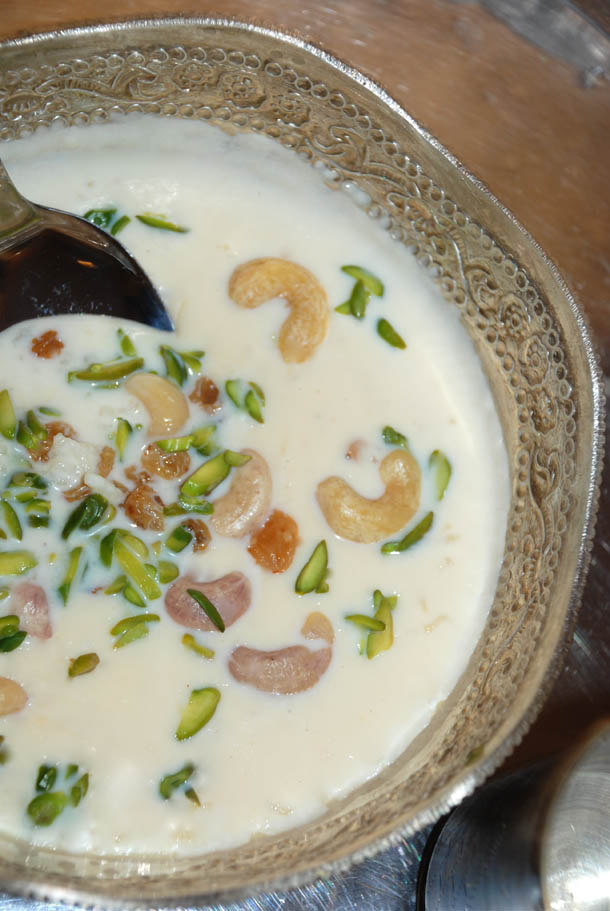
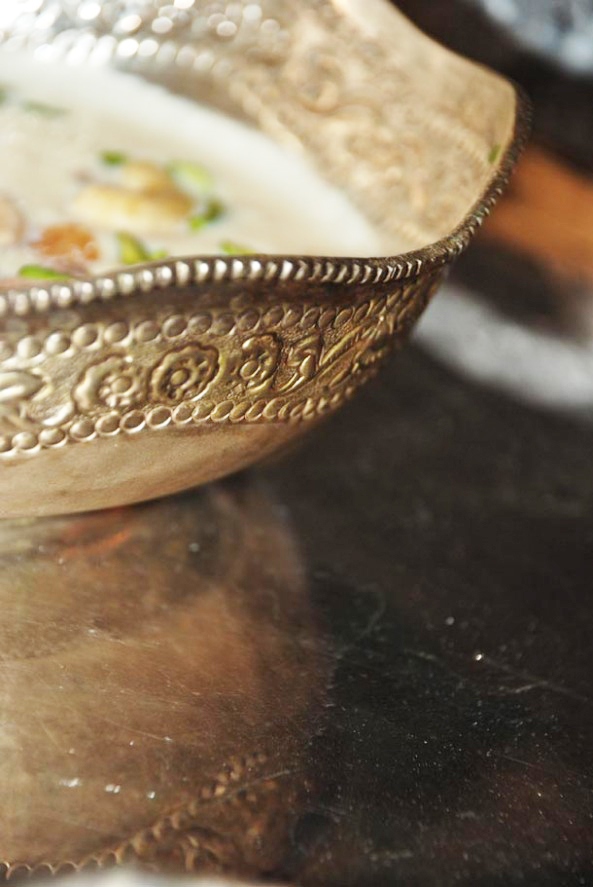
For the printable recipe→
Serves 6-8 persons (maybe less if they happen to be sweet-toothed Bengalis!)
Preparation time – 1 hr 30 minutes maximum (Boiling the milk with Rice and thickening it by constant stirring – 45-50 minutes; setting up – 10 minutes; Refrigeration – 30 minutes)
Ingredients
Low-fat Milk – 2 lt (Many prefer to use sweetened condense milk – in that case you will need much less milk. But I find Jaggery losing it’s uniqueness amidst the existing sweetness)
Jaggery – 5 one and a half inch square cubes or 1 cup of Date Syrup
Sugar – optional
Pistachios – 1/4 cup
Raisins – 1/4 cup, soaked in Water
Cashew nuts – 1/2 cup, unsalted
Fragrant White Rice – 1 cup*
* The fragrant Rice that is traditionally used in making the Bengali Payesh is a special type of rice called Gobindobhog. Wikipedia defines it as ‘Gobindobhog is a rice referenced in ancient Indian literature. It was used as an offering to the gods because it was known to be, “The rice preferred by the gods”. It is a short grain, white, aromatic, sticky rice. It is grown traditionally in West Bengal, India. It has many traditional Bengali recipes intended for it specifically. It has a sweet buttery flavor and a potent aroma.’
Method of Preparation
– Soak the Rice in water for some time and drain out
– Boil the Milk in a Dekchi/a flat bottomed pan (Dekchis are usually used for cooking Rice. Please note that Payesh is always made in utensils meant for cooking Rice or kept separately and hasn’t been used for any other type of cooking. This is because of it’s susceptibility to catching the smell of other cooked items. Constant stirring is required so that the bottom of the pan doesn’t get burnt)
– Add the Rice when the milk comes to a boil
– Keep on stirring so that the Rice is boiled properly and the Milk thickens
– Add the Jaggery only at the end, otherwise there is a risk of the Milk getting spoilt. Once the Jaggery has been added the milk shouldn’t be boiled further. Some prefer to add a bit of Sugar along with the Jaggery.
– Garnish with Pistachios, raising, Cashew Nuts. Serve it cold. However, some prefer to eat this Payesh smoking hot, just after it has been taken off the fire!
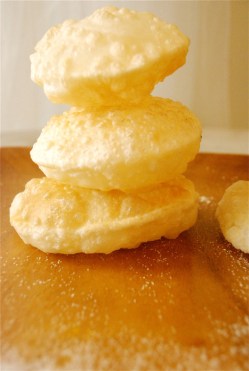 Nostalgic accompaniment
Though this is served as an independent dessert and is made in almost all auspicious Bengali occasions and ceremonies, it complements brilliantly with Luchis. My ode to Luchis has been featured in Ahlan! Gourmet. {My ode to Luchis…} Luchis are deep-fried flat-breads made of wheat flour shown in the left. Or, say Muri/Puffed Rice, specially the day after the Payesh has been made and has thickened and set in brilliantly. Well, please ignore the last part if you are used to eating fresh food!
Availability of Notun Gur and Gobindobhog outside India
Our stint in Colombo, Frankfurt and Dubai suggests that if these are available outside India, they can only be found in Bangladeshi shops and Asian supermarkets selling Bangladeshi products. I use the Date Syrup as a perfect substitute for Notun Gur and there is a type of rice which comes from Bangladesh – the Chinigura Rice (similar to Basmati and Jasmine rice but with very tiny, short grains, resembling sushi rice). The latter, though less fragrant than Gobindobhog Rice is easily available in Bangladeshi shops in the Sharjah Backet. But frankly, you may use a fragrant Basmati rice as well… after all it’s the journey with all it’s imperfections that will stay in the memory, not the perfect tit-bits!
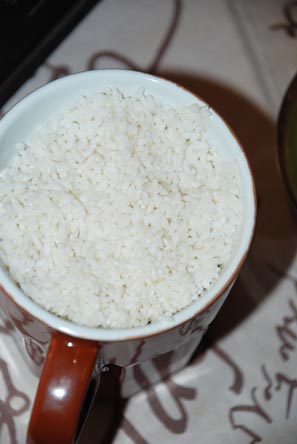
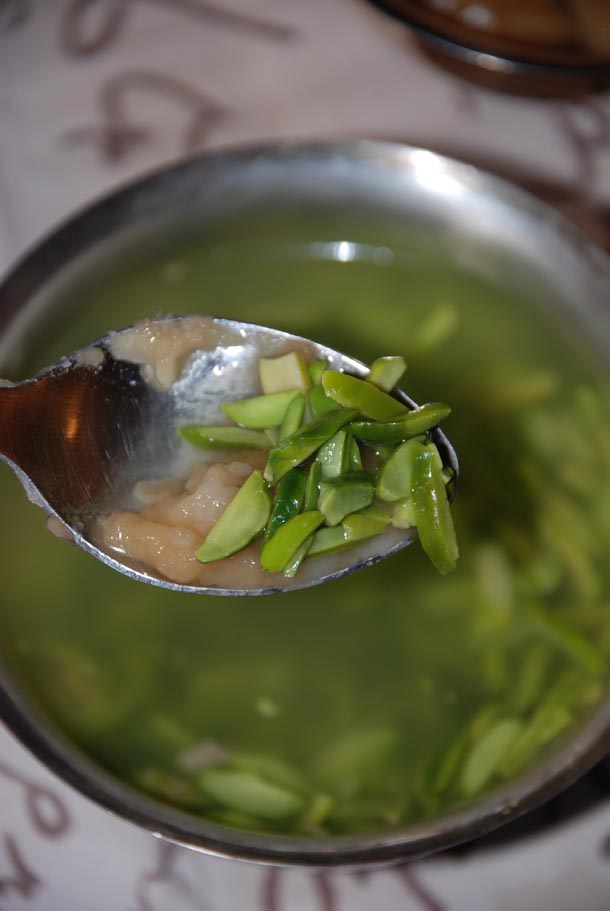
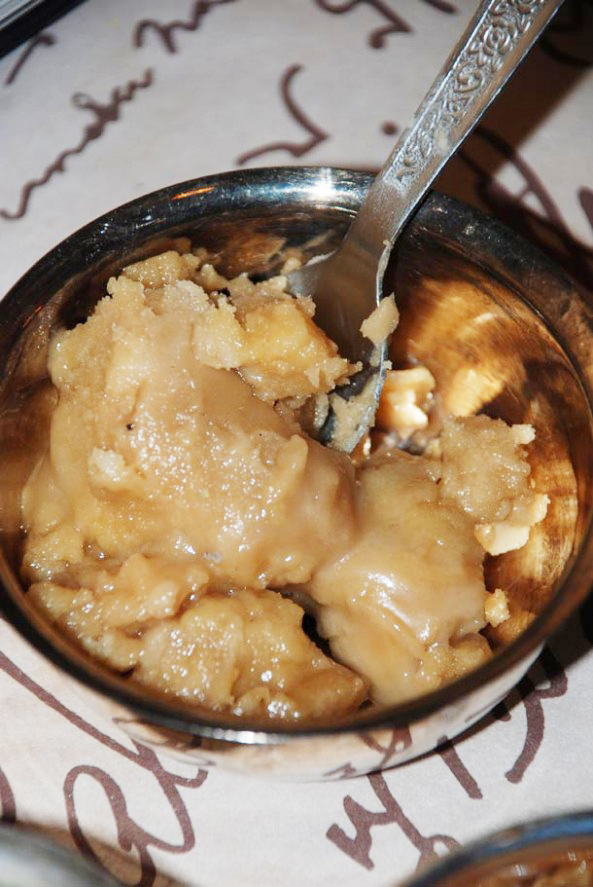

The recipe on Notun Gurer Payesh is nothing new. There must be many many more floating in the internet. And definitely much better recipes than mine. But this post is special. This is my first post remembering a very special lady in my life who’s probably smiling from somewhere above as she sees her beautiful B/W picture scanned, brightened, trimmed and uploaded in this post. My parents are visiting us now and my daily routine is filled with my Mum scolding me non-stop as my Dad affectionately walks up and down, simply smiling and probably enjoying all the fuss. I am back to my school-days and college days. ‘Beshi kore Jol khao, ki bhishon gorom poreche/Drink lots of water, it’s so hot now!’, ‘Ebare ghumiye poro to/Now go to sleep!’, ‘Shabdhane gari chalabe/Drive carefully!’ etc.
Suddenly the Z-SISTERS and I – we seem to be of the same age, all of us being prodded by our respective Mums! They are continuously discussing and swapping and trading the gifts that Ma-Baba and my li’l Bro has brought for them. This is where my childhood was different. Dida showered us with her affection and love, not through gifts but by an energy of love that she emitted. But then the reason why I am capturing this traditional Payesh in my post is because the Z-SISTERS, like me, are watching their Dida in awe as she makes the Payesh – stirring the ladle continuously so that the Payesh doesn’t burn at the bottom. It is kind of a déja-vu… I see a sudden reflection of my Dida in her. Do enjoy more pictures on my Mum’s Payesh making.
Somethings will change in our lives. But, I am happy knowing that somethings will remain the same forever!
Unblogging it all… Ishita
It does take lot of effort to capture these in text and pictures. While it’s meant for you to enjoy them, may I request you not to use them!

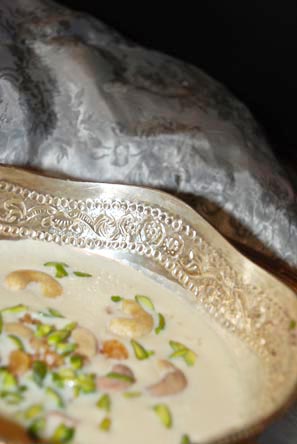
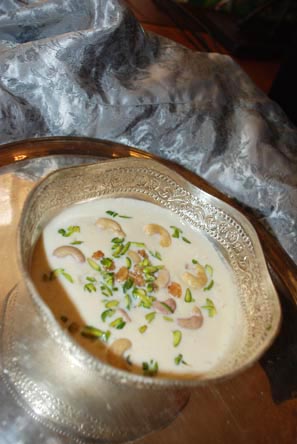
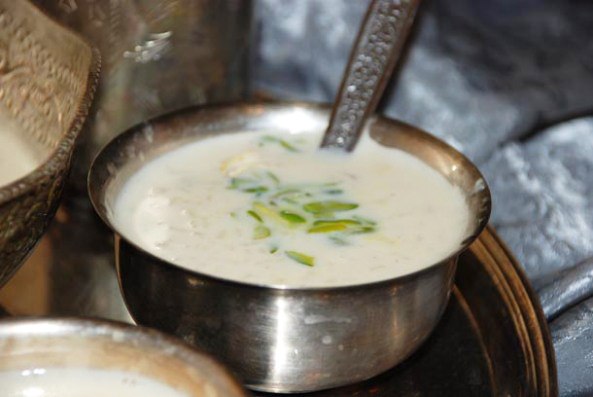
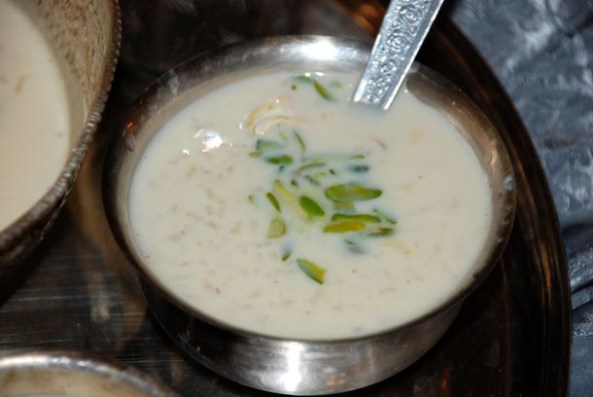
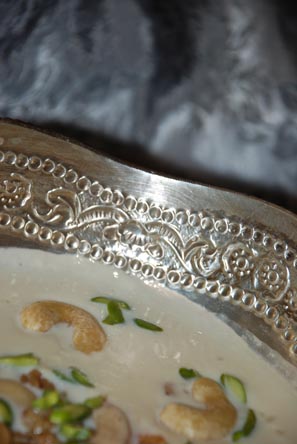
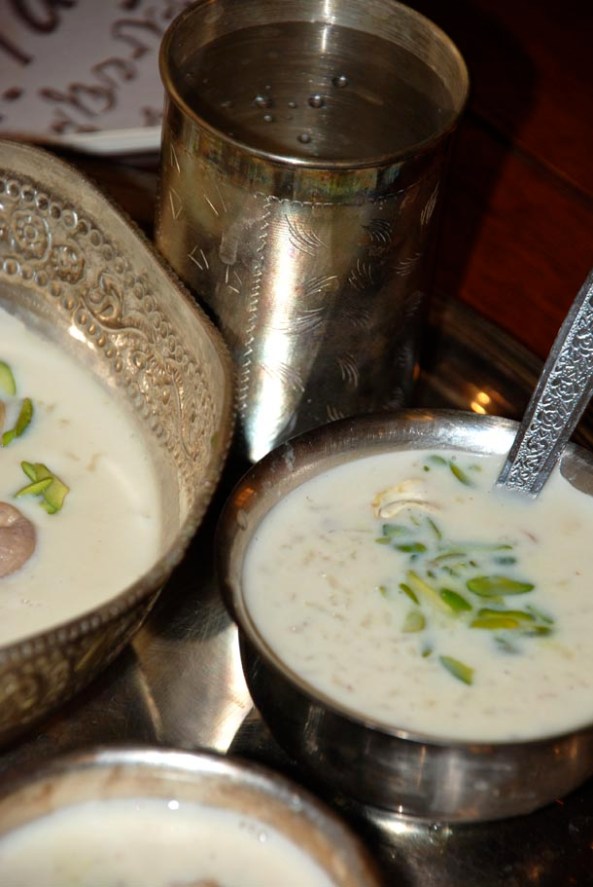
Bengali Food Banters you’ll find in my blog:
♦ Traditional Bengali Cuisine… In ‘Slight’ Details! – An etymological explanation to the Bengalis’ food festish
♦ Pickles… Mother (-in-law) Of All Pickles! – My Pickle Nostalgia
♦ Momos in Tiretti Bazar – The Last Chinese Remnants! – A chinese Bazar near Poddar Court
♦ Phuchkas in Vivekananda Park – An ode to Dilipda’s ‘world-famous’ Phuchka
♦ Bengali Sweets That Came By Parcel! – Gujia, Jibe Goja, Abaar Khabo & Jolbhora
♦ Rôshogolla (রসগোল্লা) – Bengali’s Own Sweet – An essay on the most famous Bengali Sweet
Bengali Food Recipes you’ll find in my blog: (Do click on Recipes, Reviews, Events for a complete list of all food banters)
♦ Frozen Aam Pana/Green Mango Pulp… The Change Initiative Inspiration! – Traditional Bengali/Indian
♦ Locavorism, Friday Market & Tok Palong/Sour Spinach Chutney – Traditional Bengali
♦ Semaiya Kheer/Vermicelli Pudding, Eid in Dubai… Eid Mubarak! – Indian
♦ Mutton Kassa With Red Wine And Red Grapes – Bengali Fusion
♦ Khichuri As Harbinger of Hope & Kolkata Soaked In Rains – Traditional Bengali/Indian
♦ Hot Garlic Pickle… The Pickled Diary – Episode 1 – Indian Pickle
♦ Firni or Ferni, Ramadan or Ramzan, Mallick Bazar or Karama? – Indian Dessert
♦ A Tale of 2 Cities & Naru/Coconut Jaggery Truffles – Traditional Bengali
♦ Phuchkas in Vivekananda Park – Indian Street-food/Snacks
♦ Kaancha Aamer Chutney/Green Mango Chutney – Traditional Bengali
♦ Rasgulla Macapuno – When a Filipina Turns Bong! – Dessert; Bengali Fusion
♦ Mango Lentil Soup/ Aam Dal – The Summer Combat – Dal; Traditional Bengali
♦ Easter Egg Curry – Side-dish; Bengali Fusion/Traditional Bengali/Continental
♦ Mashed Potato Bengali Style/ Aloo Bhaaté – Side-dish; Bengali Fusion
♦ Yoghurt Aubergine with Pomegranate – Side-dish; Bengali Fusion
♦ Purple Haze Yoghurt with Purple M&Ms – Dessert; Bengali Fusion
♦ Icecream Rasgulla with Blueberry Sauce – Dessert; Bengali Fusion

 IshitaUnblogged