
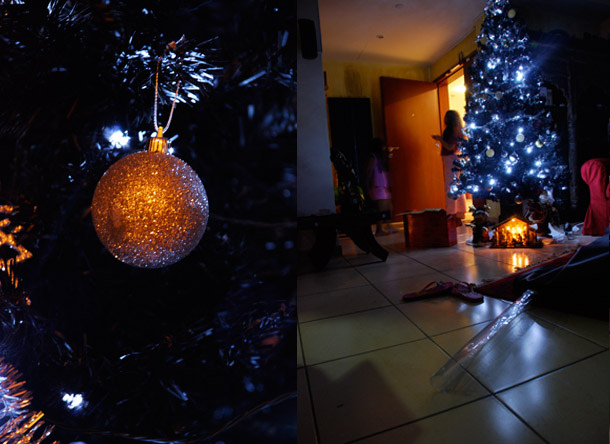


This time we are again going to celebrate Christmas at home. The decorations are complete (above). Why is Christmas so big in a non-Christian family like ours? It’s because I have grown up believing in Santa and I still believe in him. Religious fundamentalists would probably find me preposterous but well, I blame it on my genes. Growing up in Kolkata, I have learnt to carve for the festive Semaiya Kheer/Vermicelli Pudding during Eid, search for traditional Halim and Firni during Ramadan in the various Muslim restaurants in the crowded Park Circus area of Kolkata, even taking the Z-Sisters to one such journey during our summer vacation this year. I’ve immerse myself with equal vigour in the crowd during autumn when the entire city turns into a carnival mode and festive frenzy during Durga Puja, the biggest festival for the Bengalis. And yes, we’ve attended mid-night masses on Christmas Eve and lighted candles at St. Paul’s Cathedral in Kolkata. I was born a Hindu but grew up embracing all religion because of my parents and because of Kolkata, the city which nurtured me. This is not a personal post yet touches many personal chords in my life – in our lives.
Our German Christmas
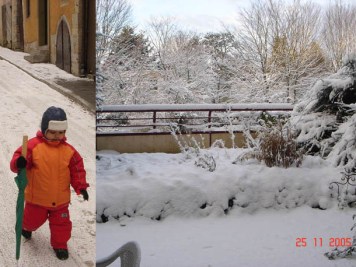
From landing in Dubai Airport in 1999 as a married couple with just 2 suitcases in hand, we have moved houses 5 times. And we have moved continents twice. It’s surprising how our assets have increased from those 2 suitcases full of material objects to many years full of memories and emotional possessions. Our setting up home in Frankfurt, Germany for 2 years in 2004 introduced us to real snow, real sausages, real Christmas and the traditional copybook Christmas dinners and German Beers – the Pilsners and Kellerbiers. And finally to the Magic of Christmas – the Weihnachtsmarkt or Christmas markets in Germany (slideshow below).
While the Weihnachtsmarkt was all about snowflakes and Santa, strawberries and shortcakes, marzipans and muffins, bon-bons and candies, scented candles and hand-crafted wooden musical boxes and perhaps everything dipped in chocolate, a Christmas tree at home also meant a real Christmas tree – unwrapping it from the nets and freeing the branches before putting on the baubles. Beautiful handcrafted baubles made from wood or glass and other Christmas decorations.
 Christmas decorations in Germany bring me back to the Käthe Wohlfahrt – the famous Christmas store. Exquisitely handcrafted Christmas tree Ornaments, Candles, Nutcrackers, Music Boxes, Advent Calendars, Cuckoo Clocks and more – Did we buy anything? Alas, not much. Earning in Dirhams give you minute chances in life to perhaps buy a few material things. Not Euros. And definitely not for newly-turned parents transported into Germany from the so-called tax-free Dubai!
So a Limitierte Edition of their unique miniature painting on wood – Kindertraum with miniature musical angels and animal figurines has now become a lovely page in our Germany album. The store is beautiful and we’ve visited their branches wherever we’ve come across… in Rothenburg ob der Tauber, Heidelberg, Rüdesheim, Oberammergau. Also Brügge in Belgium. Waiting for that day when it’s going to perhaps open in the Dubai Mall!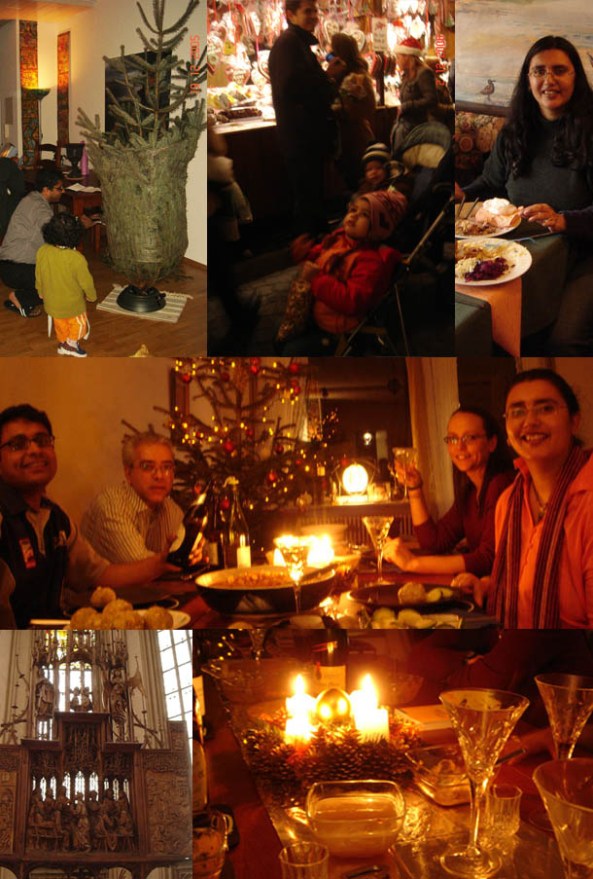
While Christmas in Germany was all dreamy, settling down in a new city with a new-born baby; groping and struggling with a new language and seeking out new friends; slipping into the melting snow; getting frustrated while making the little one wear gumboots, snow jacket and gloves just to get some grocery from 50 ft away… these weren’t all that dreamy. We did make wonderful friends who have become friends for life. But I would like to mention Zafar (with white hair in the picture above). He helped us settling down in more than many ways – from fixing our DIY cupboards to taking us to different places in the initially unfamiliar Frankfurt. Coming from Dubai where we were used to paying someone to fix all these – fixing up an entire cupboard or a bed set or a dining table can be pretty daunting! Every weekend of his was spent at our place – fixing something and eating what I would cook – the world’s perhaps simplest and the most basic Chicken Curry and Rice. He was flamboyant, enjoying life to the fullest and loved doing things in style – for example marrying his girlfriend on 05.05.05! A crowd-puller in any party for sure. Zafar has been lying in Coma since May 2006. He’s alive but not in the way he would have loved to live – in his own style. As you read the post if you just think about him once, I’m sure the positive energy from so many well-wishers will reach him. After all, Christmas is all about magic!
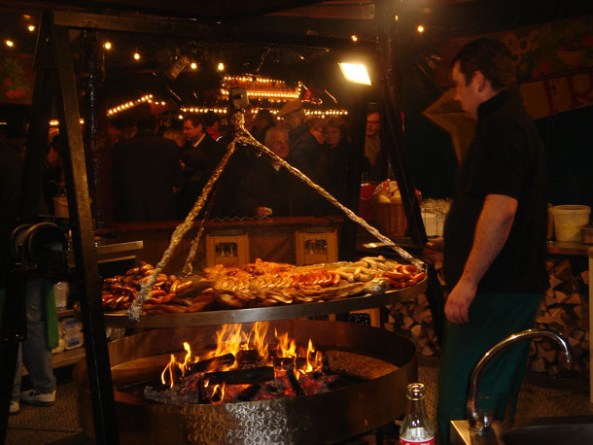
On a lighter note, I have been hallucinating about the different types of German sausages being grilled over a large fire (above) in the Christmas Market held at the Old Römer in Frankfurt ever since we have been back to Dubai in 2007!

Santa in our life
Since 2007, it has been our sole responsibility to host Christmas dinners for our Dubai friends. After all, we were now trained in Germany to host elaborate Christmas dinners! And our very, very close friend Lulu (left) has always been the Santa. He is the only Santa that I ever knew and will ever want to know. Everybody who has met him has had only complained of one thing – tummy aches – as he would make us roll in laughter with his wit and humour. He’s no more. Last year we didn’t celebrate Christmas at home because I couldn’t come to terms with this tragedy. The Z-Sisters kept on asking – Why? I said ‘Because Santa is not coming to our home.‘ I remember Big Z asking ‘But Santa is coming everywhere. Why not our home?’
I haven’t been able to explain. I’d thrown away the Christmas tree that we had and everything associated with it. But as much as I have tried I’m realising that till I write this down, share my inner feelings, upload a picture of the Santa that came home, this loss is going to haunt me forever. And there might never be any Christmas in our home.
Though we’ve hid the fact from Big Z, this year specifically she has been very inquisitive and has been demanding many answers. Now she knows. It’s time to move on. We should celebrate Christmas this season and every season here after just to remember that we too had a Santa who came home. Once upon a time. A few days back she whispered in my years that ‘Someone’s going to stick something on your Mac tomorrow morning Mama. Please don’t be upset!’ 
magic, I believe in it
We are back to celebrating Christmas. We’ve just bought a new Christmas tree and new decorations – all in silver and white. And I’m feeling absolutely charged up to celebrate. I’ve already got the recipe for cooking (above right) from my visit to the Dubai Christmas Festival at the Crate & Barell corner – All you need is 1 Mom, 2 daughters, 1 kitchen, 1 love – forever! We are planning the menu for the Christmas dinner and the Z-Sisters are so happy. We’ve also been inspired by the Baubles from Things we Make and have done our own version as well (further below left). Li’l Z who’s just 3 years, probably doesn’t have much recollection of any Christmas. She bowed a la little Ballerina and said ‘Thank you Mama, Thank you Papa for getting a Christmas tree’. And the ultimate – ‘Thank you Christmas tree for coming to our home!’ (below right)
Our Dubai Christmas
When we had come to Dubai initially, I hardly remember Christmas being celebrated in a big way as it is now. A few Christmas dinners at friends’ home. I didn’t know how to cook. We would go to our friend Neeta’s house for Christmas in Sharjah. I don’t want to sound like a fossil but I don’t even have any pictures from those pre-digital era. I’m wondering whether we had a camera at all! She would host an elaborate Christmas dinner with traditional turkey with butter and nutty rice stuffing, different kind of roasts – leg of lamb, beef, pork, garlic and potatoes, brussel sprouts, baby carrots and shallots. She would also make a traditional Christmas cake with all the fruits and nuts going into a smooth paste. She would then cut the cake into small pieces and wrap them individually in coloured foils – in-case we wanted to carry a few of them home! I’ve been missing her Christmas dinners since the time we have started celebrating Christmas at home.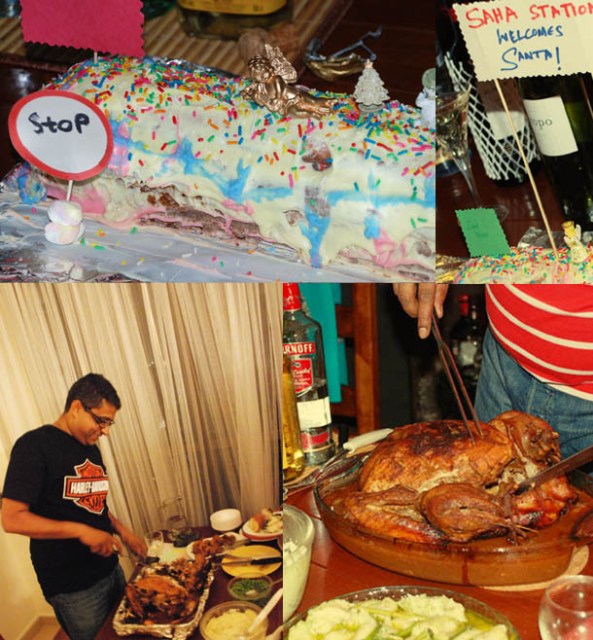
Once we made a messy train cake with 2 compartments – one for Big Z and the other for Li’l Z with a crooked paper banner proclaiming ‘Saha station welcomes Santa!’ Intentions were good so was the taste. S is officially designated for cutting the Turkey with our fancy German steel knives! We’ve had mini choirs at home – courtesy Big Z’s choir inspiration from her school. In fact their Christmas Carol Concert in school just got over, tuning us into the pre-Christmas mood.
Christmas in Dubai
Christmas is palpable in Dubai right now. Recently I took the Z-Sisters to the Dubai Christmas Festival which took place from 6th-8th December in the Amphitheatre, Dubai Media City. A huge Christmas tree with the MBC building and modern highrises in the backdrop – very strange and urban festive backdrop for sure. What was I expecting? A German Weihnachtsmarkt? I was probably expecting kiosks full of only Christmas goodies and decorations instead of branded shops and local big-named grocery stores exhibiting their own stuff. An entire store full of festive decorations from Crate and Barrel (below right) and many decorated Christmas trees apart, I’ve to admit that my expectations were a bit shattered – atleast initially. On the hindsight, it wasn’t all that disappointing. Friends and couples sitting on wooden benches, sipping on Beers and Wines in disposable plastic glasses, kids rolling in the grass and clicking pictures in front of Christmas trees – definitely there was Christmas in the air!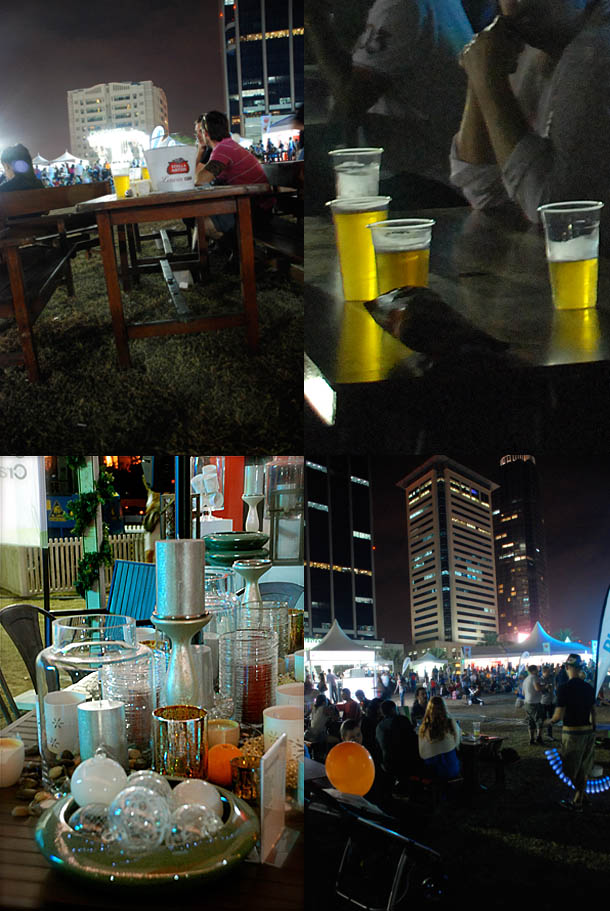
If you plan to celebrate Christmas in Shopping Malls
Is there any place in the world where you celebrate Christmas in shopping malls? Perhaps not. It happens only in Dubai! Every shopping mall and every shop window is shouting Christmas (shown below are displays from Harvey Nichols and Bodyshop)! Christmas may have been commercialised quite a bit in the modern times but the essence is still the same. The excitement of seeing huge Christmas trees in shopping malls can never cease. The sizes of the Christmas trees resonates with the sizes of the shopping mall. If you think you’ll be missing white Christmas here – then you’ll only need to enter the SkiDubai in Mall of Emirates. You’ll get a Christmas tree in the snow (further below). 
Christmas picks of mine – most of them have been tried and tested with the Z-Sisters in tow (not food-related for once!) –
– Celebrating Christmas in SkiDubai – Snow Man Building, Snow Ball Gallery, Sled Race etc – ahhh a white Christmas in real snow!
– Making soft toys stuff in Build the Bear – We’ve built two similar Reindeers last year. The accessories cost more than the Reindeers and yes, they have been lying in the closet since last year. Cutest thing? They come with their own Birth Certificates and our Reindeers are called Sophia and Koel!
– Creating an entire range of special crockery set at Café Ceramique – This has remained an uncompleted project though!
– Mall hopping in the city famous for shopping malls for FREE – yes, we’ve have done this too! If you want to have a great time during Christmas, that too for free, then this is a fabulous option. Apart from being decorated in baubles and enormously tall Christmas trees, the Shopping Malls all over the city has lined up with special events during this season.
- Deira City Centre has a revolving carousel with twinkling festive tree surrounding it and complete with oversized gifts and animated characters.
- Mirdif City Centre is celebrating the winter season with the Garden of Lights.
- In Burjuman, the acclaimed musical score, The Magical Land of Oz is running at The Observatory (13th to 22nd December with three daily shows staged at 6pm, 7:30pm and 8pm).
- Mercato Mall is holding Festive Children’s Workshops (6th – 20th December from 3pm – 8pm on the First floor) where children can create their own festive crafts – salt dough decorations, seasonal cards, bells and bookmarks. There’s also a cute cosy cabin – the Festive Log House where children can relax on bean bags and watch their favourite holiday movies and read festive stories (Courtesy – Virgin Megastore).
- Dubai Festival City has an entire festive calendar with some brilliant events. The musical weekend evenings with Community Drumming where everyone can join in along along with the 40 drummers keeping the beat – this is absolutely my favourite! This is happening at the Canal Walk (from October 18th – December 28th, Thursdays: 8:00pm, 9:00pm, 10:00pm; Fridays: 7:00pm, 8:00pm,9:00pm; Saturdays: 4:00pm, 5:00pm, 6:00pm). There’s a spectacular Light & Water Show at the Festival Marina. Initially designed for celebrating the UAE 41st National Day, this show has now been extended for the next 3 months (1st December 2012 – 28th February, 2013; with 5 daily shows).
- What about Dubai Mall? Unfortunately, nothing’s for free here. Atleast I’m not aware of anything. As of Thursday their Facebook update was ‘Pass by TDM & meet our new guest: The 128.54 carat diamond @Tiffany’!!! So yes, you could perhaps see the new guest for free! However, Downtown Dubai, will be hosting Dubai’s most visually spectacular New Year’s Eve event – the annual Burj Khalifa fireworks in the league of the world’s most popular New Year’s Eve celebrations. A peep here #BeThere http://bit.ly/W8vG39
More pictures of our totally unplanned and random weekend Mall Hoppings just to see a few Christmas trees!
(Note: I have mentioned the above malls since I have visited them during this period. Many activities are happening in other malls around the city as well!)
◊————————————————–◊
If you want to celebrate Christmas at home
This is perhaps, still the most popular way of celebrating Christmas – at home with friends and family. A bit of planning in advance and yes, this is really the most satisfying. But fret not. I’ve compiled whatever you need to know from Cake decoration to setting up the table, from Starters to what to do with left-overs from my brilliant blogger friends from Fooderati Arabia (FiA). FiA is a group of bloggers living in the United Arab Emirates, united by one subject matter – Food!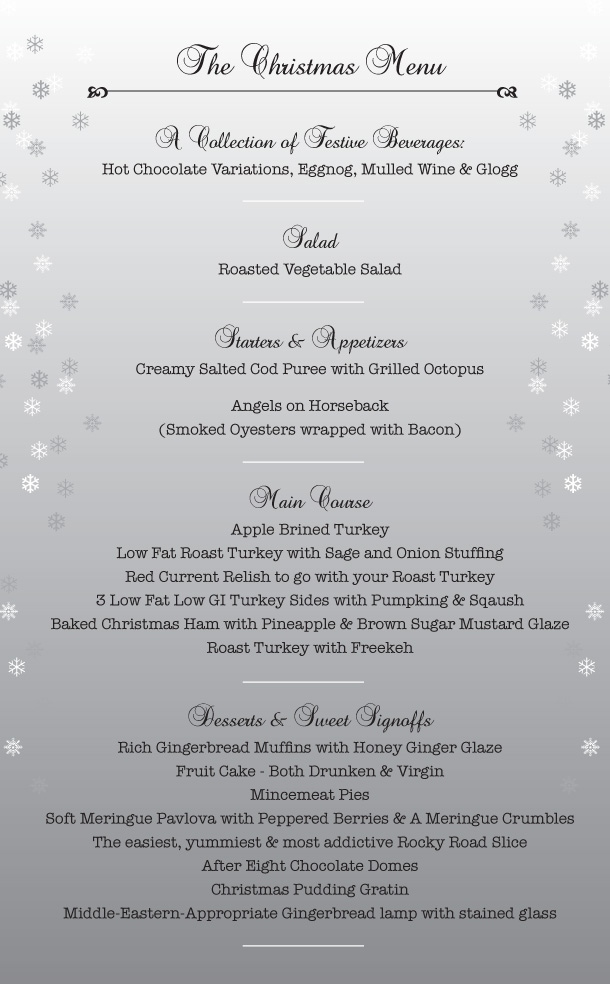
A Collection of Festive Beverages
Starters & Appetizers
- Creamy Salted Cod Puree with Grilled Octopus | From Francine’s Life in the Food Lane
- Angels on Horseback (Smoked Oyesters wrapped with Bacon) | From Stacy’s Food Lust People Love
Salads
Main Course
- Apple Brined Turkey | From Dima Sharif
- Low Fat Roast Turkey with Sage and Onion Stuffing | From Dima Sharif
- Red Current Relish to go with your Roast Turkey | From Dima Sahrif
- 3 Low Fat Low GI Turkey Sides with Pumpking & Sqaush | From Dima Sharif
- Baked Christmas Ham with Pineapple & Brown Sugar Mustard Glaze | From Stacy’s Food Lust People Love
- Roast Turkey with Freekeh | From Sarah’s The Hedonista
Desserts & Sweet Signoffs
- Rich Gingerbread Muffins with Honey Ginger Glaze | From Stacy’s Food Lust People Love
- Fruit Cake – Both Drunken & Virgin | From Dima Sharif
- Mincemeat Pies | From Dima Sharif
- Soft Meringue Pavlova with Peppered Berries & A Meringue Crumbles | From Dima Sharif
- The easiest, yummiest & most addictive Rocky Road Slice | From Dima Sharif
- After Eight Chocolate Domes | From Dima Sharif
- Christmas Pudding Gratin | From Sally’s My Custard Pie
- Middle-Eastern-Appropriate Gingerbread lamp with stained glass | From Sarah’s The Hedonista
With Leftovers
- Gobble Gobble Giblets! Cooking with Other bits| From Francine’s Life in the Food Lane
- Reinventing Leftovers & Recipe for Chinese Duck Stir Fry with Pomegranate | From Kari’s Chef & Steward
- Garlic, Herb and Parmesan Festive Wreath | From Sally’s My Custard Pie

Cooking Techniques & Other Essential Tips
- Royal Icing for Cookie Decoration | From Dima Sharif
- How to set the table for entertaining at home | From Karis Chef & Steward
A host of other Christmas recipes in E-Magazine
- Pecan fudge | From Stacy’s Food Lust People Love
- Christmas Chocolate Goodies from Forray & Galland | From Debbie’s Coffee Cakes And Running
- Gourmet Baked Christmas Goodies from Oushé | From Debbie’s Coffee Cakes And Running
- Cookie Basket Exchange & Christmas Gifts | From Dima Sharif
- What to Gift if you have foodie friends? | From Dima SharifT
- The Perfect Gifts for Enthusiastic Cooks | From Dima SharifGingerbread Cookies & Cookie Cutouts | From Dima Sharif
- Have You got an Advent Calendar? | From Debbie’s The Real Geordie Armani
Looking for a Give -away?
Nice reads on Christmas in Dubai
- A Desert Christmas Feast | From Sarah’s The Hedonista
- It’s beginning to look a lot like Christmas! | From Sarah’s A touch of Frosting and other things
Ordering the Canapes & the Turkey in
Sarah from The Hedonista rightly says – if you’d like someone else to handle the brunt, then you can order in a full Christmas dinner. It’s amazing, and I have no idea why you can’t get this done in the rest of the world. She’s also done a round-up for ordering the Turkey in from various places along with the prices.
- Bah Humbug | From Sarah’s The Hedonista
- Lafayette Gourmet’s Festive Menu! | From my blog
- Christmas Catering Menu | From Marta’s Kitchen
Dining out during Christmas
So you want to taste a Cocktail which till recently was the most expensive in the world and enter the world of fantasy? Containing the L’Heraud Grand Champagne 1906 vintage Cognac, bitters from Germany and Champagne with 24 carat gold in it all housed in a special Swarovski glass? Read on…
- The world’s most expensive cocktail?… plus a Christmas lunch goodie | From Samantha’s FooDiva
- The ultimate Champagne Cocktail at Burj – Al- Arab | From Sally’s My Custard Pie
Apart from us, the food bloggers, the Time Out Dubai gives out 64 top Christmas Eve meals in Dubai and 122 Christmas Day Meals in Dubai, segregated into various price ranges.

And if you have been thinking of going away from Dubai and still haven’t made any getaway plans, you’ll be happy to know that The Telegraph UK notes that Dubai is the most popular destination for those seeking winter sunshine! Exclusive Christmas dinners in exotic ambiances or gourmet dinners at home and lavish gifts apart – if you are in a mood of slight introspection, then do hop into my previous article Giving Back. Signing off by sharing the message that I had seen in St Paul’s Cathedral on our Kolkata visit during these summers (above) – Bishwe Shanti Biraj Koruk/May Peace prevail in the world!
Unblogging it all… Ishita
◊————————————————–◊
Disclaimer: I hope you enjoy reading the posts with lot of visuals. While you enjoy seeing them please don’t use them as some of them have been taken from our personal albums just to make your reading experience more pleasurable. You can see more pictures of my travel and food journey here.
BE SOCIAL. SHARE THIS!

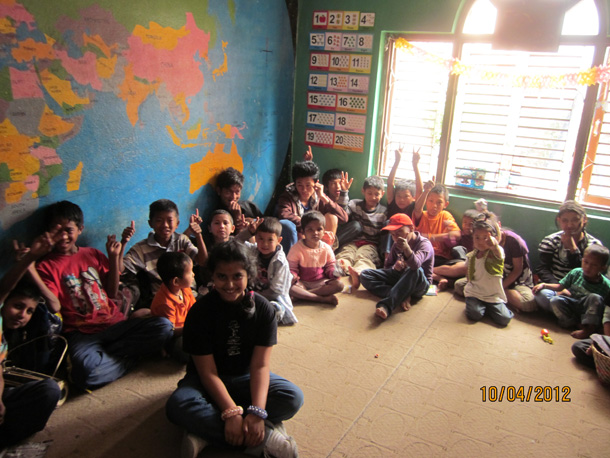
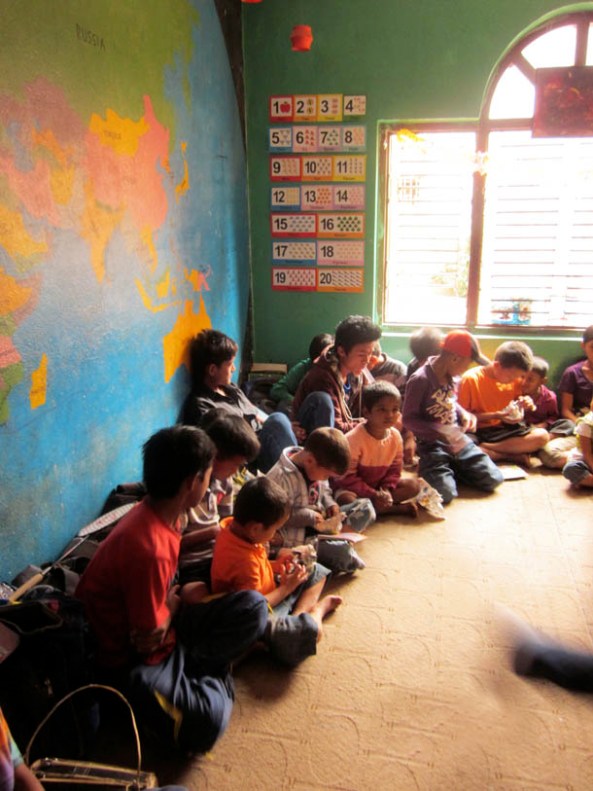
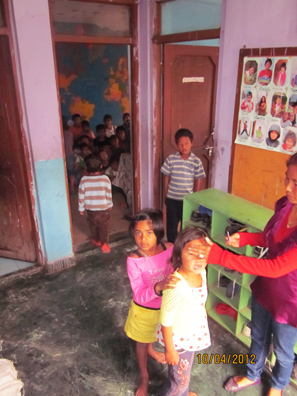
This time of the year calls for small moments of introspection. Yes, sounds clichéd. Time to give back… even more clichéd! Well some tender moments of Clichédness will not harm that much… I hope! We have been involved with the following events or drives that promise to ‘give back something to society’. In some places the involvement has given me a lot of emotional solace, specially Al Noor Training Centre for Children with Special Needs and Mums who Share. We have been consciously trying to get the Z-Sisters involved with something more meaningful than just having fun on our vacations – like visiting the Firefly Children’s Home (above) in Nepal. This post is not requesting you to do anything for that matter. I’m just sharing these moments from our special experiences…
Firefly Children’s Home
Children’s Orphanage in Kathmandu, Nepal
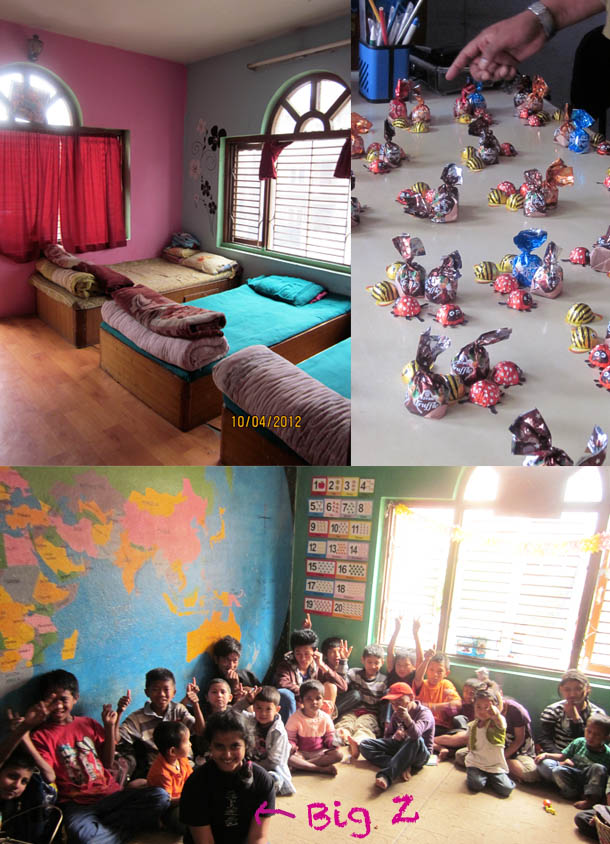
We have no intention or objective in wishing that the Z-Sisters see a world beyond the comfort of their flower-painted walls of their room. Not an attempt to make them realise that they are more fortunate than many others. We simply wish that they open their eyes and their minds and may grow up being sensitive and tolerant to the many differences that exist in the world we are living in. No major sacrifices, no giving up the ACs and their favourite toys but visiting places where they can see children of their age living in a drastically different condition. I feel that the children in Dubai are growing ensconced in ‘illusion bubbles’. Over-protected and isolated from the real world. No harm in that. But lest they get hurt when the bubbles ultimately break and they finally step into the real world – we have been trying to take them to places that they are completely alien to. The above picture is from the Firefly Children’s Home (FCH), an orphanage in Kathmandu, Nepal which we visited on our Nepal trip this year.
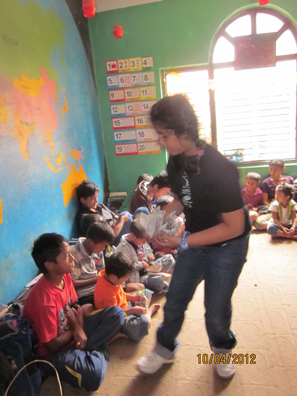 Before leaving for Nepal I had already co-ordinated with FCH and had scheduled a day when we would visit the orphanage. Big Z had initially wanted to carry all her soft toys but I wasn’t sure whether they would be reciprocated well. I asked Mr Karki, the administrator whether we could distribute some chocolates to the kids. As we approached the home we realised that everybody was expecting some visitors. The children were gathered in the hall in anticipation that perhaps the day was going to be a bit special for them. We helped Big Z to distribute the chocolates into small packets. The Z-Sisters were shown around the home. They were also told about the children’s schedule – the time they get up and what else do they do the whole day round. Big Z’s verdict – the children’s rooms were lovely (further above).
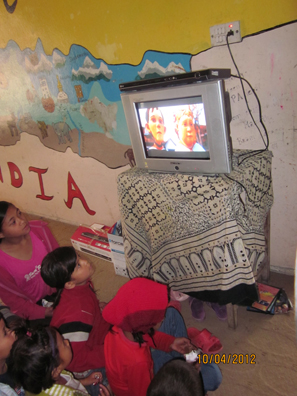
There are around 30 Firefly children who live in either the central Kathmandu home (which we visited) or a rural home in East Kathmandu. The center cares for Nepalese village children whose parents have either passed away, disappeared, are imprisoned or are too poor to feed them.
Firefly Children’s Home
Website; Facebook
◊————————————————–◊
Showing poverty-stricken faces of urban cities like Kolkata is so typical & clichéd
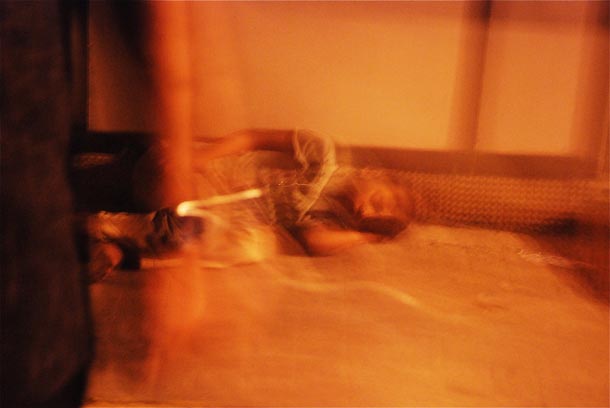
People growing up in developing countries have a different perspective. Though I was fortunate to have studied in a good school and have grown up surrounded by loving friends and family, one constantly comes across people, on a daily basis, who are not so fortunate. As a car stops at a signal, little hands jut into the window asking for money. As one walks past the pavement it’ll take seconds to realise that it is perhaps home to many people (above picture shows a kid sleeping on a pavement in Kolkata at night). Did I grow up to be more sensitive? No, not at all. Infact I would see how the westerners – many of them young students, would come to Mother Teresa’s Missionaries of Charity and help in the Nirmal Hridaya in the Kalighat area of Kolkata (this is a hospice established by Mother Teresa for the sick, destitute and the dying). I don’t think that my friends or I, growing up in Kolkata, would ever be able to do what these volunteers have been doing – live with the people they are caring for and in the most basic of conditions.
Showing poverty-stricken faces of cities like Kolkata is often slammed as a typical Westerner’s perspective and sounds clichéd. Or a NRI’s (Non Resident Indian’s) nostalgic and myopic romaticism. For me it’s definitely not the latter. But I’ve always shown and written about the beauty of my home town. All my friends are blaming me for showing Kolkata more beautiful than it actually is. For example, in writing… Living By The Water With Sunset As Prop – Kolkata & the Ganges.
Or In images…
Capturing Kolkata Kaleidscope in motion,
Kolkata – Terraces & beyond
Kolkata 323 years!
I capture the way my eyes see at that moment. If it’s pretty and rustic – I capture it. And if it’s grimy and dusty – I also capture it.

Sometimes I feel that there’s not much I can do as an individual. Or perhaps I could do but can not do because my expectations from life is too high. HOPE has a lot of power. And with that power many a times I HOPE that the children of the hundreds of homeless who have created their rambling homes under the Gariahat Fly-over (above) and yet manage to play a game of football with their bare feet and a shape-less football at the end of the day, will someday be playing in some proper park or will be able to have 4 walls and a proper ceiling defining their homes instead of the space under a Fly-over! HOPE that the child sleeping on the pavement today gets at-least a bed and a pillow to sleep on tomorrow! (excerpt taken from an earlier post of mine)
“If you wait until you can do everything for everybody, instead of something for somebody, you’ll end up not doing nothing for nobody.” ~ Malcom Bane
◊————————————————–◊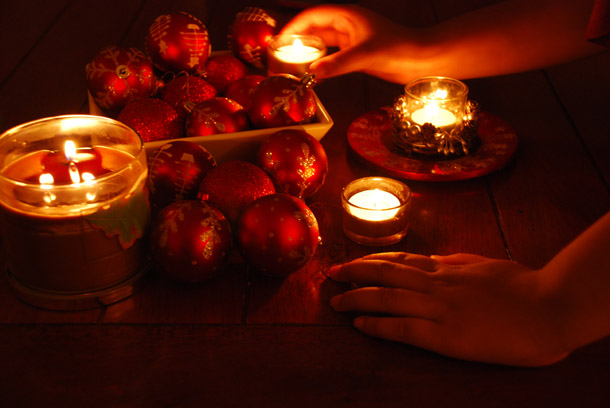
The following initiatives are in Dubai – the ones that we have associated ourselves with – either in a small or a medium or a big way. Big Z is already rehearsing for Christmas… lighting the candles every evening and cleaning all the baubles. What does Li’l Z do? Throw the baubles around as if they were ping-pong balls!
Unblogging it all… Ishita
7th Annual Stollen Charity Cake Sale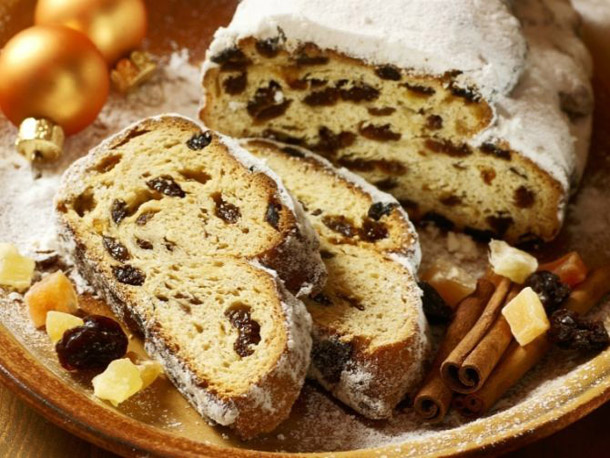
Kempinski Hotel MOE, in partnership with Mall of the Emirates (MOE), is holding the 7th Annual Stollen Charity Cake Sale on Friday, 14th December in the Central Galleria in MOE… At 570 metres long, this will be the largest cake made to date by Kempinski’s very own pastry chefs. At just 5 AED per slice of the German fruitcake and 100 AED for an entire loaf, all proceeds will be donated to the Dubai Center for Special Needs. Starts at 10.00am until sold out.
Gulf News writes about the cake… “It is customarily prepared and eaten only during Christmas,” said Sudgi Nadaff, the hotel’s executive chef. “Each of the loaves you see is 60cm long and we will be aligning them to make the 570-metre cake on December 14.” He said 14 chefs have been working on the dry cake over the last few days with “magnificent” quantities of the ingredients. They include 595kg of flour, 175kg of butter for the dough, 31.5kg of yeast, 265kg of raisins, 2,100 eggs, 105 litres of milk, 52kg of marzipan, 125kg of oranges and 114kg of lemons for their peel and 87kg of almonds. “The raisins, almonds and orange and lemon peels are kept soaked in orange juice for two to three days,” said Nadaff.
Dubai Center for Special Needs
This is a charitable non-profit organization for individuals with special needs. The proceeds of charity will go towards providing care and support for students between 4 to 27 years old at the Centre.
Tel: +971-4-344 0966; Website; Facebook
◊————————————————–◊
Donate A Shirt Drive by Mums Who Share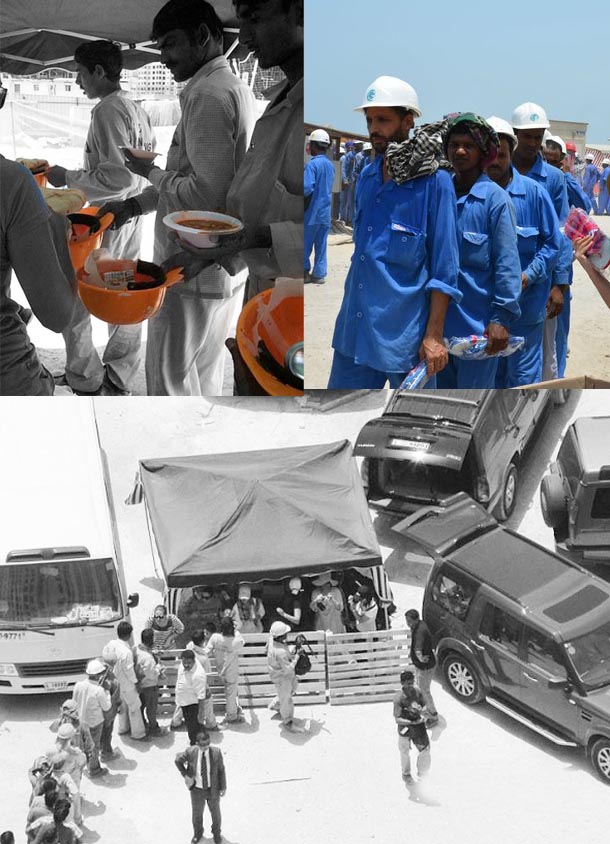
Mums Who Share (MWS) began as a simple gesture of distributing food on Thursdays on the traditional belief that this would bring in blessings and goodwill for family and loved ones. So, every Thursday a few mums would take time out to cook and pack food to distribute around the neighbouring construction sites with the focus being ‘sharing’ no matter how big or little the quantity. Today, around 400 workers are fed every Thursday and special donation drives during festive occasions – Ramadan, Diwali or Christmas when MWS has managed to donate Blankets, Special Care packs containing personal grooming items, Watches, Rucksacks, Shirts and a lot more. I have written about the incredible story of MWS earlier. The Gulf New’s Friday magazine featured us once.
Info: Visit Facebook page and drop a line and MWS will be too spring-clean your kitchen cupboard. 
◊————————————————–◊
Smiles n’ Stuff at Al Noor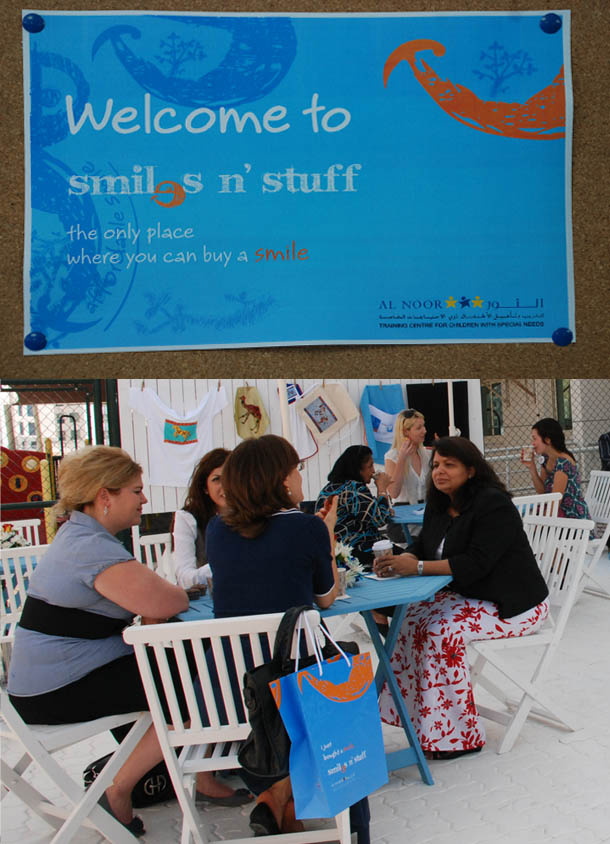
I have a special attachment with Al Noor Training Centre for Children with Special Needs, having visited the school many times. I have photographed the children, visited their fun fair, watched their fashion show and concert. Launched in 2010 Smiles n’ Stuff is a brilliant initiative to support individuals with special needs that goes beyond their training and education. This is the first Vocational Training store of its kind in the GCC, which is run by individuals with special needs to promote and sell items made by them.
You can click on this link and view the catalogue for the wonderful key chains, magnets, coasters, t-shirts, mugs, pencil holders, mobile stands and other unique knick knacks that can make lovely gift items. You can also buy chocolate and butter cookies and cupcakes made by the students of Al Noor.
Al Noor Training Centre for Children with Special Needs
Al Noor is a non-profit organization serves children with special needs from different nationalities.
Website; Facebook
Smiles n’ Stuff: 04- 3418960; email: smilesnstuff@alnooruae.org; The store is located on Al Noor’s premises, behind MOE in Al Barsha.
◊————————————————–◊
Disclaimer: I hope you enjoy reading the posts with lot of visuals. While you enjoy seeing them please don’t use them as some of them have been taken from our personal albums just to make your reading experience more pleasurable. You can see more pictures of my travel and food journey here.
BE SOCIAL. SHARE THIS!

Galeries Lafayette. The name says it all. For many many years the French department store, Galeries Lafayette epitomised my fantasy about Paris. And yes, stepping into Galeries Lafayette in Paris didn’t shatter my fantasy, rather strengthened it with the sheer brilliance of dazzle and fragrance floating around in the air. Forget about the high-end fashionable clothes that were on display. Or the eclectic shoes or the accessories. This was a different world altogether. Galeries Lafayette also housed one of Paris’ gourmet food markets, Lafayette Gourmet, which was initially modeled after a mid-eastern baazar. When we entered the Lafayette Gourmet for the first time in Paris, I stumbled. My knowledge on food was on such a dwindling score at that time. But my senses were alert enough to realise yes, this is what epitomises French notion of gourmandising. As this article notes – Galeries Lafayette Gourmet in Paris is a one-stop foodie destination… It’s a great place for travelers in search of foodie souvenirs, since you can buy many Paris specialties here – Jean-Paul Hevin chocolates, Mariage Freres tea. But this is not a tourist trap – Parisians account for about 60% of the clientele, which is why you’ll also find supermarket basics here, like milk, eggs and produce. Galeries Lafayette Gourmet stocks over 10,000 products, 70% of which are French.

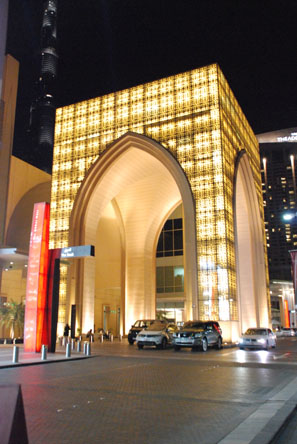
That’s quite understandable in a city which is called Paris! But what about Lafayette Gourmet in Dubai? What product does it sell in a multi-cultural city boasting of more than 200 nationalities jostling for residential space? Opened in 2010 and housed in the world’s largest shopping mall, the Dubai Mall (above right), Lafayette Gourmet keeps up to it’s French promise of delivering gourmet food products with flavors from all over the world… 8 kitchens in one location! And as Gulf News comments ‘Those aspiring to be the Nigella Lawsons and Jamie Olivers of the UAE have, until recently, been limited by a lack of available ingredients… Lafayette Gourmet is a 3,000-square-metre emporium dedicated to high-end food products’.
When Galeries Lafayette opened it’s doors in Dubai in 2009, I was thrilled to see the same image that is synonymous with Galeries Lafayette in Paris – the model wearing the Eiffel Tower on her head, all tied by the French Flag coloured ribbon (above left)! If a Dubai-ite cannot visit Paris, Paris visits the Dubai-ite. With Christmas around the corner, visiting Lafayette Gourmet this time was slightly different from my gourmet cheese shopping visits. This time it was Chef Russel Impiazzi, the Culinary Director of Lafayette Gourmet who was hosting us, a few festively-inspired bloggers (including me, ahem!) for their festive menu tasting.


 Festively inspired we definitely were – a few of my hearty food blogger friends (above left) donning the masks that were part of the table decor (left) and I’ve to admit that they did look as good as the fashionable mannequins (above right) wearing the same masks in the retail section of the Galeries Lafayette! In-case you need an alternative career options buddies…
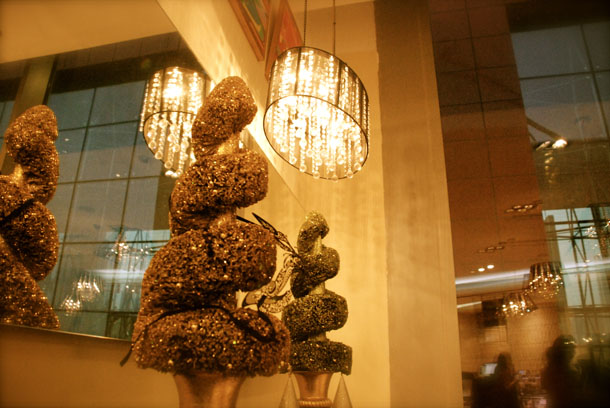
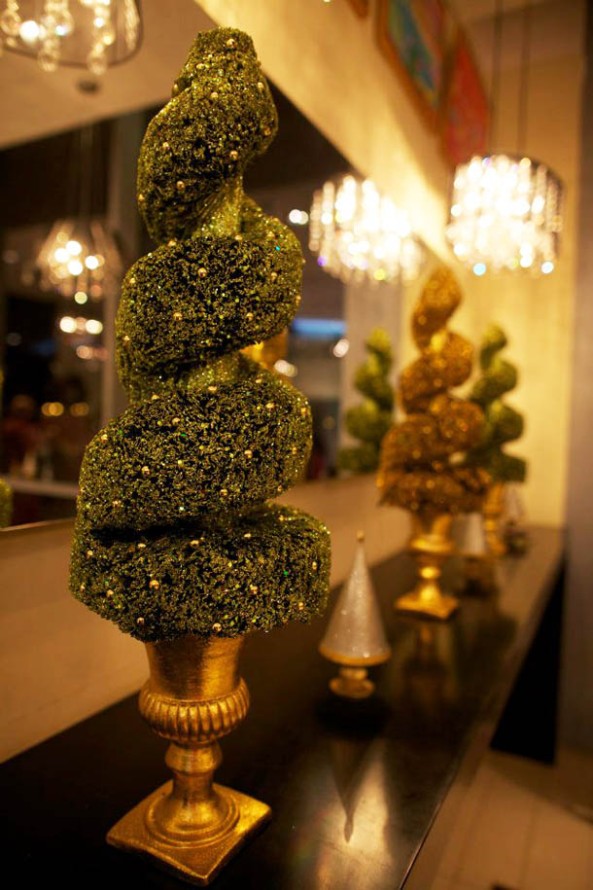
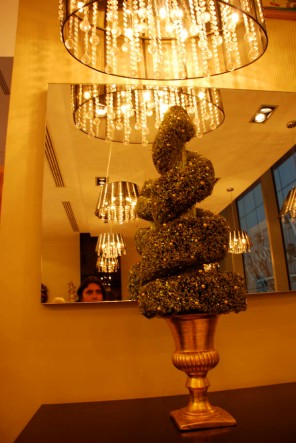
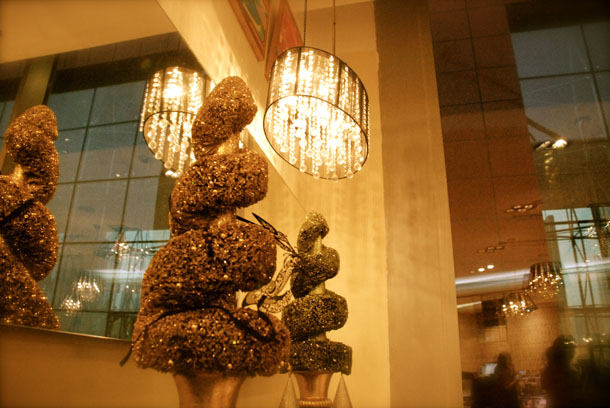
The expansive Lafayette Gourmet, situated on the third floor of the Galeries Lafayette seemed to bask in the festive spirit of the season – candles ensconced in flower wreaths and mini Christmas trees shimmering in gold. Real gold? Not sure but well, why not? After all Dubai is also referred to the city of gold and even boasts of a Gold ATM, vending machines that dispense gold bars and coins 24 hours a day and that adjusts to market rates every 10 minutes!
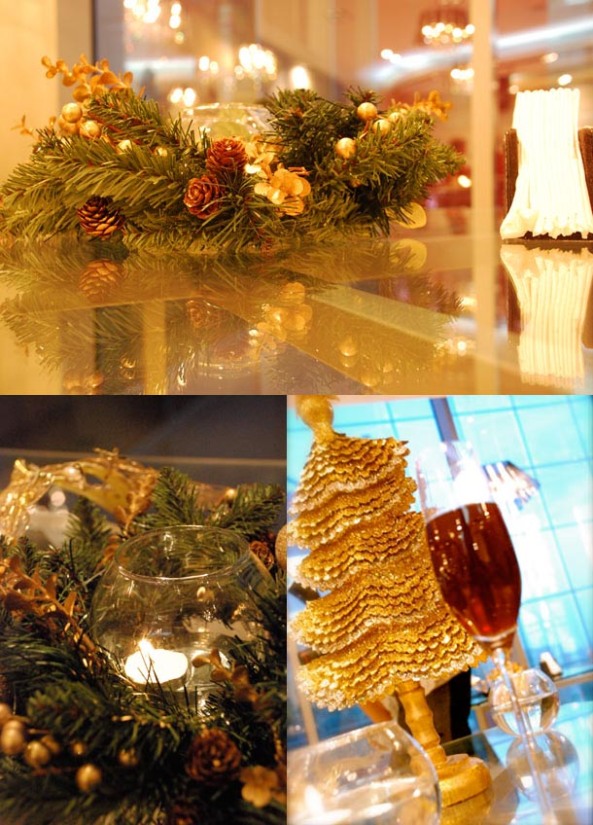
I’ve realised one thing and that is to enjoy a delicious moment like this special evening one needed to be surrounded by like-minded buddies. In my case, a few like-minded food bloggers from Fooderati Arabia who are increasingly entering my actual world of friendship and camaraderie from the virtual world where it all started. Attending the festive menu tasting were Saba of Culinary Delights, By Saba Wahid, Jasmine of Pear Tree Food Diaries, Debbie of Coffee, Cakes & Running, Francine of Life in the Food Lane, Mitzie of The World according to Mitzee Mee, Nina of Acoustic Chef, Sarah of The Hedonista and your’s truly ce’st moi – Ishita!
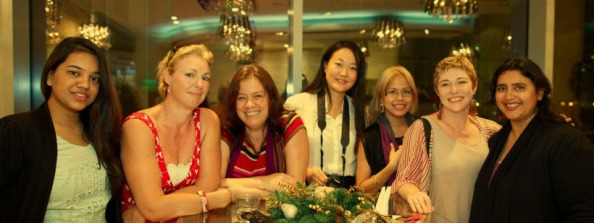
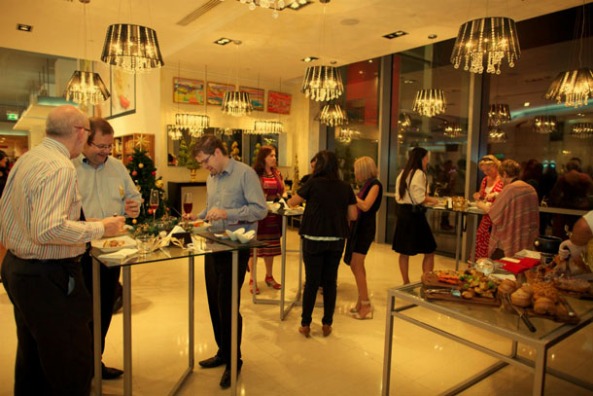
 Having said that I have also started appreciating the comfort of dining with fellow food bloggers – no body bothers if one one wants to click the food before the food leaves the plate for the tummy. Nobody minds if one takes multiple pictures amidst the wafting aroma of food which in itself a kind of a challenge for sure! Definitely a separate post on the pleasures of dining with food bloggers – for a food blogger I mean. I’ve always felt dejected by the way my friends behave when we dine out – they don’t understand our social responsibility of sharing our culinary experiences with the world at large!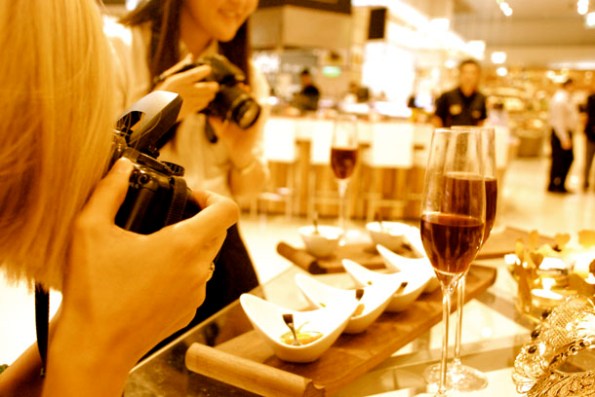
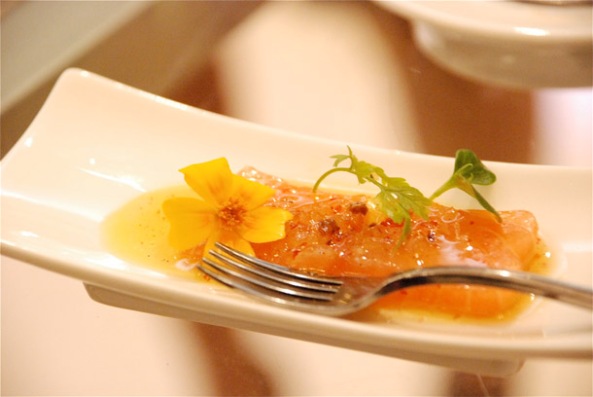
After being served warm Cranberry juice which surprisingly tasted a bit like a non-alcoholic version of Glühwein, the Starters started pouring in. Maple cured Scottish smoked salmon platter with traditional garnish looking beautiful with a yellow flower perched on it, Smoked Salmon Roll, Canadian lobster and poached prawn ‘cocktail’ prepared with the signature Lafayette cocktail sauce…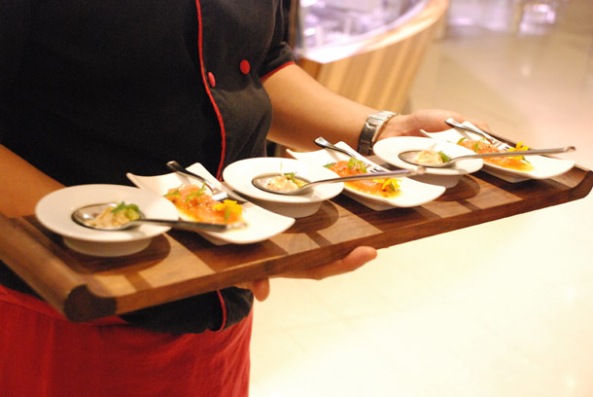
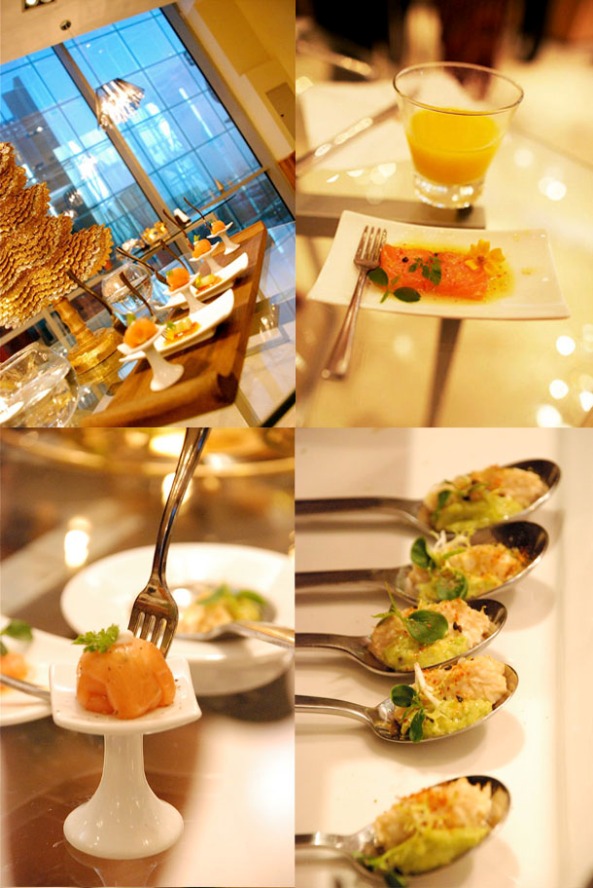
More festive mini plates were rolling out which can be served as perfect pre dinner reception baits! Scotch egg with duck confit and quail egg, Duck and chestnut ‘chipolata’ with spiced blueberries, Turkey and Foie Gras ‘sausage roll’ with cranberry dip…
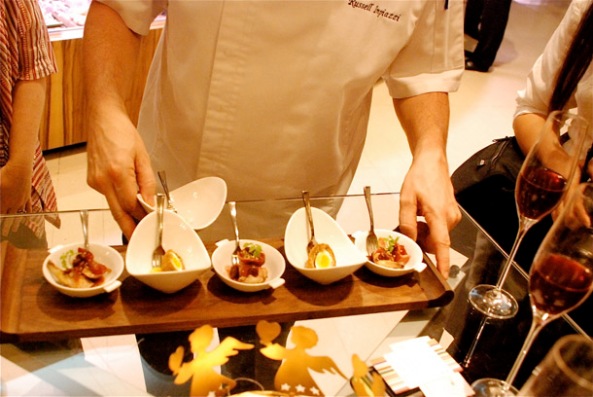
But yes, the Scotch Eggs (below) took me into my home turf, reminding me of similar tasting Deemer Devil (Devil’s Egg or the famous Bengali Egg Chop!) that are so famously served in movie halls in Kolkata – not the Multiplexes serving the standard Popcorn and Nachos but stand-alone movie halls like Priya, Menoka, Lighthouse etc.

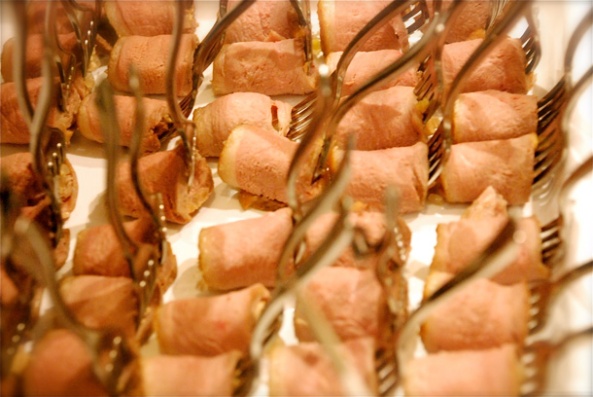
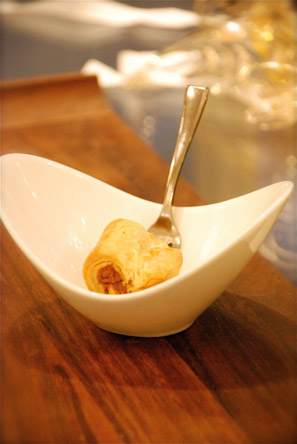
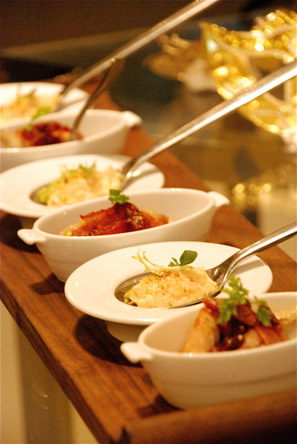
Canapes and gourmet starters served in a good high-end eatery always fascinate me. Mini plates of art, painstakingly created – the food rolled, carved or wrapped, placed delicately with such artistic exuberance – I feel that they should be enjoyed for the sheer pleasure of putting a work of art into your mouth and the excitement and the anticipation these creations build for the main course to come!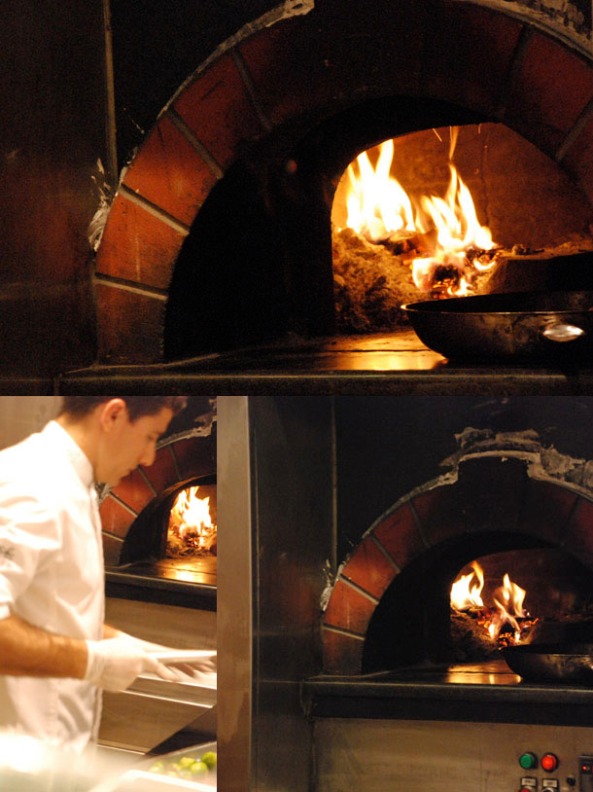
The Starters were definitely a fantastic prelude to the Main Course. I did take a major fancy at the oven (above) – the actual fire burning inside the modern interiors with hot roasts coming out of it – a sudden homely warmth of a hearth in the midst of the modern decor of the Lafayette Gourmet. Anticipation of traditional home cooked Christmas roasts!
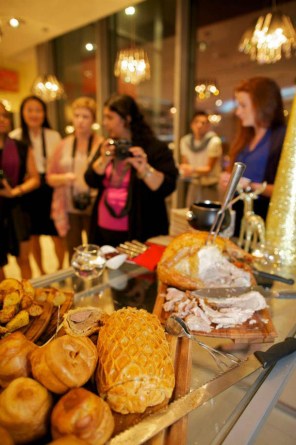
As cameras were ready to click (aha!), Chef Lawrence Najjad did the honour of slicing the Canadian Heritage Roast Prime Rib of beef with Yorkshire pudding (below) which was served with delicious duck fat roasted potatoes and vegetables.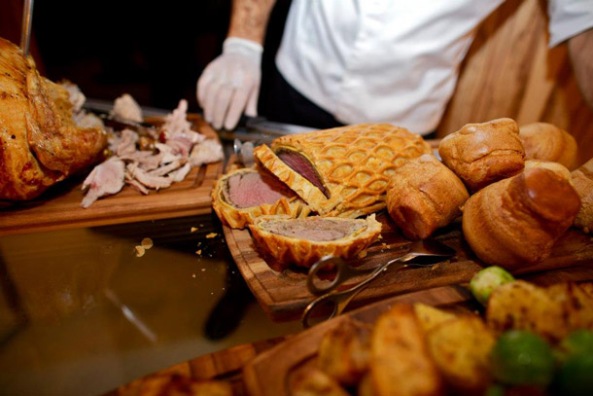
And finally came the Turkey (below) – the protagonist of the festive evening! A classic whole Roasted Turkey served with Cranberry sauce complete with all the traditional festive accompaniments – Bread sauce, Turkey gravy, Chipolatas, chestnut stuffing and seasonal vegetables – brussel sprouts, carrots, yams, potatoes.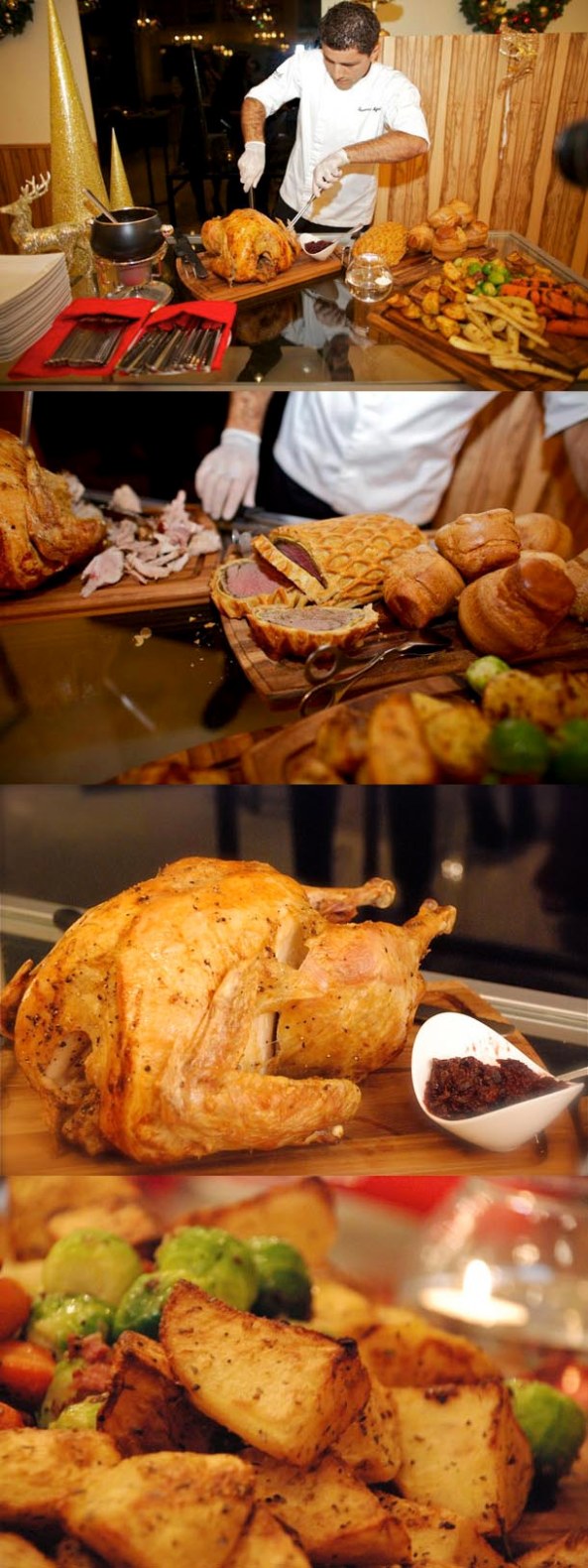
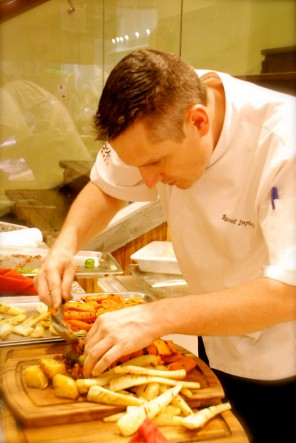
What was really impressive was the way Chef Russel Impiazzi (below) overlooked everything – complete hands on – setting up the vegetables, giving the final garnishing and supervising every little detail. Even while preparing the dessert I was amazed at the way he scooped the chocolate mousse, decorated with minute edible foils before placing the mini dessert platters on to the tray. Touching and bringing a lot of homely warmth to our festive menu tasting.
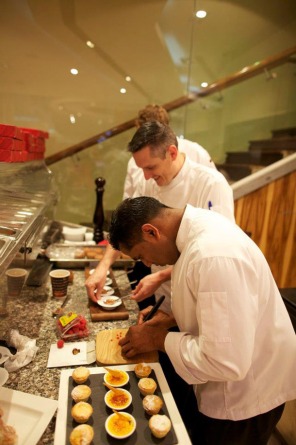
What is a menu tasting without the sweet sign-off… the Desserts? Starting from classic Puff pastry Mince pies, Mini Christmas pudding, seasonal Berry Trifle, Chocolate Truffles, Chocolate Mousse, Crème Brûlée and some Ice Cream – we were pampered and horrifically spoilt! 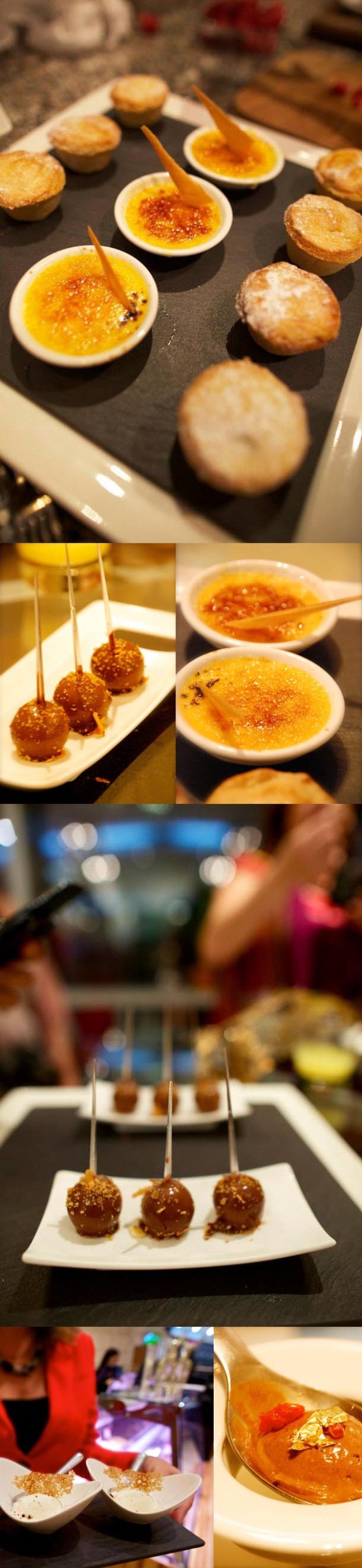
Have I finished? I guess for the time being, yes. Sally of My Custard Pie rightly describes an earlier experience of her Lafayette Gourmet Menu tasting as ‘A big appetite for small food’! You’ll also enjoy the following posts on Lafayette Gourmet from other Fooderati Members – Francine and Samantha in their respective blogs – Life in the Food Lane, FooDiva. Apart from tasting all these exceptional ‘small food’ and the ‘big festive turkey’, one can place orders for a lavish traditional Christmas dinner or some signature platters from the comfort of one’s home. I was surprised to hear stories from the Event Coordinator as to how Lafayette Gourmet has previously customised home-catering according to the clients’ myriad demands. Here, you can have your very own chef for hire. And at what cost? I’m copy-pasting Sally’s comment on my post, ‘Good to note that GL home catering prices are very reasonable and I’ve been to some parties where they did the food and it was all superb. Competitive for Christmas dinner catering (and they deliver) too’. So if you ready for Christmas but not ready to don the aprons, here are the details…

Lafayette Gourmet
Location: 2nd Floor, Galeries Lafayette
Tel: +9714 339 9933 ext 2342/ext 2383
Email: Lafayettegourmet.chef@medsdubai.com
Website; Facebook… Do check out the brilliant pictures of us Food bloggers hobnobbing that evening on their Facebook Page! A few pictures shown here, maybe 4-5 have been taken from there as well.
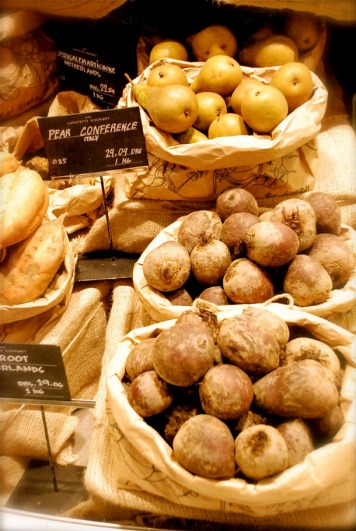
Yes, Christmas is in the air. Gulp it down before the Shamal, the sandstorms that hit the Dubai shores often in the winters.While writing this post, I’m taken back years ago to our Paris visit. Not much pictures from those pre-digital days. However, those memories livened up once again by the beautiful evening at Lafayette Gourmet and some brilliant Parisian shots of gloomy grey skies from my blogger friend, Kankana in her Paris post in her blog Sunshine & Smiles.
 Apart from the festive menu offering, Lafayette Gourmet is definitely what it proclaims to be – a food emporium from all over the world. It boasts of 8 kitchens in one location – Italian specialties and wood fired pizzas, great salads from The Mediterranean, Asian favorites, Indian Tandoor and Curries, primes steaks from the Grill, Foie Gras and Caviar from the Luxury section, authentic Tapas and Paella from the newly opened Tapeo to Arabic specialities from Just Falafel. I have been eying the Black Paella with Cuttlefish & Shrimp and the Traditional Seafood Paella and have been splattering these (photographs only) all over my Facebook Page the other day.
The Fresh Market in Lafayette Gourmet sells UAE’s local seafood specialties, sustainable fish from Europe, Al Fumo traditional, hand sliced locally smoked Salmon, live Canadian lobster and crab, fresh oysters, mussels, clams and jumbo shrimps; artisans hand-cut beef fresh every day from Welsh lamb, Canadian Angus and heritage beef, USDA prime and Canadian milk fed tender veal; a range of fresh, high quality, fully certified organic vegetables from The Green League, the latest venture and business division of Unifrutti; 100 different French and Italian cheeses, homemade Foie gras and fine luxurious Caviar. Absolute high quality and high-end food products.
Well, the sudden realisation of the year passing by at an insane speed has been hitting me ever since December page came forth on my desk calendar. Now it’s probably time to sit back and enjoy rewinding my foodie escapades from my Dubai Diary!
Unblogging it all… Ishita
◊————————————————–◊
Disclaimer: I hope you enjoy reading the posts with lot of visuals. While you enjoy seeing them please don’t use them as some of them have been taken from our personal albums just to make your reading experience more pleasurable. You can see more pictures of my travel and food journey here.
BE SOCIAL. SHARE THIS!

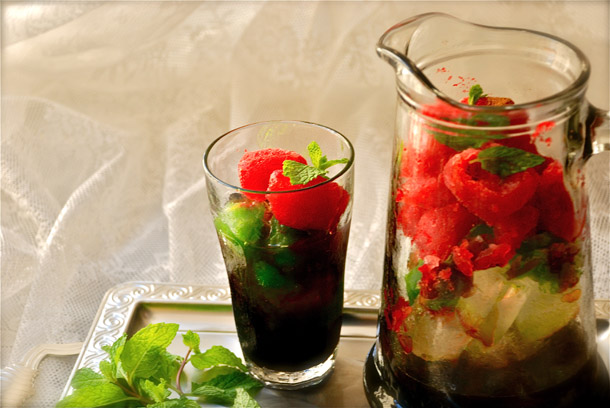
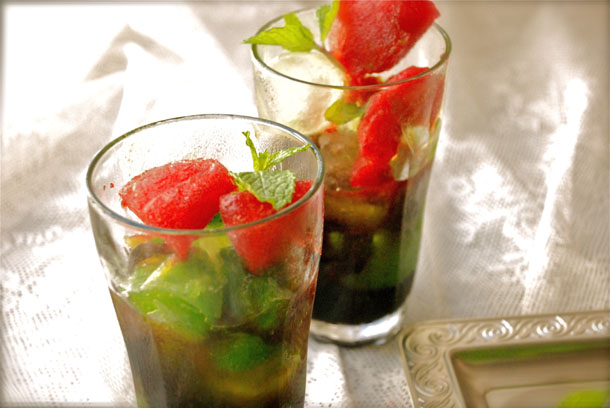
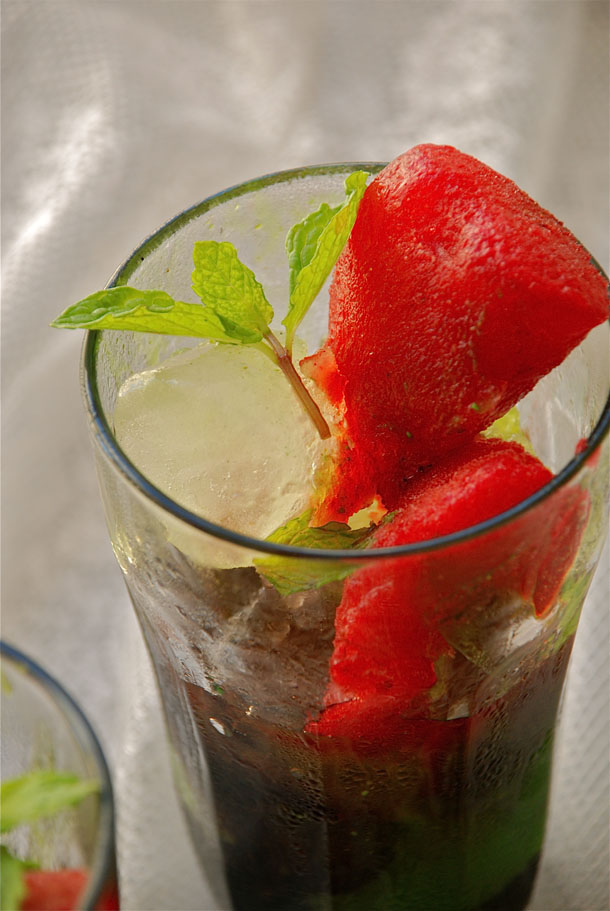
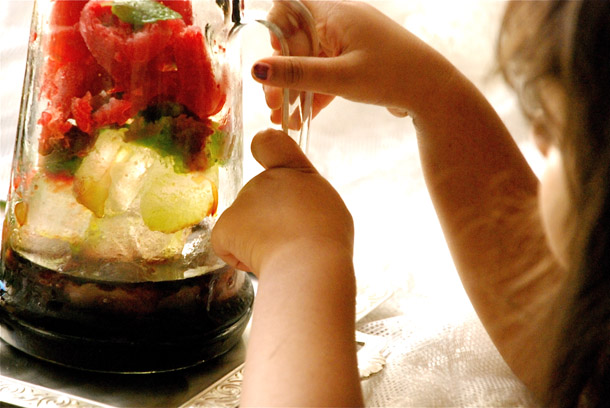
Today is the 41st UAE National Day or Al-Eid Al Watani as it is called in Arabic. The above picture is a personal favourite of mine. It might look like a canvas but is actually a special drink that I’ve created as a tribute to the UAE National Day. The lovely Jihad and Sajith from My Dubai My City, the first video guide to the city of Dubai, came home the other day to shoot the video. So many things to learn from them as they effortlessly went on with their job. I hope you will like the video as much as I do!
2nd December marks UAE’s formal independence from the United Kingdom and the eventual unification of the seven emirates (Abu Dhabi, Ajman, Dubai, Fujairah, Ras al-Khaimah, Sharjah, and Umm al-Quwain) in 1971 which combined to form the modern-day UAE that is today. Here’s wishing everyone residing in the UAE the 41st UAE National Day!
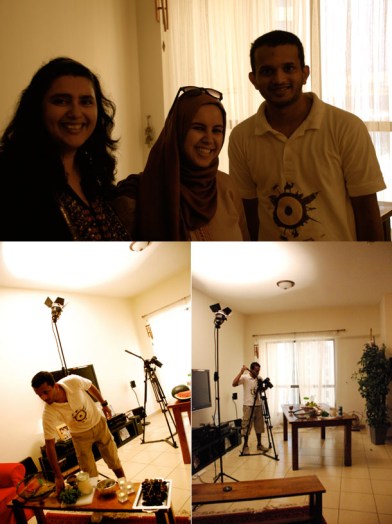 ‘This is my Kitchen’ is a segment in My Dubai My City (@MyDubaiMyCity) where the main aim is to highlight how UAE – specially Dubai, is a beautiful hub of all sorts of cultures. The host of each episode shows us how to make a traditional dish with a story – any kind of story, for example the meaning/origin of the name or if it’s associated with any personal experience.
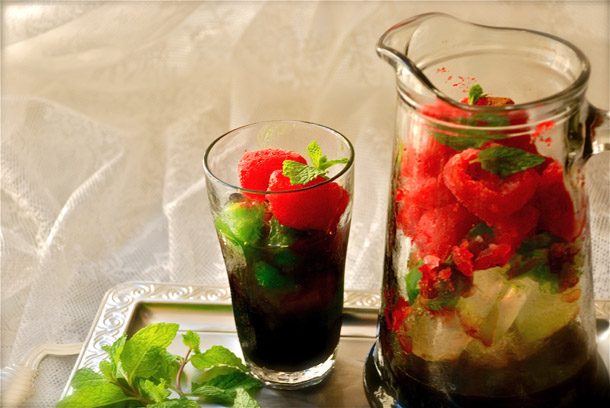
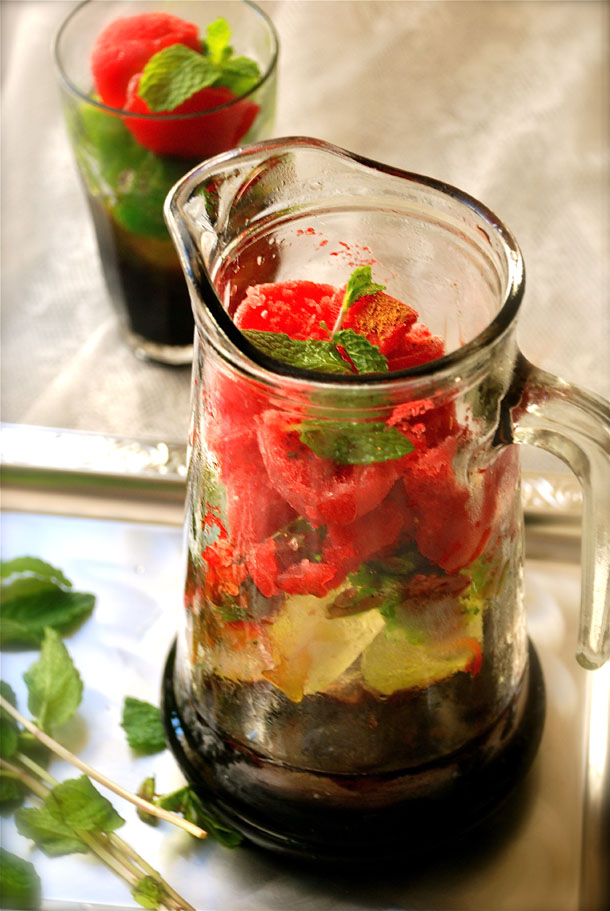
I was fortunate to have hosted an episode where I showed how to make the Bengali Aam Pana or Green Mango Drink in the traditional way. At the end I twisted this traditional recipe to make frozen pulps of Black grapes and watermelon and created a special drink for the UAE National Day (above)!
Jihad (the smiling lady to my left) transformed my dining table with her little feminine touches here and there – the candle stand, the table cloth and the white crockery and elegant cutlery – thank you my dear! And yes, Sajith (the smiling and humble gentleman above), the next time you come home I’ll try to blink less and probably wear my glasses instead of wearing my usual set of contact lenses and blinking all the way through the shoot!
I’ve written about the Frozen Aam Pana where I’ve frozen the pulp scooped out of smoked Green Mangoes in an earlier post of mine – Frozen Aam Pana/Green Mango Pulp… The Change Initiative! The idea of frozen fruit pulps had been inspired from a visit to The Taste Initiative, the first sustainable café in Dubai.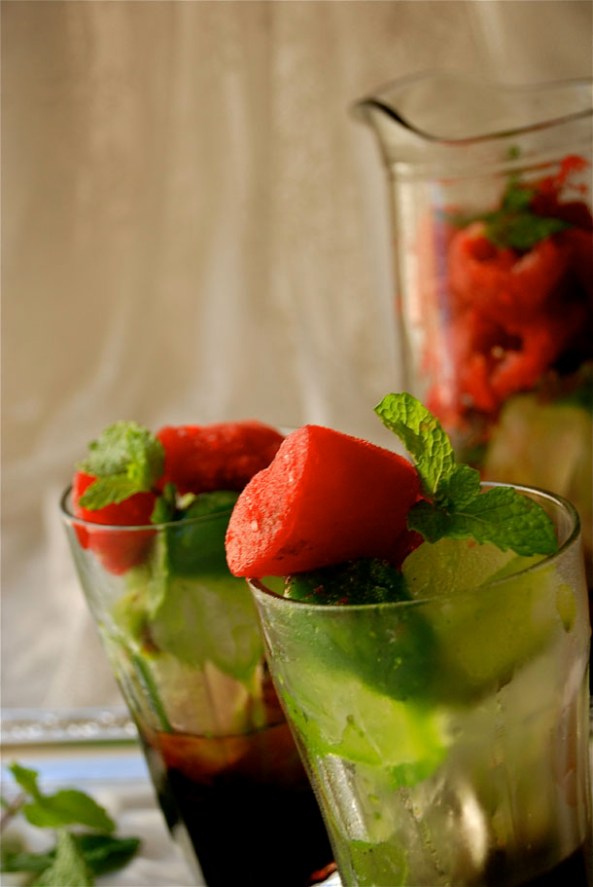
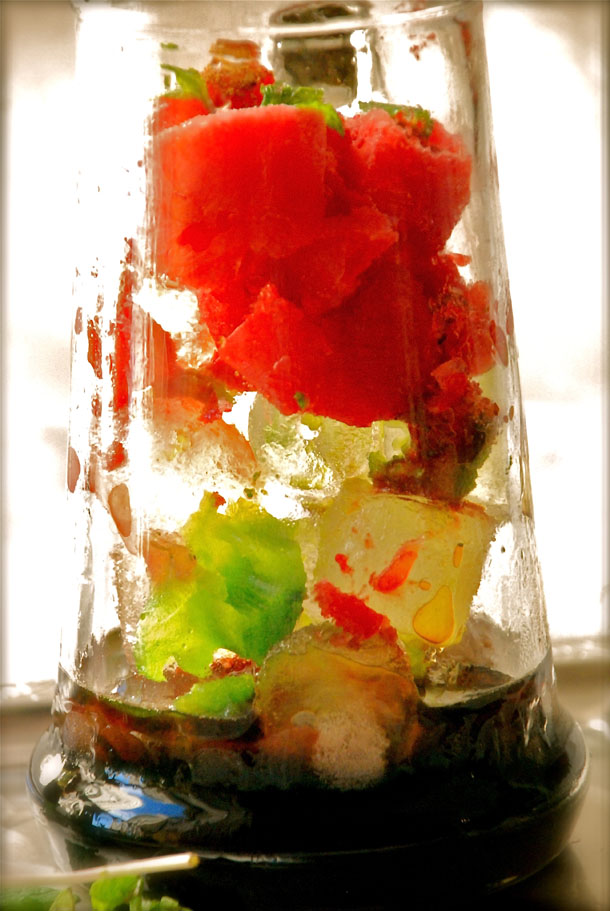
For the UAE National Day Drink, I froze pulp of Black Grapes, pulp of Watermelons and the green Mango pulp. The Watermelon pulp required some additional sugar. And I added roasted Cumin Powder and a bit of rock salt. Garnish it with fresh green Mint leaves if you prefer and a delicious blend of sorbet-melting-into-a-drink is ready! I do hope you enjoy the pictorial journey of this beautiful drink inspired by the UAE flag colours. The colours on the UAE flag represent the following: white for peace and honesty, red for hardiness, bravery, strength and courage, green for hope, joy, love and optimism and black for the defeat of enemies or strength of mind. You may read more about the UAE flag here.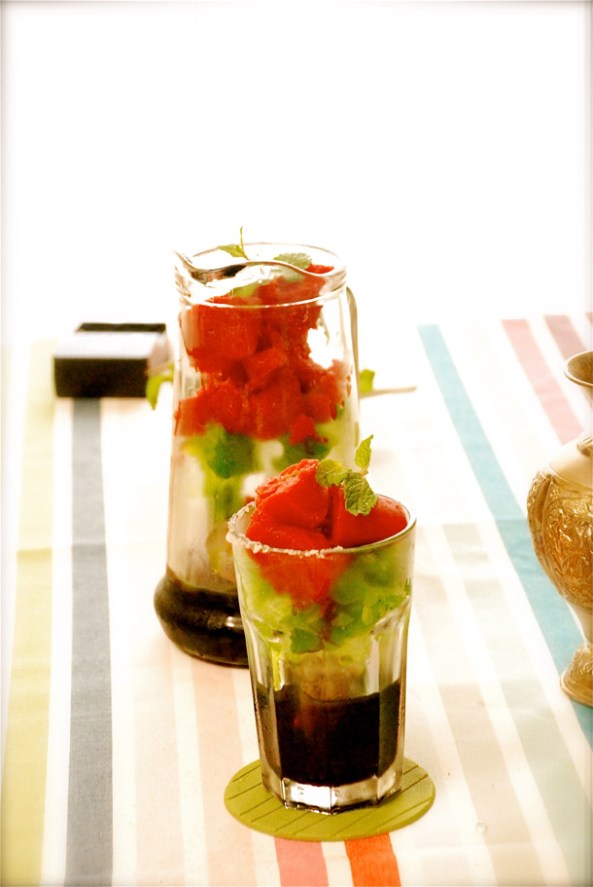
Frozen Aam Pana/Raw Mango Pulp Drink
Category – Drinks & Beverage; Cuisine type – Traditional Bengali, Indian
Following are the characteristics of all recipes doling out of our little hands, big hearth –
♥ Easy to cook
♥ Regular canned products off the shelf may be used (However, we advocate using fresh products)
♥ Goes well both as a regular or party dish
♥ Children can easily help in making the dish (My two little sous-chéfs are aged 8 and 3 years!)
♥ And lastly, guaranteed to be tasty!
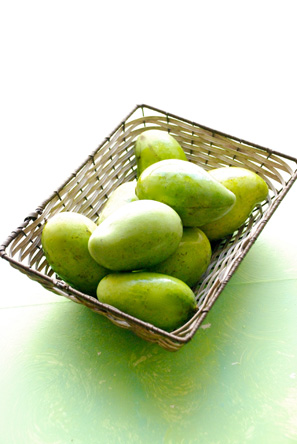
Aam Pana or Green Mango Drink is a great summer combat and is made in most regions in India. The Bengali Aam Pana is however a bit different in the sense that the green mangoes are first smoked (right below) and then the pulp is taken out. So while the taste of the mango is intact the smoky smell is strong and lends this drink an unusual charm. While in other places in India, the green mangoes are boiled and then pulped. You may get the recipe from my earlier post Frozen Aam Pana/Green Mango Pulp.
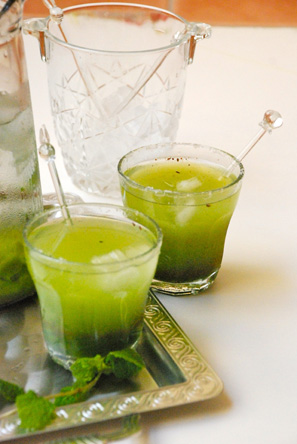
Enjoy the photographic journey of the special UAE National Drink…
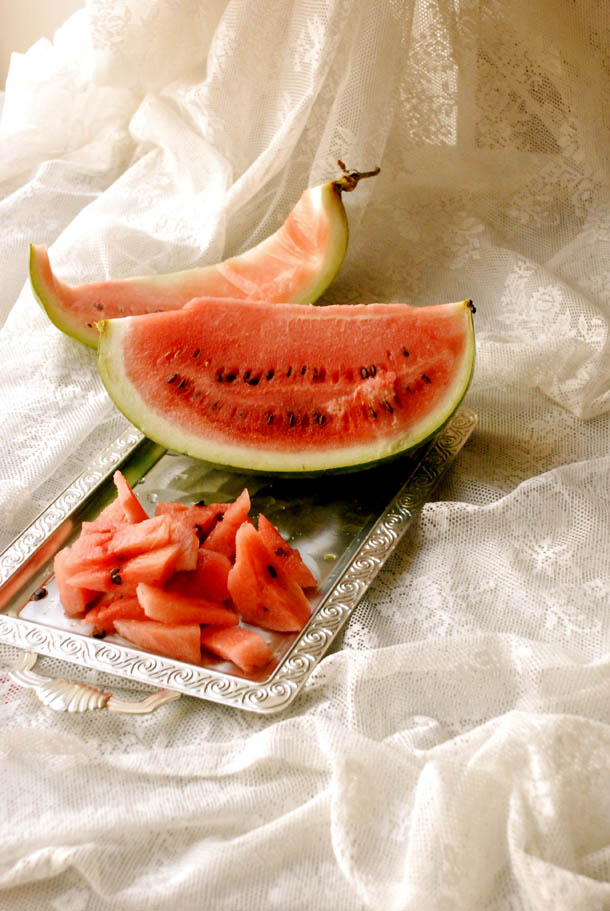
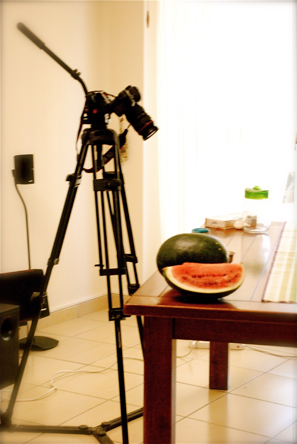
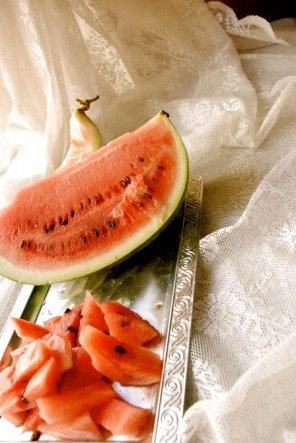
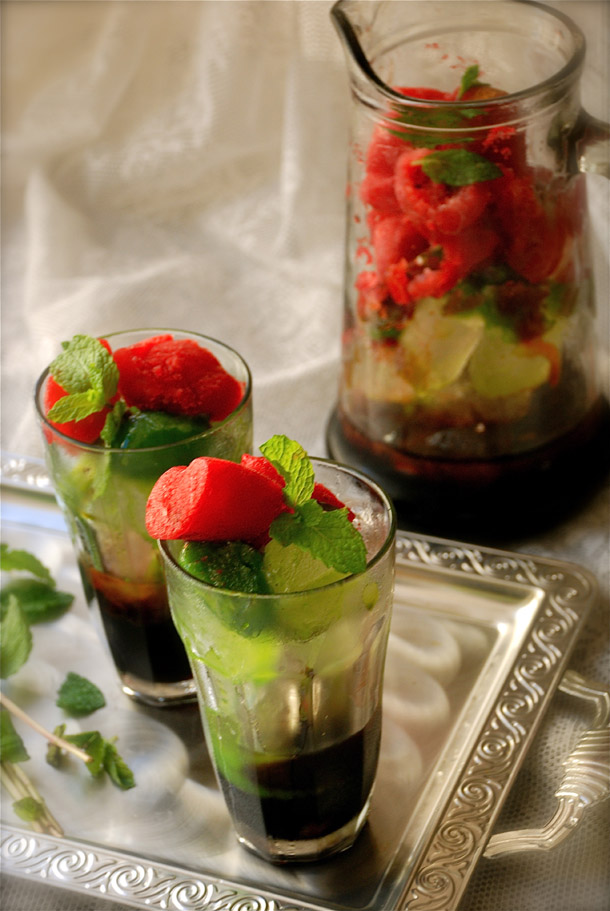
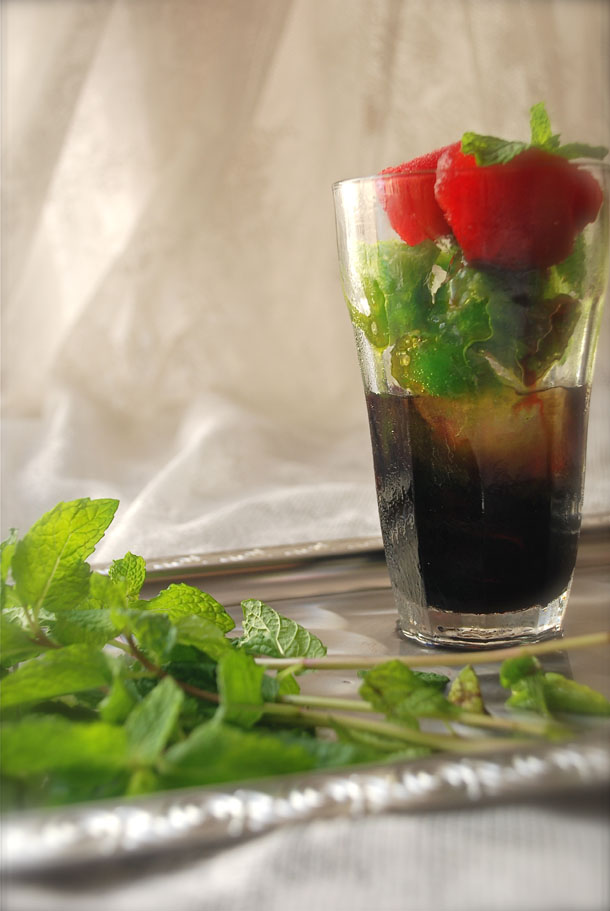
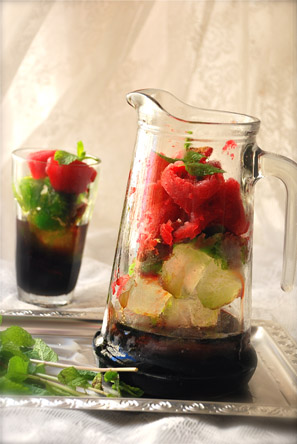
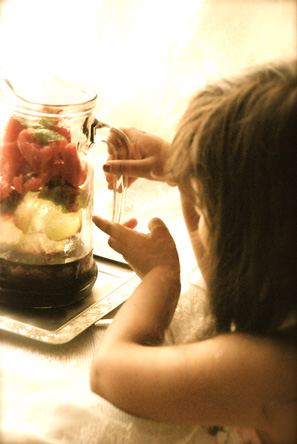
As everybody joins in the celebrations, I love the way Google Doodles join in each country’s festive celebrations. Google joins UAE in celebrating the country’s 41 National Day with an artistic doodle highlighting the occasion on Google’s homepage on the UAE domain on December 2.
The doodle shows four flying falcons carrying banners in the colours of the UAE flag: red, white, green and black. Each of the six banners features a letter from the Google logo, with the second ‘o’ in the word depicting one of the ancient tombs found on the island of Umm Al Nar. You can read more about the concept here.
An interesting timeline of events for the UAE starting from the 1820’s can also be found in BBC Middle East. If you prefer to watch videos, then don’t miss out these string of videos that The National had come out with last year – ’40 historic objects that shaped the UAE’… for example a Foetal heart monitor – early 1960s, Etisalat phone – 1987, Royal invitation cards- 1979, A Grundig radio used by Sheikh Shakhbut and many more. You’ll get to watch all the videos here.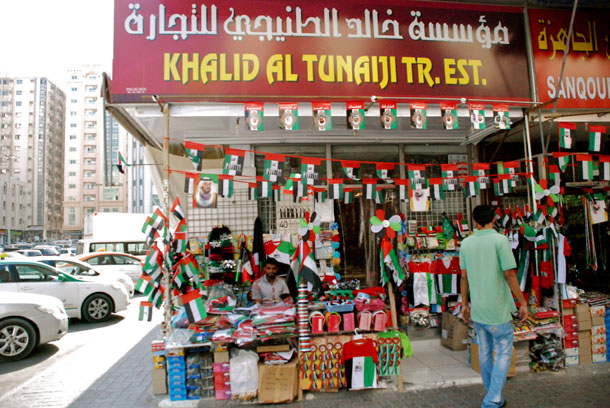

As UAE flags dot each and every shop located in each alley of Satwa, Karama or in the other emirates, UAE is probably the only country where patriotism is marked by how dressed up your car is! So it’s not surprising that UAE residents may win Dh100, 000 in prizes for decorating the best vehicles on the National Day parade. More on such patriotic fervour here!
I’m signing off with two of my Dubai posts – The Diary Of A Dubai Resident… As Home Turns Into An Inn! and Things to do in Dubai – Like a tourist in my own city! The latter post is perhaps one of the most ‘shared’ post in my blog. I am digging out this post from the archives only because I had spent lots of humorous hours penning it down and now it’s time to showcase my love for Dubai with the 41st UAE National Day lurking around the weekend. Also, I have been nominated for the Expats Blog Awards. If you like reading my posts, do show some love for me by leaving your comments here.
Updating my post with a video shot right now (12:50am on 3rd December) at the JBR Walk… the National Day celebration continues with full fervour!
Unblogging it all… Ishita
Disclaimer: I hope you enjoy reading the posts with lot of visuals. While you enjoy seeing them please don’t use them as some of them have been taken from our personal albums just to make your reading experience more pleasurable. You can see more pictures of my travel and food journey here.
◊————————————————–◊
My Dubai Diary in this blog:
♦ Things To Do In Dubai – Like A Tourist In My Own City – Showcasing the city I love to call my home!
♦ My First Authentic Emirati Food Experience! – Al Fanar Restaurant, Dubai Festival City
♦ Al Maha Desert Resort & Twitterati Lunch – Al Maha Luxury Eco Resort
♦ An Evening of Wine Tasting at Asado Wine Club – Asado Wine Club, The Palace Hotel, Old Town
♦ The Label Project – Wines Tasted Blindly! – Invite to a Global Wine initiative from Jacob’s Creek
♦ TRIBES Celebrating South African Heritage Day! – TRIBES, the South African Restaurant in MOE
♦ Locavorism in UAE, Friday Market
♦ The Change Initiative Inspiration! – Dubai’s first sustainable store, restaurant & café
♦ Zatar Lamb, Crushed Lemon Potato with Chef Ron Pietruszka – Treat 2012, Burjuman World Food Fest + a Recipe
♦ Back To Dubai, Back to Costa –A nostalgic recount of favourite coffee haunt
♦ Searching for Shiraz – Lucknow to Kolkata to Dubai – Nostalgic search for Kolkata’s famous Shiraz Restaurant ends with Siraz opening in Bur Dubai. Exploring some Awadhi/Lucknowy Khana!
♦ Down To Earth Organic Store In Dubai & Mutton Chick Peas Curry – An event + a Recipe
♦ Mums Who Share @JBR – A charity initiative
♦ Deep Sea Fishing & Fish Barbeque – Persian Gulf off Dubai Coast
♦ The Million Street, in the middle of nowhere – Rub Al-Khali Desert, UAE
BE SOCIAL. SHARE THIS!



Bikol Express is one of our favourite Filipino dish. I do not know whether it’s because of the amazing taste combining both the spicy taste of chilli and the smooth-sweet taste of coconut milk or whether it’s the stories that I have heard about the Mayon Volcano (below) looming over the horizon that must have romanticised in my mindat-least ten-folds! However, one thing is certain – I find both the dish and the region Bikol absolutely fascinating. Or it could be a combination of three things – the taste hitting us physically, the stories hitting us emotionally and some real adrenaline flying high! Yes, I’m still on a Filipino Food trail triggered off only in my last post Pancit – Palabok, Bihon, Canton… On A Filipino Food Trail – which was a tribute to my Lady Friday (LF), who so diligently looks after our home and our two little ones – the Z-Sisters. And cooks us wonderful Filipino dishes once in a while!
Perhaps, we have some connection with volcanoes. The heavy betrayals that lie beneath a repentant, angry volcano and the visual grandeur of it’s appearance that splendidly covers the inner turmoil fascinates the both of us while the Z-Sisters are yet to figure out a volcano from a sand-dune! Volcanoes pull us like magnets. The smoke emanating from the summit that casts a gloomy spell on a cloudy day or etching a beautiful portrait on a sunny day, absorbs our imagination. Years back we had run upto Mt Etna in Sicily and ran back shuddering at the thought what if it erupts right away? And it did erupt in January 2011. Fortunately, we had visited long before that. But I can tell you that even then when Mt Etna was lying all quiet, you could see the dark grey smoke coming out of the crater and cloud the entire sky. You could ‘feel’ the imminent danger bottling up inside the heart of the cone. And shudder of shudders – One could also trek through a sea of lava right onto the summit! Much later, we’ve also thronged to see Mt Vesuvius looming over the ill-fated city of Pompeii where 16,000 people succumbed to their sleeps as their bodies became covered with the molten lava flowing out of Mt Vesuvius. 
LF hails from Bikol. Located in the southernmost tip of Luzon Island, the largest island in the Philippine archipelago, Bicol or Bikol is known for it’s extremely spicy cuisine. Bikol has had a history of trade relations with the Malay-Indonesian kingdoms, India and Arabia. So cuisine here is enriched with their influences, even resulting in a Biriyani dish! But her stories of her region of Bikol has become legendary. She would talk about how her mother brought them up – a handful of only 12 children(!) all by herself, provided them with fresh fruits and vegetables grown on their own land. LF and her siblings would help their mother in the paddy fields, plucking the paddy plants when necessary, planting new seeds while preparing again for new harvest. They would climb up the coconut trees and bring down green tender coconuts and crack them open to take out the soft white kernel (Buko) from inside. She would recall many many stories – which now seems like a a different life from a different time period altogether!
All tales would evolve through acres and acres of green paddy fields and would eventually end up with the beautiful Mayon Volcano! Bicol Region is volcanic in origin and falls under the Pacific Ring of Fire. And the Mayon Volcano, is the most active volcano in this region. Renowned for the ‘perfect cone’ because of its almost symmetric conical shape, Mayon forms the northern boundary of Legazpi City, the largest city in terms of population in the Bicol Region. The mountain has been declared a national park – Mayon Volcano Natural Park and is a protected landscape since 2000. Locals lovingly refer to the Volcano as Bulkang Magayon or the ‘Beautiful Volcano’ after the legendary heroine Daragang Magayon.
The legend as it goes… (Courtesy: Wikipedia, heavily edited by me though!)
Magayon, the only daughter of the Makusog (strong) tribal chief of Rawis, grew up to be a very beautiful and sweet woman who struck the swains from faraway tribes who always vied for her attention. But none of the young men could captivate the heart of Magayon, not even the handsome and haughty Pagtuga (eruption), a hunter who showered Magayon with gifts as he too vied for her attention.
One day, Panginorin/Panganoron/Ulap (cloud), the chief of the Karilaga tribe of the Tagalog region, showed up in Rawis. Unlike the other suitors, he had come a long way just to see the beauty of Magayon. For many days, he simply stole glances of Magayon, from a distance, as she bathed at the Yawa River. After a few more meetings with Magayon, Panginorin signified his intention to marry her by thrusting his spear at the stairs of Magayon’s father’s house. The two were overjoyed but the wedding had to wait for a month’s time as Panginorin had yet to inform his people to gather the provisions for the celebration.
The news spread fast and reached Pagtuga, who became furious. He sent word to Magayon that unless she agreed to marry him, a war will be waged against her father and the Rawis.
Panginorin abandoned the preparations for their wedding to go to Pagtuga. They fought each other until Pagtuga was slained by Panginorin. As a joyous Magayon rushed to embrace Panginorin she too was hit by a stray arrow. While Panginorin held the dying Magayon in his arms, Linog (earthquake), Pagtuga’s henchman, hurled his spear at Panginorin’s back, killing him instantly. Makusog swung his mighty arms and stuck down Linog with his minasbad.
Makusog dug a grave for Magayon and Panginorin. Makusog laid them together as they held each other’s arms. As the days followed, they saw the grave rising higher and higher, accompanied by muffled rumblings, earthquakes, and red-hot boulders bursting from the crater. When this occurs, old folks believe that Pagtuga, aided by Linog, agitates the volcano to get back his gifts, which following ancient custom, was buried with Magayon.
On other days, when the tip of the volcano is covered by clouds, old folks say that Panginorin is kissing Magayon, and afterwards, rain trickles caressingly downthe gentle slopes of the volcano, insisting that they must be the tears of Panginorin.
‘Bulkang Magayon’ has become ‘Mayon’ with the passage of time.

Ahhhh… heart-wrenching folklore! My dear LF, I can imagine how it feels to see highrises and construction, glitzy cars and even glitzier shopping malls engulf you instead of the green paddy fields that you have grown up in. I can imagine that the paddy plants swaying in the breeze must have tickled you many a time when you were growing up and even tickles you sometimes in your dreams nowadays… but just to tell you, my dear LF, you’ve got to lose something to gain something. It’s the truth of life for all of us trying to make a living, wherever we are in whichever part of the world we are! 
◊—————————————————————◊
Seafood Bikol Express
Category – Side-dish; Cuisine type – Filipino
Bikol Express can also be cooked with Lamb, Chicken, Beef or Pork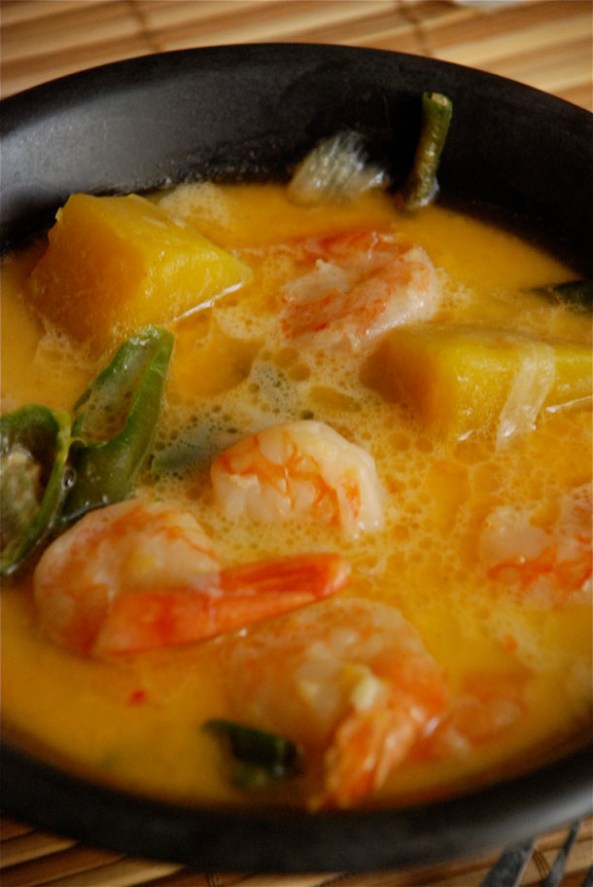
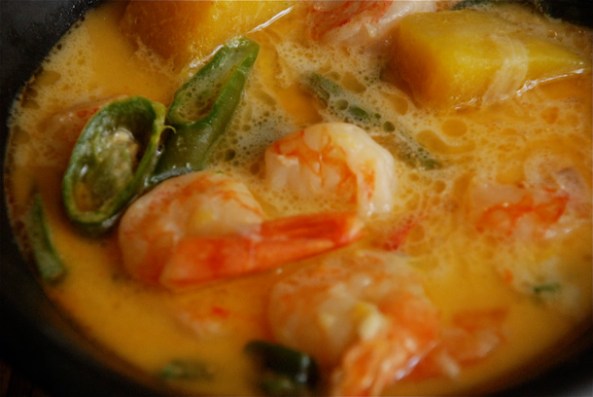
Bicol Express is a very popular Filipino dish which is our personal favourite. It is a stew made from long special chilies (siling mahaba in Tagalog, lada panjang in Malay/Indonesian), coconut milk, shrimp paste or stockfish, onion, and garlic. Originally cooked as a Pork stew, nowadays it is cooked with any meat in it. Or, seafood for that matter. Why such a peculiar name? Well, Bicol Express was named after the passenger train service from Manila to the Bicol region! Did they serve this meal, did you ask me? Well, my search is still on!
Serves 6-8 persons
Preparation time – 45 minutes maximum (Boiling the Pancit/Noodles or Rice – 10 minutes; Preparing the Bikol Express – 30 minutes)
Ingredients
Onions – 2 big, finely chopped
Garlic – 5 pods, crushed
Coconut Milk – 1 can
Large Prawns – 800gms, deveined with the shell on
String Beans – 200gms, chopped into long slices
Pumpkin – small, cubed
Black Pepper – 1/2 tsp, grounded
Long Thai Green Chilli or Serrano Pepper – 6, cut into long slices
Shrimp Paste – 1/2 cup
Salt – as per taste
White Oil – 2tbsp
Method of Preparation
– Heat White oil in a wok
– Fry the Onions and Garlic till they are brown
– Add the Coconut Milk, Prawns, ground Black Pepper, Salt, Long Green Chillies, Shrimp Paste and stir fry
– Cover the wok with a lid and let the stewt simmer for a while in low seam
– Add the chopped String Beans, Pumpkin Cubes and let them cook for a while (the vegetables should be cooked but not turn soggy and soft)
– Serve Bikol Express either with Pancit/Noodles or fragrant Jasmine Rice
* You can also use mixed sea food along with big Prawns or add small eggplant cubes. Please note: Bikol Express is spicy! Enjoy the pictorial journey of Bikol Express…
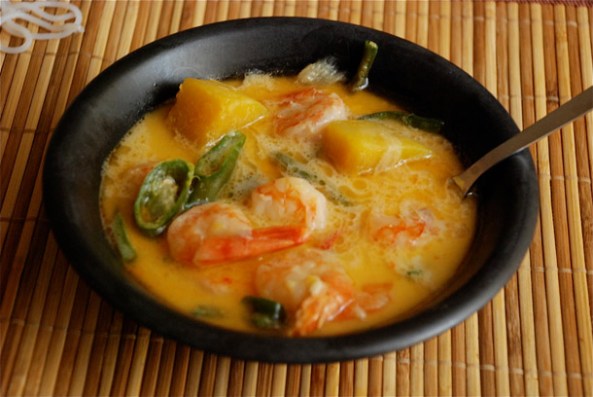


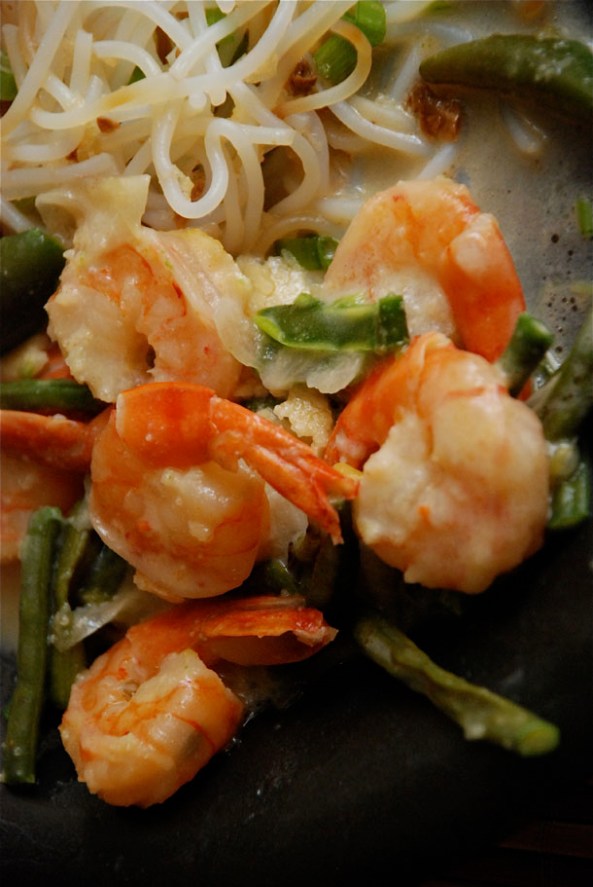
There are many restaurants in Dubai serving very good Filipino food. But Bikol Express is not that common. We really enjoy our Bikol Express when it’s cooked at home. Otherwise it’s got to be Seafood Bikol Express or even Crab Bikol Express at the Golden Fork restaurant. They have many branches across Dubai and have a huge option of Filipino dishes in their menu – a detailed menu preview can be had here. Well, until my next post where I am hitting the roads on a Halo-Halo trail in Dubai!
Unblogging it all… Ishita
Disclaimer: I hope you enjoy reading the posts with lot of visuals. While you enjoy seeing them please don’t use them. You can see more pictures of my travel and food journey here.
◊—————————————————————◊
More on my Filipino Food Trail:
Pancit – Palabok, Bihon, Canton… On A Filipino Food Trail
Rasgulla Macapuno On TV & Shubho Bijoya to all!
BE SOCIAL. SHARE THIS!


I’m taking a breather from Bengali cuisine. It’s been long that I’ve been writing on Bengali food only, juxtaposed against living in Dubai. This is but very natural since we come from Bengal. There’s a lot of experiments on Bengali cuisine in our kitchen – Bengali food and non-Bengali food – both traditional and fusion. There is also another type of cuisine that is cooked on a fairly regular basis in our kitchen. That is Filipino food, courtesy, our Lady M who hails from Bikol. Located in the southernmost tip of Luzon Island, the largest island in the Philippine archipelago, Bicol or Bikol is known for it’s spicy cuisine. Bikol has had a history of trade relations with the Malay-Indonesian kingdoms, India and Arabia. Naturally, the cuisine of Bikol is influenced by these associations, even resulting in a signature Biriyani dish!
Once Lady M and I had co-created a Filipino-Bengali fusion dish… the Rashulla Macapuno. It has been aired on a local TV channel. It’s my tribute to Lady M without whom my endless photographic sessions on food experiments would never have materialised. She’s also been a mother to Li’l Z, having missed out on bringing up her own kids as she has been staying far away from home to earn the money that is required to raise them comfortably. It is estimated that between 9.5 million to 12.5 million Filipinos work or reside abroad, many taking up jobs that they haven’t been doing back in their country. So while Lady M had been working as a cashier in Manila, she looked after our home and our children in Dubai. She did mention many times that she often thought about getting a more respectable job. We hope to give her the respect that she feels that she earned while she was working as a cashier back home.
Going on a tangent… if staying with a person who hails from a different culture doesn’t inspire us, what else can? The real essence of living in a city like Dubai is that for a Filipina who’s turned into a Bong, there is also a Bengali ME who’s turned into a Filipina!
There are also many restaurants in Dubai from where one can get a fair dose of Filipino food. In fact, contrary to popular belief, Filipino food can be quite elaborate and the cooking process has been influenced by the countries Philippines had trade relationship with. For example, Malay, Indian, Arab, Chinese, Spanish, Japanese, American and other Asian and Latin countries. [wiki explains here]
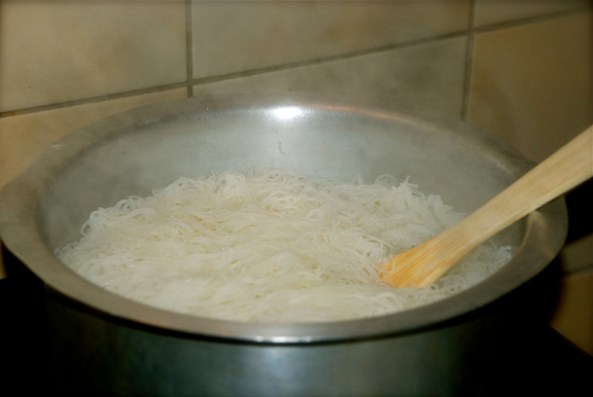
Pancit/Noodles – Palabok, Bihon, Canton
Pancit or Pansit is the Filipino term for Noodles. In Philippines, once can find Panciterias or shops specialising only in noodles. The following read is interesting:
- There are around 30 variations of Pancit that are available
- Noodles were introduced into the Philippines by the Chinese and have since been adopted into the Filipino local cuisine. Other Chinese influences in Filipino cooking is Toyo/Soy sauce; Tokwa/tofu; Tawge/Bean sprout and Patis/Fish sauce as well as the method of stir frying and making thick soup bases
- According to Chinese food lore handed down, noodles should be eaten on one’s birthday. Since noodles represent long life and good health; they must not be cut short! Chinese restaurants in the Philippines often have birthday noodles as part of their special menus
- There’s no time for eating Pancit or Rice for that matter. It can be eaten for breakfast, lunch, dinner, snacks and in between
- It can be had by mixing only Pancit and Rice together with some left over dish or simply with dried fish pickle
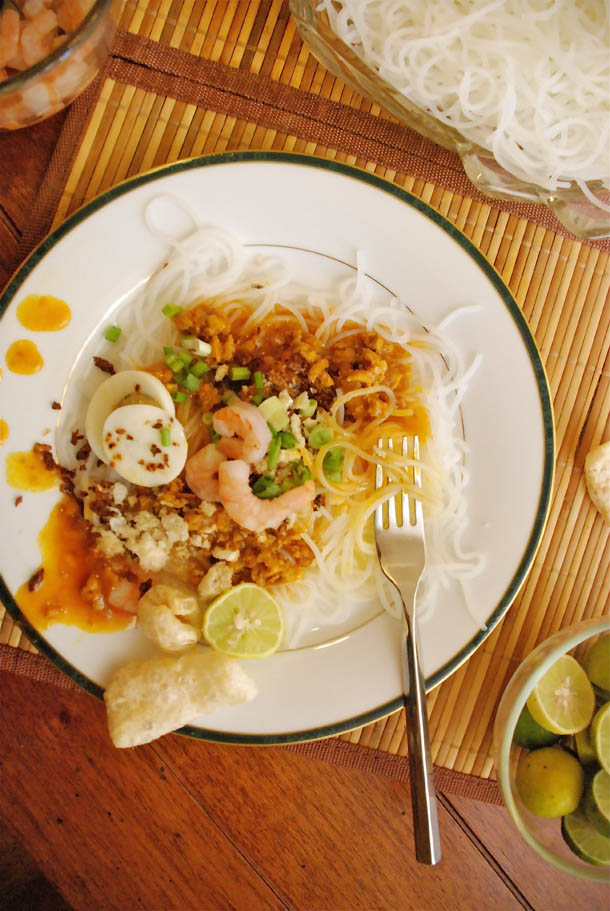
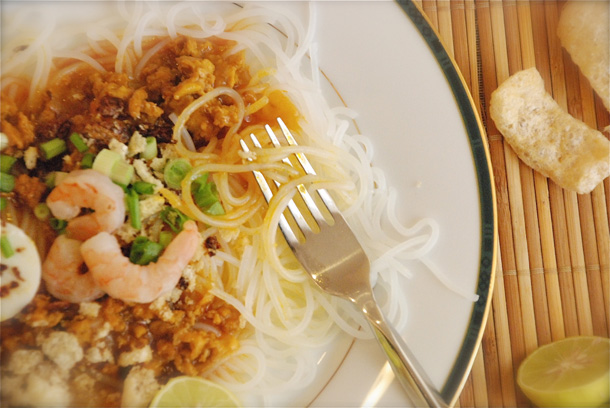
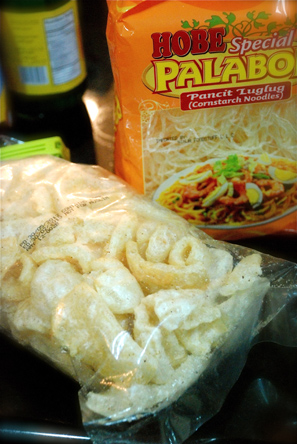
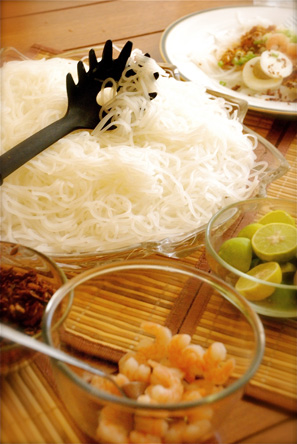
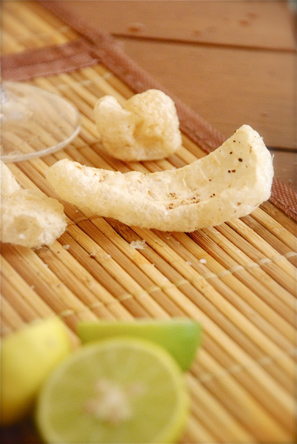
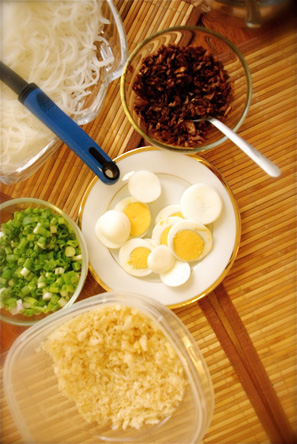
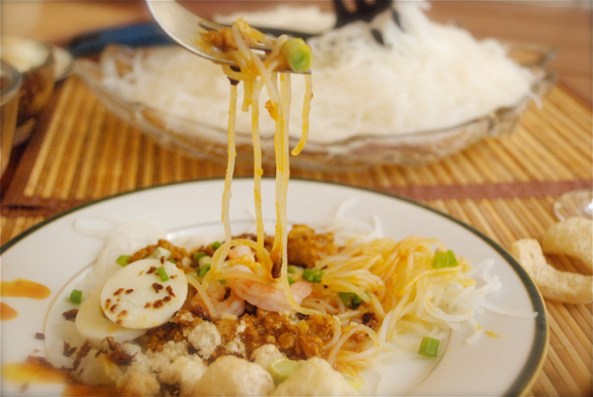
Pancit Palabok and Pancit Luglug are more or less the same. In the latter, thicker noodles are used than the traditional Palabok (above). Pancit Palabok is more like the Burmese Khauk swè thohk – wheat noodle salad with dried shrimps, cabbage and carrots, garnished with fried peanut oil, fish sauce, fried onions, garlic and lime. You are supposed to vary these every time you serve yourself and the taste completely varies. The Pancit is served first then the thick meat sauce or broth and then the various garnishes – fried shrimp, shrimp sauce, fried garlic, boiled pork, hard-boiled egg (sliced into smaller pieces), fresh green spring onions (chopped), Tinapa (smoked fish flakes) and Chicharon (crushed pork crackling, shown in the left picture below). The Chicharrón looks like prawn chips and we have sprinkled these over for friends who do not eat pork. Not the same smell though! Squeeze a lot of lime and the Pancit Palabok is ready to be slurped up.
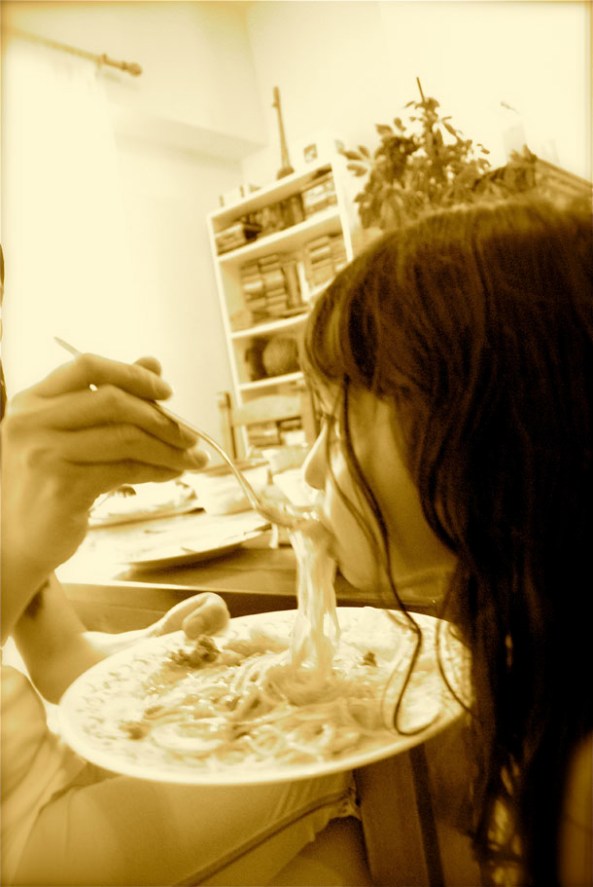
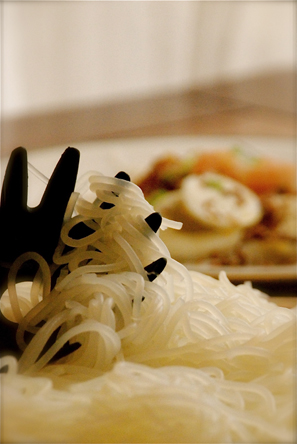
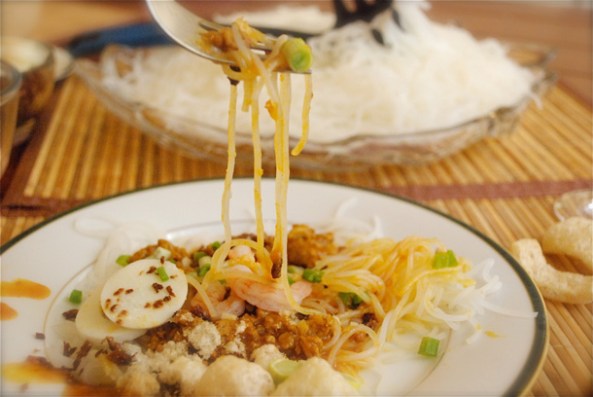
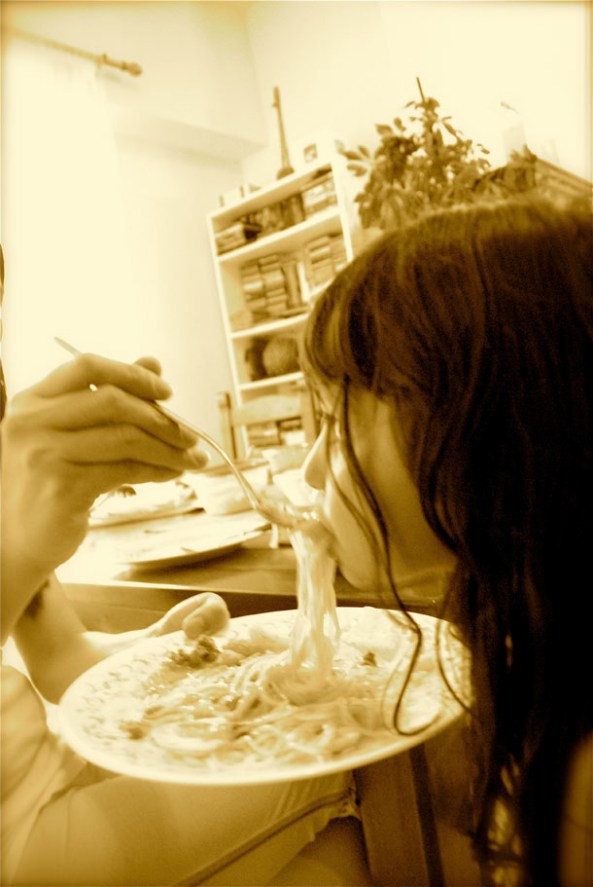
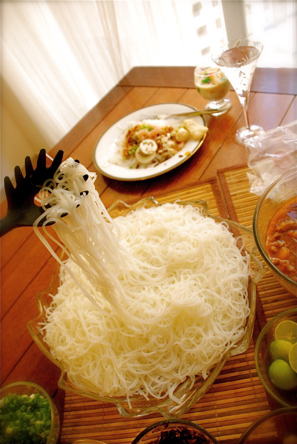
Pancit Palabok is a very popular communal comfort food and why should it not be? When you slurp up a fork twisting in some thin white Rice vermicelli noodles dripping with meat sauce and shriek as a few drop of the sauce splatters on your clothes, you’ll realise the comfort that surrounds you for sure. The entire Pancit Palabok entourage is shown below!

Pancit Meat Sauce or Broth Garnishing or Toppings Pancit Broth How do we serve Palabok?Pancit Palabok
Recipe contains Pork and Beef but that can be easily substituted with Lamb and Chicken
Ingredients
Special Palabok Noodles – 1 pack (Please check for the word ‘palabok’ written in the pack. You may have Bihon type of Rice Noodles which are really thin or the Pancit Luglug where the strands of Rice Vermicelli are relatively thicker than the Bihon type)
2 big onions, finely chopped
5 pods of garlic, crushed
2tbsp patis / fish sauce
200 gms beef or pork, minced and pounded
100 gms shrimps, shelled, deveined and cut into small pieces
1/2 tsp black pepper, grounded
salt as per taste
2 tbsp Achuete or annatto seeds, pre-soaked in 1/4 cup water for a few minutes to give the bright orange colour (Annatto is safe for most people when used in food amounts; however, it can cause rare allergic reactions for those who are sensitive. Read more)
3 tbsp all purpose flour or corn Starch, dissolved in 1/4 cup water
2tbsp white oil
100 gms boiled meat (beef or pork), thinly sliced
Tinapa/smoked tuna flakes from 2-3 pieces smoked fish, cooked, deboned and flaked
8 pieces Tokwa/tofu, fried and cubed
1 cup Chicharrón, crushed (fried pork belly or fried pork rinds. Chicharrón may also be made from chicken, mutton or beef.)
3 eggs, hard-boiled and sliced
1/2 cup spring onions, chopped finely
1 cup shrimps, boiled and chopped
10 pods garlic, sliced and fried crisply
6 pieces Calamansi/lime (Calamansi is a kind of lime available in all Filipino kitchens and is perhaps the secret ingredient to many mouthwatering Filipino delicacies – from popular desserts like Leche Flan to adding that magic sour flavour to Pancit Palabok and other Filipino dishes)Method
Serve Pancit on a plate, pour the mince meat broth over it, sprinkle Tinapa flakes, crushed Chicharon, Tokwa pieces, fried garlic, boiled eggs, boiled shrimps and freshly chopped spring onions. Squeeze Calamansi or lime generously. This is our favourite of all Pancits that LF cooks at home.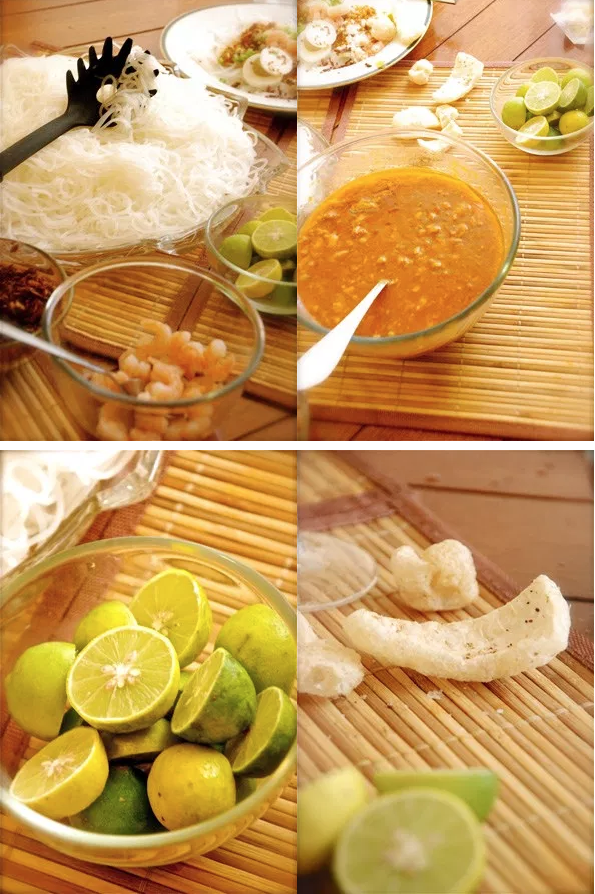

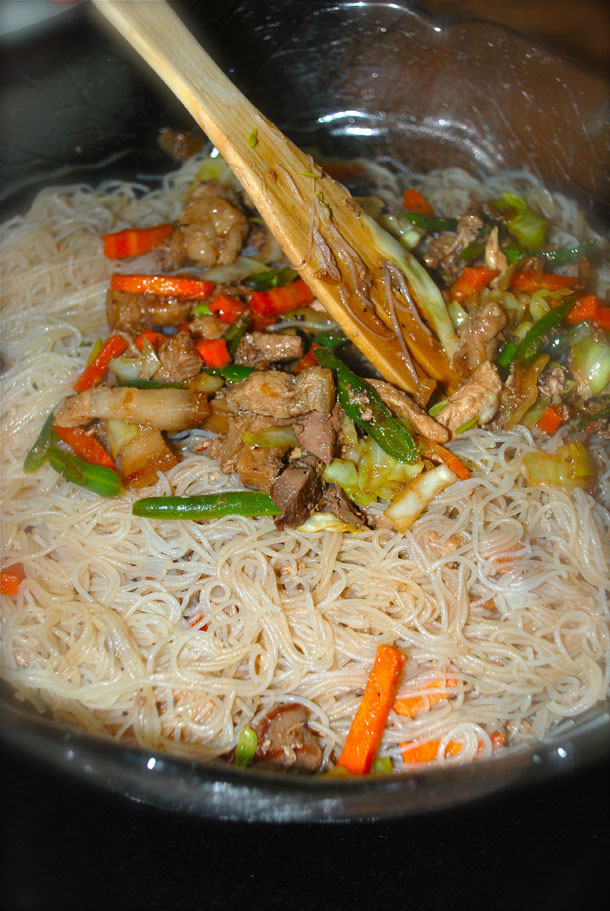
Pancit Bihon are very thin rice noodles. It’s accompanied by fried meat slices, chopped fresh vegetables, soy sauce, Patis/fish sauce and definitely Chinese sausage and cabbage. Pancit For Meat & Vegetables Pancit Meat & VegetablesPancit Bihon
Recipe contains Pork and Beef but that can be easily substituted with Lamb and Chicken
Ingredients
Special Bihon Noodles – 1 pack
2 big onions, finely chopped
5 pods garlic, crushed
2tbsp Patis/fish sauce
200 gms beef or pork, stripped into thin pieces
2 carrots, sliced into thin strips
French beans, sliced angularly
1 small cabbage, julienned
3 tbsp Toyo/soy sauce
1/2 tsp black pepper, grounded
salt as per taste
2tbsp white oilMethod
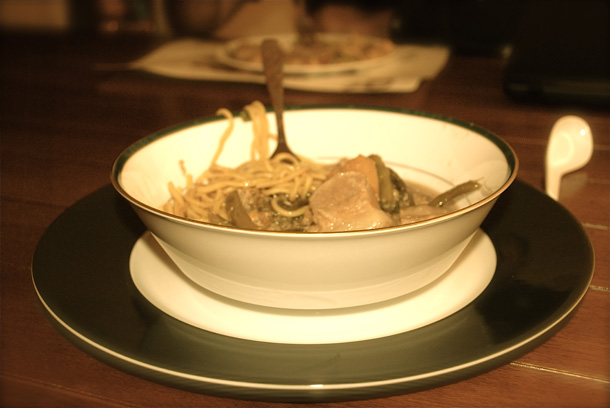
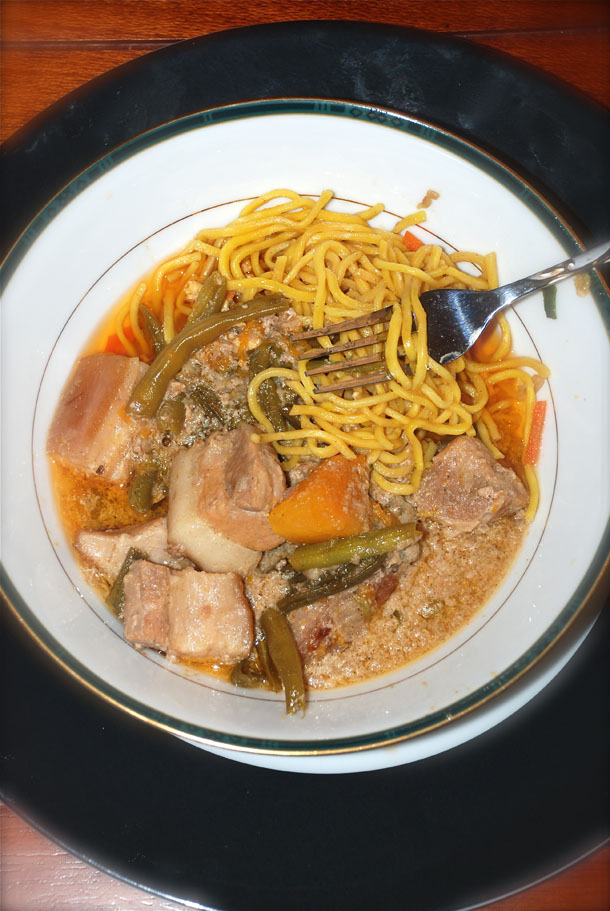
Pancit Canton are thick flour noodles. This dish closely resembles the Chinese chowmein. But LF sometimes cooks another favourite dish of ours called Bikol Express (see recipe of mixed Seafood Bikol Express from my blog). Pancit Bikol Express Pancit Meat & VegetablesPancit Canton
Recipe contains Pork and Beef but that can be easily substituted with Lamb and Chicken
Ingredients
Pancit Canton Noodles – 1 pack
2 big onions, finely chopped
5 pods of garlic, crushed
1 can coconut milk
500 gms pork belly, cubed
200 gms string beans, chopped into long slices
1 pumpkin, small and cubed
1/2 tsp black pepper, grounded
6 long Thai green chilli or Serrano pepper, cut into long slices
1/2 cup shrimp aste
salt as per taste
2tbsp white oilMethod
Boil the Pancit Canton/rice noodles for 3-4 minutes. Drain the water and set aside.(The noodles should be soft but not soggy)
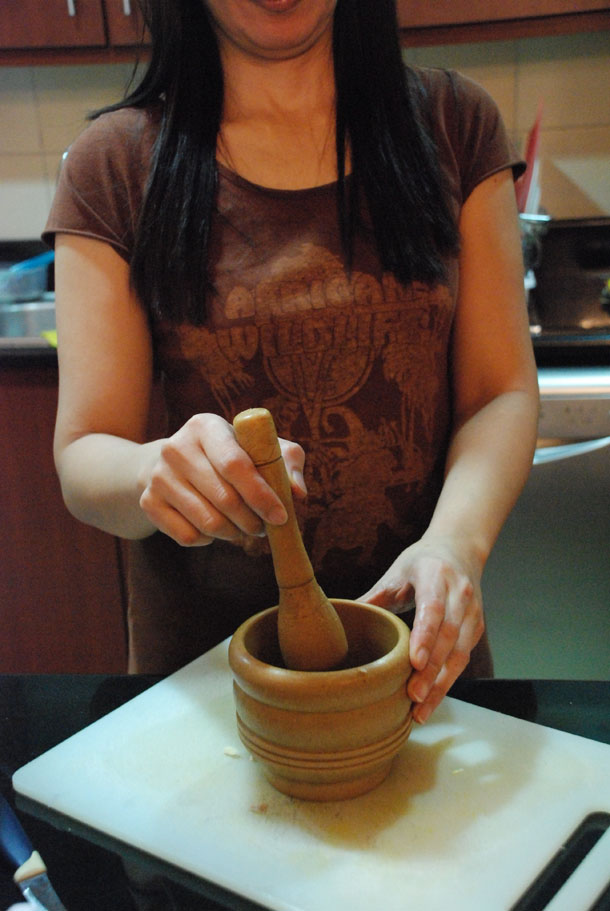
Thanks to Lady M, we have been introduced to the delicious world of Filipino cuisine. She has also learnt how to cook Bengali food and has become quite a pro at it. She’s become a part of our family. Gulf News, the leading newspaper in this region, once featured a blog, True life story of Filipina Maid in Dubai. It is quite an interesting take on the Filipino diaspora residing in Dubai and resonates the lives and moments of thousands of thousands of maids employed in the UAE.
Working for a couple with two school-going children, Sally describes the daily details of looking after children, cleaning house, stealing time to catch up on gossip with neighbouring maids, the joys of computer-educating herself, her pangs of homesickness, her best friend Lilibeth and her devious plans to make money, all with a generous dose of humour, some of it dark, and some outright tears-in-your-eyes moments.
Don’t judge her English or the grammar. I feel that it’s a reflection into our inner minds as well!
Unblogging it all… Ishita
Edited in January 2018: Just realised that my instagram post above - six years after I wrote this post, reflects the same emotions about Lady M even now!
Thank you for joining me on my daily food and travel journey on Pinterest, Instagram, Facebook and Twitter! Much love – Ishita
Disclaimer: This isn’t a sponsored post, nor are there any affiliated links for any of the brands that may have been mentioned in this blogpost. The subject, story, opinions and views stated here are my own and all images are from my personal album. While you enjoy reading my posts with lot of visuals, please do not use any material from these posts.
BE SOCIAL. SHARE THIS!


Ultimately I’m taking a breather from Bengali cuisine. It’s been long that I have been writing only on Bengali food juxtaposed against living in Dubai. This is but very natural since we come from Bengal. There’s a lot of experiments on Bengali cuisine in our kitchen – Bong food and non-Bong food – both traditional and fusion. There is also another type of cuisine that is cooked on a fairly regular basis and that is Filipino food. Courtesy, my Lady Friday (LF) who hails from Bicol. Located in the southernmost tip of Luzon Island, the largest island in the Philippine archipelago, Bicol or Bikol is known for it’s spicy cuisine. Bikol has had a history of trade relations with the Malay-Indonesian kingdoms, India and Arabia. So cuisine here is enriched with their influences, even resulting in a Biriyani dish!
An earlier post dwells upon a fusion dish that we both created – Rasgulla Macapuno which has also been aired on local TV channel. It’s a tribute to LF without whom my endless photographic sessions on food experiments would never have materialised. She’s also been a mother to Li’l Z, having missed out on bringing up her own kids as she has been busy working far away from home to earn the money that is required to bring her own children up. It is estimated that between 9.5 million to 12.5 million Filipinos work or reside abroad, many taking up jobs that they haven’t been doing back in their country. So while LF had been working as a cashier in Manila, here she looks after our home and our children. She’s working as a maid – a term I detest totally. And I do hope that we are being able to give her the respect that she feels that she had earned while she was working as a cashier.
On a tangential note, if staying with a person from a different culture for a long time doesn’t inspire us, we must be devoid of all emotional sensibilities. The real essence of living in a city like Dubai is that for a Filipina who’s turned into a Bong, there is also a Bengali ME who’s turned into a Filipina!
◊—————————————————————◊
Over a few episodes in my Filipino food trail, I shall venture upon a few dishes that LF cooks regularly for us. There are also many restaurants in Dubai where we generally get our fix of Filipino fare! Contrary to popular belief, Filipino Cuisine can be elaborate and the cooking process has greatly been influenced by the countries it has had trade relationship with, namely Malay, Indian, Arab, Chinese, Spanish, Japanese, American and other Asian and Latin countries. An elaborate read on Filipino Cuisine can be found here.
Pancit/Noodles – Palabok, Bihon, Canton
Pancit or Pansit is the term for Noodles in Filipino cuisine. In-fact, in Philippines you’ll find Panciterias or shops specializing only in noodles. The following points are interesting:
– There are around 30 variations of Pancit that are available!
– Noodles were introduced into the Philippines by the Chinese and have since been adopted into the Filipino local cuisine. Other Chinese influences in Filipino cooking is Toyo/Soy sauce; Tokwa/tofu; Tawge/Bean sprout and Patis/Fish sauce as well as the method of stir frying and making thick soup bases
– According to Chinese food lore handed down, noodles should be eaten on one’s birthday. Since noodles represent long life and good health; they must not be cut short! Chinese restaurants in the Philippines often have birthday noodles as part of their special menus
– There’s no time for eating Pancit or Rice for that matter. It could be had for breakfast, lunch, dinner, snacks and even in between
– It can be had by mixing only Pancit and Rice together with some left over dish or simply with dried fish pickle
◊—————————————————————◊
Pancit Palabok
Category – Main Meal; Cuisine type – Filipino
Recipe contains Pork and Beef but that can be easily substituted with Lamb and Chicken
Following are the characteristics of all recipes doling out of our little hands, big hearth –
♥ Easy to cook
♥ Regular canned products off the shelf may be used (However, we advocate using fresh products)
♥ Goes well both as a regular or party dish
♥ Children can easily help in making the dish (My two little sous-chéfs are aged 8 and 3 years!)
♥ And lastly, guaranteed to be tasty!


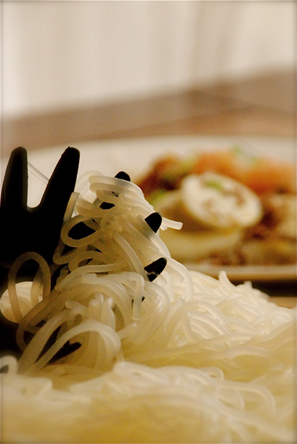
Pancit Palabok and Pancit Luglug are more or less the same. In the latter thicker noodles are used than the traditional Palabok (above). This is a very popular communal comfort food and why should it not be? When you slurp up a fork twisting in some thin white Rice vermicelli noodles dripping with meat sauce and shriek as a few drop of the sauce splatters on your clothes, you’ll realise the comfort that surrounds you for sure.
Pancit Palabok is more like the Burmese Khauk swè thohk – wheat noodle salad with dried shrimps, cabbage and carrots, garnished with fried peanut oil, fish sauce, fried onions, garlic and lime. You are supposed to vary these everytime you serve yourself and the taste completely varies. The Pancit is served first then the thick meat sauce or broth and then the various garnishes – fried shrimp, shrimp sauce, fried garlic, boiled pork, hard-boiled egg (sliced into smaller pieces), fresh green spring onions (chopped), Tinapa (smoked fish flakes) and Chicharon (crushed pork crackling, shown in the above left picture). The Chicharon looks like Prawn chips and we have sprinkled these over for friends who do not eat pork. Not the same smell though! Squeeze a lot of lime and the Pancit Palabok is ready to be slurped up. The entire Pancit Palabok entourage is shown below!




Serves 6-8 persons
Preparation time – 1 hr maximum (Boiling the Pancit – 10 minutes; Preparing the Broth – 30 minutes; preparing the other garnishes – 15 minutes)
Ingredients
Special Palabok Noodles – 1 pack (it’s written in the pack. You may have Bihon type of Rice Noodles which are really thin or the Pancit Luglug where the strands of Rice Vermicelli are relatively thicker than the Bihon type)
For the Meat Sauce or the Broth
Onions – 2 big, finely chopped
Garlic – 5 pods, crushed
Patis/Fish Sauce – 2tbsp
Beef or Pork – 200gm. minced and pounded
Shrimps – 100 gm, shelled, deveined and cut into small pieces
Black Pepper – 1/2 tsp, grounded
Salt – as per taste
Achuete or Annatto Seeds – 2 tbsp, pre-soaked in 1/4 cup water for a few minutes to give the bright orange colour (Annatto is safe for most people when used in food amounts; however, it can cause rare allergic reactions for those who are sensitive. Read more)
All purpose Flour or Corn Starch – 3 tbsp, dissolved in 1/4 cup water
White Oil – 2tbsp
Garnishing or Toppings
Boiled Pork – 100 gms, thinly sliced
Tinapa/smoked Tuna flakes – 2-3 pieces smoked Fish, cooked, deboned and flaked
Tokwa/Tofu – 8 pieces, fried and cubed
Chicharon – 1 cup, crushed
Eggs – 3, hard-boiled and sliced
Spring Onions – 1/2 cup, chopped finely
Shrimps – 1 cup, boiled and chopped
Garlic – 10 pods, sliced and fried crisply
Calamansi/Lime – 6 pieces*
*Calamansi is a kind of Lime available in all Filipino kitchens and is perhaps the secret ingredient to many mouthwatering Filipino delicacies – from popular desserts like Leche Flan to adding that magic sour flavour to Pancit Palabok and other Filipino dishes)
Method of Preparation
Pancit
– Boil the Palabok/rice noodles for 3-4 minutes. Drain the water and set aside.(The noodles should be soft but not soggy)
The Broth
– Heat White oil in a wok
– Fry the Onions and Garlic till they are brown
– Add the Patis/Fish Sauce, mince meat, ground Black Pepper, Salt
– Add 2 cups of boiled water, cover the wok with a lid and let the Broth simmer for a while in low seam
– Add the soaked Annatto and let the Broth boil till the Mince Meat is done
– Add the boiled Shrimps at the last
– Add the Corn starch and let the broth thicken by boiling for 5 more minutes
How do we serve Palabok?
Serve Pancit on a plate, pour the Mince Meat Broth over it, sprinkle Tinapa flakes, crushed Chicharon, Tokwa pieces, fried garlic, boiled Eggs, boiled Shrimps and freshly chopped Spring Onions. Squeeze Calamansi or Lime generously. This is our favourite of all Pancits that LF has been cooking at home.

◊—————————————————————◊
Pancit Bihon
Category – Main Meal; Cuisine type – Filipino
Contains Pork and Beef. But can be easily substituted with Lamb, Chicken or Shrimps
Pancit bihon are very thin rice noodles. It’s accompanied by fried meat slices, chopped fresh vegetables, Soy Sauce, Patis/Fish Sauce and definitely Chinese sausage and cabbage.
Serves 6-8 persons
Preparation time – 45 minutes maximum (Boiling the Pancit – 10 minutes; Preparing the Meat and vegetables – 30 minutes)
Ingredients
Special Bihon Noodles – 1 pack
For the Meat & Vegetables
Onions – 2 big, finely chopped
Garlic – 5 pods, crushed
Patis/Fish Sauce – 2tbsp
Beef or Pork – 200gm. stripped into thin pieces
Carrots – 2, sliced into thin strips
French Beans – Sliced angularly
Cabbage – 1 small, julienned
Toyo/Soy Sauce – 3 tbsp
Black Pepper – 1/2 tsp, grounded
Salt – as per taste
White Oil – 2tbsp
Method of Preparation
Pancit
– Boil the Pancit Bihon/rice noodles for 3-4 minutes. Drain the water and set aside.(The noodles should be soft but not soggy)
The Meat & Vegetables
– Heat White oil in a wok
– Fry the Onions and Garlic till they are brown
– Add the Patis/Fish Sauce, Meat strips, ground Black Pepper, Salt
– Add 1/2 cup of boiled water, cover the wok with a lid and let the meat simmer for a while in low seam
– Add the chopped Carrots, Cabbage and French beans and let them cook for a while (the vegetables should be cooked but not turn soggy and soft)
– Mix the Meat and the Vegetables to the Pancit
◊—————————————————————◊
Pancit Canton
Category – Main Meal; Cuisine type – Filipino
Contains Pork and Beef. But can be easily substituted with Lamb, Chicken or Shrimps. Note: This is a spicy dish
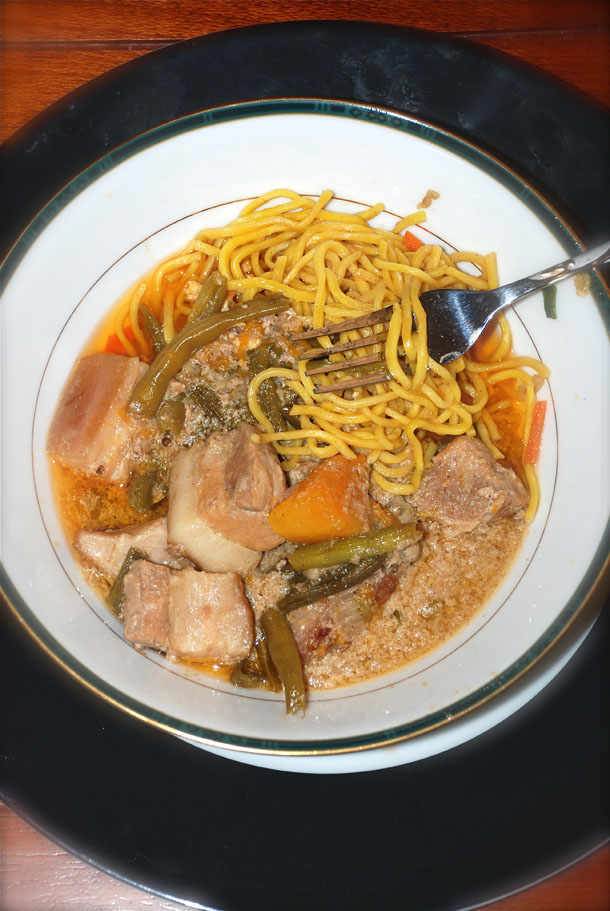
Pancit Canton are thick flour noodles. This dish closely resembles the Chinese Chow Mein. But LF sometimes cooks another favourite dish of ours called Bikol Express (Mixed Seafood Bikol Expresscoming up definitely in a detailed future post).
Serves 6-8 persons
Preparation time – 45 minutes maximum (Boiling the Pancit – 10 minutes; Preparing the Bikol Express – 30 minutes)
Ingredients
Pancit Canton Noodles – 1 pack
Bikol Express
Onions – 2 big, finely chopped
Garlic – 5 pods, crushed
Coconut Milk – 1 can
Pork belly – 500gms, cubed
String Beans – 200gms, chopped into long slices
Pumpkin – small, cubed
Black Pepper – 1/2 tsp, grounded
Long Thai Green Chilli or Serrano Pepper – 6, cut into long slices
Shrimp Paste – 1/2 cup
Salt – as per taste
White Oil – 2tbsp
Method of Preparation
Pancit
– Boil the Pancit Canton/rice noodles for 3-4 minutes. Drain the water and set aside.(The noodles should be soft but not soggy)
The Meat & Vegetables
– Heat White oil in a wok
– Fry the Onions and Garlic till they are brown
– Add the Coconut Milk, Pork cubes, ground Black Pepper, Salt, Long Green Chillies, Shrimp Paste and stir fry
– Cover the wok with a lid and let the meat simmer for a while in low seam
– Add the chopped String Beans, Pumpkin Cubes and let them cook for a while (the vegetables should be cooked but not turn soggy and soft)
– Mix the Bikol Express to the Pancit
◊—————————————————————◊

Thanks to LF we have been introduced to the brilliant gastronomical world of Filipino Cuisine. She has also learnt how to cook Bengali food and has become quite a pro at it. She’s become a part of our family. Gulf News, the leading newspaper in this region featured a blog, True life story of Filipina Maid in Dubai, which is quite an interesting take -off on the Filipino diaspora residing in Dubai and resonates the lives and moments of thousands of thousands of maids employed in the UAE. Working for a couple with two school-going children, Sally describes the daily details of looking after children, cleaning house, stealing time to catch up on gossip with neighbouring maids, the joys of computer-educating herself, her pangs of homesickness, her best friend Lilibeth and her devious plans to make money, all with a generous dose of humour, some of it dark, and some outright tears-in-your-eyes moments.
Don’t judge the English or the grammar. It’s a reflection into our inner minds as well!
Unblogging it all… Ishita
Disclaimer: I hope you enjoy reading the posts with lot of visuals. While you enjoy seeing them please don’t use them. You can see more pictures of my travel and food journey here.
BE SOCIAL. SHARE THIS!

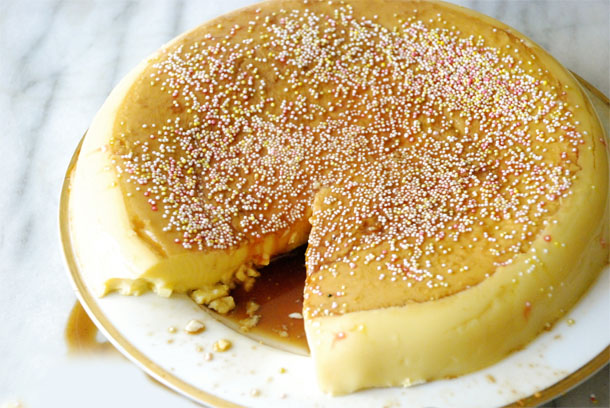
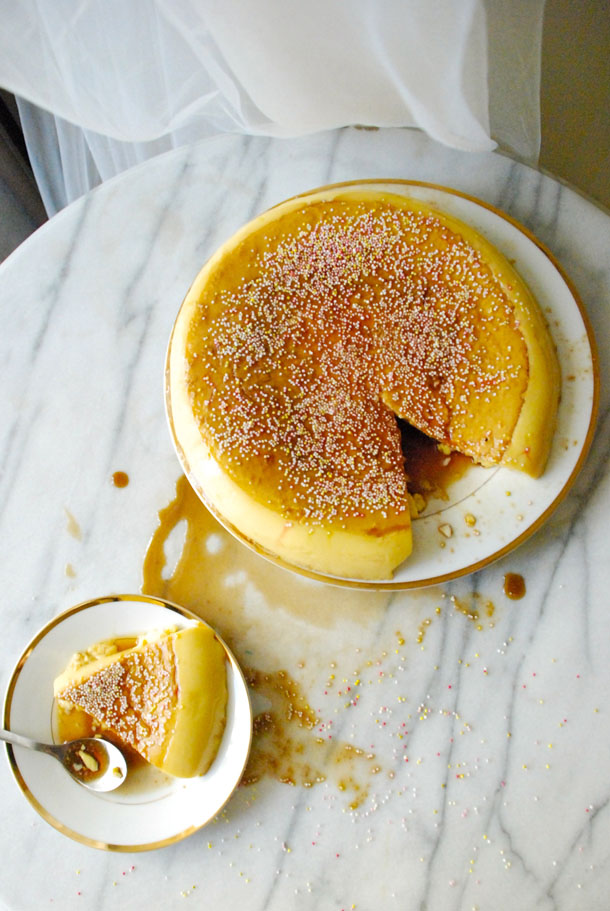
This is a guest post for Sudeshna. Long before my blogging journey began, my association with Cook Like a Bong started just like any other Bengali who’s starting their lives outside the comfort zones of their parents’ home… either because of work or because of marriage. Most Bengali girls (most) grow up with not much knowledge of cooking and the Porashuno or studying becoming the sole objective. ‘Jao to porashuno koro giye, rannaghor-e aar shomoy noshto korte obe na/Go and study, don’t have to waste time in the kitchen’ being the constant reminders from quintessentially Bong parents. So what do these cooking-illiterate people do once they have to set up their own homes and make their own meals? They make sites like Sudeshna’s their sole reference point!
My Blog just turned one! Not a very long journey but it has definitely been a momentous one – from making some good bloggers friends down the way, getting featured in BBC Good Food Magazine, making my favourite Rasgulla for a Ramadan special episode in the local TV channel to having loads of love from a lot of foodies the world over – the blogging journey of this Bong blogger has been quite fulfilling. And throughout the journey there has been a lot of introspection – how can I transcend myself from being a regional blogger to being an international one? No idea. Everybody still knows me as the Bong Dubai Blogger and the biggest hit that my posts have had are when I have written about Phuchka or traditional Bangla Khabar or my post on Things to Do in Dubai – Like a Tourist in my own city!
Funnily, when I made the Rasgullas for the local TV channel, I was almost mugging up the recipe from where else? But, Cook Like a Bong! The least I can do for all the meals that I have cooked successfully following these recipes apart from saying A BIG THANK YOU is to give back one recipe to Sudeshna!
But what kind of recipe shall I contribute to? Drinks, Curries, Chutneys, Sweets – everything seems to be here anyway. Before the summer hit us, Sudeshna suggested that I could perhaps do a cool summer drink. But whatever I thought of seems to have been here. Summer turned into Monsoons and now the Autumns too seem to be turning into Winter. Bengalis are still greeting each other Subho Bijoya – probably the exchange of festive greetings can continue till Kali Pujo and Diwali. This is also the time to visit family & friends with a box of sweets. Hence my virtual treat of a fusion Bengali Sweet – the Shondesh Pudding to all those who aspire to Cook Like A Bong!
Click here to hop onto Cook Like a Bong for the recipe!
This is a fairly simple recipe. Sudeshna’s blog also has many more Bengali recipes – both traditional as well as variations. Do take care while turning the pudding gently onto the plate after it’s set. It’s soft, creamy and indulgent. And prone to breaking!
◊—————————————————————◊
Sprinkling hundreds-and-thousands
Sprinkles (also called jimmies) are very small pieces of sugar strands used as a decoration on cupcakes, cookies, doughnuts, ice cream, frozen yogurt, and puddings. Hundreds-and-thousands pep up a dessert in a very novel way – it adds lot of childish spunk! These sugar-loaded pieces could be a subject by itself as you can read here.
◊—————————————————————◊
Shondesh is perhaps one of the most popular and unique of Bengali Sweets made with Channa/Paneer/Indian Cottage Cheese. Most Bengali sweet shops outside Bengal have managed to dole out a wide variety of Bengali Sweets, but Shondesh! What could be the probable reason, I’m not too sure. It’s probably the simplicity of the recipe of Shondesh – mixing pure sweetened Channa with other aromatic garnishing – that makes it difficult to replicate!
Again, Caramel Pudding though originally transported from the European shores has entered the Indian kitchens in many parts of India and has become popular amongst the Parsis, Mangaloreans and the Anglo-Indians. There are many regional variations of the Caramel Pudding in many parts of the world (read here).
Pudding for me has many memories associated with it. Every-time my brother and I, we wanted something fancy, our Mum would stir up a Caramel Pudding in a jiffy. And we would be so thrilled and happy with our special treat. Unfortunately, my girls don’t enjoy the simple Caramel Pudding so much as we did in our childhood. Neither do they like the dry taste of Shondesh. But when I conjure the two of them together in this so called Shondesh Pudding with hundreds-and-thousands sprinkled on top, I see the same thrill and excitement in their eyes as we had in ours – many decades back. 
This is perhaps the very essence of cooking – everything comes in a full circle. Recipes are passed on from one generation to another and modified and modernised in the way, incorporating the trendy bits and skimming the non-trendy ones… so Pudding from one continent gets fused with Shondesh from another continent and becomes a Bengali fusion dessert – Shondesh Pudding for the new generation of Bongs!
Unblogging it all… Ishita
Disclaimer: I hope you enjoy reading the posts with lot of visuals. While you enjoy seeing them please don’t use them. You can see more pictures of my travel and food journey here.
◊—————————————————————◊
My Dubai diary in this blog:
♦ Things To Do In Dubai – Like A Tourist In My Own City – Showcasing the city I love to call my home!
♦ My First Authentic Emirati Food Experience! – Al Fanar Restaurant, Dubai Festival City
♦ Al Maha Desert Resort & Twitterati Lunch – Al Maha Luxury Eco Resort
♦ An Evening of Wine Tasting at Asado Wine Club – Asado Wine Club, The Palace Hotel, Old Town*
♦ The Label Project – Wines Tasted Blindly! – Invite to a Global Wine initiative from Jacob’s Creek
♦ TRIBES Celebrating South African Heritage Day! – TRIBES, the South African Restaurant in MOE*
♦ Locavorism in UAE, Friday Market♦ The Change Initiative Inspiration! – Dubai’s first sustainable store, restaurant & café
♦ Zatar Lamb, Crushed Lemon Potato with Chef Ron Pietruszka – Treat 2012, Burjuman World Food Fest + a Recipe
♦ Back To Dubai, Back to Costa –A nostalgic recount of favourite coffee haunt
♦ Searching for Shiraz – Lucknow to Kolkata to Dubai – Nostalgic search for Kolkata’s famous Shiraz Restaurant ends with Siraz opening in Bur Dubai. Exploring some Awadhi/Lucknowy Khana!
♦ Down To Earth Organic Store In Dubai & Mutton Chick Peas Curry – An event + a Recipe*
♦ Mums Who Share @JBR – A charity initiative
♦ Deep Sea Fishing & Fish Barbeque – Persian Gulf off Dubai Coast
♦ The Million Street, in the middle of nowhere – Rub Al-Khali Desert, UAE
Bengali Food Banters you’ll find in my blog:
♦ Traditional Bengali Cuisine… In ‘Slight’ Details! – An etymological explanation to the Bengalis’ food festish
♦ Pickles… Mother (-in-law) Of All Pickles! – My Pickle Nostalgia
♦ Momos in Tiretti Bazar – The Last Chinese Remnants! – A chinese Bazar near Poddar Court
♦ Phuchkas in Vivekananda Park – An ode to Dilipda’s ‘world-famous’ Phuchka
♦ Bengali Sweets That Came By Parcel! – Gujia, Jibe Goja, Abaar Khabo & Jolbhora
♦ Rôshogolla (রসগোল্লা) – Bengali’s Own Sweet – An essay on the most famous Bengali Sweet
Bengali Food Recipes you’ll find in my blog: (Do click on Recipes, Reviews, Events for a complete list of all food banters)
♦ Frozen Aam Pana/Green Mango Pulp… The Change Initiative Inspiration! – Traditional Bengali/Indian
♦ Locavorism, Friday Market & Tok Palong/Sour Spinach Chutney – Traditional Bengali
♦ Semaiya Kheer/Vermicelli Pudding, Eid in Dubai… Eid Mubarak! – Indian
♦ Mutton Kassa With Red Wine And Red Grapes – Bengali Fusion
♦ Khichuri As Harbinger of Hope & Kolkata Soaked In Rains – Traditional Bengali/Indian
♦ Hot Garlic Pickle… The Pickled Diary – Episode 1 – Indian Pickle
♦ Firni or Ferni, Ramadan or Ramzan, Mallick Bazar or Karama? – Indian Dessert
♦ A Tale of 2 Cities & Naru/Coconut Jaggery Truffles – Traditional Bengali
♦ Phuchkas in Vivekananda Park – Indian Street-food/Snacks
♦ Kaancha Aamer Chutney/Green Mango Chutney – Traditional Bengali
♦ Notun Gurer Payesh/Rice Pudding & My Dida – Traditional Bengali
♦ Rasgulla Macapuno – When a Filipina Turns Bong! – Dessert; Bengali Fusion
♦ Mango Lentil Soup/ Aam Dal – The Summer Combat – Dal; Traditional Bengali
♦ Easter Egg Curry – Side-dish; Bengali Fusion/Traditional Bengali/Continental
♦ Mashed Potato Bengali Style/ Aloo Bhaaté – Side-dish; Bengali Fusion
♦ Yoghurt Aubergine with Pomegranate – Side-dish; Bengali Fusion
♦ Purple Haze Yoghurt with Purple M&Ms – Dessert; Bengali Fusion
♦ Icecream Rasgulla with Blueberry Sauce – Dessert; Bengali Fusion
BE SOCIAL. SHARE THIS!


Happy Diwali to all of you! May the Indian Festival of Lights brighten up your lives, illuminate your homes and your minds. May Health be there… Happiness will follow. May Peace be there… Prosperity will follow. May Love be there… Luck will follow. Today’s recipe has been lovingly cooked by my Aunt who’s been visiting us for a while. While she left for Kolkata two days back, she cooked this special Gajorer Payesh/Carrot Pudding and put it in the freezer so that we could have a special dessert for Diwali!
Festivals all over the world have the same essence – they bring families and friends together. A small excerpt form an earlier post Semaiya Kheer/Vermicelli Pudding, Eid in Dubai… Eid Mubarak!… While a lot of us living in Dubai are lucky enough to be with our friends and family, many of us are not. There are many people toiling in the city just to earn a living so that their loved ones can have a decent life back in their home countries. My greetings and warm wishes to all of them. Most likely, my wishes are not going to reach them I doubt that these people are going to read my post. Writing food posts while taking photo-shots of them in well laid out dining table in the air-conditioned comforts of our humble home, may seem preposterous to some. But I was awake to greet Eid Mubarak to the man who delivers the newspapers daily as early as 3 am in the morning, throwing out the newspapers as he stands inside the lift, aiming them perfectly as they land in-front of the main doors of the different apartments in the floor that we live in. At the time I had greeted him, he had 30 more floors to go!
This time I woke up early to greet him for Diwali. It didn’t matter whether he’s a Muslim or a Hindu, whether he celebrated Diwali or not. My greetings are as much as for him as it is for everybody. I’ll be greeting him during Christmas. For me what matters is that Festivals give us an opportunity to reach out to people who are there in our daily lives but to whom we don’t have the time to reach out at other times. Every day can be the day but today is definitely the day. Happy Diwali everyone!
◊—————————————————————◊
Gajorer Payesh/Carrot Pudding
Category – Dessert; Cuisine type – Bengali Fusion/Indian
Following are the characteristics of all recipes doling out of our little hands, big hearth –
♥ Easy to cook
♥ Regular canned products off the shelf may be used (However, we advocate using fresh products)
♥ Goes well both as a regular or party dish
♥ Children can easily help in making the dish (My two little sous-chéfs are aged 8 and 3 years!)
♥ And lastly, guaranteed to be tasty!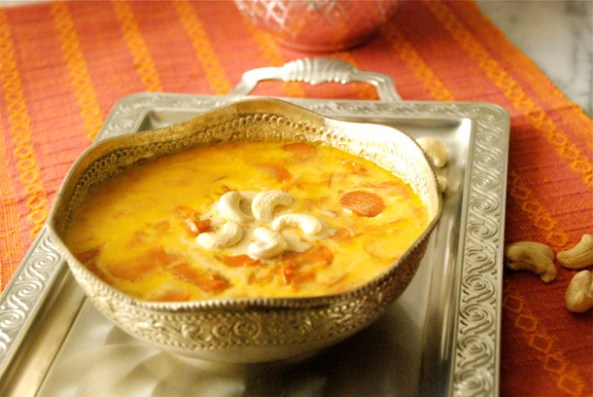

Gajorer Payesh is not Gajjar Ka Halwa!
Why is this a Bengali Fusion Dessert and not a traditional Bengali recipe? Gajor or Carrots have probably now entered into Bengali desserts but predominantly it has been Gajjar ka Halwa which is a very popular Indian Dessert, specially in Punjab. The dish originated from the nut dishes introduced by the traders from the Middle East and South Asia during the Mughal period. In-fact, Halwa is an Arabic word meaning ‘sweet’. Vegetables such as carrots, pumpkin, zucchini, potatoes and snake squash have also been used in the Middle East for making similar desserts. Gajjar Ka Halwa is traditionally a festive Indian dessert eaten during Diwali, Holi and other Indian festivals. Eaten smoking hot during the winters, Gajar Ka Halwa is now eaten the year around as Carrots are no more a typical winter vegetable, courtesy hybrid and other farming technology!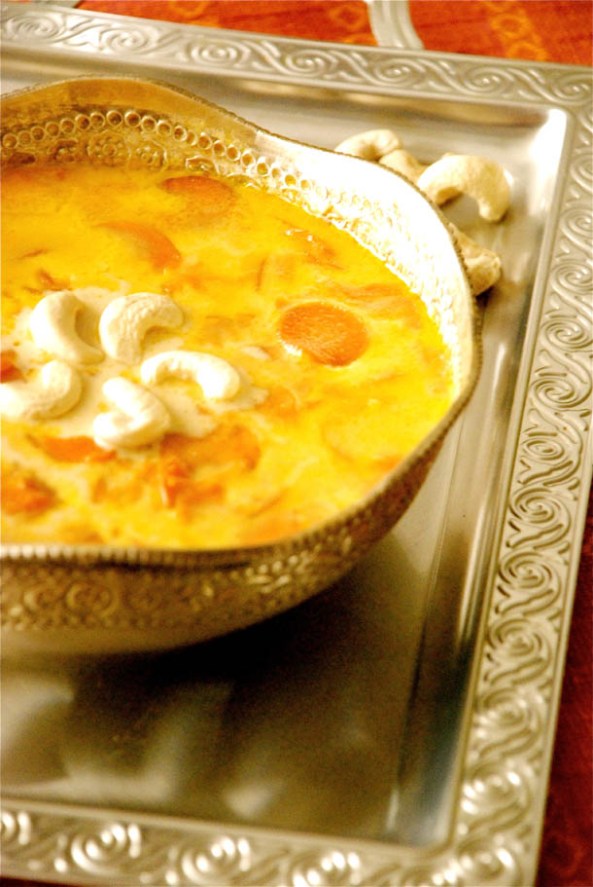
Payesh in itself is a very important traditional Bengali dessert. The only other way to explain the importance of a traditional Payesh/Rice Pudding is to compare it with Champagne. If you can understand the importance of Champagne to bring in a family celebration then you can probably understand the importance of Payesh. Or say, cutting a cake on a birthday. For a Bengali, a spoonful of Payesh is a must on a special occasion. Also, the first spoon of non-solid food that goes into a Bengali child during Annaprashan or the First Rice is Payesh (for traditional Payesh you may read an earlier post – Notun Gurer Payesh/Traditional Bengali Rice Pudding & My Dida).

While Gajjar ka Halwa uses grated Carrots and is cooked in Ghee and Milk till it becomes dry, in Gajorer Payesh, my Aunt has used rounded slices of Carrots in the traditional Bengali Payesh recipe – Gajjar ka Halwa adapted in Bengali style Payesh. The Carrots tastes more like a creamy layer as you’ll find in the Calcutta Rabri (the picture below) rather than in the Gajjar Ka Halwa! This famous version of the Rabri hails from Calcutta. As the sweetened milk starts boiling, a layer of cream begins to form on the surface of the milk. That is taken off and kept aside. Repeated process of the same results in the Calcutta Rabri – layers and layers of cream floating in sweetened and thickened milk. Needless to say this is extremely rich and creamy and is bound to be heavy on the stomach and extremely fattening! (More here)


Serves 6-8 persons (maybe less if they happen to be sweet-toothed Bengalis!)
Preparation time – 2 hrs maximum (Boiling the milk with Rice and thickening it by constant stirring – 45-50 minutes; setting up – 10 minutes; Refrigeration – 30 minutes)
Ingredients
Gajor/Carrots – Long and slender, 5 pieces; chopped into ultra-thin round slices
Full Cream Milk – 1lts*
Sugar – 1 cup (if you are using sweetened condensed milk then use less of sugar)
Cardamom pods – 4, crushed into powder
Cashew Nuts – 1/4 cup, unsalted
Ghee/Indian Clarified Butter – 4tsp
Mitha Attar – a drop for the sweet perfumed aroma of Attar (Availability? Well, I haven’t checked on the local supermarkets but had got mine from a little spice shop in the Spice Souk in Deira)
Rose water – 1 tsp (if you are using Mitha Attar then there’s no need to use Rose Water)
* You may substitute this with Low-fat Milk. Many prefer to use sweetened condensed milk – in that case you will need much less milk (1 lt low-fat Milk, 1/2 cup sweetened low-fat condensed milk)
Method of Preparation
– Heat 3 tsp Ghee in small wok. Stir the Carrots in the Ghee for a little while till it turns slightly soft and set them aside
– Boil the Milk in a Dekchi/a flat bottomed pan (Dekchis are usually used for cooking Rice. Please note that Payesh is always made in utensils meant for cooking Rice or kept separately and hasn’t been used for any other type of cooking. This is because of it’s susceptibility to catching the smell of other cooked items. Stir constantly is required so that the bottom of the pan doesn’t get burnt)
– Add the Carrots when the milk comes to a boil
– Add the Cardamom, Sugar, Cashew nuts, Almonds, Raisins, sweetened condense milk (if you are using)
– Lower the temperature and keep on stirring until the Milk really thickens (this should take about 45 minutes to an hour!)
– Add a tsp of Ghee during the last 1 minute of stirring
– Adda Mitha Attar or Rose water
– Garnish with Cashew Nuts
Let the Gajorer Payesh/Carrot Pudding set for a while and refrigerate it. Serve it cold. However, some prefer to eat their Payesh smoking hot, just after it has been taken off the fire!
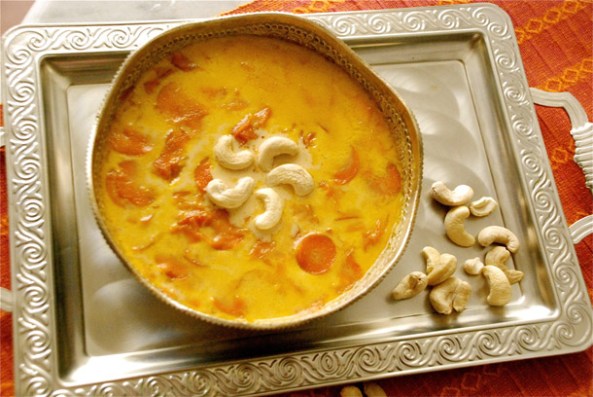
◊—————————————————————◊

The essence of Rose water in Indian Desserts
Rose water (above) has been used in Indian Desserts for a long time. Ladies from the royal courts of India have been using Rose water for ages in the form of cosmetics. The fragility and the aroma thus transcends naturally from cosmetics to cuisine. Originating in the Arab world and the Middle East the custom must have crossed the borders along with Muslim invaders and traders. Rose water is also used in many other parts of the world as can be seen below (reference courtesy: Wikipedia)…
Rose water was first produced by Muslim chemists in the medieval Islamic world through the distillation of roses, for use in the drinking. Rose water is used heavily in Persian and Mesopotamian cuisine—especially in sweets such as Nougat, Raahat and Baklava. It’s also used to give Loukoum/Turkish Delight their distinctive flavours.
The Cypriot version of Mahleb uses Rose water. In Iran, it is also added to tea, ice cream, cookies and other sweets in small quantities. In the Arab world and India it is used to flavour milk and dairy-based dishes such as rice pudding. It is also a key ingredient in sweet lassi/Yogurt Drink, sugar, various fruit juices and is also used to make Jallab. In Malaysia and Singapore, Rose water is mixed with milk, sugar and pink food colouring to make a sweet drink called Bandung. Rose water is frequently used as a halal substitute for red wine and other alcohols in cooking. In parts of the Middle East, rose water is commonly added to lemonade.
In Western Europe, Rose water (as well as orange flower water) is sometimes used to flavour Marzipan. Rose water was also used to make Waverly Jumbles. American and European bakers enjoyed the floral flavouring of rose water in their baking until the 19th century when vanilla flavouring became popular.
In the United States, Rose syrup is used to make rose scones and marshmallows.
◊—————————————————————◊

Diwali in Dubai & the essence of multicultural living
Diwali is celebrated in a big way in Dubai and the credit does go to the fact that amongst all the Indian festivals, Diwali has managed to elevate its’ popularity level amongst the non-Indian communities living in Dubai. Probably world-wide! I love the fact that Z-Sisters‘ school celebrates Diwali even though the school follows the British curriculum. This is the very essence of living in Dubai. There are 12 nationalities amongst the 24 students in Big Z’s class! Yes, they will also be celebrating St Andrew’s Day, Christmas, Chinese New Year, Eid and many more festivals around the world. In-fact Big Z’s topic right now is Festivals!
Tomorrow, Big Z will be giving a small power-point presentation that Mummy Dear has made on Diwali – the story of Ram-Sita returning home; how Goddess Lakshmi is worshiped; what do the Indians do during Diwali… Both the sisters will be painting on Diyas/earthen lamps along with all the other friends as a part of Diwali activity in school. A friend of mine who owns an Indian Sweet shop in Karama and has her son studying in the same school, will be distributing nuts-free Indian sweets in school. Most schools in Dubai are predominantly adhere to a nut-free policy. And yes, the dress up code for the Diwali day is ‘Indian clothes’!
Residential areas in Dubai like the Golden Sands area (behind Burjuman), Meena Bazaar have already brightened up with colourful lights hanging from the balconies. Shikhadi, my very good friend who’s now become a part of our family was kind enough to send a picture clicked from her balcony. Does this look like Diwali is being celebrated in a foreign land, many many miles away from the Indian shores?
◊—————————————————————◊
–
Diwali will light up our houses. But this Diwali, I pray that the lights brighten our minds and our thoughts as well. Also praying for peace and happiness for people struggling in the war-torn regions all around this region and in the world.
Unblogging it all… Ishita
Disclaimer: I hope you enjoy reading the posts with lot of visuals. While you enjoy seeing them please don’t use them. You can see more pictures of my travel and food journey here.
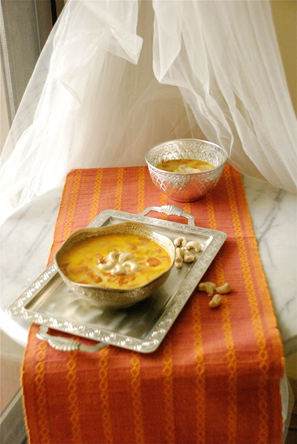
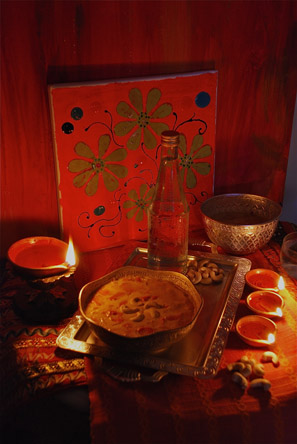

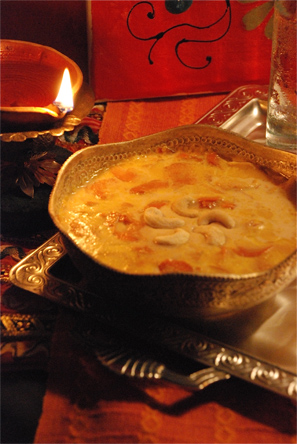




◊—————————————————————◊
My Dubai diary in this blog:
♦ Things To Do In Dubai – Like A Tourist In My Own City – Showcasing the city I love to call my home!
♦ My First Authentic Emirati Food Experience! – Al Fanar Restaurant, Dubai Festival City
♦ Al Maha Desert Resort & Twitterati Lunch – Al Maha Luxury Eco Resort
♦ An Evening of Wine Tasting at Asado Wine Club – Asado Wine Club, The Palace Hotel, Old Town*
♦ The Label Project – Wines Tasted Blindly! – Invite to a Global Wine initiative from Jacob’s Creek
♦ TRIBES Celebrating South African Heritage Day! – TRIBES, the South African Restaurant in MOE*
♦ Locavorism in UAE, Friday Market♦ The Change Initiative Inspiration! – Dubai’s first sustainable store, restaurant & café
♦ Zatar Lamb, Crushed Lemon Potato with Chef Ron Pietruszka – Treat 2012, Burjuman World Food Fest + a Recipe
♦ Back To Dubai, Back to Costa –A nostalgic recount of favourite coffee haunt
♦ Searching for Shiraz – Lucknow to Kolkata to Dubai – Nostalgic search for Kolkata’s famous Shiraz Restaurant ends with Siraz opening in Bur Dubai. Exploring some Awadhi/Lucknowy Khana!
♦ Down To Earth Organic Store In Dubai & Mutton Chick Peas Curry – An event + a Recipe*
♦ Mums Who Share @JBR – A charity initiative
♦ Deep Sea Fishing & Fish Barbeque – Persian Gulf off Dubai Coast
♦ The Million Street, in the middle of nowhere – Rub Al-Khali Desert, UAE
Bengali Food Banters you’ll find in my blog:
♦ Traditional Bengali Cuisine… In ‘Slight’ Details! – An etymological explanation to the Bengalis’ food festish
♦ Pickles… Mother (-in-law) Of All Pickles! – My Pickle Nostalgia
♦ Momos in Tiretti Bazar – The Last Chinese Remnants! – A chinese Bazar near Poddar Court
♦ Phuchkas in Vivekananda Park – An ode to Dilipda’s ‘world-famous’ Phuchka
♦ Bengali Sweets That Came By Parcel! – Gujia, Jibe Goja, Abaar Khabo & Jolbhora
♦ Rôshogolla (রসগোল্লা) – Bengali’s Own Sweet – An essay on the most famous Bengali Sweet
Bengali Food Recipes you’ll find in my blog: (Do click on Recipes, Reviews, Events for a complete list of all food banters)
♦ Frozen Aam Pana/Green Mango Pulp… The Change Initiative Inspiration! – Traditional Bengali/Indian
♦ Locavorism, Friday Market & Tok Palong/Sour Spinach Chutney – Traditional Bengali
♦ Semaiya Kheer/Vermicelli Pudding, Eid in Dubai… Eid Mubarak! – Indian
♦ Mutton Kassa With Red Wine And Red Grapes – Bengali Fusion
♦ Khichuri As Harbinger of Hope & Kolkata Soaked In Rains – Traditional Bengali/Indian
♦ Hot Garlic Pickle… The Pickled Diary – Episode 1 – Indian Pickle
♦ Firni or Ferni, Ramadan or Ramzan, Mallick Bazar or Karama? – Indian Dessert
♦ A Tale of 2 Cities & Naru/Coconut Jaggery Truffles – Traditional Bengali
♦ Phuchkas in Vivekananda Park – Indian Street-food/Snacks
♦ Kaancha Aamer Chutney/Green Mango Chutney – Traditional Bengali
♦ Notun Gurer Payesh/Rice Pudding & My Dida – Traditional Bengali
♦ Rasgulla Macapuno – When a Filipina Turns Bong! – Dessert; Bengali Fusion
♦ Mango Lentil Soup/ Aam Dal – The Summer Combat – Dal; Traditional Bengali
♦ Easter Egg Curry – Side-dish; Bengali Fusion/Traditional Bengali/Continental
♦ Mashed Potato Bengali Style/ Aloo Bhaaté – Side-dish; Bengali Fusion
♦ Yoghurt Aubergine with Pomegranate – Side-dish; Bengali Fusion
♦ Purple Haze Yoghurt with Purple M&Ms – Dessert; Bengali Fusion
♦ Icecream Rasgulla with Blueberry Sauce – Dessert; Bengali Fusion
BE SOCIAL. SHARE THIS!

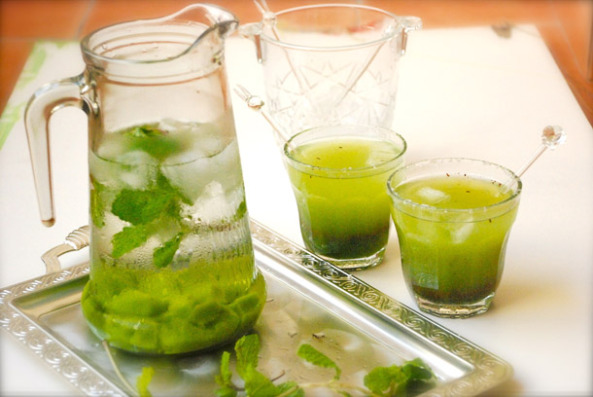
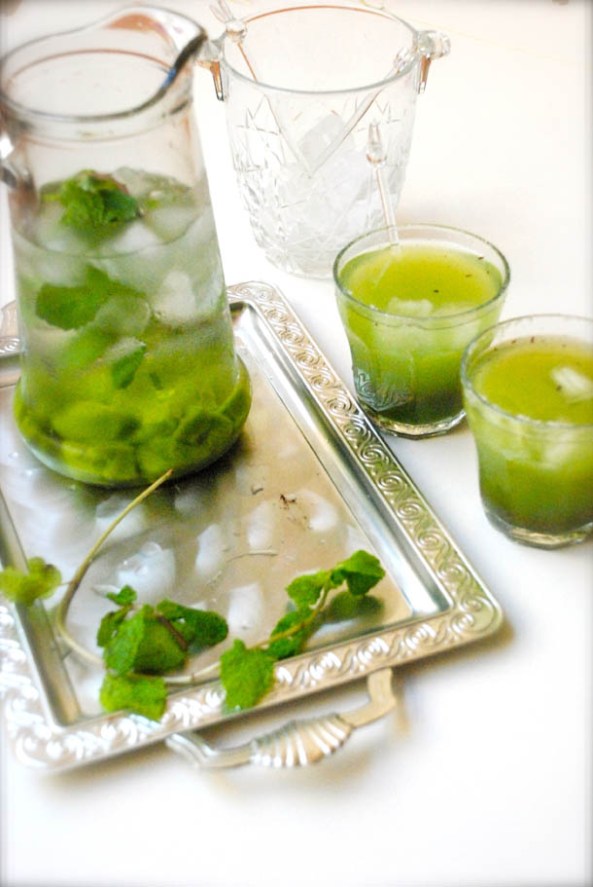
Aam Pana or Green Mango Drink (above) is one of the most famous coolants for Indian Summer. The mango concentrate can be very easily made at home and stored for much longer than the summer months themselves. So, adapting the drink to combat Dubai summers perhaps seemed the most obvious thing to do. Taking cue from the last article which touched upon the subject of Locavorism and fresh local produce in UAE, this post jumps straight into the subject of sustainability in Dubai with the opening of The Change Initiative, Dubai’s first sustainable store and it’s restaurant and café – The Taste Initiative. And it is here that I got inspired to twist the traditional Aam Pana, make them frozen and use them in table water as a healthy alternative to bottled flavoured drink!
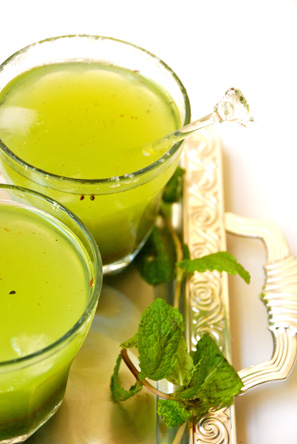
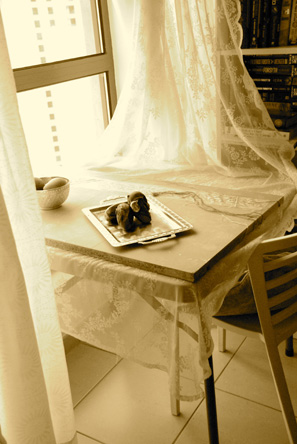
My previous article touched upon the current hot food topic right now – Locavorism in UAE or the movement towards supporting the fresh local produce. Dubai too has woken up to realise that sustainability is the key to long-term growth. Lot of positive developments are taking place in sustainability – not only agriculture but energy, water, lifestyle and also waste management. A few days back, The World Energy Forum concluded in Dubai where world leaders had gathered with the goal of creating a roadmap towards safe and sustainable energy accessible to all.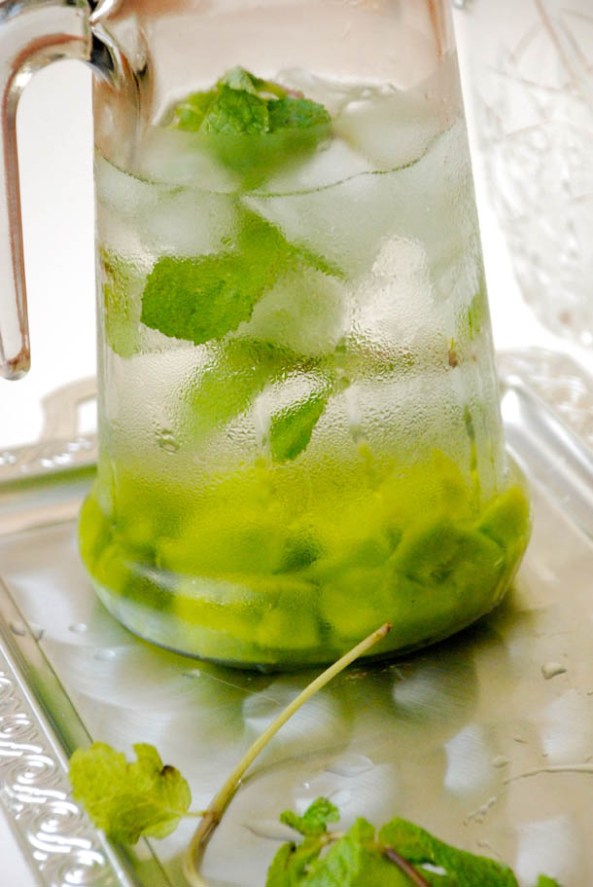
The Taste Initiative
A sustainable restaurant & café serving breakfast, brunch, lunch, dinner as well as light snacks and exquisite coffees during the store-hours
Opening Hours: 8am – 9pm Sunday to Wednesday; 9am-10pm Thursday to Saturday
Location: The Change Initiative marketplace, Al Barsha 1, Sheikh Zayed Road, near Ibis Hotel opposite Wellington School
Tel: 800-TCI (824); Or, you can visit their Facebook Page and Website
The Taste Initiative, Dubai’s first sustainable store has just opened its doors with many novel concepts that may inspire people to integrate sustainability into their day-to-day lives. While attending the preview of it’s café & restaurant, a whole lot of ideas deluged my mind which we could incorporate easily at home. Frozen Aam Pana or Green Mango pulp in water with herbs (above)… is just a small idea inspired by the restaurant where we were served special ‘House’ waters with infusions of frozen fruit pulps and herbs in them. Initially, the water seems flavoured with the fruit pulps in them. Gradually a strong taste seeps in as the pulp melts. At the end, the water tastes absolutely divine – sweet and flavoured and absolutely fresh as they are being served from glass bottles into glasses made with recyclable materials – No plastics! Very simple, yet heavenly. I hope the simplicity and the beauty of it has been captured in the slideshow below.
What makes The Taste Initiative special? To start with – a lot of things. The menu focuses on organic produce and serves food that is mostly locally sourced – less carbon footprint! The kitchen uses energy saving appliances – induction oven, LEED certified refrigerators (achieving a LEED certification is perhaps the best way to demonstrate a ‘green’ project), and LED lighting (read here) for the whole restaurant! The waste produced from the restaurant is recycled and a dewatering device is used to extract water from food waste – thus reducing the volume of the waste, which is then composted in Bokashi bins (read here). The need for chemicals is eliminated in the entire restaurant by using plant-based Ecover cleaning products (read here) are used in the entire restaurant – No chemicals!
–
What do you eat in a sustainable restaurant? ‘Eating is one of life’s greatest pleasures’… declares the cover of the menu. In other words it meant that it didn’t require us to remain self-sustainable only on fresh air and solar lighting. Mark Taquet, the Head Chef does conjure up a whole array of gastronomical delights and doesn’t merely depend upon lofty ideas and concepts – a big scorer in the entire conversation! While the menu on one side focuses on healthy options like a variety of granola served with yoghurt, soups and fresh salads, it also offers interesting quiches and sandwiches, noodles, pizzas, breads, signature main courses and not yes, hold your breath – tempting desserts like the Citrus Cheese Cake, Chocolate Ganache Tart, Scones served with fresh cream and much more! The butters and jams are all home-made so are the freshly baked loafs.
The food verdict – The House waters are an absolute delight. Fresh, aromatic and rejuvenating. The Crumpets we tasted seemed almost fresh from the oven and came with home-made peanut butter, strawberry jam and lemon curd served on the side. Personally I am not a great fan of peanut butter, so I’ll reserve my comments here but the lemon curd was superb – light yet creamy, sour yet sprinkled with slight sweetness. We also ordered The Full Initiative – egg and bread of one’s own selection served with Portobello Mushrooms, beef bacon and vine tomatoes. The mushrooms were perfect – meaty and flavoured, tossed lightly in oil, sprinkled with herbs. Definitely high on the scores! We also enjoyed very much one of The Taste Initiative sandwiches that we had – the Goats Cheese, Confit Tomato & Basil.
The Sweet Verdict – We were told that the Cheesecake and the Carrot Cakes were on of their specialities. However, we ended up ordering a Strawberry Tart. The Coconut Macaroons that we got to taste as ‘starters’ were simply fantastic – crunchy yet not too crumbly, sweet but not too sweet! Yes, my Bengali sweet tooth was adequately satisfied.
How much does it cost you to eat in a sustainable restaurant? This is by far the most nagging question that keeps on lurking behind. I would say that the prices fare pretty well considering the freshness and organic quotients that have been infused into the menu. The House Waters are priced at Dhs 12/-Dhs 16/ (for short and tall respectively), so are the regular fresh fruit juices. You’ll get you dessert within Dhs 22/. The priciest tag comes at Dhs 60/ for a signature dinner meal of Pan Fried Sherri, Cashew Nut & Lemongrass Quinoa. You do have an interesting array on the Menu like Roasted Asparagus, Fried Eggs & Aged Parmesan; Grilled Chicken & Chilli Peanut Satay or Prawns with Thai Green Curry Sauce with further plans to add more to the spread.
The final verdict – Freshness is guaranteed. So is great taste. And it definitely has the guilt-free, feel-good factor that whatever went inside the tummy is all healthy and going to add some sparkle into my aging eyes. But can I bring the Z-Sisters here for a Friday brunch or will we enjoy our meals while Li’l Z strolls loiters around? There is enough space to laze and enjoy your meals but I like the feel of a little bit of a cozy ‘visual’ seclusion when I’m having my meals unless I’m in a food-court or consciously dining on a boulevard-sitting with onlookers passing by. I’ll also be worried with the little ones running around and knocking off a few things from the store area while I focus on my munching. A small glass or any innovative visual separation from the store would calm my nerves and make me settled into a more relaxed environment.
How did it all start? Many of us think most of the times that sustainability is a subject that belongs exclusively to researchers and environmentalists. But we as individuals can do our small little share to contribute to a greener future by making small lifestyle amendment. After all, ‘We all need to make an effort to preserve the planet and the sooner we realise that this is the only home we have, the sooner we will begin to take steps to clean it up and keep it that way’!… read here.
◊————————————————–◊

How sustainable is the concept of sustainability in a place like Dubai?
Egged on by a brilliant post from Chef and Steward on the Top food trends in Dubai & UAE my earlier post dwells on local fresh and the Friday market in Fujairah.A lot of us from Fooderati Arabia are touching upon these pertinent issues. Sally writes about honest food and fresh ingredients in her blog My Custard Pie. Francine in her Life in a Food Lane has been writing about all the experiences she’s been gaining in Slow Food on her travels. Francine had been with me in The Taste Initiative and was telling me about her particular interest on sustainable food.
Which brings me to the entire logistics of sustainability in Dubai. How far is local sourcing sustainable? While I do support fresh, local produce, a worrying question is also triggered off – while trying to produce things locally and organically in a place like UAE where the weather is absolutely harsh for as much as four months in a year, are we not better off importing fresh produce? What is the trade-off between the carbon footprints spent air-freighting fresh produce vis-a-vis trying to produce things probably in a very controlled farm environment? It’s ironical that while ‘locavorism’ and going organic is suddenly a topic of hot discussion, when a few years back these were but the most natural thing to do!
An entire series of conversation follows Chef and Stewards’ earlier post and I’m taking the liberty of including that here with the conviction that it will benefit the reader immensely… Arva brilliantly writes about hole-in-the-wall ethnic eats of old Dubai in her blog I Live in A Frying Pan while Sarah is The Hedonista.
Arva: On the case of locavorism, I’d love to see more discussions about (1) local vs. organic – I used to use the terms synonymously, until I realized that local was not always organic (2) what is ‘really’ sustainable. While I love the idea of being as close to the source of food as possible, there is research [Food Production in the Middle East, Tony Allen] that shows that in some cases, importing is actually a better solution than stressing Middle Eastern land or water resources in trying to use them for local agriculture. I don’t know what the right answer is, I just think more research needs to be done to take complete stock of environmental losses and gains from scaling up local farming efforts in the UAE – before determining whether ‘local’ is truly sustainable. Sarah initiated this thought through her excellent post on whether local tomatoes were better for the environment than imported – she found that local ones were better … and I do think a larger scale effort needs to be done to review this along similar lines.
Chef and Steward: … There are local farms that actually use well-water to irrigate and very conservative methods to utilize water and reduce temperatures in their greenhouses. I had a farm visit with one, Al Shuwaib that employs an agronomist from Jordan who pretty much has very basis but effective methods. Farming in the Middle East has been going on for centuries, from the Persians right up to now and places like Israel, Oman and Jordan have thriving industries, so much so that they can also export in the region and beyond. It is harder to farm in the UAE but not difficult and it doesn’t have to be with costly desalinated water.
◊————————————————–◊
Coming back to the Aam Pana or the Green Mango Drink
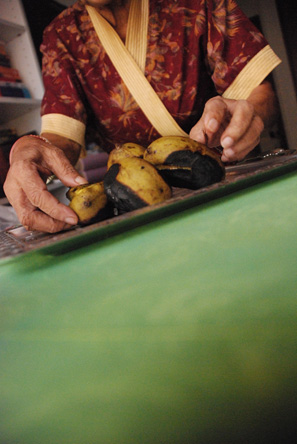
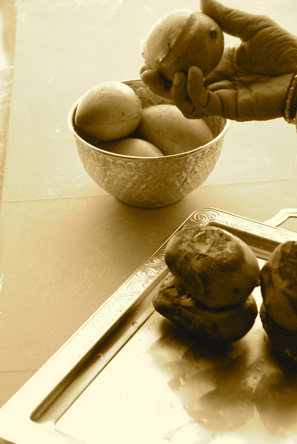
In my last few posts I have been talking about my Aunty who’s visiting us from Kolkata and has been cooking up quite a conventional cooking storm in my non-conventional kitchen. I have been documenting everything – starting from recipes that crossed the borders of Bangladesh during the Partition and entered the Bengali kitchens on the Indian side of Bengal. You may read this dichotomy of Bengali emotions in an earlier post, Mango Lentil Soup/Aam Dal – The Summer Combat! A little excerpt follows below from that post…

The story of ‘This Side and That Side’ or the dichotomy of Bengal
This is an interesting aspect of Bengalis which calls for a lot of controversy and has given rise to many a literary or intra-family debates. When India attained her independence in 1947, Bengal got divided into two parts – one part falling into India and the other part falling into Pakistan which was known as East Pakistan. in 1971 East Pakistan became Bangladesh when the later seceded from Pakistan.
A lot of families were scattered between these two portions (if I may borrow the term from food terminlogy!) of Bengal.
For a Bengali residing in the Indian portion of Bengal, Bengal in India is Epar Bangla (Bengal on This Side!) and a person hailing from this side is colloquially referred as a Ghoti.
And the portion of Bengal that falls in Bangladesh is Opar Bangla (Bengal on That Side!) and a person whose ancestors originally hailed from ‘that side’ is termed as a Bangal.
Bengali is spoken in both sides but the dialect and the accent differs drastically. So does food habits and cultural orientation.
I am a Ghoti but my husband is a Bangal. The fish dishes cooked in my in-laws’ place are very different from what I have grown up eating. So are some of the Dals cooked. Aam Dal is eaten here at the end of a meal and not in the beginning of a meal as other traditional Dals!
There is a major debate as to who are better cooks. I love eating good food – whether it is from this side or that side or from the middle. I have incorporated both the styles of cooking in my life and in my opinion there’s no point getting into a debate as to which side cooks better. Simply enjoy both as that will give you more options in life!
Map Courtesy – Web (though I take the credit of a drastic make-over!)
◊————————————————–◊
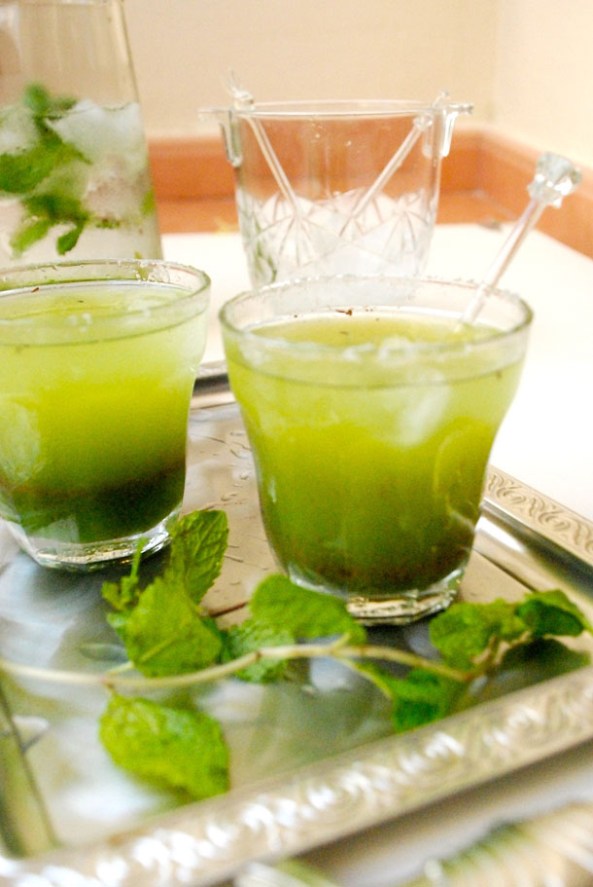
Frozen Aam Pana/Raw Mango Pulp Drink
Category – Drinks & Beverage; Cuisine type – Traditional Bengali, Indian
Following are the characteristics of all recipes doling out of our little hands, big hearth –
♥ Easy to cook
♥ Regular canned products off the shelf may be used (However, we advocate using fresh products)
♥ Goes well both as a regular or party dish
♥ Children can easily help in making the dish (My two little sous-chéfs are aged 8 and 3 years!)
♥ And lastly, guaranteed to be tasty!
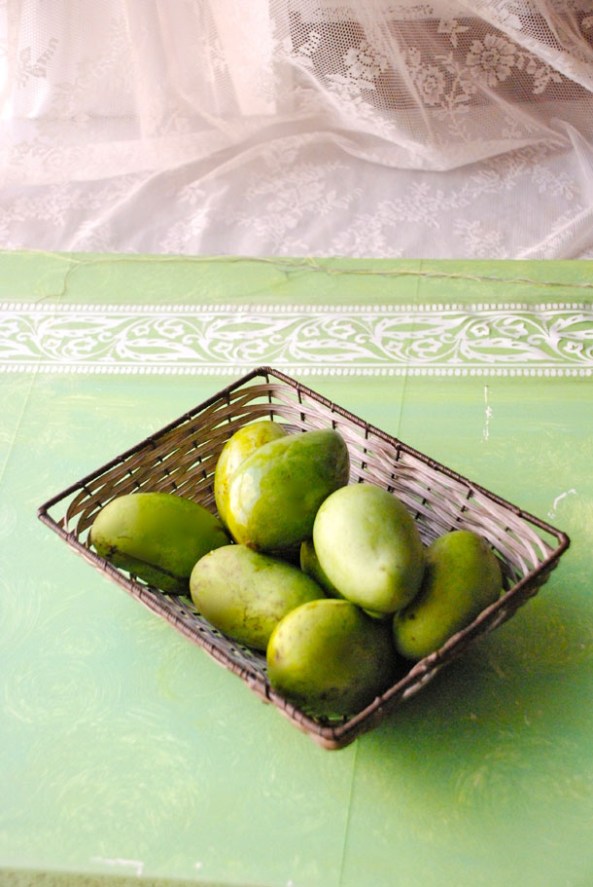
Aam Pana or Green Mango Drink is a great summer combat and is made in most regions in India. The Bengali Aam Pana is however a bit different in the sense that the green mangoes are first smoked (right below) and then the pulp is taken out. So while the taste of the mango is intact the smoky smell is strong and lends this drink an unusual charm. While in other places in India, the green mangoes are boiled and then pulped.
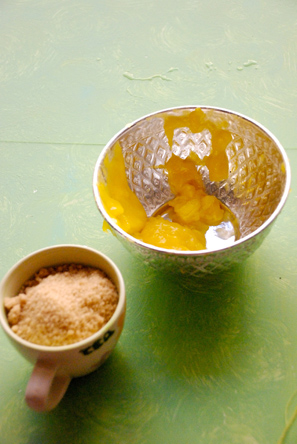
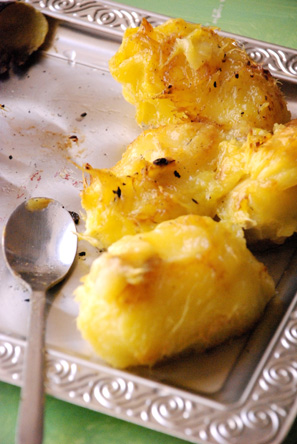
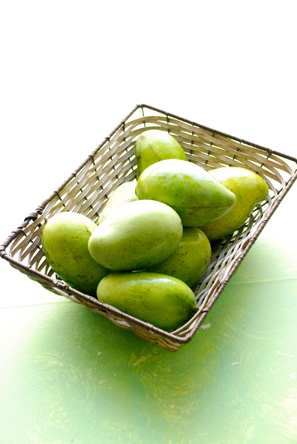
Serves 6-8 persons (maybe less if they happen to be sweet-toothed Bengalis!)
Preparation time – 2 hours 15 minutes maximum (Boiling/Smoking the Green Mangoes and then pulping – 15 minutes; freezing – 2 hours)
Ingredients
Kancha Aam/Green Mango – 4
Sugar – 1-1/2 cup or more (depends upon individual preference. Also see the alternative method of preparation – if you want to boil or grill the Green Mangoes)
Rock Salt – 1/2 tsp
Giner Powder – 1/2 tsp (there’s no Ginger in traditional Aam Pana. I like to add Ginger for it’s medicinal properties)
Bhaja Guro Moshla/Roasted Cumin Powder – 1/4 tsp*
Green Food Colouring – 1/2 tsp (You may avoid using this but then sadly the Green mango pulp is really not green at all even though we would like to believe that!)
For Garnishing
Mint Leaves
Roasted Cumin Powder – 1/4 tsp
Salt – A pinch
Method of Preparation
– Soak the Green Mangoes for a while and pat them dry. This will make sure that the sticky substance that oozes out from the Mangoes are gone
– Smoke the Green Mangoes evenly on all sides on fire. (Note: You may use barbecue coals as well. I use the normal burner on an Electric Cooker)
– Peel the skin off and scoop out the pulp from inside
– Purée the pulp in a blender with Sugar, Rocksalt, Roasted Cumin Powder
– Put it in an Ice-tray and freeze
Serving
– Pour the frozen Green Mango ice cubes into a jug of water
– Add the Mint leaves, Roasted Cumin Powder to the jug (the amount depends depends upon how strong or mild you prefer your Mint leaves to be. I prefer less of Mint leaves and more of Roasted Cumin Powder) and let the herbs soak in a while to infuse some aroma and it’s herbal benefits
– Initially the water turns out to be mildly flavoured but as the pulp melts the water soon catches the strong taste. Stir it before you serve
– Add ice cubes according to your preference – more if you want the water to be more sweet
– Wet the rim of the glass and sprinkle a bit of Salt before serving
Alternative Method of Preparation
– You may boil or grill the Green Mangoes too. You may add the ‘smoky’ smell by placing the pulp of the mangoes on a plate, setting a small piece of paper on fire on the same plate and covering the entire plate with an iron bowl. The amount of Sugar you want to add depends upon personal preference. Some like their Aam Pana/Green Mango Drink to be a bit sour, while others prefer it more sweet.
*Bhaja Guro Moshla/Roasted Spices
In a skillet or a flat bottomed frying pan, dry roast the Cumin Seeds. Constantly stir for a minute. Do make sure that the seeds are not burnt while it retains a fresh and strong aroma. Grind the roasted Cumin Seeds to a powder in a spice grinder (I use a coffee grinder) and keep in an air-tight container. This Bhaja Moshla/Roasted Masala is used to temper many Bengali (also Indian) dishes like Raita, different types of Chutneys etc.


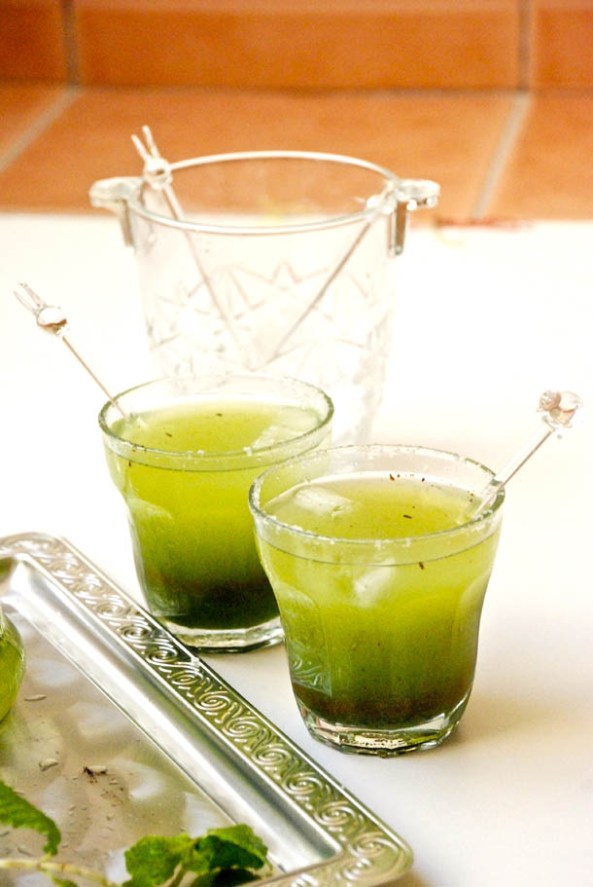
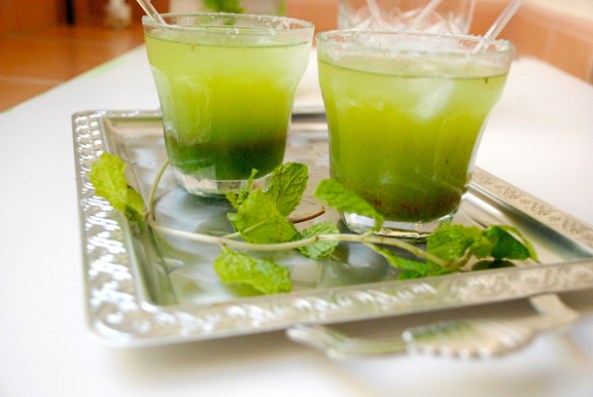
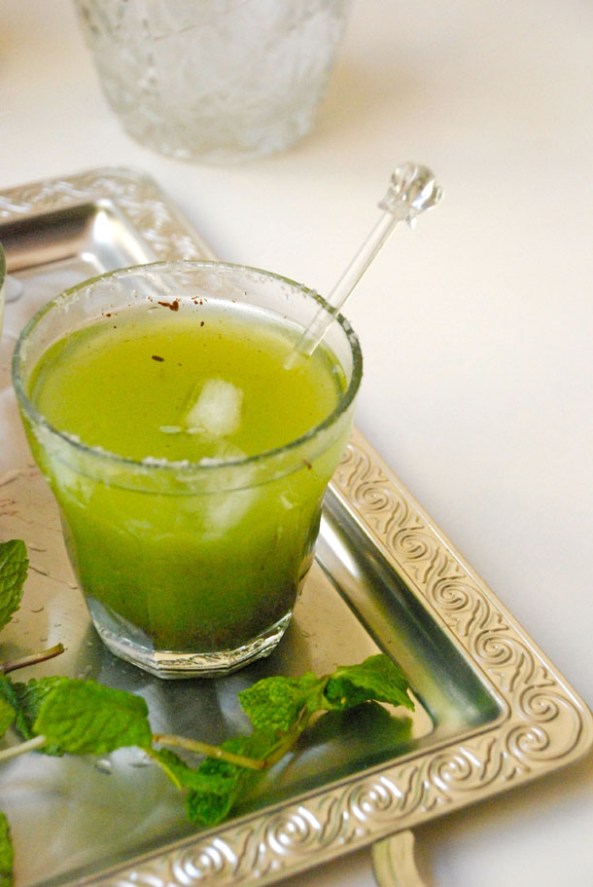
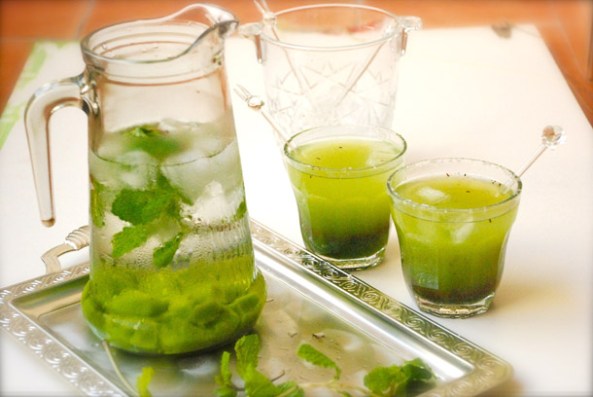

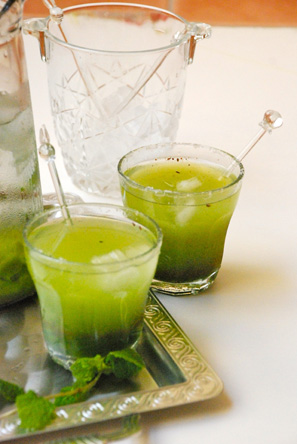
◊—————————————————————◊
Waste Can be Art
Inspiration comes from many things. Maybe a small idea or a big one. If you want to be inspired, you’ll be absorbing a spark from here, another spark from elsewhere and light up the entire self. The small inspiration from The Taste Initiative came in the form of freezing traditional ideas (the Green Mango pulp here) and serving them as House waters or a summer drink. The big inspiration came in the form of a huge art work on the wall – a collage of Steve Jobs looming on me till I realise that each stroke was some electrical waste that has been reused as art material. I am still reeling from it!
While more on lighting, illuminating your mind and spirits with Diwali being celebrated tomorrow, right now it’s the small ideas that are brightening up my mind and cooling my soul – frozen Aam Pana/Green Mango pulp!
Unblogging it all… Ishita
Disclaimer: I hope you enjoy reading the posts with lot of visuals. While you enjoy seeing them please don’t use them. You can see more pictures of my travel and food journey here.
◊—————————————————————◊
Some of my green posts that you may like reading:
Locavorism, Friday Market & Tok Palong/Sour Spinach Chutney
Machan Paradise View in Chitwan, Nepal
Heritance Tea Factory Hotel – Nuwara Eliya, Srilanka
Rafters Retreat in Kitulgala, SrilankaAl Maha Desert Resort, UAE
Down to Earth Organic
BE SOCIAL. SHARE THIS!

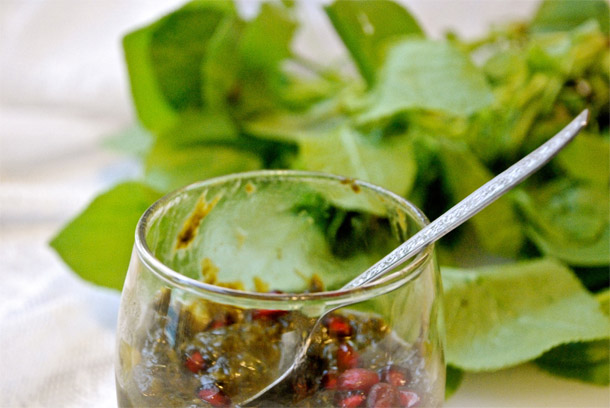
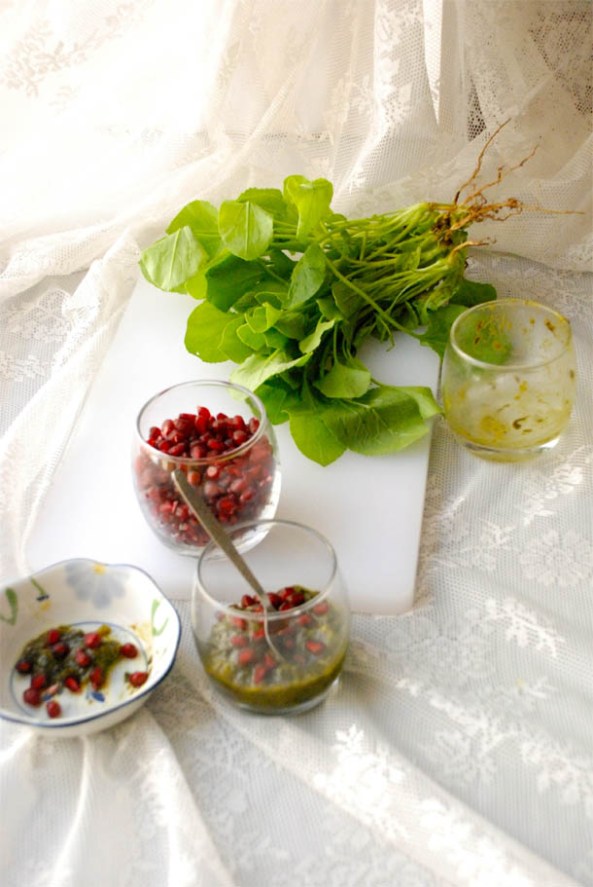
Tok Palong/Sour Spinach (above) is a variant of the leafy green Spinach that we are so familiar with. Resembling more like Baby Spinach, these leaves are sour even when they are uncooked. Absolutely new to me, my taste-buds are totally thrilled with this new discovery. And no, I haven’t seen these Spinach variant in any supermarkets in Dubai. I got them from the vegetable market that we always stop at when we head towards the East Coast of UAE – the Friday Market in Fujairah. One of our favourite drives away from the glitzy sky-scraper donned urban landscpae of Dubai is this Friday Market. Takes about an hour to drive to this market, this is a real charming market – looks real unlike the polished fruits and vegetables showcased in the air-conditioned supermarkets in the city. If there is some countryside that one can refer to in UAE, well it would probably be this – though the rocky terrain may not match up to the visual expectation of a verdant green European countryside or the rural landscape that I’ve grown up seeing in India. But, even barrenness has it’s own charm and has a ruggedness that is beautiful. And this is so evident once you hit out on the highways directing you to Dhaid.
Around the Dibba region in Fujairah, small fruit and vegetable kiosks flock the road sides. Dramatically perched on top of each other, the colourful fruits cry out a loud ‘Buy Me’! So should you? Well, of-course but only after you have haggled a bit and bargained further – for most prices that are thrown at your face are probably at a enormously marked up. But the experience is so different – that it’s worth all of it. UAE may boast of swanky and glitzy shopping malls, particularly Dubai. But choosing fresh, local produce from roadside kiosks in a natural landscape has it’s own charm. Doubting the freshness and getting a small slice of fruit to taste in return (aren’t I really mean?), haggling for prices, suspecting whether they are genuinely sourced from a local farm and ending up meeting and talking to the farmer himself – I can any-day swap my Dubai life for all these. Okay, let me re-phrase this – atleast over the weekends!
We’ve come across many novel ideas while stopping by these kiosks… there are stems or roots of some plant which act as great aphrodisiacs and sell at incredibly high prices. Tempted, yes – many a times. But given into the temptation? No, never. What if I go insane (more than the level that I am already at)? But once we reach the Friday Market, I give into my temptation. Not in terms of buying the aphrodisiac stems but in terms of loading our 4-WD with a week’s supply of fruits and vegetables!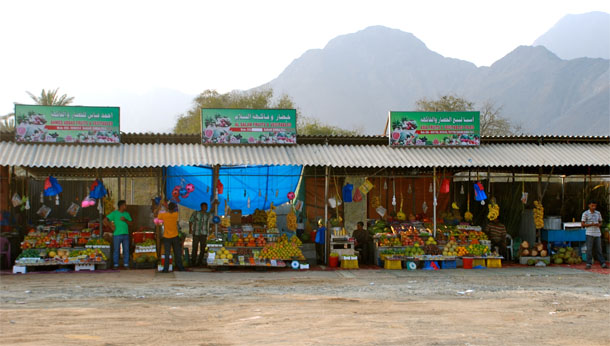
The Friday Market is located on the Dubai-Fujairah highway just before Masafi (not the new highway that has been inaugurated just a few days back which promises to bring Fujairah within an hour’s proximity to Dubai!). It’s open daily till late at night, so I wonder why the market started getting called as the Friday market? A web study on Fujairah writes that decades ago three Emirati farmers would come to the mosque and after Friday prayers they would unload their trucks and sell the produce from their farms at the roadside stalls. So originally catering only on Fridays, now you can walk into the Friday Market on any day of the week, almost at any hour – even during the lazy hot afternoons when you’ll find most of the attendees taking their afternoon siestas. Walk upto any one of them and wait for a while – they are brought back to their trading selves from their slumber – ‘What would you like to buy Madam?’ or ‘You want this watermelon – very nice, Madam’!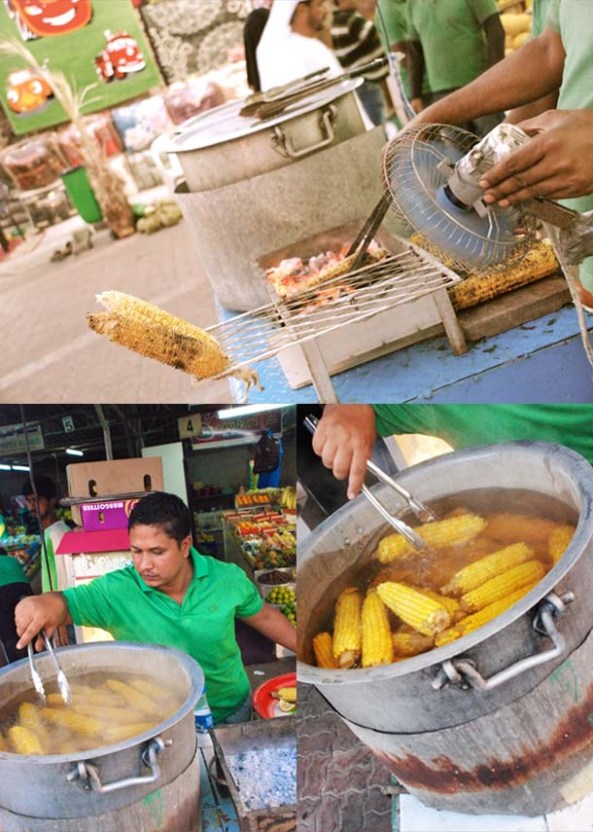
Our first call in the Friday Market is to have corn-on-the-cobs, the ones which have been boiled first and then char-grilled. A squeeze of lime and a dash of rocksalt or pepper and the corn-on-the-cobs are ready to be eaten. A small portable electric fan (above) peps up the fire in the char-coal laden make-shift aluminum oven. Ah what indigenous ways to cater to human needs! This reminds me of the corn-on-the-cobs that are sold on the roadside pavements in Kolkata (below). When we are in Kolkata on our summer vacations, corn-on-the-cobs from the lady who sits with her corns on the road pavement in the local market (GD Block market, Saltlake), becomes our daily dietary fiber intake! However, these corns take a bit too long to get prepared there – first the Unun/clay oven needs to fire up adequately, then the corns are set on the char-coals. A cue from the Friday Market that I most probably will lend the next time I am having corn-on-the-cob in Kolkata – pre-boiling the corns and then char-grilling it would save a lot of time and thereby cater to more customers!
The Z-Sisters love Corns. Whether they are on the cobs or they sit pretty in cups. Big Z very often is making her own Cuppa Corn. You may enjoy a post on that… dug from the archive from my earlier blogging days, cutely called Cuppa-Corn Sweet Yellow Moments!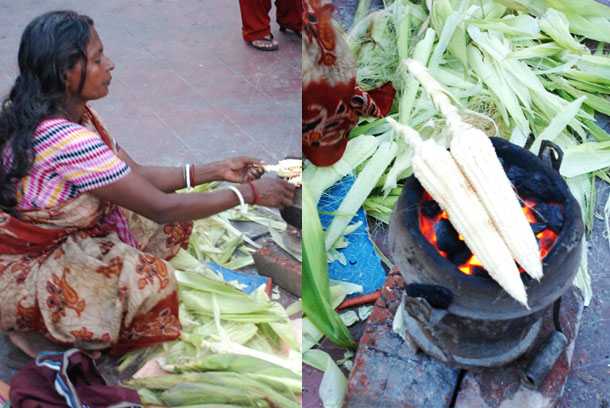
Many years back (around a decade!) when we used to visit the Friday Market, there was no electricity. Today, though it has changed a lot, the essence of the earlier days is still intact. Previously, the fruits and vegetable stalls were manned by local Emirati (Emirati is a person from the Emirates) farmers. But on our recent visits we haven’t seen much of them. Instead, now most of the stalls selling fruits and vegetables are looked after by Bangladeshis. The stalls look more organised, there are small labels jutting out declaring the prices of the products. And local brands selling fresh lime concentrate, date honey, fresh honey, palm syrups etc, seem to be sold in bottles. But the produce is usually fresh and declared to be locally grown. So, back to locavorism.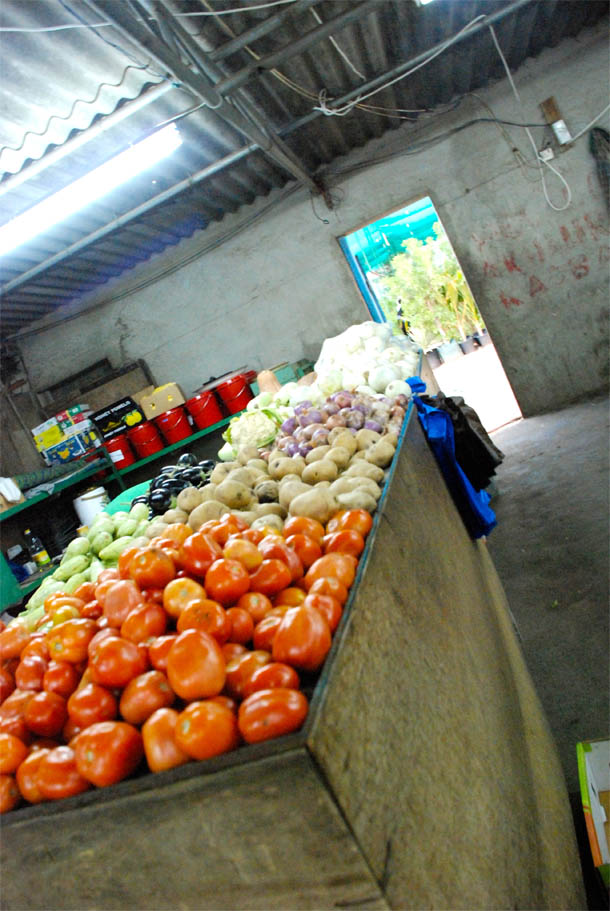
Locavorism
Locavorism is the buzz right now in UAE. It is definitely one of the hottest food trends in UAE right now. A subject that had been sitting half-written and hidden in one of the folders tugging in the hard-disc of my laptop, until a brilliant post from Chef and Steward on the Top food trends in Dubai & UAE made me start digging the folders. The recently concluded International Fine Food Festival which was held at Meydan also acted as a catalyst. This was one real food festival where one could meet the farmers selling local produce from UAE.
A Locavore is a person interested in eating food that is locally produced, not moved long distances to market… “local” food is food grown within 100 miles of its point of purchase or consumption…
Farmers’ markets play a role in efforts to eat what is local. Preserving food for those seasons when it is not available fresh from a local source is one approach some locavores include in their strategies. Living in a mild climate can make eating locally grown products very different from living where the winter is severe or where no rain falls during certain parts of the year. Those in the movement generally seek to keep use of fossil fuels to a minimum, thereby releasing less carbon dioxide into the air and preventing greater global warming. Keeping energy use down and using food grown in heated greenhouses locally would be in conflict with each other, so there are decisions to be made by those seeking to follow this lifestyle. Many approaches can be developed, and they vary by locale. Such foods as spices, chocolate, or coffee pose a challenge for some, so there are a variety of ways of adhering to the locavore ethic.
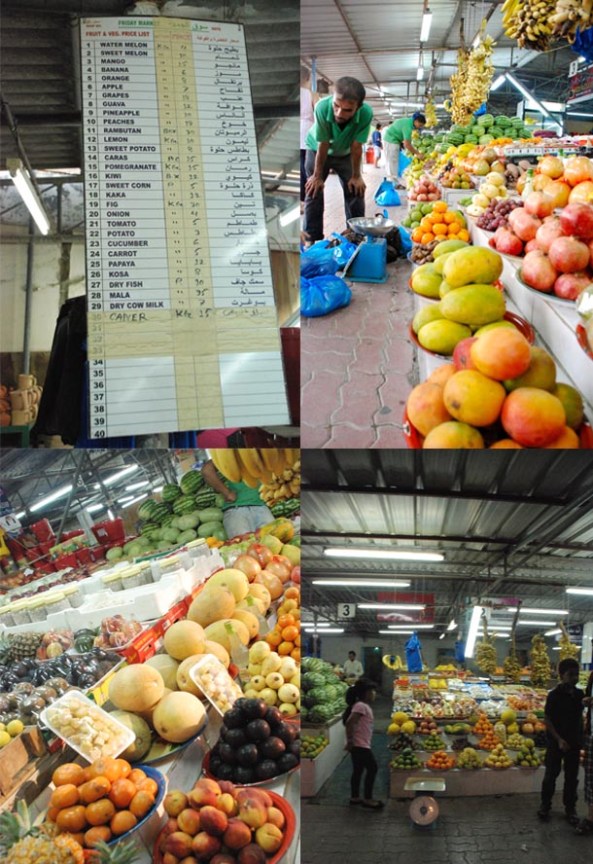
Though the Friday Market might not fulfill the criterion of Locavorism to the Tee, it does quite fit in, in it’s own way. If not from the UAE, a majority of produce is brought from the neighboring countries like Saudi Arabia, Oman etc. Given the geological soil condition of the UAE, most of it is non-cultivable land. But the area around Dibba-Masafi region seems to be pretty fertile and small patches of fenced green farms erupt once in a while amidst the barren rocky landscape. Engulfed by the high mountains and drenched by the nearby Wadis. Wadis are permanently or intermittently dry riverbeds which get filled up with occasional bursts of rainfall. The high rainfall in this area (!) makes this region a natural oasis and helps in a good production of crops. In-fact, the geology of this region is very unique.
The UAE-Oman mountain zone comprises an unusual suite of oceanic rocks that are rarely found on the continental surfaces of the Earth. These rocks (lavas, oozes and oceanic crustal rocks) are believed to have formed at the site of a mid-oceanic ridge (where the Indian Ocean now lies) more than 70 million years ago. It’s really interesting and you may read more on it here.
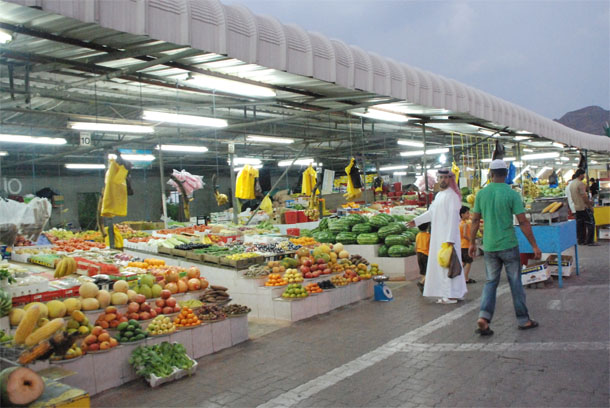
Most of the times we buy fresh seasonal fruits, specially mangoes, guavas and watermelons and a whole lot of leafy vegetables – Baby Spinach, Red Spinach, Spinach etc. Mausambis/Sweet lemons are unavailable in most supermarkets in Dubai. Only on a few occasions I’ve found them in the Karama Fruit & Vegetables market. You get them here aplenty. Are they locally sourced? Almost. From Oman. I have grown up having fresh Mausambi Juice every day in the morning during my school days, so I load a whole lot of these into the car trunk along with tender green Coconuts. You might also sip into the cool coconut water with a modern straw as the coconuts are taken out from chillers meant to chill beverages! I am totally sold on the ideas as you must have already found out and a few tender coconuts get into the car trunk as well. At Dhs 5/piece. Only to find the next day at Lulu Hypermarket in Dubai that the same are being sold at Dhs 3.50/piece!
This post was initially intended to be a food post and not a travel post, hence I wouldn’t go into the Afghani and Pakistani stalls selling carpets and rugs – from sizes varying from a doormat to the ones which can probably cover up our entire apartment! Designs – the modern geometric ones to traditional Persian ones don these carpets. So does the Taj Mahal or the Burj Khalifa. Or for that matter the faces of Their Highnesses – the Sheikhs of the ruling families of UAE! Most of the carpets that we use have been bought from the Friday Market, almost a decade back. Those were the days when we would end up buying multiples of the same product – the sudden availability of easy cash for the two of us – the DINKs (Double Earning No Kids)!
I don’t remember that the last few visits to the Friday Market has landed us in any financial debt, apart from the perpetual craving and the occasional lament – We should have crossed the road and dug our fingers into some potentially nostalgic Bengali food in the Bangladeshi Hotel! 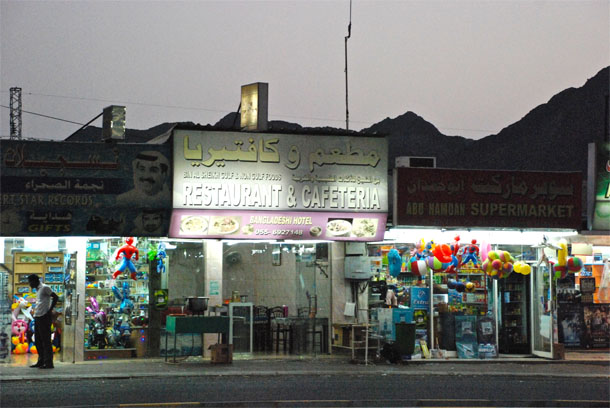
This is one trip that we are bound to make every now and then. So hopefully in one of our future trips we shall definitely get the chance to fulfill our wishes. But yes, more on our East coast journey will continue in some future posts as this region still holds an age-old charm that has ceased to exist in most rapidly developing urban areas. The concept has definitely become a fossil in Dubai. Do watch this small video from Gulf News to lure you more. The video is dated 4 years back, but not much has changed since then. It still is a bustling, charming, small hidden gem, contributing in it’s own small way to Locavorism in the UAE.
◊————————————————–◊
Chutneys
Sweets are a necessary sign-off for a traditional Bengali meal. The Bengali Chutney slightly differs from the other Indian Chutneys in the sense that they are not eaten as dips with snacks and savouries but as a mini sweet sign-off before the actual desserts. Chutneys have several variations. You end your meal with Chutney. Chutney is a sweet, tangy paste and can be made with every conceivable fruit and even vegetables! For example – Aam/mangoes, Jalpai/Olives, tomatoes, Anarosh/pineapple, Tetul/tamarind, Pépé/papaya and various other type of fruits. Dry fruits like Khejur/dates, Kishmish/raisins may also be added to it the Chutney which is also splashed with Phoron/Mustard seeds cooked slightly in oil or Paanch-Phoron/5 seeds cooked in oil).
Papad/Big chips like flakes made up of Potatos or Dried Dal usually accompanies the Chutney. After the Chutney comes the formal dessert tasting!
Shown below are Khejur aar Tomator Chutney/Tomato-Date Chutney (left) and Paanch-Phoron/Unique Bengali 5 Spice-Mix (right)
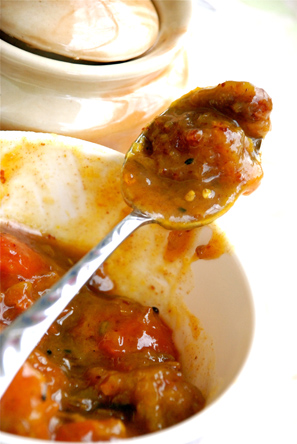
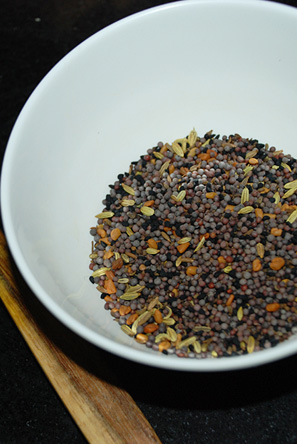
◊————————————————–◊
Tok Palong Chutney/Sour Spinach Chutney
Category – Dips & Chutneys; Cuisine type – Traditional Bengali, Bangladeshi
Following are the characteristics of all recipes doling out of our little hands, big hearth –
♥ Easy to cook
♥ Regular canned products off the shelf may be used (However, we advocate using fresh products)
♥ Goes well both as a regular or party dish
♥ Children can easily help in making the dish (My two little sous-chéfs are aged 8 and 3 years!)
♥ And lastly, guaranteed to be tasty!
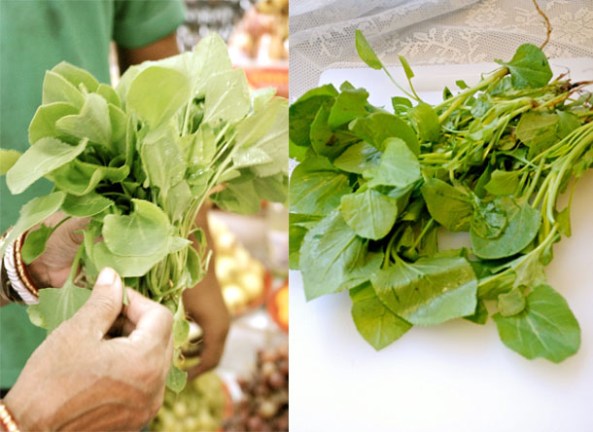
We got a bunch of Tok Palong/Sour Spinach on our recent visit to the Friday Market. Had I come across these leaves on a routine vegetable shopping I would probably have not picked them up only because I do not know how to use them or have never had them before. But my Aunty who’s visiting us from India is cooking up a whole lot of traditional Bengali cooking that even I have not grown up eating. The reason being that though I’ve grown up eating Bengali food, each Bengali household has it’s own spice variations and unique tempering. Cooking style differs between regions within Bengal. Also, it differs within families whose ancestral lineage hails from Bangladesh which before Partition was a part of the Bengal province of the Indian sub-continent.
My Aunt’s ancestors hail from Faridpur district in Bangladesh and I am capturing all these dishes, some of them can be termed as Heritage Dishes that I haven’t even known of when I had gathered everything that I could on a post that is probably one of the most popular posts of mine – Traditional Bengali Cuisine! Generally, Spinach is thought to have originated in ancient Persia (modern Iran and neighboring countries). Arab traders carried spinach into India, and then the plant was introduced into ancient China. Probably, writing on Spinach is the most natural thing to do sitting on an Arab land. These Sour Spinach (Rumex Vesicarious) are a variant of the commonly used Spinach and grows without much effort in many regions in Bangladesh and is readily available in local vegetable markets in Kolkata. The latter fact took me pretty much by surprise as I tasted these for the first time. I learnt from Aunt says that apart from cooking them in Chutneys the leaves can also be put into Dals/Lentil Soups so as to make another variation of the Bengali Toker Dal/Sour Dal that is so popular in Bengal. Also, as many as 150 plants are used as greens by the women in rural Bengal!
A small video (below, 2:39 minutes onwards) reveals that this Tok Palong/Sour Spinach, also known as Khatta Palak in Hindi) is amongst a few unconventional crops which are ignored in conventional industrial agriculture in the subcontinent. These are nutritious and do not require extra care for its growth. Some farmers are trying to conserve them through cultivation while conserving the crop biodiversity.
Spinach by itself has a high nutritional value and is extremely rich in antioxidants, especially when fresh, steamed, or quickly boiled. It’s also a rich source for Iron. You may read all about it here. Also, a favourite with most children, kind courtesy of Popeye the Sailor!
Serves 6-8 persons (maybe less if they happen to be sweet-toothed Bengalis!)
Preparation time – 20 minutes maximum (Boiling the Sour Spinach – 10 minutes; tempering and garnish – 10 minutes)
Ingredients
Tok Palong/Sour Spinach– 200g
Sugar – 1/2 cup (depends upon individual preference. Also see the alternative method of preparation – the healthier option*)
Salt – 1/2 tsp
Turmeric – 1/2 tsp
Mustard Seed – 1/2 tsp
Mustard Oil – 1 tsp
Pomegranate – 1/4 cup, for garnishing (non-traditional addition)
Method of Preparation
– Separate the green leaves from the roots
– Wash the leaves properly and drain the water
– Chop the green leaves into small pieces
– Heat the Oil in a small wok. Add the Mustard Seeds and let them splutter
– Add the green leaves, Sugar, Salt, Turmeric Powder
– Cover the pan with a lid and let it simmer for a while till the leaves become soft and turns into a paste
– Serve it chilled with a bit of Pomegranate garnish
* Alternative Method of Preparation
– You may Boil/Microwave the Tok Palong/Sour Spinach leaves and draining the sour water before. This will require less Sugar. However, the amount of Sugar you want to add depends upon personal preference. Some like their Chutneys to be a bit sour, while others prefer it more sweet.
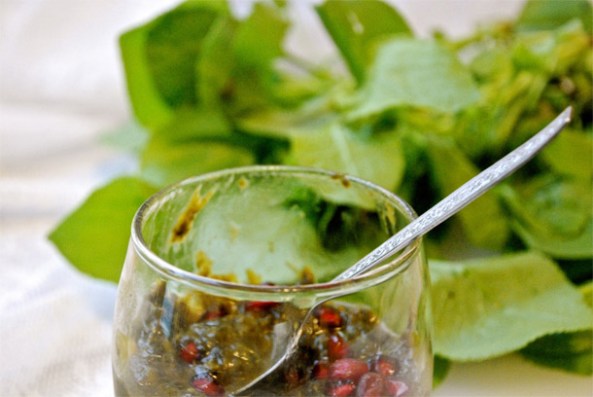
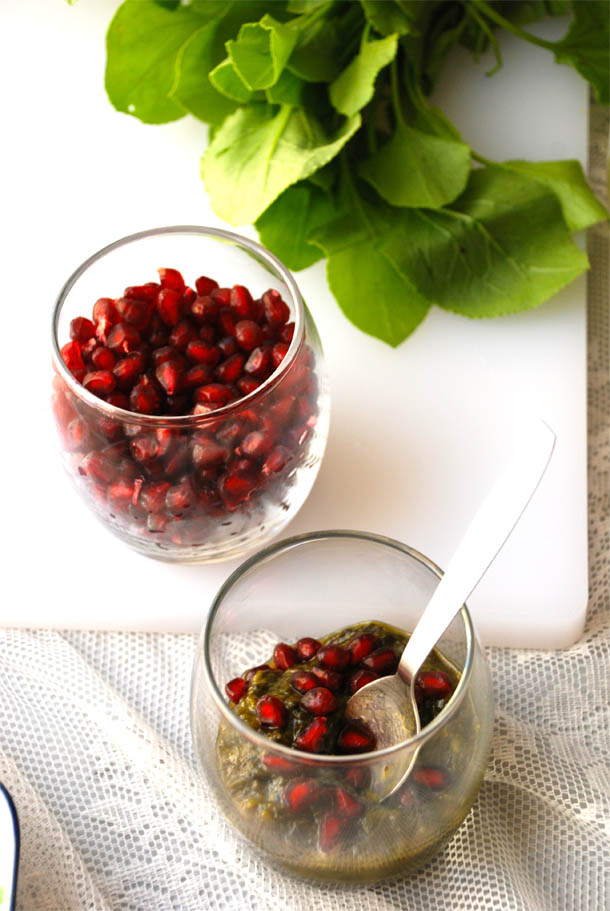
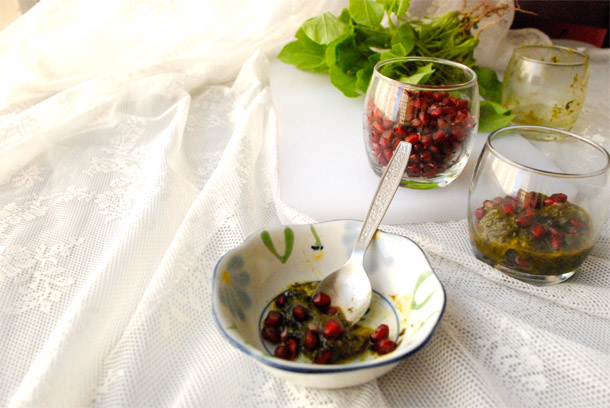
◊—————————————————————◊
Is Locavorism same as Organic? The essence of IFFF
Locavorism doesn’t imply going Organic. It simply implies local produce being sold locally which can lead to sustainability. Which leads to the question – how far can UAE adhere to Locavorism when the climatic or the geographic conditions do not help a lot of times? Or, where different nationalities have different ethnic requirements which must necessarily be air-freighted from the respective home countries? Can Salmon be farmed in the UAE waters? Do we stop eating Salmon? Well, the answer is No, we don’t have to take such drastic measures. But yes, Salmons can be flown in and smoked here and make it as much sustainable as possible.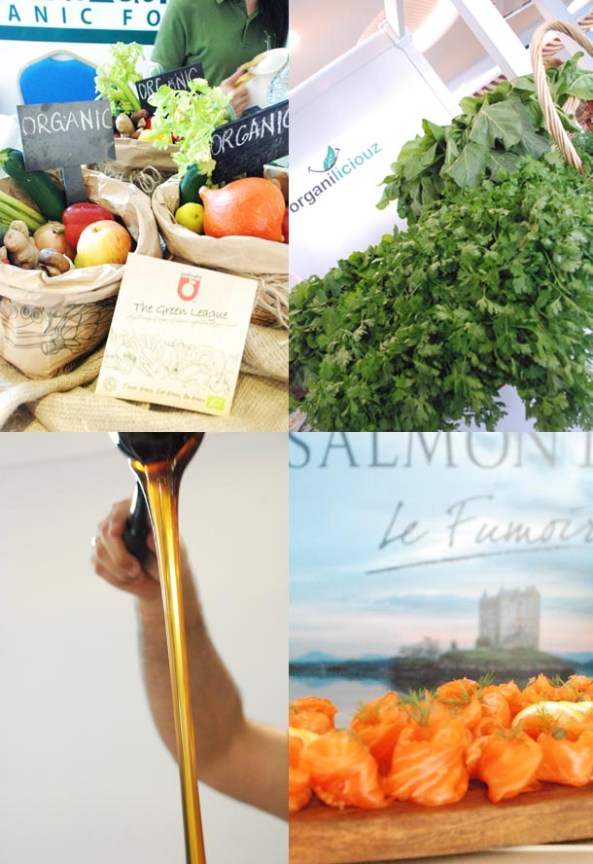
The International Fine Food Festival (IFFF) which was held recently at Meydan provided a platform for many such sustainable concepts. Here, one could meet the local farmers or come in touch with those who are providing an alternative solution to the UAE’s burgeoning sustainable future. Organiliciouz (@Organiliciouz) a local farm run by an Emirati family produces wide range of fresh, locally-grown, organic vegetables to different supermarkets, hypermarket and co-operative societies stores as well as restaurants and markets. They also supply directly to the customer through the farmers’ markets held by Baker and Spice in Souk Al Bahar and the Marina. I’m looking forward to visiting their farms one of these days. Organiliciouz has also started supplying to Down to Earth Organic (@DownToEarthDxb), another organic store in Dubai which till now didn’t sell fresh produce. Barakat (@BarakatME) too has been selling fresh fruits and vegetables and supplying fresh juices to supermarkets and restaurant. A visit to their factory is also in my cards soon. Ripe is another company with an aim to promote healthy eating amongst UAE residents by providing easy access to fresh, organic produce by supporting local farms and promoting local agriculture. All the above are instances where
Meeting the people propelling Organiliciouz, Down To Earth and Barakat, ransacking some gourmet products (@chezcharlesuae, @gourmetpoint), tasting the world’s most expensive honey – the Yemeni Sidr Honey from Balqees Honey (@BalqeesHoney), learning about Scottish Salmons (@salmontini) being smoked all the way here in UAE… a lot of interesting concepts came under one roof at the IFFF… some of them sustainable and encouraging Locavorism.
Starting off with Sour Spinach, travelling to the Friday Market in Fujairah, touching upon hot food trends like Locavorism – all in one post could be a bit overwhelming. But that is the whole essence of being a responsible food blogger. And where do you cut off one subject from the other? Food, travel, local issues – everything seems to be inter linked. Sally’s blog My Custard Pie talks about honest food and fresh ingredients. Francine in her Life in a Food Lane is writing about all the experiences she’s gaining in Slow Food as she travels.
Dubai too has woken up to realise that sustainability is the key to long-term growth. Lot of positive developments are taking place in sustainability – not only agriculture but energy, water, lifestyle and also waste management. A few days back, The World Energy Forum concluded in Dubai where world leaders had gathered with the goal of creating a roadmap towards safe and sustainable energy accessible to all.
The Change Initiative, Dubai’s first sustainable store has just opened its doors with many novel concepts that may inspire people to integrate sustainability into their day-to-day lives. While attending the preview of it’s Café & restaurant, a whole lot of ideas deluged my mind which we could incorporate easily at home. More on that on a future post.
Many of these issues are interlinked and inseparable. But pervades our daily lives. Just like the Chutney and my relationship. It pervades my daily life, boosting my emotions and moods at random. I am left licking my finger for the invisible last drop of Chutney, yearning for more!
Unblogging it all… Ishita
Disclaimer: I hope you enjoy reading the posts with lot of visuals. While you enjoy seeing them please don’t use them. You can see more pictures of my travel and food journey here.
◊—————————————————————◊
Some of my green posts that you may like reading:
Machan Paradise View in Chitwan, Nepal
Heritance Tea Factory Hotel – Nuwara Eliya, Srilanka
Rafters Retreat in Kitulgala, SrilankaAl Maha Desert Resort, UAE
Down to Earth Organic
BE SOCIAL. SHARE THIS!



Yes, my blog turns one! A big milestone indeed. A few posts down the line, a few blogging ‘good’ friends made down the way, a whole lot of unexpected blog love from all of you… Thank You very much indeed! A Romantic Dinner for two awaits a lucky couple at OPTIONS by Sanjeev Kapoor, featuring the signature dishes of Indian Master Chef Sanjeev Kapoor.
RANNAGHAR, Bengali Food Festival at OPTIONS
A la-carte Bengali menu is being offered alongside the Eid Specials, till 2nd November, 2012
Each month a special food festival is celebrated at OPTIONS. Currently, the restaurant is celebrating the Bengali Food Festival to coincide with the Bengalis’ biggest festival – the Durga Puja. Though the actual celebrations just got over, the restaurant has extended the Bengali Food Festival, overwhelmed by its popularity and demand! The Bengali menu will be offered alongside the Eid Specials, till 2nd November. Lot of thought and detailing has gone into making the special Menu Cards associated with each festival that the restaurant celebrates. The Bengali Menu Card touches the right emotional chord – Black & White pictures of all Bengali legendary icons – Rabindranath Tagore, Netaji Subhas Chandra Bose and even Uttam-Suchitra accompanies some of the quintessential Bengali food that are on offer. But a brilliantly designed Menu Card and a luxurious romantic chandelier lit decor apart, how authentic was the food?
Growing up eating Bengali food cooked by different Didas/Maternal Grandmas & Thakumas/Paternal Grandmas (my own and others’), Mums (my own and again others’), Mashis/Aunties and a few Bengali Uncles – I have realised that judging authenticity is practically an Utopian concept. Each household has it’s own spice variation and unique tempering. Cooking style differs between regions within Bengal. Also, it differs within families whose ancestral lineage hails from Bangladesh which before Partition was a part of the Bengal province of the Indian sub-continent. So what is the hallmark of authenticity?
I think as long as it tugs at the nostalgic Bengali tastebud and confirms to a broad spectrum, small misses here and there can be overlooked. After all the subject – Traditional Bengali Cuisine, is absolutely vast.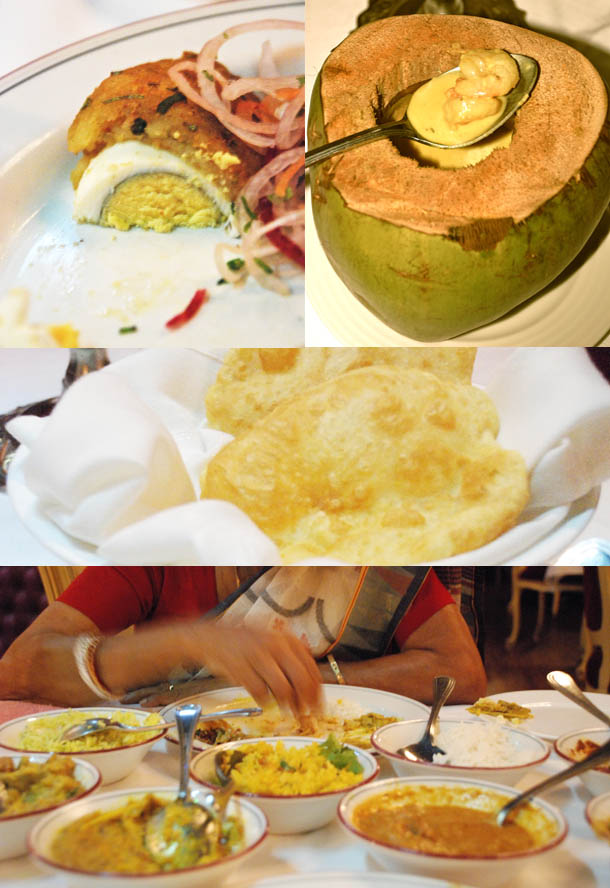
Starters: you get a choice of popular Bengali Snacks, served essentially in a Bengali home if you land unexpectedly at an odd time apart from meal times – the Vegetarian Starters being Rokomari Pakora/Assorted vegetables fried in Batter, Singara/Samosa, Shobjir Chop/Vegetable Chop, Pyaazi/Onion fritters, Begun Bhaja/Fired slices of Eggplant while the Non-Vegetarian Starters being Deemer Pakora/Egg Chops, Chingri Macher Cutlet/Prawn Cutlet, Mangsher Chop/Mutton Chop. It is however a different matter altogether that nowadays nobody lands up in anybody’s home unexpected – so all these simple and unexpected snacks have had to get into a luxurious Menu Card in an elegant restaurant!
The verdict – the Deemer Pakora was fabulous tasting like the usual Egg Chops sold in road side kiosks in Kolkata or inside the Movie hall and is popularly known as the Deemer Devil. The sliced onions, carrots & the Beet roots accompanying the Salad with a bit of Salt & Lemon juice tasted as authentic as those available in Kolkata! No complaints about the Chingrir Cutlet and Mangsher Chop that we tried, but Deemer Devil was the clear winner.
The Rokomari Bhaja – Can anybody ever go wrong with fritters? Perhaps not. And a bit of addition here and there, for example, the Green Chilli fritters… perhaps to suit a wider Indian palate.
Vegetarian side-dish: It requires a lot of courage to offer Shukto, a traditional bitter vegetable preparation in the menu. This is a very very unique and traditional Bengali offering, had at the beginning of the meal. Gota Shedho/Steamed Whole Vegetables is another very traditional dish cooked generally the day after the Saraswati Pujo. Chaana Bhapa Shorshe/Steamed Mustard Paneer, Methi Phulkopi/Fenugreek Cauliflower, Aloor Dum/Potato and many other choices are available for Vegetarian diners.
Non-Vegetarian side-dish: Daab Chingri/Prawn in tender green Coconut, Lau Chingri/Calabash & Prawns, Doi Maach/Yogurt Fish, Shorshe Bata Maach/Mustard Fish, Murgir Jhol/Chicken Curry, Kasha Mangsho/Mutton Kassa… the choice of the Menu is pretty perfect.
The verdict – Shukto is a teaser. It requires an elaborate preparation process. Plus Posto/Poppy Seeds is an essential ingredient in Shukto which is banned in Dubai for it’s addictive properties. Yet, the Shukto tasted as authentic as it can get – cooked by Bengali Mums in traditional Bengali homes. This is a feat by itself!
We absolutely loved the Daab Chingri. Though the sizes of the prawns are an eternal subject of debate – you can never ever be too thin, too rich or your size of the prawns too big!
Shorshe Bata Maach… you can order the very famous Ilish Maach/Hilsa Fish cooked in this style or Hamour. We tried both. For those uninitiated to Hilsa, this can be really bony. Many restaurants in Kolkata have perfected the art of preparing bone-less Hilsas. A gentle suggestion here requesting the Chef to learn the technique so that many diners who are curious about the Hilsa can try this. Did we like our Hilsa? We did like the preparation but not the taste of the Hilsa by itself. But then, that is a issue of debate worldwide regarding Hilsa this year.
‘Special mention has to be made to the Hilsa fish. The Hilsa is synonymous with Bengal and is considered the ‘queen’ of all Bengali fish. Hilsa is also of political importance. It is a serious bone of contention between India and it’s neighbouring country Bangladesh. Which Hilsa is better – the Hilsa that is found in the Padma river in Bangladesh or the Ganga river, the last phase of which flows through Bengal before it merges into the sea-waters of Bay of Bengal? The entire month of July and August, that is during the Monsoons, Kolkata is gripped by Hilsa. Hilsa festivals and special Hilsa lunches are organised in different clubs and hotels. Each conversation revolves around Hilsa. This year had been hard-hitting for the Hilsas with the prices shooting upto as high as Rs 1,500/kg (Dhs 100/- approximately!). The fish markets in Kolkata are in itself a subject for immense discussion – perhaps better kept for another future post. The bony Hilsa is a delicacy and is prepared traditionally in many ways – the Shorshe Baata/Mustard Hilsa, Kalo Jeerar Jhol/Black Cumin Curry, Bhapa/Steamed etc.’
We did not find the Kasha Mangsho to be very authentic. But then Chef Kuldeep Raturi had his own justification – this was his version where he had added some of his own elements. Definitely tasty, but not as the ‘Bengali’ Kasha Mangsho.
The Chingrir Polao/Prawn Polao was very good but wasn’t impressed with the Bhuna Khichuri… but then it could be my mindset – I am so much into Bhoger Khichuri/Khichuri that is traditionally cooked during the festivals that any other Khichuri pales in comparison!
BTW, you can also order Luchis/Deep-fried flatbread made of flour. However it’s not mentioned in the Menu Card.
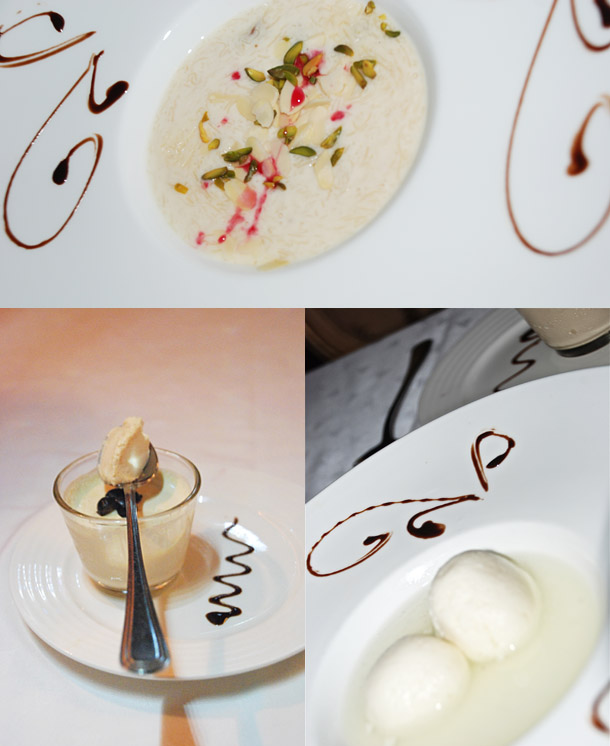
Sweets: Sweets are a necessary sign-off for a Bengali meal and here, all the right boxes are ticked, all the nostalgic sweet pores are clogged out and emotions are carried back home. Bengali Sweets can be mind-boggling and the array can really make a sweet-lover go astray. You have a whole industry and artisans (if I may call so) who are engaged in sweet making. So it’s not expected that you’ll be having a huge variety of Bengali Desserts on offer. But what you have is, I would describe it as a limited version of classic Bengali Sweets – Mishti Doi/Sweet Yogurt, Roshogolla/Rasgulla, Pati Shapta/Sweet wraps, Semaiya Kheer/Vermicelli Pudding… Incidentally, my last post was on Semaiya Kheer, a sweet dessert traditionally had during the Eid.
The verdict – To be honest, the Rasgullas are really one of the best Rasgullas that I have ever tried so far. Very very soft and soaked deliciously in the sugar syrup. And the presentation has been inspiring me ever since! Misti Doi was also very good – perfectly set and not too sweet and strikes definitely a very high score in the Bengali Sweetness tasto-meter! I personally didn’t try the Semaiya Kheer, but my companion loved it. Pati Shapta was missing on both days that we visited. And unfortunately, Mishti Doi was not there on our second day – a proof that the Bengali Sweets must have tasted quite a ‘sweet’ success!
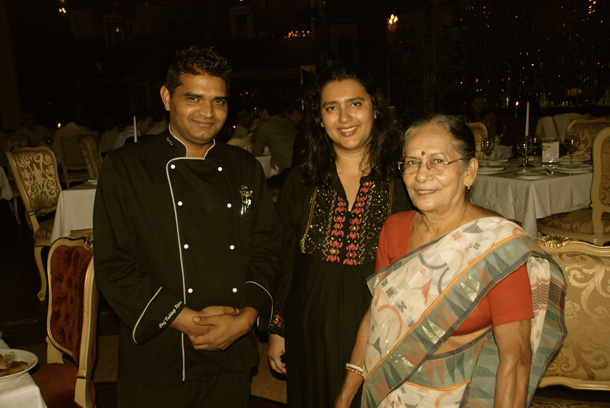
The Sign-off verdict – We landed up for the Bengali Food Festival on two occasions. On our first day we tried out a whole lot of things from the Menu. My Aunty who’s visiting us from Kolkata accompanied me. I thought she would be a better critique, being a traditional Bengali cooking Bengali food in a very traditional way. She enjoyed her meal. The fact that there’s not a single Bengali staff in the kitchen and yet they have managed to cook up quite a lot of Bengali dishes, a few of them with great success – is really commendable. If they can cook up Shukto as authentic as this, they can learn to cook up everything Bengali in the most authentic way.
A little suggestion is to add some ‘Chutney’ in the Menu. The Bengali Chutney slightly differs from the other Indian Chutneys in the sense that they are not eaten as dips with snacks and savouries but as a mini sweet sign-off before the actual desserts. Chutneys have several variations.
Dubai doesn’t have many places where you can get to taste a Bengali meal. It’s definitely worth a visit if you have never tasted Bengali food. And if you are hell bent on being a traditionalista, I’m sure the Deemer Chop, Shukto, Daab Chingri, Murgir Jhol will be scoring high marks. And if everything fails, then the Rasgullas are definitely worth the visit!
◊————————————————–◊
Don’t miss out the special Diwali Menu that is going to be celebrated in OPTIONS from 8th November till the 23rd November. A small peep into the incredibly delicious menu that Chef Raturi has prepared and that really caught my fancy…
In Mocktails…Bhustrina Lassi/Chilled yogurt blended with flavored lemongrass! Or say, Kiwi Ka Panna/Refreshing kiwi drink with a spicy twist!!! In Appetizers… Gosht Ka Dahi Vada/Mutton balls are dipped in sour yogurt, black salt and liberally doused with tangy-sweet tamarind chutney… Non Vegetarian Starters… Tulsi Patte Ka Lobster/King Lobster marinated in holly basil Leaves and fragrant Indian herbs, cooked in Charcoal Tandoor or the Jhinge Ki Galouti/Pan fried prawns patties, mixed with aromatic Indian spices, and served on ulte tawe ka paratha! In Vegetarian Starters… Palak Anjeer Ke Kebab/Minced spinach patties stuffed with figs, cooked over hot grill! Or the Nadru Shammi Kebab/A Kebab made from lotus root and odoriferous herbs cooked over hot tawa! In Desserts… Blueberry Kulfi/Creamy blueberry kulfi, served on bed of falooda dazzled with almond flacks!
◊————————————————–◊
‘A man with a dream will not be denied,’– a famous saying that Sanjeev Kapoor, the celebrity Indian Mega Chef abides by. He’s one man who has single-handedly changed many mindsets (specially in India and the subcontinent) into now considering the Chef’s profession as a very sought-after profession. I really appreciate his vision and his dream of ‘making Indian cuisine the number one in the world and empowering Indian women to become self-sufficient through the power of cooking’… as taken from an excerpt of FooDiva’s. Further insight into this man from Dubai Guzzler.
Options by Sanjeev Kapoor
Award winning Family restaurant; Fully licensed; Free Valet Parking
Opening Hours: 12pm – 11:45pm daily
Location: Ground Floor, Convention Tower, Dubai World Trade Centre;
Tel: +971 4 3293293/4; Or, you can visit their Facebook Page and Website

This is my first giveaway as my blog celebrates one year! One lucky couple gets a Romantic Dinner Giveaway from OPTIONS by Sanjeev Kapoor.
Click here for the blog Giveaway
The competition closes midnight 15th November, 2012 (UAE time). Though this giveaway is only for those who can avail of the dinner giveaway in UAE, I am planning the next giveaway for all the readers who have been reading my blog, irrespective of all geographical glitches. Don’t forget to leave your comments as well… I’ll be putting them in the draw-list for my next giveaway.
One year… not a very long journey. But definitely a very momentous one with all your love. Looking forward to many more years of celebration.
Unblogging it all… Ishita
◊————————————————–◊
Disclaimer: We visited OPTIONS on two occasions. On the first occasion, I had been a guest – the Bengali food blogger, very generously hosted by OPTIONS. The second occasion was an independent visit. The opinions regarding both the visits are my own and are independent of the dinner giveaway from the Restaurant. I hope you enjoy reading the posts with lot of visuals. While you enjoy seeing them please don’t use them. You can see more pictures of my travel and food journey here.
BE SOCIAL. SHARE THIS!

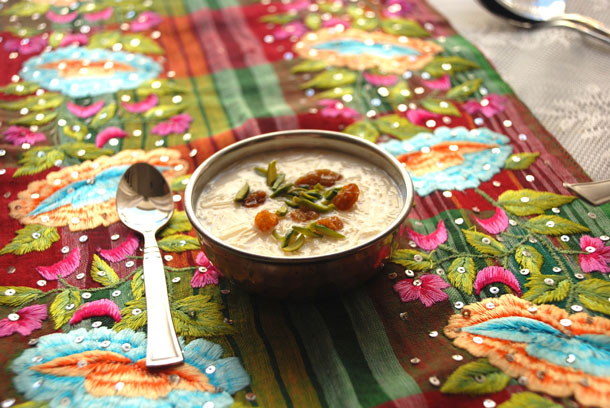
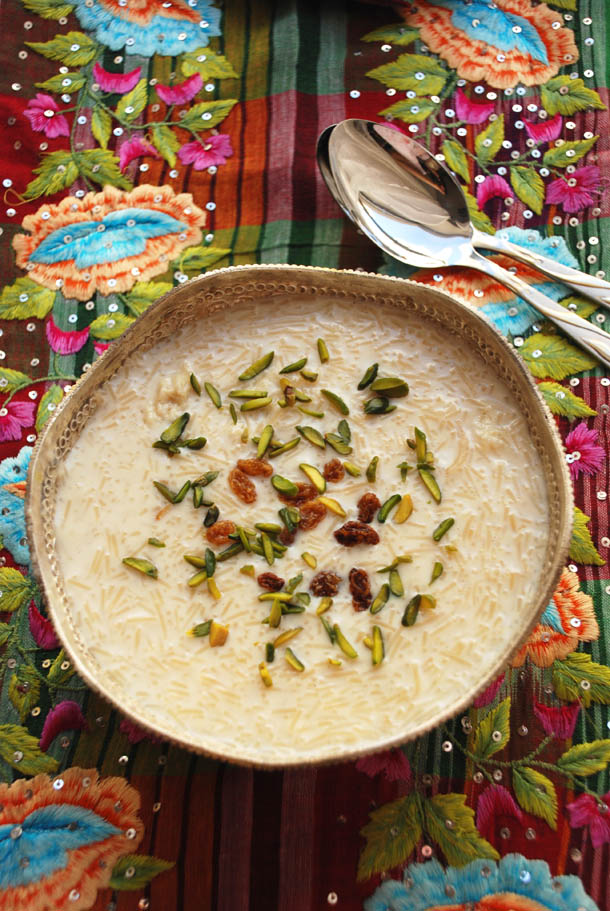
Eid Mubarak to all of you! Festivities bring in lots of varied emotions – emotions of togetherness, memories of childhood and hope for the future. Nothing like being in a city like Dubai, where people from all over the world call them their homes, while the city prepares to celebrate their biggest festival Eid. Incidentally the word Eid means ‘festivity’ in Arabic. And here we are, in the city of bling, readying ourselves to welcome 2 million expected visitors over this weekend!
Childhood memories of Eid brings in the sweet taste of Semaiya Kheer/Vermicelli Pudding, also called Shemaiyer Payesh (above) in Bengali. Payesh or Pudding has a lot of meaning in a Bengali’s life, specially the Rice Pudding. It is the first initiation of solid food as an infant gets ready to embark on his/her momentous non-milk food journey… a journey that I’ve already in earlier posts – Tarditional Bengali Cuisine, Notun Gurer Payesh/Traditional Bengali Rice Pudding. The introduction of Semaiya to the Bengali Cuisine has been organic in nature and this Islamic influence can be traced back to a little history… In 1857 AD after the Awadh kingdom (modern day Lucknow in India) was annexed by the British, the Nawab was exiled to Calcutta (today’s Kolkata). His passion for gourmet food traveled from Lucknow to Calcutta and was nurtured, garnished and fuelled by his special Bawarchis or the Chefs of the Nawab.

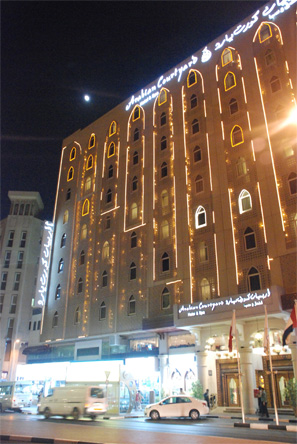
Eid in Dubai
With 2 million tourists expected over the this Eid weekend, Dubai is bulging. Cultural programs, various events, special Eid menu in different restaurants – the weekend promises to a whole lot of fun. Leading shopping malls are going to remain open 24 hours. If yesterday’s traffic and crowd was just a sample, I am slightly apprehensive about what’s going to happen over the weekend. The roads leading to the Trade Centre round-about was choc-a-blocked (above left), Meena Bazaar (above right) area was thronging with tourists and the JBR Walk (below) had turned into a carnival. 1.5 million GCC tourists are expected with the largest tourist traffic expected from Saudi Arabia. Hotel occupancy has been touched almost 100% with availability of and hotel apartments being a thing of the past. Click here for all that is in store for you while you celebrate your Eid in Dubai.
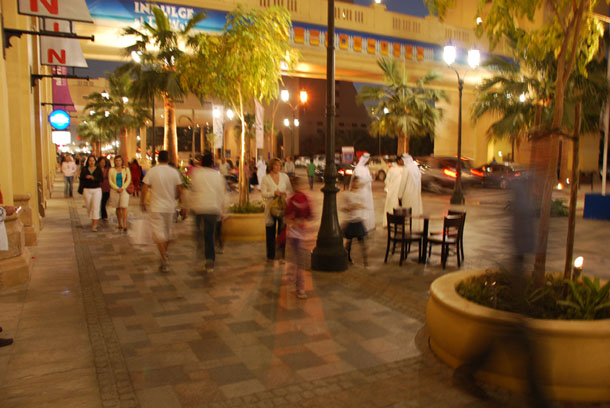
And here I am cribbing all the time why are they still constructing hotels in Dubai? When will these construction work stop? So maybe it won’t. To host every visitor that visits Dubai during the festive seasons, we – the residents are generously willing to accept the grilling that comes with the constructions. If Dubai has been cosmopolitan enough to embrace more than 200 nationalities from different orientations and cultural backgrounds, we – the Dubai residents can very well embrace the 2 million visitors that are expected over this weekend. That’s how large-hearted we are!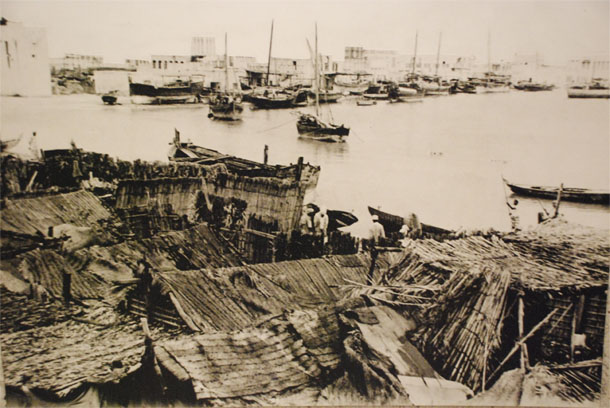
A long way definitely for a small trading town engaged in pearl-trading and fishing to a multi-cultural hub that it is today. The above picture is taken by me in Dubai Museum – it shows Dubai in the early 20th century. It amazes me really. I tell the Z-Sisters that this is probably the only place in the whole world where they can see a city being built – brick by brick, floor by floor, flyover by flyover! This is also the only city probably where construction takes place every hour of the day and every hour of the night. As if, if the Construction stops, the city will stop breathing. 
Eid Al- Adha
Whereas Eid al-Fitr marks the end of the fasting month of Ramadan – the Islamic holy month of dawn-to-sunset fasting, Eid al-Adha means ‘solemn festivity’. Today is Eid al-Adha, also known as the Greater Eid or Eid al-Zuha. In India it is called the Bakhri-Eid or the Feast of Sacrifice.
This is an important 4-day religious holiday celebrated by Muslims worldwide to honor the willingness of the prophet ʾIbrāhīm (Abraham) to sacrifice his young firstborn son Ismā’īl (Ishmael) as an act of submission to God, and his son’s acceptance of the sacrifice before God intervened to provide Abraham with a ram to sacrifice instead… read more
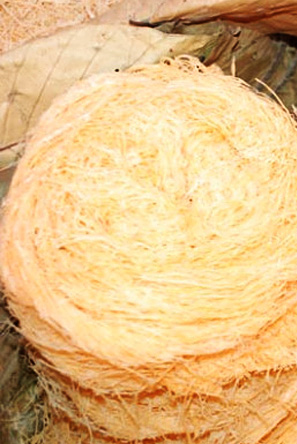
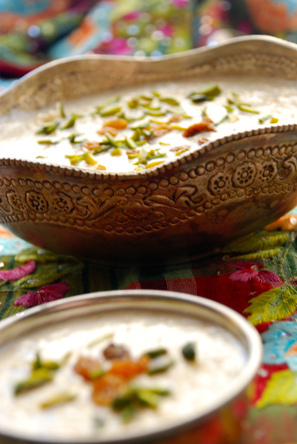
In Kolkata we have always associated the Semaiya/Vermicelli with Eid celbrations. Vermicelli is ‘worm like’ thin Pasta (above left) and is made almost like the Rice Pudding, excepting that this is sweetened with Sugar and sugar only, never with Gur/Jaggery. Another popular variation of Semaiya is the cold beverage – Falooda which itself is an adaptation of the Persian dessert Faloodeh. The latter is very popular in Iran, Pakistan, North India and Afghanistan. The introduction of Falooda in Indian Cuisine is because of the Mughal influence in India.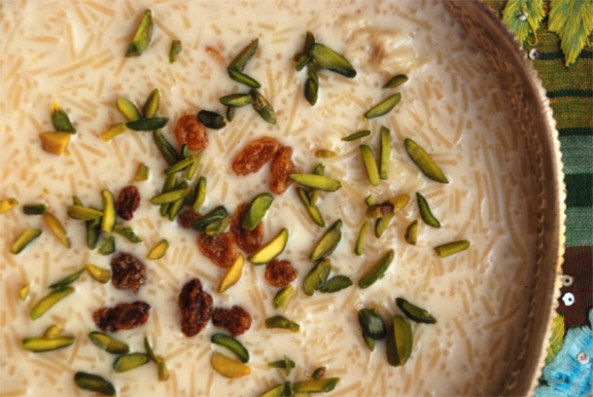
The essence of Eid to me, a non-Muslim
Though we are Hindus, we grew up celebrating all festivals from all religion in Kolkata. So Eid would mean that we would flock to the homes of our Muslim friends and pestering their Mums whom we would address as Mashi/Aunt to refill our bowls of Shimuyer Payesh or Semayia/Sevaiya Pudding umpteen number of times. Or ransack their kitchens for home-made Biriyanis and Laccha Parathas, a type of Indian flat bread, triangular in shape with multiple layers lapped with Ghee/Indian clarified butter. An earlier post – Living By The Water With Sunset As Prop – Kolkata & the Ganges talks about this multi-cultural upbringing that shaped my own philosophies in life. 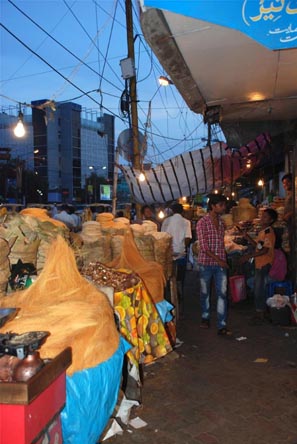
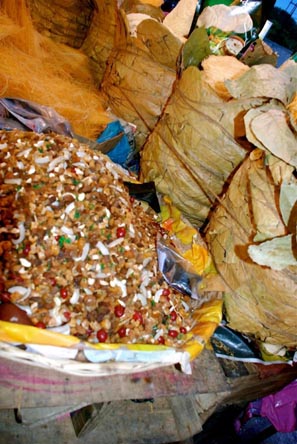
During the last Eid ul-Fitr we were enjoying our summer holidays in Kolkata – a period I like to call my summer hibernation! I took the Z-SISTERS to Mallick Bazar in Park Circus area (above). This is essentially a Muslim neighborhood and the road-side kiosks were full of Samaiya/Semolina, mixed dried fruits, Firni (a dessert pudding made with Rice Powder) mix, glass bangles – absolutely mersmerising the otherwise unperturbed Z-SISTERS. The Semaiya bundles were stocked up high looking quite surreal – as if they were fluffs of cotton wool blown by the festive breeze (below).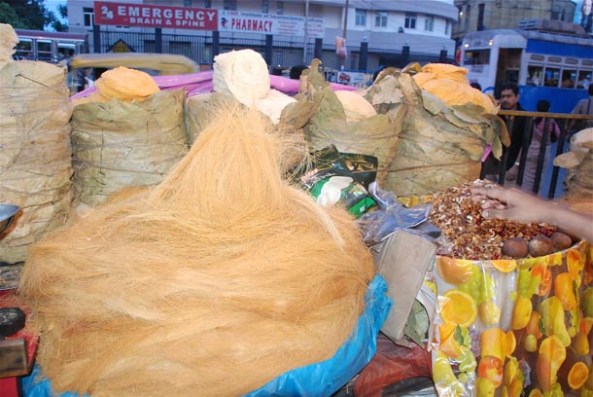
A little boy manning the jiosk came running to me – ‘Didi amar photo tulben?/Sister, do you want to photograph me?’ Immediately bombarding me with the next question -‘Apni ki kono bideshi magazine theke?/Are you working for any foreign magazine?’ And the heart-breaker was when he got really dispappointed that I was taking pictures just like that – emni emni. He instructed the others – ‘Dhoot char to Didike… ja ja shob byabshay lag!/Forget her… go and mind your business!’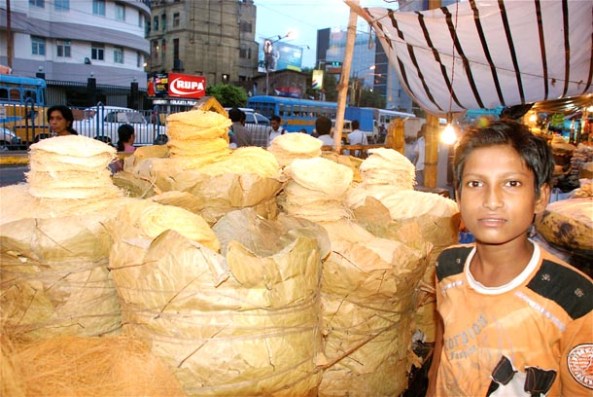
Neither did we buy any Semaiya, nor any dry fruits. On top of that I didn’t even work for any foreign magazine and declared absolutely hopeless. We ended up buying Haleem or Halim (a special Ramadan dish made of wheat, barley, meat) from two popular restaurants in this area – Shiraz and Rahmania. Haleem is a delicacy and it is cooked in large quantities in a huge aluminum cooking pot. In the Park Circus and Mallick Bazar area, there are many alleys and small restaurants where you’ll find long queues for Haleem. We too queued for Haleem and took a container home. And on reaching home, devoured some awesome Firni made by Mum-in-law, all set in small earthen clay pots. A journey, an experience and a discovery that has been unblogged in an earlier post – Firni or Ferni, Ramadan or Ramzan, Mallick Bazar or Karama – It’s The Same Festive Sentiment!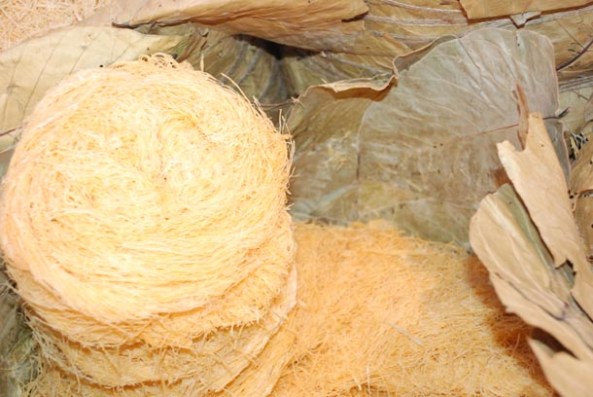
Semaiya Kheer/Vermicelli Pudding or Shemaiyer Payesh
Category – Dessert; Cuisine type – Indian, Pakistani
Following are the characteristics of all recipes doling out of our little hands, big hearth –
♥ Easy to cook
♥ Regular canned products off the shelf may be used (However, we advocate using fresh products)
♥ Goes well both as a regular or party dish
♥ Children can easily help in making the dish (My two little sous-chéfs are aged 8 and 3 years!)
♥ And lastly, guaranteed to be tasty!
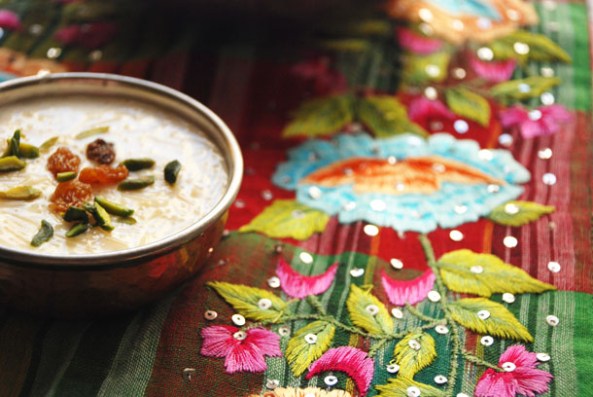
For the printable recipe →
Serves 6-8 persons (maybe less if they happen to be sweet-toothed Bengalis!)
Preparation time – 1 hr 30 minutes maximum (Boiling the milk with Rice and thickening it by constant stirring – 45-50 minutes; setting up – 10 minutes; Refrigeration – 30 minutes)
Ingredients
Semaiya/Vermicelli – 100g (Semaiya packets are easily found in most supermarkets around Dubai)
Full Cream Milk – 2lts*
Sugar – 1 cup (if you are using sweetened condense milk then use less of sugar)
Cardamom pods – 4, crushed into powder
Cashew Nuts – 1/4 cup, unsalted
Almonds – 1/4 cup, slivered
Raisins – 1/4 cup, soaked in water
Pistachios – 2 tsp, for garnishing
Ghee/Indian Clarified Butter – 4tsp
Mitha Attar – a drop for the sweet perfumed aroma of Attar (Availability? Well, I haven’t checked on the local supermarkets but had got mine from a little spice shop in the Spice Souk in Deira)
* You may substitute this with Low-fat Milk. Many prefer to use sweetened condense milk – in that case you will need much less milk (1-1/2 lt low-fat Milk, 1/2 cup sweetened low-fat condense milk.
Method of Preparation
– Heat 3 tsp of Ghee in small wok. Break the mounds of Semaiya into smaller portions and stir it in the Ghee for a little while till it turns slightly golden
– Boil the Milk in a Dekchi/a flat bottomed pan (Dekchis are usually used for cooking Rice. Please note that Payesh is always made in utensils meant for cooking Rice or kept separately and hasn’t been used for any other type of cooking. This is because of it’s susceptibility to catching the smell of other cooked items. Stir constantly is required so that the bottom of the pan doesn’t get burnt)
– Add the Semaiya when the milk comes to a boil
– Add the Cardamom, Sugar, Cashew nuts, Almonds, Raisins, sweetened condense milk (if you are using)
– Lower the temperature and keep on stirring until the Milk thickens (this should take about 45 minutes to an hour!)
– Add the Ghee and Mitha Attar
– Garnish with Pistachios, more Raisins, Almonds &Cashew Nuts.
Let the Semaiya Kheer set for a while and refrigerate it. Serve it cold. However, some prefer to eat their Payesh smoking hot, just after it has been taken off the fire!
◊—————————————————————◊
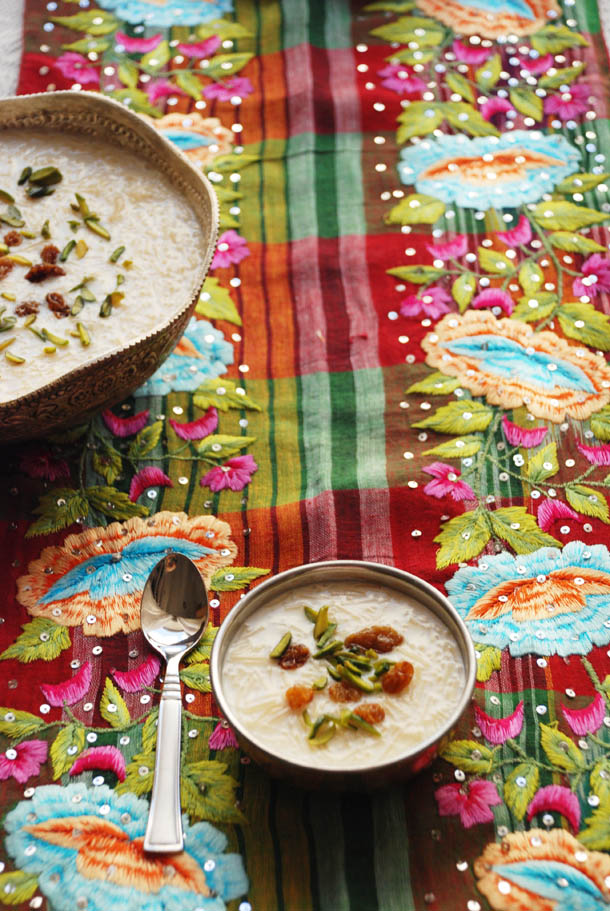
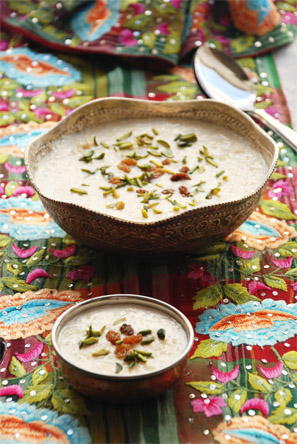

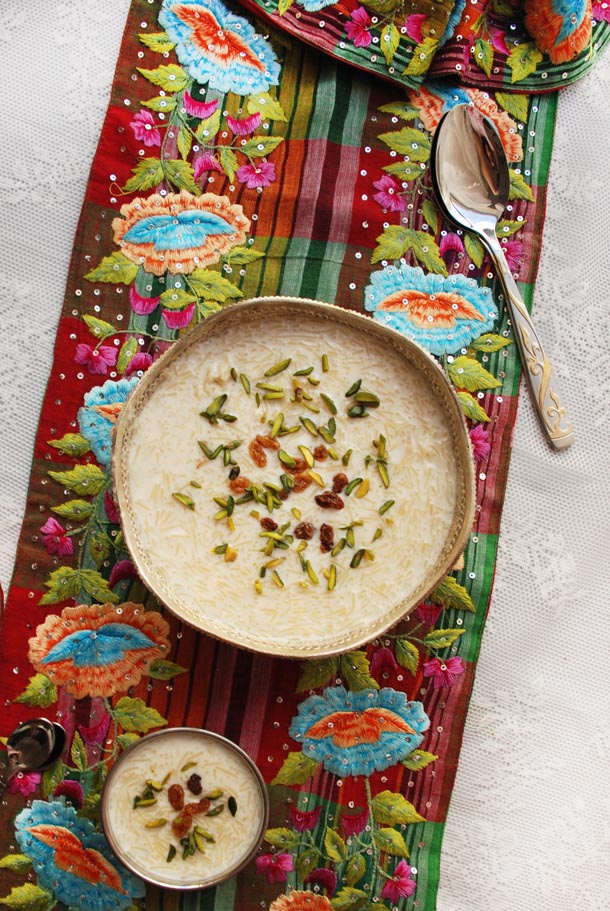
While a lot of us living in Dubai are lucky enough to be with our friends and family, many of us are not. There are many people toiling in the city just to earn a living so that their loved ones can have a decent life back in their home countries. My greetings and warm wishes to all of them. Most likely, my wishes are not going to reach them I doubt that these people are going to read my post. Writing food posts while taking photo-shots of them in well laid out dining table in the air-conditioned comforts of our humble home, may seem preposterous to some. But I was awake to greet Eid Mubarak to the man who delivers the newspapers daily as early as 3 am in the morning, throwing out the newspapers as he stands inside the lift, aiming them perfectly as they land in-front of the main doors of the different apartments in the floor that we live in. At teh time I had greeted him, he had 30 more floors to go!
I had taken a video on my mobile as I had a conversation with one of the Taxi-drivers of Dubai Taxi. It’s a shame that I’m not techno-savvy enough to upload it to this post. But he was talking about a Rice that is made during Eid in his home in Pakistan where the special Rice is cooked along with the Masalas. He missed the Parathas that are made for breakfast during these days of celebrations and reminisces that his kids refuse to have their normal Subeh ka Chai/Morning Tea without these Parathas. And yes, he misses the Shir Khurma that his Ami/Mother makes. And if you are wondering what is this Shir Khurma – it is the same Vermicelli Pudding that I’ve just written about.
I am hoping that his emotions and greetings reach his children at home. Also hoping that the Eidi (money given to the children for buying gifts during Eid) that he’s sent home is being used by his children wisely and carefully. Their father is doing a greater job of driving some tourist around while Dubai celebrates Eid!
Praying for peace and happiness for people struggling in the war-torn regions all around this region and in the world.
Unblogging it all… Ishita
◊—————————————————————◊
Disclaimer: I hope you enjoy reading the posts with lot of visuals. While you enjoy seeing them please don’t use them. You can see more pictures of my travel and food journey here.
My Dubai diary in this blog:
♦ Things To Do In Dubai – Like A Tourist In My Own City – Showcasing the city I love to call my home!
♦ My First Authentic Emirati Food Experience! – Al Fanar Restaurant, Dubai Festival City
♦ Al Maha Desert Resort & Twitterati Lunch – Al Maha Luxury Eco Resort
♦ An Evening of Wine Tasting at Asado Wine Club – Asado Wine Club, The Palace Hotel, Old Town*
♦ The Label Project – Wines Tasted Blindly! – Invite to a Global Wine initiative from Jacob’s Creek
♦ TRIBES Celebrating South African Heritage Day! – TRIBES, the South African Restaurant in MOE*
♦ Zatar Lamb, Crushed Lemon Potato with Chef Ron Pietruszka – Treat 2012, Burjuman World Food Fest + a Recipe
♦ Back To Dubai, Back to Costa –A nostalgic recount of favourite coffee haunt
♦ Searching for Shiraz – Lucknow to Kolkata to Dubai – Nostalgic search for Kolkata’s famous Shiraz Restaurant ends with Siraz opening in Bur Dubai. Exploring some Awadhi/Lucknowy Khana!
♦ Down To Earth Organic Store In Dubai & Mutton Chick Peas Curry – An event + a Recipe*
♦ Mums Who Share @JBR – A charity initiative
♦ Deep Sea Fishing & Fish Barbeque – Persian Gulf off Dubai Coast
♦ The Million Street, in the middle of nowhere – Rub Al-Khali Desert, UAE
Bengali Food Banters you’ll find in my blog:
♦ Traditional Bengali Cuisine… In ‘Slight’ Details! – An etymological explanation to the Bengalis’ food festish
♦ Pickles… Mother (-in-law) Of All Pickles! – My Pickle Nostalgia
♦ Momos in Tiretti Bazar – The Last Chinese Remnants! – A chinese Bazar near Poddar Court
♦ Phuchkas in Vivekananda Park – An ode to Dilipda’s ‘world-famous’ Phuchka
♦ Bengali Sweets That Came By Parcel! – Gujia, Jibe Goja, Abaar Khabo & Jolbhora
♦ Rôshogolla (রসগোল্লা) – Bengali’s Own Sweet – An essay on the most famous Bengali Sweet
Bengali Food Recipes you’ll find in my blog: (Do click on Recipes, Reviews, Events for a complete list of all food banters)
♦ Mutton Kassa With Red Wine And Red Grapes – Bengali Fusion
♦ Khichuri As Harbinger of Hope & Kolkata Soaked In Rains – Traditional Bengali/Indian
♦ Hot Garlic Pickle… The Pickled Diary – Episode 1 – Indian Pickle
♦ Firni or Ferni, Ramadan or Ramzan, Mallick Bazar or Karama? – Indian Dessert
♦ A Tale of 2 Cities & Naru/Coconut Jaggery Truffles – Traditional Bengali
♦ Phuchkas in Vivekananda Park – Indian Street-food/Snacks
♦ Kaancha Aamer Chutney/Green Mango Chutney – Traditional Bengali
♦ Notun Gurer Payesh/Rice Pudding & My Dida – Traditional Bengali
♦ Rasgulla Macapuno – When a Filipina Turns Bong! – Dessert; Bengali Fusion
♦ Mango Lentil Soup/ Aam Dal – The Summer Combat – Dal; Traditional Bengali
♦ Easter Egg Curry – Side-dish; Bengali Fusion/Traditional Bengali/Continental
♦ Mashed Potato Bengali Style/ Aloo Bhaaté – Side-dish; Bengali Fusion
♦ Yoghurt Aubergine with Pomegranate – Side-dish; Bengali Fusion
♦ Purple Haze Yoghurt with Purple M&Ms – Dessert; Bengali Fusion
♦ Icecream Rasgulla with Blueberry Sauce – Dessert; Bengali Fusion
BE SOCIAL. SHARE THIS!

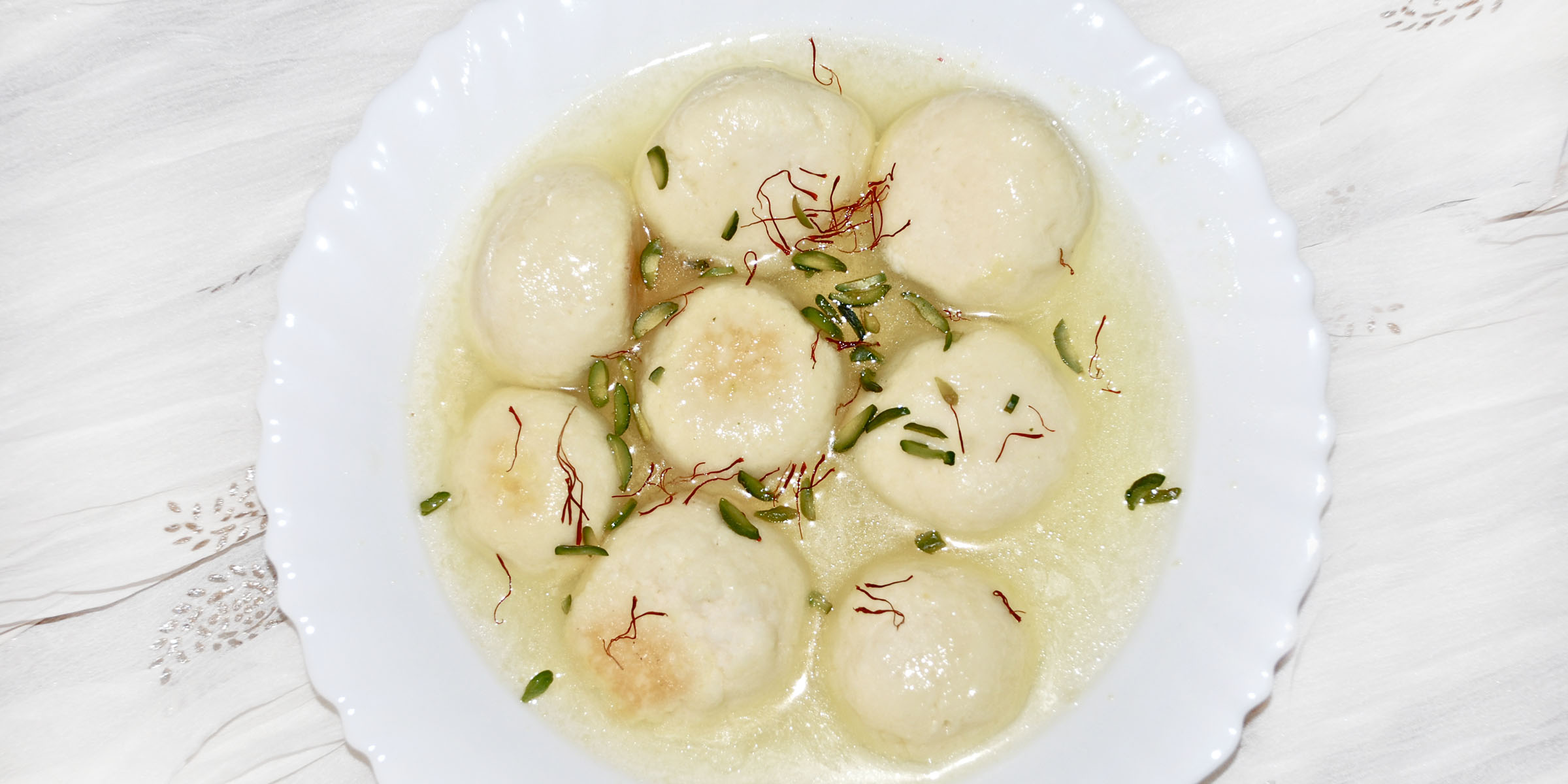
Rasgullas are made from balls of Chhana/Paneer/Indian Cottage Cheese or Ricotta Cheese and Suji/Semolina dough. Then these soft and spongy balls are cooked in a sugar syrup. The quality of the channa is vital in making of soft rasgullas, as I realised while making rasgullas at home.
A few months ago my Rasgullas or Roshogollas was aired on Noor Dubai TV and Dubai One during Ramadan (above video). And whoosh by some sudden act of magic, I got the video in hand today just as I had sat down to write a festive post wishing all of you Shubho Bijoya!
If you are hopping into my blog for the first time and wondering why you are being pulled into such a Bengali post – well, I am a quintessential Bong (colloquial term to Bengalis) and at this hour being dunked under the massive onslaught of Bengali nostalgia and elation. Nostalgia, because sitting here on the shores of Dubai, I am remembering all the festive memories of Durga Pujo from my childhood. Elated, because here I am – a Bengali outside Bengal, sitting on a foreign shore sharing my stories with all of you. You may or may not be a Bengali, or an Indian for that matter. This could be your story or may not be, yet you are making my story yours!
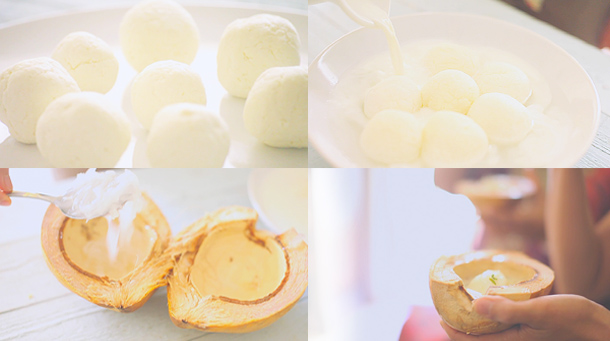
Screenshots taken by Reem for Noor TV Dubai
Rasgulla Macapuno & Essence of Living in Dubai
In the month of May this year I had written a post Rasgulla Macapuno – When a Filipina Turns into a Bong. A fusion recipe on rôshogolla or rasgullas – perhaps the most famous of all Bengali sweets. It was a tribute to Lady M, our Filipina nanny without whom my endless photographic sessions on food experiments would never have materialised. Rasgulla Macapuno is our fusion dessert inspired by Rasgulla, the popular Bengali sweet and Macapuno, the sweetened tender coconut flesh used in several Filipino desserts. I was contacted by Noor TV to recreate it for a Ramadan special episode for Noor TV and Dubai One. Only this time, I was requested to make the rasgullas at home!

Reem, Ramadan, Akl el Bait… and the Emirati woman of today
A very young, elegant lady Reem from Noor Dubai TV came home to make a film on akl el bait or homemade food for Ramadan. Not mentioning her in this post would be wiping off some very essential facts about the modern generation of Emirati women. Sweet and almost shy but insisting on carrying her cameras and other props all by herself, Reem was the epitome of silent strength. She bowled me over with her proclamation – ‘I love Rabindra Sangeet and I love watching Bengali films’!
My parents were incidentally visiting us at that time and my mum is a proponent of Rabindra Sangeet (Tagore songs). Reem requested my mum to sing ‘Bodhu kon alo laglo chokhe‘ pronouncing the word in perfect Bengali. She told me how she loved listening to Rezwana Banya Chowdhury, a very famous Rabindra Sangeet exponent from Bangladesh. Love for World Cinema seemed to shape[o Reem’s knowledge, exposing her to different cultures. She conversed on Bengali Cinema and Rabindra Sangeet just like a proud quintessential Bengali would in a typical Bengali cultural meeting or a friendly dinner get-together. Her conversations with my mother were in the lines of… ‘Oh I can’t remember that song in Chokher Bali… can you sing that Mama?’ Every time we interacted later on, she would always say, “Give my regards to Mama and Mela (that’s our Lady M)’!
‘There’s one condition when you mail me’, she declared… ‘you’ll have to send me a Bengali song every time, preferably Rabindra Sangeet’! Yes, Reem, I loved the film that you made on my rasgulla for your Ramadan special episodes. You are a brilliant representation of modern generation Emirati women who are shaping up Dubai – well manicured hands and a treasure chest full of knowledge and awareness. Professional yet humane, articulate yet coy, opinionated yet subtle.
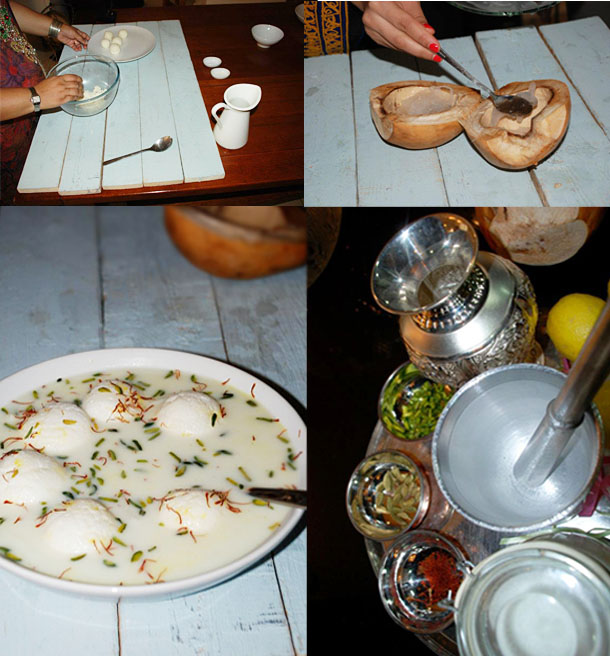
Behind the Scenes shots
Historically, the Emirati women had been responsible for looking after the day to day needs of their families as the menfolk who had been primarily engaged in pearl diving and fishing, left for work for many long months. Today, Emirati women are significantly contributing to the nation’s progress – in all spheres of life – be it in the private sector or the public sector. The following articles are interesting reads on the roles that Emirati women play in the development of today’s UAE… The role of Emirati women in the UAE (The National), The Women in the UAE (wiki)
Making Rasgullas at home
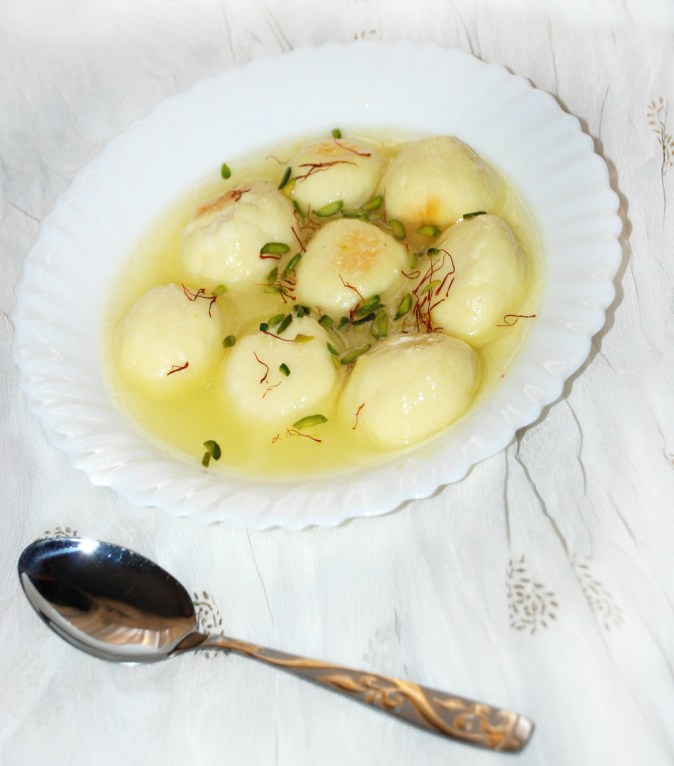
Rasgullas are made from balls of Chhana/Paneer/Indian Cottage Cheese or Ricotta Cheese and Suji/Semolina dough. Then these soft and spongy balls are cooked in a sugar syrup. In Dubai, there are many Indian sweet shops selling good rasgullas. We like our rasgullas from Chappan Bhog, Bikanerwala, Gangaur or Puranmal. The quality of the channa is vital in making of soft rasgullas, as I realised while making rasgullas at home.
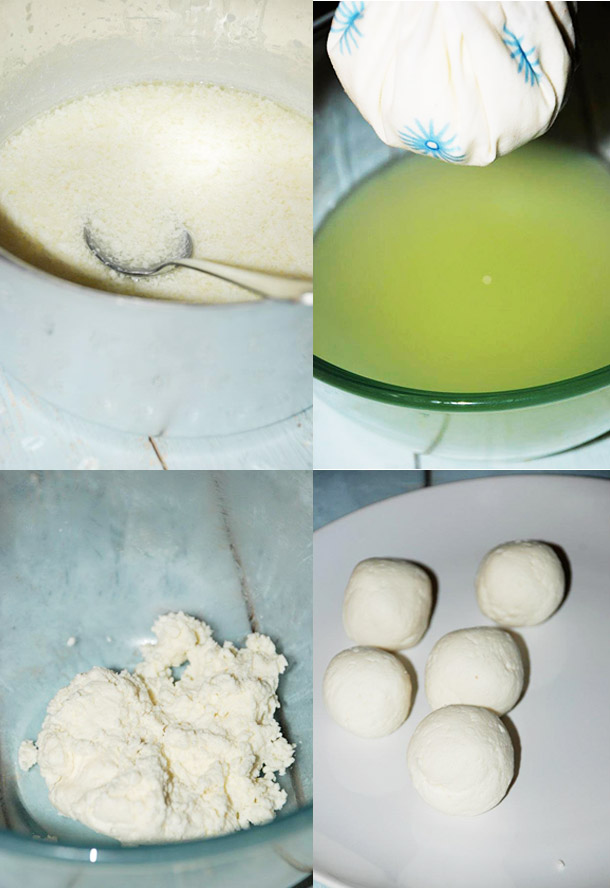
Making the Channa/Indian Cottage Cheese for the Rasgulla
For the Gollas or the round Channa balls For the Shira/Sugar Syrup For the Gollas For the Shira/Sugar Syrup and the RosogollasRoshogollas or Rasgulla
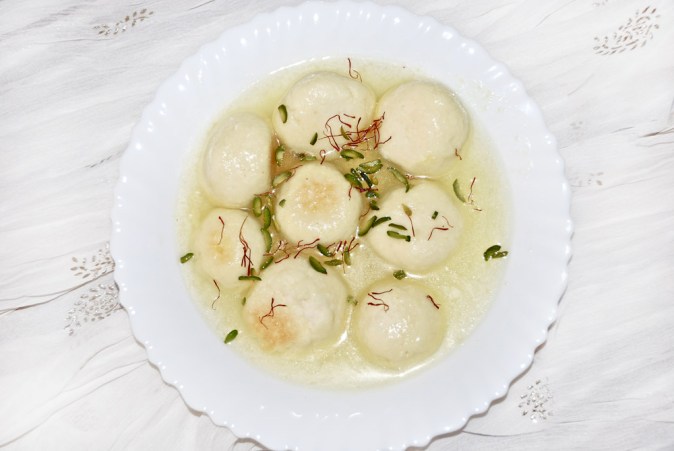
Ingredients
2 litres full fat cow’s milk (will make about 24 rasgullas)
2 limes, juiced Juice of 2 limes
1 tsp suji or semolina
1 tbsp maida or plain flour
1 tsp sugar
muslin cloth/fine strainer
5 cups water – 5 cups
3 to 4 cups granulated sugar (depending on your sweet tooth)
½ tsp green cardamom, crushed
2 tsp rose water – 2 tsp
small pinch of saffronMethod
The following Rasgulla recipe is from Cook like a Bong. The Rasgullas came out soft and round and absolutely crack-less!
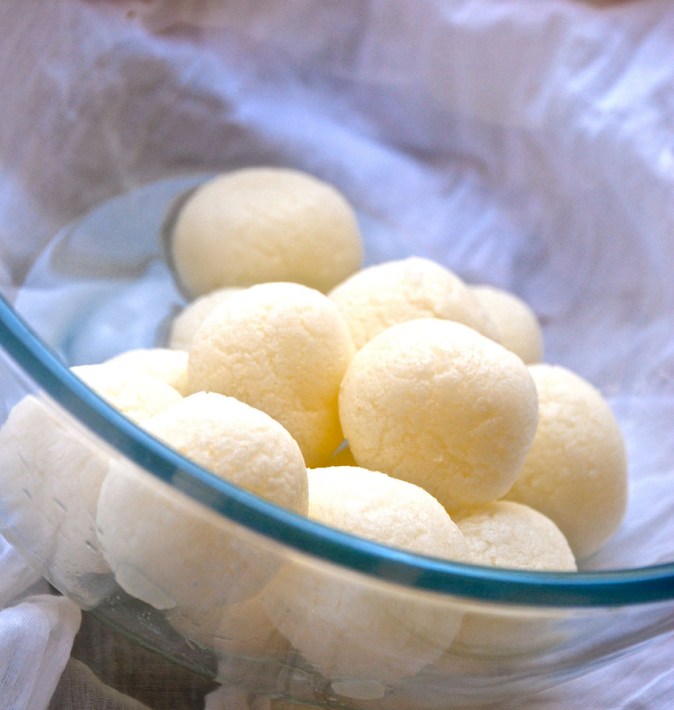
An excerpt from my essay on Roshogolla or Rasgulla - Bengali's Own Sweet...

Importance of Chhana
Chhana is fresh, unripened curd cheese widely used in India and Bangladesh and is a crumbly and moist form of Paneer (Indian Cottage Cheese or farmer cheese or curd cheese made by curdling heated milk with lemon juice, vinegar, or any other food acids). This Cutting of the Milk to make Chhanna ie Acidification is the most important factor affecting the quality of Rôshogolla. Chhana is created in a similar process to Paneer except that it is not pressed for as long. Though the Paneer can be traced back to the Vedas dating back to 3000 BC and has an Indian origin, Chhana that is the base for most of the Bengali Sweets has been imported from Portugal and can be traced back to the Portugese settlements in Bengal during the 16th Century AD.

Important Factors Affecting the Quality of Rôshogolla
 - The Cutting of the Milk to make Chhana ie Acidification is the most important factor affecting the quality of Rôshogolla
 - Rosh or Chasni ie the thickness or BRIX of Sugar Syrup
 - The temperature and the way the medium ie the previous day’s whey water, vinegar, lime is introduced to cut the milk (the best results are produced when you slowly introduce the acid medium into the milk)
Do watch (though technically I should be asking you to read) a brilliant and beautiful post from Journey Kitchen on ‘How to make Paneer at home’.
Durga Pujo around the world & a desi trail in Meena Bazaar
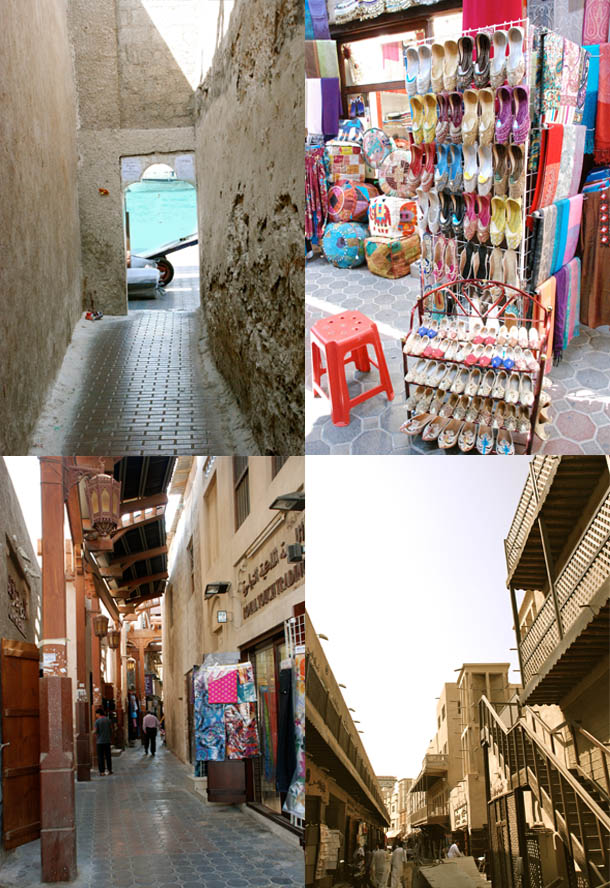
On a desi trail… walking around Meena Bazaar
As Bengalis celebrate the Pujo all around the world, I hit the roads of Meena Bazaar in Bur Dubai area on the rebound… on my own little desi trail! Contrary to the glitzy shopping malls in Dubai, Meena Bazaar has a different charm altogether. From glaring lightnings to the blaring horns from cars struck in perennial traffic, from the snaky lanes and by-lanes to the crowded main-road, from Indian and Pakistani stores selling traditional clothing to Iranian spice shops, from haute-couture fashion boutiques (selling mainly traditional Indian and Pakistani ethnic attire) to stores selling high-street fashion, branded watch-houses to shops – the ’10 Dirhams shops’ selling inexpensive models, from electronics to home products, from computers to spare-parts, from quick-fixers like cobblers and menders to expensive tailoring shops – I love Meena Bazaar. Specially when the narrow dark alleys suddenly open up and you are hit with the bright sunlight and the sparkling sea-green waters of the Dubai Creek!

The alley that leads to the temple
The alley leading to the Hindu temple is a sudden revelation – I love the cultural aspects of any religion – the strength in the spiritual beliefs and traditions of people believing in their respective faiths. The faces of people going into the temples with their flower offerings laid out on plates says it all – smitten with the belief of the submission to some form of supreme strength above, however that may have been defined in each individual’s respective religion.
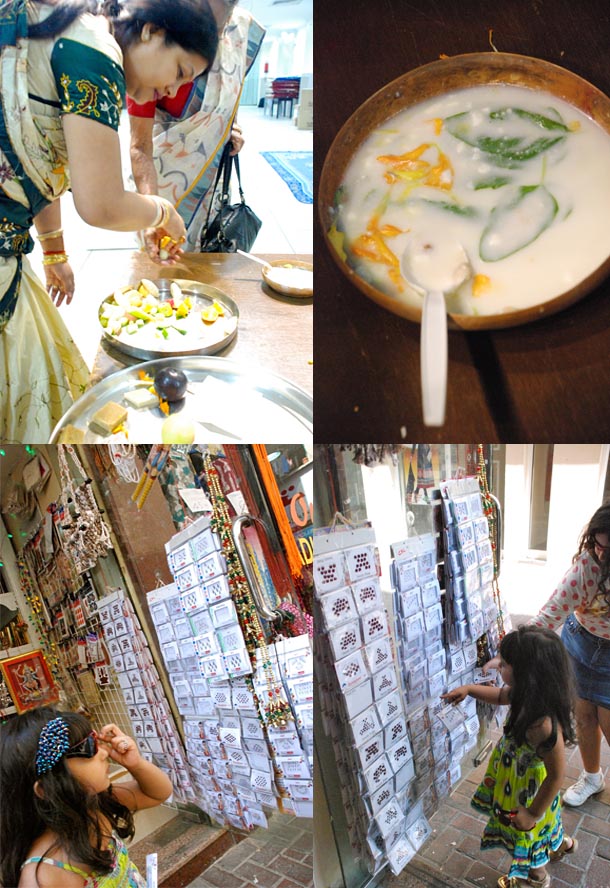
Pujo Celebrations in the Sindhi Hall & scouting for Bindis
The last week, the Bengalis world-wide were caught up in a festive frenzy celebrating their biggest festival – the Durga Pujo. Facebook updates from our friends is testimony to Durga Pujo celebrations around the world – Bangkok, Singapore, different cities in the US, UK, Europe, Oman and many other places. The Pujo celebrations in Dubai takes place in either the Sindhi Hall tucked into an alley in the Meena Bazaar area or privately organised by different associations.
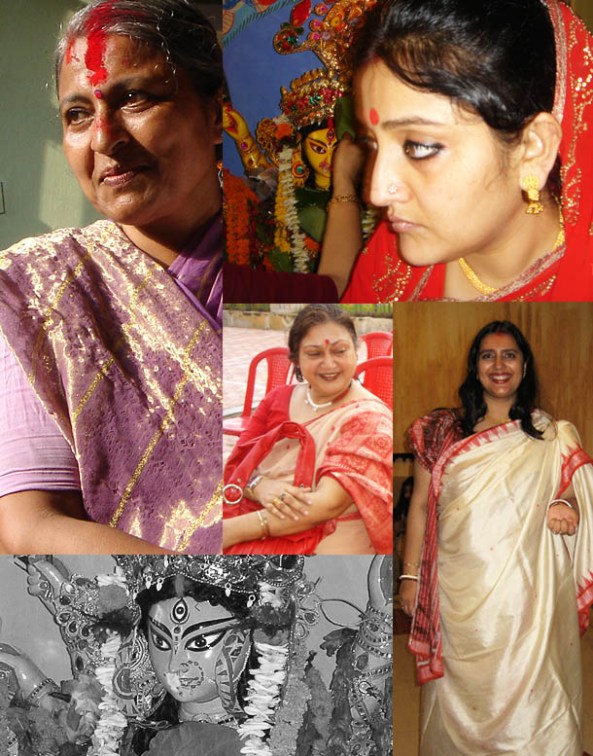
Bengali tradition is reflected by two colours – Red & White
Today is Bijoya, the last day of the worship and the celebrations come to an end as everyone greets each other, the younger ones seeking the blessings of the elder ones. The Bengali married women wear their traditional white saris with red borders and perform the Sindoor Khela where the married women smear each other with Vermillion. The men engage themselves in embraces – the Kolakuli. Bengalis embrace each other is the bond of love and sweets! Tomorrow is also Eid. This is indeed a prolonged festive season. May all your lives be filled with peace, prosperity, health and happiness – wherever you are!
Unblogging it all… Ishita

Durga Pujo Card collaborately made by the Z-sisters
Try some of my dessert recipes:
Semaiya Kheer or Vermicelli Pudding
Firni or Ferni - The broken rice pudding
Moong Daaler Payesh or Yellow Lentil Pudding
Thank you for joining me on my daily food and travel journey on Pinterest, Instagram, Facebook and Twitter!
Disclaimer: This isn’t a sponsored post, nor are there any affiliated links for any of the brands that may have been mentioned in this blogpost. The subject, story, opinions and views stated here are my own and all images are from my personal album. While you enjoy reading my posts with lot of visuals, please do not use any material from these posts.
BE SOCIAL. SHARE THIS!

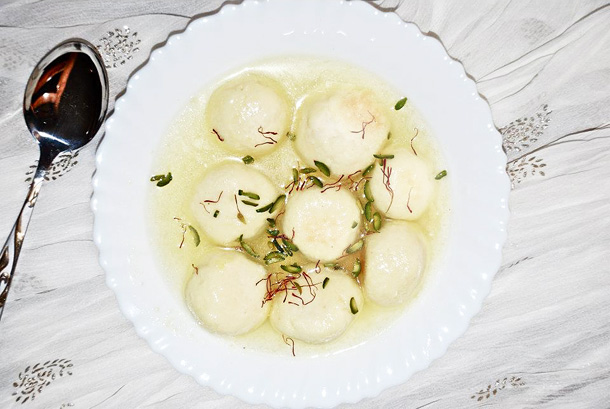
Shubho Bijoya to all of you!
A few months ago my Rasgullas or Roshogollas was aired on Noor Dubai TV and Dubai One during Ramadan (above video). And I got the video in hand today just as I had sat down to write a festive post wishing all of you a Shubho Bijoya! And whoosh by some sudden act of magic, came up the video at the perfect junction when I was ransacking my photo albums to write a very, very Bengali post.
If you are hopping into my blog for the first time and wondering why you are being pulled into such a Bong (colloquial term to Bengalis) post – well, I am at this moment on a massive overdose of Bengali nostalgia and elation. Nostalgic because sitting here on the shores of Dubai, I am reminded continuously of the moments that I’ve grown up with… specially Durga Pujo. But at the same time Elated because here I am – a Bengali when I’m outside and an outsider in Bengal – sharing my stories with all of you coming from so many different parts of the world or coming from the same country I come from but living in different parts of the world!
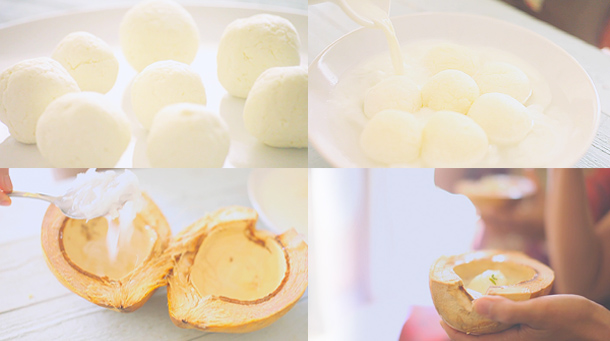
Screenshots taken by Reem for Noor TV Dubai
Rasgulla Macapuno & Essence of Living in Dubai
In the month of May this year I had written a post – Rasgulla Macapuno – When a Filipina Turns Bong! Yet another fusion recipe on Rôshogolla – perhaps the most famous of all Bengali sweet and definitely my favourite subject to write on and to experiment. It’s a tribute to my my Lady Friday (LF) without whom my endless photographic sessions on food experiments would never have materialised. LF hails from Bikol, a region in Phillipines which is known for it’s spicy fare. Filipino food is cooked on a regular basis in our kitchen along with traditional Bengali or we end up cooking some Bengali Fusion food!
When I eat some traditional Filipino dish, I talk about how we could use and adapt it to our Bengali palate. When LF eats some Bengali dish she talks about how similar dishes exist in her cuisine or may be how a little addition here and there would make it quite easy to pass off as a Filipino dish.
If staying with a person from a different culture for a long time doesn’t inspire us, we must be devoid of all emotional sensibilities. The real essence of living in a city like Dubai is that for a Filipina who’s turned into a Bong, there is a Bengali me who’s turned into a Filipina!
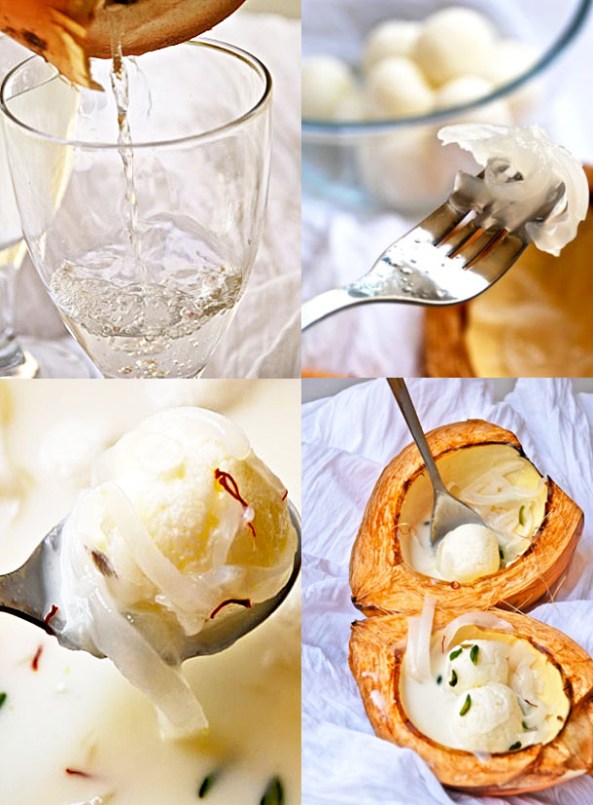
Rasgulla Macapuno from my earlier post
Reem, Ramadan, Akl el Bait… and the Emirati woman of today
A very young, elegant lady (though I would like to say girl) by the name of Reem from Noor Dubai TV comes home to make a film on akl el bait or homemade food for Ramadan. Not writing anything on her would be wiping off some very essential facts about the modern generation of Emirati women. Sweet and almost shy but insisting on carrying her cameras and other props all by herself, Reem seems absolutely determined. She bowls me over – ‘I love Rabindra Sangeet and I love watching Bengali films’!
While the shoot was on in the living room, I had almost locked my Mum (my parents were incidentally visiting us at that time) inside. Mum being a typical Mum would otherwise start being her usual self… ‘Orokom kore Channata makhish na/Don’t knead the dough like that’ or ‘Dekh bhalo kore shirata phutlo kina/Check whether the Sugar Syrup is boiling properly’.
Sorry Mum, I’m a food blogger trying all I can to be caught in the right ‘social’ radar, please don’t snatch my thunder away from me, not yet. And definitely, not in-front of this sweet, young girl who’s called Reem!
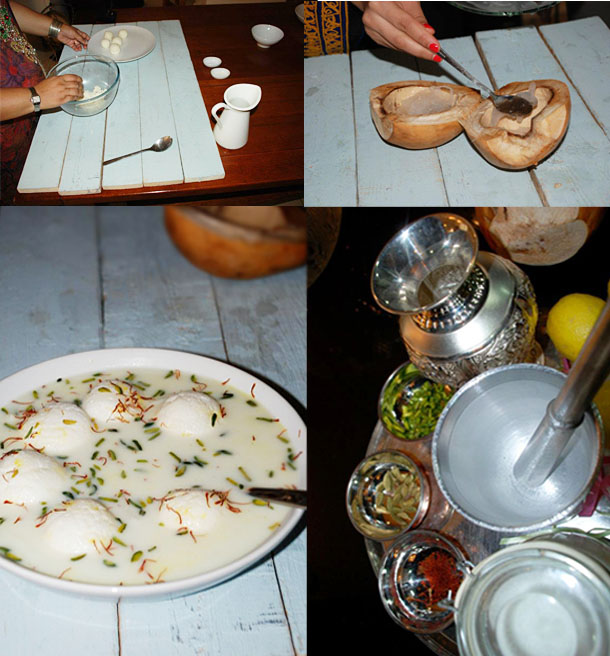
Behind the Scenes shots
Reem not only listens to Rabindra Sangeet but actually requested my mum to sing ‘Bodhu kon alo laglo chokhe‘ pronouncing the word in perfect Bengali. Reem loves listening to Rezwana Chowdhury Bannya (official site – here), the very famous Rabindra Sangeet exponent from Bangladesh. Dear Reem, this is for you as my Mum stumbled with the words while she sang for you (Forgive me Mama, for stealing your thunder away slightly – tit for tat!) singing. The least I owe you is a complete hearing of the song. Do click here to listen.
Bodhu-Kon-Alo-Laglo-Chokhe (webmusic.in) by Ishita Saha
Love for World Cinema has shaped Reem’s knowledge, exposing her to different cultures. She converses on Bengali Cinema and Rabindra Sangeet just like a proud quintessential Bengali would in a typical Bengali cultural meeting or a friendly dinner get-together. Her request of ‘Oh I can’t remember that song in Chokher Bali… can you sing that Mama?’ or ‘Give my regards to Mela’, my LF, every time we interact is absolutely touching.
‘There’s one condition when you mail me’, she tells me ‘and that is you’ll have to send me a Bengali song every time, preferably Rabindra Sangeet’!
And yes, Reem, I love the film that you have made on my dish and a few others I know for your Ramadan special episodes. You are a brilliant representation of modern generation Emirati women who are shaping up Dubai with their well manicured hands and a treasure chest full of knowledge and awareness in your brains. Professional yet humane, articulate yet coy, opinionated yet subtle.
◊—————————————————————◊
Historically, the Emirati women had been responsible for looking after the day to day needs of their families as the menfolk who had been primarily engaged in pearl diving and fishing, left for work for many long months.
As the late President Sheikh Zayed bin Sultan Al Nahyan said, “Nothing could delight me more than to see the woman taking up her distinctive position in society … Nothing should hinder her progress … Like men, women deserve the right to occupy high positions according to their capabilities and qualifications.”
The right of UAE women to take part in the development of all areas of their society is laid out in the UAE Constitution, adopted when the federation was founded in 1971. It states that social justice should apply to all and that, before the law, women are equal to men. They enjoy the same legal status, claim to titles and access to education. They have the right to practice the profession of their choice… More here.
Today, Emirati women are significantly contributing to the nation’s progress – in all spheres of life – be it in the private sector or the public sector. The following articles are interesting reads on the roles that Emirati women play in the development of today’s UAE… The role of Emirati women in the UAE (The National), The Women in the UAE (Wikipedia)
◊—————————————————————◊

Back to Rôshogolla or Rasgulla
This Bengali sweet is amazingly versatile – made from balls of Chhana/Paneer/Indian Cottage Cheese or Ricotta Cheese and Suji/Semolina dough. Then these soft and spongy balls are cooked in a sugar syrup. In Dubai, there are many Indian sweet shops selling good Rasgullas. We get our Rasgullas from Chappan Bhog which is located opposite Centrepoint on the Karama side of the Trade Centre road. Rasgullas from Chappan Bhog are soft and meets all the Bong sweet-satisfying criterion though it’s completely a subjective issue. Some prefer their Rasgullas from Puranmal and others from Bikanerwala, all located in Karama and details can easily be found over the internet.
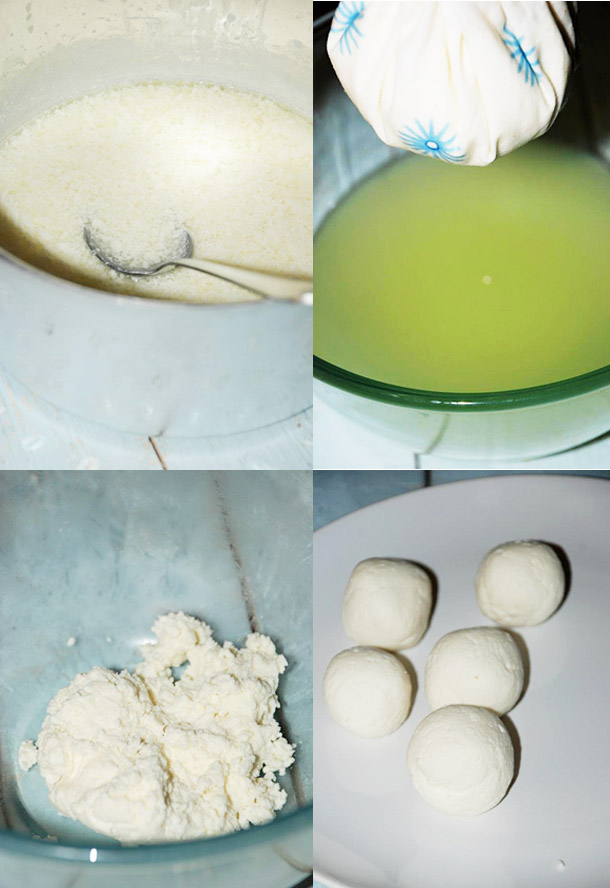
Making the Channa/Indian Cottage Cheese for the Rasgulla
The following Rasgulla recipe is from Cook Like A Bong. I have used the same recipe with stupendous success. The Rasgullas came out soft and round and absolutely crack-less!
Ingredients
For the Gollas or the round Channa balls
Full Fat Cow’s Milk – 2 litres (will make about 24 Rosogollas)
Juice of 2 limes
Suji/Semolina – 1 tsp
Maida/Plain Flour –1 tbsp
Sugar – 1 tsp
Muslin Cloth/Fine strainer
For the Shira/Sugar Syrup
Water – 5 cups
Granulated Sugar – 3 to 4 cups (depending on whether u have a sweet tooth or not!)
Green Cardamom – ½ tsp Crushed
Rose Water – 2 tsp
Saffron – 1 small pinch
Method of Preparation
For the Gollas
– Heat the milk in a deep bottomed sauce pan and bring to boil
– Add the lemon juice slowly to curdle the milk
– Once the milk is fully curdled and the green whey has been released. Place the muslin cloth on a strainer and slowly drain – the whey out
– Keep the Paneer under cool running water for a few seconds (this will remove any smell of lime)
– Tie the ends of the cloth and hang for an hour. In a large bowl start kneading the Paneer
– Add the semolina and flour and knead for about 5-10 mins till the dough is soft and smooth
– Divide into equal sized round smooth balls (Note: Keep an eye on the size of the balls as they will get bigger-about double the original size!!) Make sure the balls are crack free!
For the Shira/Sugar Syrup and the Rosogollas
– Heat water and sugar in a wide mouth stock pot
– Add the rose water and cardamom powder after the water starts boiling and the sugar is dissolved
– Lower the heat and add the balls one at a time
– Cover the pot and cook on lowest flame for about 40-45 mins
– Remove lid and add the saffron strands and cook for another 5 mins
– Take the pan off heat and let it sit for 5 mins. Garnish with roughly chopped pistachios and serve warm
◊—————————————————————◊
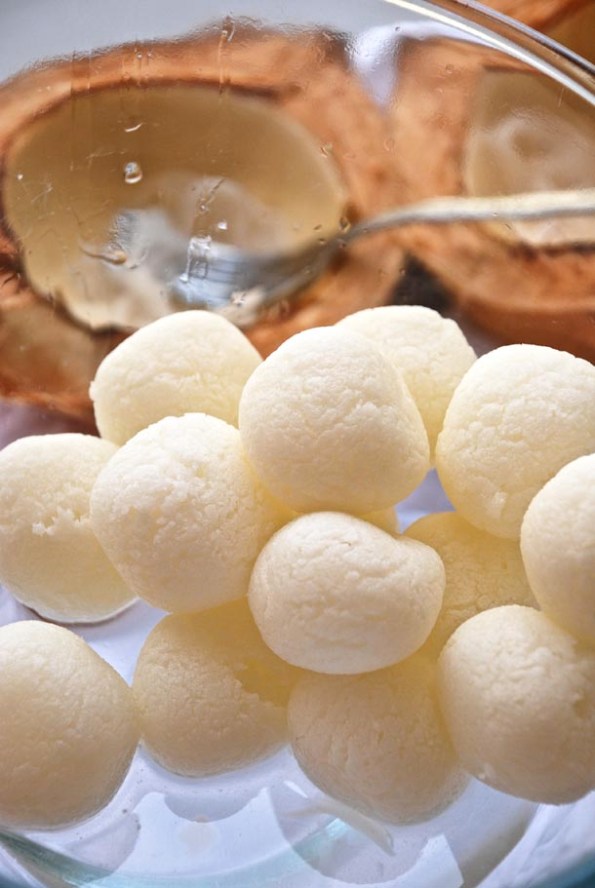
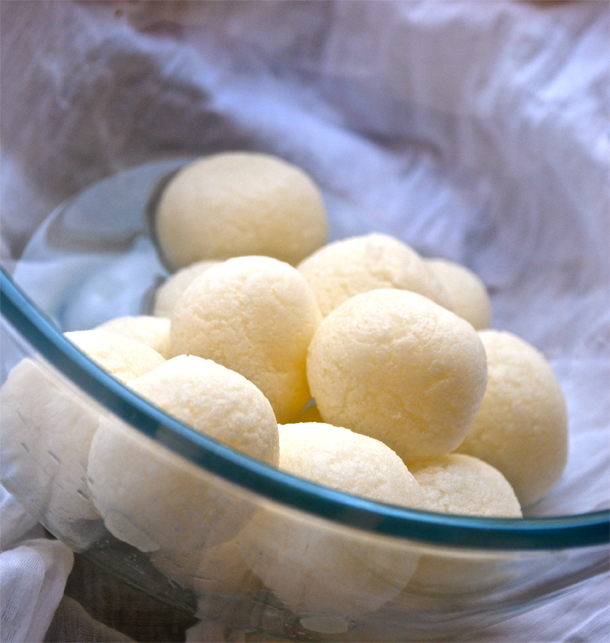
There is a superb conversation going on here regarding the making of Rôshogollas. It is a definite read for those who are attempting to make Rôshogolla at home. An excerpt from my essay on Roshogolla – Rôshogolla or Rasgulla – Bengali’s Own Sweet…
Importance of Chhana
Chhana is fresh, unripened curd cheese widely used in India and Bangladesh and is a crumbly and moist form of Paneer (Indian Cottage Cheese or farmer cheese or curd cheese made by curdling heated milk with lemon juice, vinegar, or any other food acids). This Cutting of the Milk to make Chhanna ie Acidification is the most important factor affecting the quality of Rôshogolla. Chhana is created in a similar process to Paneer except that it is not pressed for as long. Though the Paneer can be traced back to the Vedas dating back to 3000 BC and has an Indian origin, Chhana that is the base for most of the Bengali Sweets has been imported from Portugal and can be traced back to the Portugese settlements in Bengal during the 16th Century AD.Important Factors Affecting the Quality of Rôshogolla
– The Cutting of the Milk to make Chhanna ie Acidification is the most important factor affecting the quality of Rôshogolla
– Rosh or Chasni ie the thickness or BRIX of Sugar Syrup
– The temperature and the way the medium ie the previous day’s whey water, vinegar, lime is introduced to cut the milk (the best results are produced when you slowly introduce the acid medium into the milk)
Please watch (though technically I should be asking you to read) a brilliant and beautiful post from Journey Kitchen on How to make Paneer at home.
◊—————————————————————◊
Macapuno
Hailing from Philippines, this is a variety of coconut which has more flesh than the regular coconut. They are extensively used in making Filipino sweets, fruit salads, ice-creams with Macapuno flavours etc. Bottled or canned Macapunos are easily available in regular supermarkets in Dubai (Choitram’s, Al Maya Lal’s, Spinneys etc) and are available in different colours – green, red etc. I prefer to buy only the white Macapuno to complement the sanctity of my white Rasgullas!
It is also very easy to make Macapuno at home from regular coconuts. Coconuts are always available in the Lulu supermarkets or many other Asian supermarkets in Karama. Try to get a coconut which is very tender and will be having a lot of soft flesh inside – Shansh as it is called in Bengali.
Method of Preparation of Macapuno
Slice the soft kernel of a young coconut – the Shansh into thick strips. Mix it with white sugar and a small amount of water. Simmer in a pan for a while until it turns into a sweet syrup without dissolving the kernel strips completely.
◊—————————————————————◊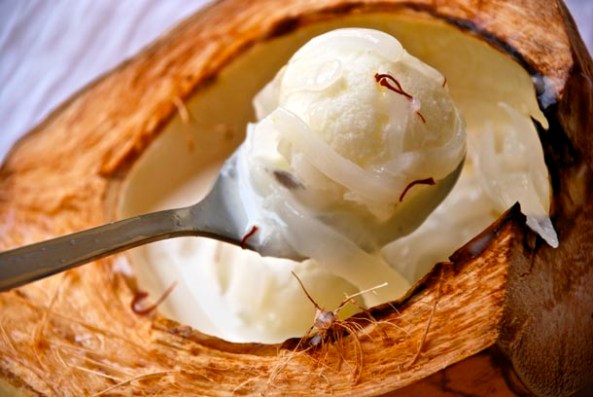
Rasgulla Macapuno
Category – Dessert; Cuisine type – Bengali Fusion (Bong/Filipino)
Following are the characteristics of all recipes doling out of our little hands, big hearth –
♥ Easy to cook
♥ Regular canned products off the shelf may be used (However, we advocate using fresh products)
♥ Goes well both as a regular or party dish
♥ Children can easily help in making the dish (My two little sous-chéfs are aged 8 and 3 years!)
♥ And lastly, guaranteed to be tasty!
For the printable recipe →
Serves 5-6 persons (maybe less if they happen to be sweet-toothed Bengalis!)
Preparation time – 1 hr 30 minutes maximum (Making the Macapuno – 45-50 minutes; setting up – 10 minutes; Refrigeration – 30 minutes) or 10 minutes if you use bottled Macapuno
Ingredients
Rasgullas – 15 pieces (you can also get canned Rasgullas from Haldiram’s or other known brands. These are readily available in most hypermarkets like Carréfour, Lulu and other supermarkets like Spinneys or Choitram’s in selected locations)
Fresh Coconut Water – 1 glass
Macapuno – 1 cup (if prepared at home) or 1 Bottle
Saffron – 1/2 tsp, soaked in Milk
Pistachios – 4 tsp
Milk* – 2 cups
Method of Preparation
– Prepare the Macapuno (described earlier)
– Pour the Rasgullas into a deep glass bowl (it’s amazing to see them through the transparent glass when it seems like they are floating – there’s one photograph above!)
– Add fresh Coconut Water, Milk, Macapuno and the soaked Saffron
– Refrigerate and serve chilled
– Garnish with Pistachios just before serving
◊—————————————————————◊
Durga Pujo around the world & I’m on a desi trail in Meena Bazaar!
On a desi trail… walking around Meena Bazaar
As Bengalis celebrate the Pujo all around the world, I hit the roads of Meena Bazaar in Bur Dubai area on the rebound… on my own little Desi trail! Contrary to the glitzy shopping malls in Dubai, Meena Bazaar has a different charm altogether. From glaring lightnings to the blaring horns from cars struck in perennial traffic, from the snaky lanes and by-lanes to the crowded main-road, from Indian and Pakistani stores selling traditional clothings to Iranian spice shops, from haute-couture fashion Boutiques (selling mainly traditional Indian and Pakistani ethnic attire) to stores selling high-street fashion, branded watch-houses to shops – the ’10 Dirhams shops’ selling inexpensive models, from electronics to home products, from computers to spare-parts, from quick-fixers like cobblers and menders to expensive tailoring shops – I love Meena Bazaar. Specially when the narrow dark alleys suddenly open up and you are hit with the bright sunlight and the sparkling sea-green waters of the Dubai Creek!
The alley that leads to the temple
The alley leading to the Hindu temple is a sudden revelation – I love the cultural aspects of any religion – the strength in the spiritual beliefs and traditions of people believing in their respective faiths. The faces of people going into the temples with their flower offerings laid out on plates says it all – smitten with the belief of the submission to some strength above – however that may be defined in each individual’s respective religion.
Pujo Celebrations in the Sindhi Hall & scouting for Bindis
Facebook reminds me of how forlorn and starved I am sometimes. Though I try to be generous and feel happy when my friends have the pleasure of some materialistic glory that I haven’t got myself but this is one moment when I break down, a little bit. Forget about the different cities in India that are celebrating Durga Pujo, the Facebook updates from my friends is testimony to similar celebrations the world over – Bangkok, Singapore, different cities in the US, UK and Europe, even Oman. Excepting the UAE. I would be lying if I said that Durga Pujo is not celebrated here. It is celebrated in Abu Dhabi, also in Dubai. The Pujo celebrations in Dubai takes place in the Sindhi Hall tucked into an alley in the Meena Bazaar area. Though this cannot be compared to the scale and the grandeur with which the celebrations occur world-wide. Yes, faith is in the mind but unfortunately celebrations aren’t!
Bengali tradition is reflected by two colours – Red & White
The last entire week the Bengalis world-wide were caught up in a festive frenzy celebrating their biggest festival – the Durga Pujo. Today is Bijoya, the last day of the worship and the celebrations come to an end as everyone greets each other, the younger ones seeking the blessings of the elder ones. The Bengali married women wear their traditional white saris with red borders and perform the Sindoor Khela where the married women smear each other with Vermillion. The men engage themselves in embraces – the Kolakuli. Bengalis feed each other, gift each other and share with each other – yes, you guessed it correctly – Sweets!
As I binge on the Pujo pictures downloaded from the Facebook albums of my friends (with permission ofcourse) and inundate my desktop the following have been some Bong food posts that I’ve been drooling on –
– Aloor Dum
– Durga Puja Ashtami Bhoger Khichudi
– Feasting during Durga Puja
– Mishti Doi/Sweetened Yoghurt
– Mitha Chawal/Sweet Rice
– Mutton without Onion Garlic
– Rasgulla/Roshogolla

Durga Pujo Card collaborately made by the Z-SISTERS
Tomorrow is also Eid. This indeed is a festive season and I’ve only one thing to pray for – May your lived be filled with peace, prosperity, health and happiness. And may peace prevail everywhere!
Unblogging it all… Ishita
◊—————————————————————◊
Disclaimer: I hope you enjoy reading the posts with lot of visuals. While you enjoy seeing them please don’t use them. You can see more pictures of my travel and food journey here. Chappan Bhog, Bikanerwala, Puranmal are just a few examples of very good sweet shops in Dubai. Most are located on Trade Centre Road in Karama and you may find all details from the internet.
My Dubai diary in this blog:
♦ Things To Do In Dubai – Like A Tourist In My Own City – Showcasing the city I love to call my home!
♦ My First Authentic Emirati Food Experience! – Al Fanar Restaurant, Dubai Festival City
♦ An Evening of Wine Tasting at Asado Wine Club – Asado Wine Club, The Palace Hotel, Old Town*
♦ The Label Project – Wines Tasted Blindly! – Invite to a Global Wine initiative from Jacob’s Creek
♦ TRIBES Celebrating South African Heritage Day! – TRIBES, the South African Restaurant in MOE*
♦ Zatar Lamb, Crushed Lemon Potato with Chef Ron Pietruszka – Treat 2012, Burjuman World Food Fest + a Recipe
♦ Back To Dubai, Back to Costa –A nostalgic recount of favourite coffee haunt
♦ Searching for Shiraz – Lucknow to Kolkata to Dubai – Nostalgic search for Kolkata’s famous Shiraz Restaurant ends with Siraz opening in Bur Dubai. Exploring some Awadhi/Lucknowy Khana!
♦ Down To Earth Organic Store In Dubai & Mutton Chick Peas Curry – An event + a Recipe*
♦ Mums Who Share @JBR – A charity initiative
♦ Deep Sea Fishing & Fish Barbeque – Persian Gulf off Dubai Coast
♦ The Million Street, in the middle of nowhere – Rub Al-Khali Desert, UAE
Bengali Food Banters you’ll find in my blog:
♦ Traditional Bengali Cuisine… In ‘Slight’ Details! – An etymological explanation to the Bengalis’ food festish
♦ Pickles… Mother (-in-law) Of All Pickles! – My Pickle Nostalgia
♦ Momos in Tiretti Bazar – The Last Chinese Remnants! – A chinese Bazar near Poddar Court
♦ Phuchkas in Vivekananda Park – An ode to Dilipda’s ‘world-famous’ Phuchka
♦ Bengali Sweets That Came By Parcel! – Gujia, Jibe Goja, Abaar Khabo & Jolbhora
♦ Rôshogolla (রসগোল্লা) – Bengali’s Own Sweet – An essay on the most famous Bengali Sweet
Bengali Food Recipes you’ll find in my blog: (Do click on Recipes, Reviews, Events for a complete list of all food banters)
♦ Mutton Kassa With Red Wine And Red Grapes – Bengali Fusion
♦ Khichuri As Harbinger of Hope & Kolkata Soaked In Rains – Traditional Bengali/Indian
♦ Hot Garlic Pickle… The Pickled Diary – Episode 1 – Indian Pickle
♦ Firni or Ferni, Ramadan or Ramzan, Mallick Bazar or Karama? – Indian Dessert
♦ A Tale of 2 Cities & Naru/Coconut Jaggery Truffles – Traditional Bengali
♦ Phuchkas in Vivekananda Park – Indian Street-food/Snacks
♦ Kaancha Aamer Chutney/Green Mango Chutney – Traditional Bengali
♦ Notun Gurer Payesh/Rice Pudding & My Dida – Traditional Bengali
♦ Rasgulla Macapuno – When a Filipina Turns Bong! – Dessert; Bengali Fusion
♦ Mango Lentil Soup/ Aam Dal – The Summer Combat – Dal; Traditional Bengali
♦ Easter Egg Curry – Side-dish; Bengali Fusion/Traditional Bengali/Continental
♦ Mashed Potato Bengali Style/ Aloo Bhaaté – Side-dish; Bengali Fusion
♦ Yoghurt Aubergine with Pomegranate – Side-dish; Bengali Fusion
♦ Purple Haze Yoghurt with Purple M&Ms – Dessert; Bengali Fusion
♦ Icecream Rasgulla with Blueberry Sauce – Dessert; Bengali Fusion

 IshitaUnblogged

Interesting and a very relevant conversation that was! If I go back to my childhood, as far as I remember, growing up in Kolkata, every thing that Mom would cook would either be fresh from our own gardens or brought from the local farmers. In-fact the first time we bought some ‘hybrid’ vegetable – some super red capsicums, we were so excited! Dubai does need to move towards more and more sustainable living if it’s going to project itself as a city of the future. At the same time this has to trickle down to all financial brackets and the different trade-offs should be weighed very cautiously.